
The valley temple was a distinct and essential architectural component of the Egyptian royal funerary complex in ancient Egypt, specifically during the Old and Middle Kingdoms. Functionally defined as a sanctuary constructed at the terminal end of a causeway, it typically occupied a position on the edge of the desert plateau or near a canal connected to the river Nile. This strategic location facilitated its role as a quay or harbor, enabling ceremonial boats carrying the deceased monarch's remains to moor directly at the temple's entrance. Unlike the pyramid mortuary temple, which was situated in close proximity to the pyramid itself, the valley temple served as the initial point of arrival for the royal funerary procession, marking the transition from the mortal world to the sacred necropolis.
Historically, the valley temple emerged as a standardized component of pyramid complexes during the reign of Sneferu in the 4th Dynasty and remained a persistent feature until the end of the 12th Dynasty. The most exceptionally preserved example is the Valley Temple of Pharaoh Khafre at Giza, which exemplifies the austere and monumental architectural style of the Old Kingdom. These structures were characterized by the use of megalithic limestone blocks, often encased in polished red granite from Aswan and paved with white alabaster. Structurally, they often featured a T-shaped central hall supported by massive square pillars and were designed without the elaborate inscriptions or reliefs common in later Egyptian temples. The interior spaces were intentionally dimly lit by narrow roof slits, creating a somber atmosphere conducive to sacred ritual, and were designed to house numerous diorite or granite statues of the king.

circa 2670-1155 BCE

The valley temple was an Old Kingdom, Middle Kingdom and New Kingdom specific feature of the royal funerary complex. Even though the valley temples continued to be built well in to the New Kingdom period, they had lost most of their liturgical and ritualistc fuctions and were in most cases used as a water-gate from the Nile.
Though some valley temples are known or theorised from the Middle Kingdom, like those of Senusret III and Amenemhat III, but the material remains have still not been discovered.
circa 2670-1155 BCE
The primary purpose of the valley temple was to facilitate the ritual purification and symbolic reanimation of the pharaoh's body before final entombment in the pyramid. Extensive archaeological evidence and textual references, such as the Abu Sir papyri, suggest the temple was the site of the "Opening of the Mouth" ceremony, a critical rite intended to restore the deceased's senses for the afterlife. Beyond its practical role in mummification and embalming, the temple functioned as a bridge between life and eternity, where priests performed daily offerings to the king’s ka (spirit).
Its orientation toward the rising sun and proximity to the Great Sphinx also indicate a deeper cosmological purpose, linking the pharaoh's divine kingship with solar worship and the concept of eternal rebirth. Through these rites, the valley temple ensured the pharaoh’s successful transformation into a divine being, thereby maintaining the cosmic order known as Ma'at.
circa 2558–2532 BCE
Khufu's Valley Temple
The Valley Temple of Khufu (Cheops), situated at the eastern terminus of a 740-metre-long basalt-paved causeway, serves as the monumental riverine gateway to the Great Pyramid complex at Giza. Although the superstructure is largely lost—buried beneath the modern urban settlement of Nazlet el-Samman—archaeological investigations, including those by Zahi Hawass, have identified a massive limestone foundation and a basalt pavement that facilitated the transition from the Nile's floodwaters to the sacred precinct. The temple functioned as a ceremonial harbor and a "landing stage", likely serving as the site for initial purification rites and the Opening of the Mouth ceremony upon the arrival of the royal body.
The architectural and decorative program of the temple is primarily reconstructed through reused relief blocks discovered in the Twelfth Dynasty pyramid of Amenemhat I at Lisht. These fragments exhibit a sophisticated iconographic repertoire, including depictions of the Sed festival, personified agricultural estates bringing offerings, and nautical processions. These reliefs indicate that the temple was not merely a functional threshold but a decorated cult center that established the pharaoh’s divine legitimacy and economic dominion. Furthermore, its proximity to the administrative hub of Heit el-Ghurab (the "Lost City of the Pyramids") suggests that the Valley Temple acted as the vital socio-economic and liturgical link between the living "pyramid city" and the eternal funerary monuments of the plateau.
circa 2558–2532 BCE
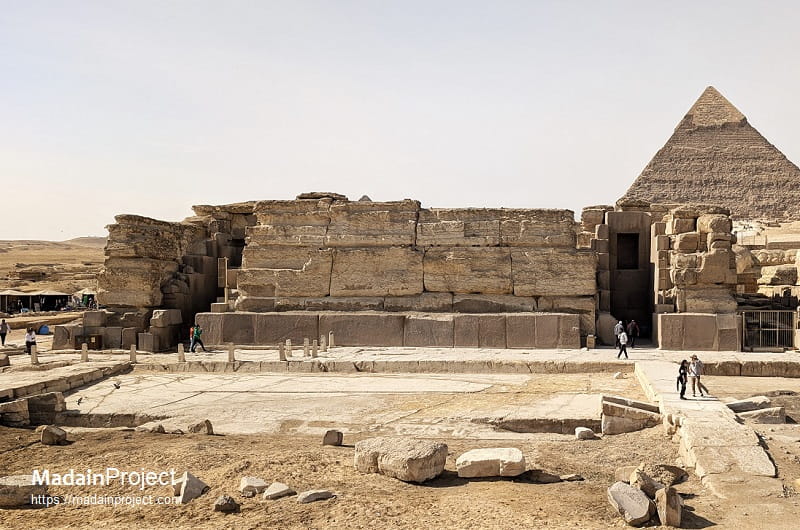
Valley Temple of Khafra
The Valley Temple of Khafre, situated on the Giza Plateau, stands as a quintessential exemplar of Old Kingdom megalithic architecture, distinguished by its structural austerity and profound engineering precision. Constructed during the 4th Dynasty, the edifice is composed of massive limestone core blocks encased in meticulously fitted red granite from Aswan, utilizing a post-and-lintel system that reflects a transition from primordial building techniques to sophisticated royal monumentality.
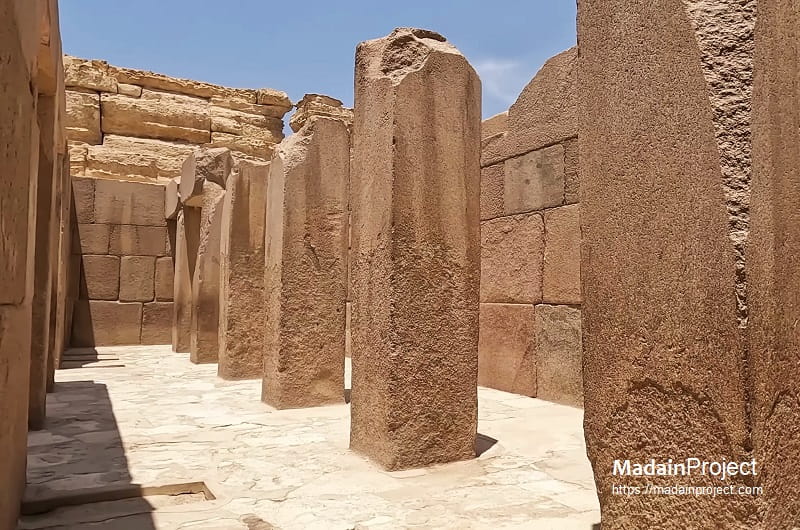
The interior is defined by a T-shaped hall featuring sixteen monolithic square pillars, which originally supported a heavy stone roof and created an environment of stark, rhythmic shadows. Archaeologically, the temple is significant for its recovery of twenty-three diorite statues of the Pharaoh, including the renowned seated Khafre with the Horus falcon, which underscores the site’s function as a locus for the king’s cult and the performance of essential purification rites prior to the final procession up the causeway.
circa 2345–2315 BCE

Valley Temple of Unas
The Valley Temple of Unas (circa 2375–2345 BCE), part of much larger funerary complex, situated at the eastern terminus of a 750-metre-long causeway in Saqqara, represents the final architectural development of the Fifth Dynasty funerary complex. Positioned at the mouth of a wadi that originally met a natural harbor or lake, the temple served as the monumental landing stage and ceremonial gateway for the pharaoh's funerary precinct. Constructed primarily of limestone with a basalt-paved floor, the structure featured a distinctive T-shaped hall supported by monolithic granite columns with palm-leaf capitals. This architectural arrangement facilitated the transition of the royal sarcophagus from the riverine environment to the desert plateau, acting as the primary site for the initial purification rites and the reception of the funerary barque.
Decoratively, the temple and its connecting causeway are renowned for an exceptional iconographic program that provides rare insights into the socio-economic conditions of the late Old Kingdom. While many reliefs follow traditional motifs of offering bearers and personified estates, the Unas complex is unique for its "famine reliefs", which depict emaciated figures, suggesting a period of significant climatic or economic hardship. Furthermore, scenes illustrating the transport of massive Aswan granite columns by boat underscore the temple's functional link to the river Nile-based logistics of royal construction. Despite significant stone robbing in antiquity, the surviving foundations and fragments recovered by archaeologists like Selim Hassan and Ahmad Musa confirm the temple's role as a vital administrative and ritual hub that bridged the urban "pyramid city" with the sacred necropolis.
A number of artefacts were discovered in the valley temple including, a smashed black statue (from 12th - 13th dynasties), limestone relief from a 28th dynasty tomb, and a lintel from a 19th dynasty tomb.
circa 1479–1458 BCE
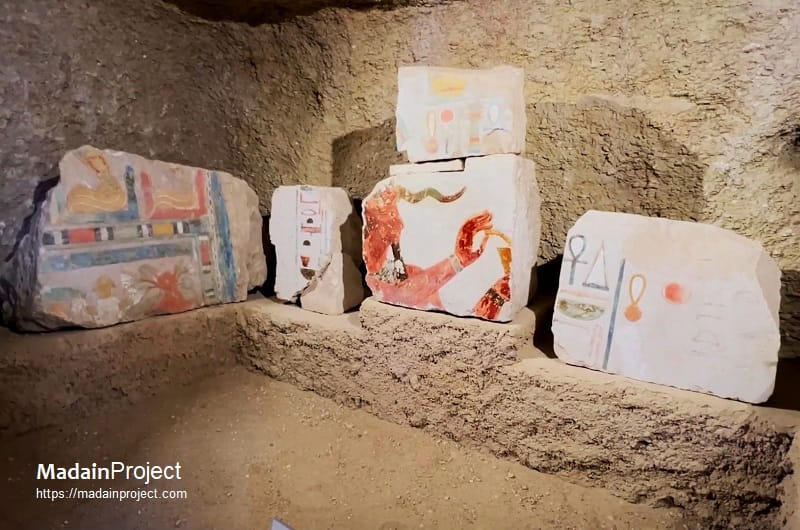
Hatshepsut's Valley Temple
The Valley Temple of Hatshepsut was located, approx. 1 kilometer east of the monumental mortuary temple in the area of el-Asasif, which borders the Dra' Abu el-Naga necropolis to the north in the larger Theban Necropolis. It served as the indispensable riverine gateway and the initial liturgical station of the queen's extensive funerary complex at Deir el-Bahari. Situated approximately one kilometre east of the main terraced sanctuary, the structure was strategically positioned at the edge of the Nile’s cultivation to function as a ceremonial harbor for the arrival of the royal barque from Karnak Temple. Recent excavations in early 2025 CE by teams led by Zahi Hawass have unearthed over 1,500 decorated stone blocks and foundation walls, many of which retain original polychrome pigments depicting nautical processions and ritual offerings. These findings confirm the temple's role as a monumental "landing stage" where the initial purification rites and the Opening of the Mouth ceremony were conducted before the funerary procession ascended the 37-metre-wide, sphinx-lined causeway.
Architecturally, the Valley Temple was integrated into a larger urban and religious landscape that facilitated the annual Beautiful Festival of the Valley. During this event, the barque of Amun-Re was transported across the Nile to reside within the temple's sanctuary, symbolically reuniting the living and the dead. Unlike the earlier, more enclosed valley temples of the Old Kingdom, Hatshepsut’s design featured an innovative T-shaped basin and garden complex, which accommodated rare flora—such as frankincense and myrrh trees—imported during her celebrated expedition to Punt. This botanical integration served not only as a display of imperial wealth but as a functional "garden for Amun", reinforcing the queen’s divine legitimacy through the tangible fulfillment of her cultic obligations.
Signup for our monthly newsletter / online magazine.
No spam, we promise.

The Madain Project is an online archive of Abrahamic History and Archaeology.
Abrahamic History & Archaeology is the study of history and archaeology with respect to the three Abrahamic Faiths without considering the religious and theological aspects. The goal of Abrahamic History is to understand how and why the religious doctrines and behaviours have evlovled and changed over time. Searching for patterns in the evolution of significant cultural events such as the development of farming, the emergence of cities, or the collapse of major civilizations for clues of why and how these have influenced the three major Abrahamic religions.
Cloud Drive -
About -
Help -
Editorial Policy -
AI Policy -
Privacy Policy -
Contact
Madain Project: Encyclopedia of Abrahamic History & Archaeology.
Copyright MadainProject 2017 - 2026.


