
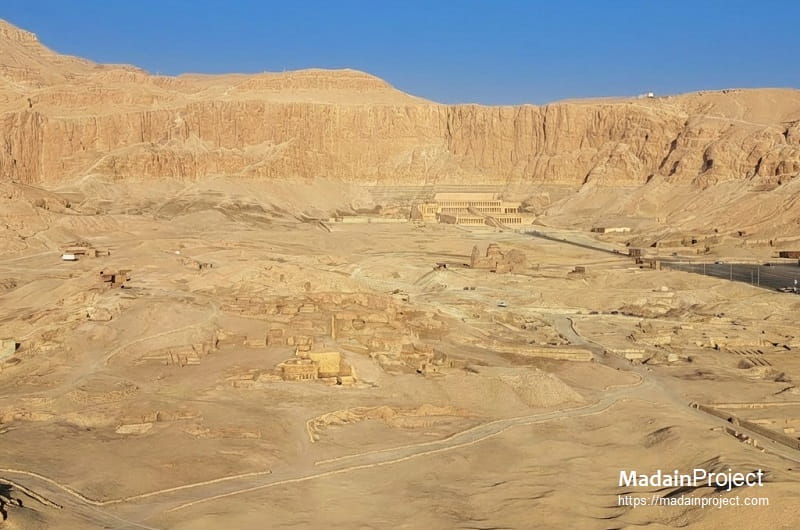
The Theban Necropolis (مدينة طيبة الجنائزية) refers to the extensive funerary landscape situated on the western bank of the Nile opposite the ancient city of Thebes, in present-day Luxor, Egypt. The term designates a vast archaeological zone comprising royal and non-royal tombs, mortuary temples, chapels, and associated settlements dating primarily from the Middle Kingdom of Egypt through the New Kingdom of Egypt and into later periods. Functioning as the principal burial ground for the rulers and elite of the Theban region, the necropolis formed an integral component of the religious and ceremonial landscape of ancient Thebes, reflecting Egyptian conceptions of death, kingship, and the afterlife. Its monuments, distributed across a series of wadis and desert terraces, represent one of the most important concentrations of funerary architecture and decoration in ancient Egypt.
The development of the Theban Necropolis is closely connected to the political rise of Thebes during the late Middle Kingdom and its emergence as the capital of Egypt in the New Kingdom. Earlier burials occurred in scattered areas along the western desert edge; however, the necropolis assumed monumental scale after the reunification of Egypt under rulers of the Theban dynasty in the early second millennium BCE. Royal burial practices evolved significantly during this period. Beginning in the Eighteenth Dynasty, pharaohs abandoned pyramid construction in favor of rock-cut tombs concealed within remote valleys, most notably in the Valley of the Kings and the nearby Valley of the Queens, where members of the royal family and high-ranking elites were interred. These developments reflected changing theological conceptions of royal burial as well as practical concerns regarding tomb security.
Alongside the royal cemeteries, the necropolis expanded to include large clusters of elite and private tombs distributed across several districts. Among the most prominent are the necropolis areas of Sheikh Abd el-Qurna, Dra' abu el-Naga', el-Assasif, and Deir el-Medina. These areas contain elaborately decorated tomb chapels belonging to officials, priests, and artisans connected with the royal court and temple institutions. The necropolis also incorporates major mortuary temples built along the desert margin, including those associated with New Kingdom pharaohs, which served as cult centers for the posthumous worship of the king. Collectively, the architectural diversity and scale of these districts illustrate the central role of ancient Thebes as a religious and political center of ancient Egypt and provide crucial evidence for the social, artistic, and ritual practices surrounding death and commemoration in pharaonic society.
circa 1550–1070 BCE

Primarily utilized during the New Kingdom (circa 1550–1070 BCE), the site served as the principal burial ground for the pharaohs, their families, and the administrative elite of the Egyptian empire. The geographical selection of the west bank was deeply rooted in solar theology, as the setting sun symbolized the transition from the world of the living to the realm of the dead, governed by the deity Osiris.
The evolution of the necropolis is marked by a distinctive shift in funerary architecture and security strategy. During the Eighteenth Dynasty, pharaohs abandoned the traditional pyramid structure in favor of rock-cut tombs hidden within the limestone cliffs of the Valley of the Kings (Wadi el-Biban el-Moluk). This transition, attributed to the desire to protect royal burials from systemic tomb robbery, decoupled the burial chamber from the commemorative mortuary temple. While the kings were interred in the secluded valley, their grand cult temples—such as the Ramesseum and Medinet Habu—were constructed along the edge of the cultivation, serving as permanent sites for the royal ancestor cult and the celebration of the Beautiful Feast of the Valley.
Parallel to the royal developments, the necropolis expanded to include various sub-sites dedicated to the broader Theban hierarchy. The Valley of the Queens provided interment for royal consorts and princes, while the Tombs of the Nobles, clustered in districts like Sheikh Abd el-Qurna and Deir el-Medina, offered a rich iconographic record of daily life, bureaucracy, and religious belief through their vibrant wall paintings. Deir el-Medina is particularly significant as the dedicated village for the artisans and workmen who constructed the royal tombs, providing unprecedented insights into the socio-economic structures and literacy of the non-elite classes in ancient Egypt.
The decline of the Theban Necropolis mirrored the fragmentation of the Egyptian state during the Third Intermediate Period. As central authority waned, the site suffered from extensive state-sanctioned looting and the relocation of royal mummies to hidden caches, such as DB320, to protect them from desecration. Despite this, the necropolis remained a site of sporadic burial and religious veneration through the Graeco-Roman period. Modern systematic exploration began in the 19th century CE, leading to monumental discoveries such as the tomb of Tutankhamun (KV62) in 1922, which fundamentally reshaped the global understanding of New Kingdom material culture and funerary praxis.
circa
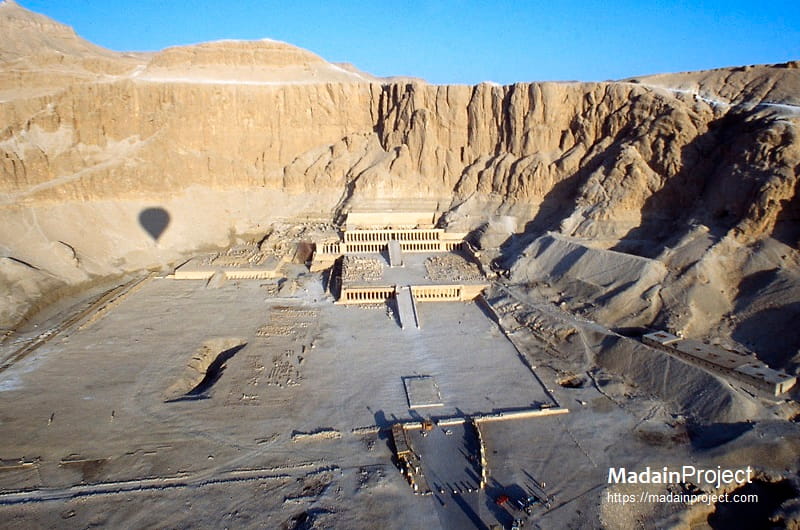
Deir el-Bahari
Deir el-Bahari constitutes a focal point of the Theban Necropolis, distinguished by its natural amphitheatrical limestone cliffs and its long-standing association with the goddess Hathor and the funerary cults of the Egyptian elite. Architecturally, the site is dominated by the innovative terraced mortuary temples of the Middle Kingdom pharaoh Mentuhotep II and the New Kingdom sovereign Hatshepsut, the latter of which represents a masterpiece of classical symmetry and integrated landscape architecture. Beyond its monumental structures, the district served as a vital nexus for the Beautiful Feast of the Valley, while its secluded shafts—most notably the royal cache DB320—played a critical role in the preservation of New Kingdom mummified remains during the political instabilities of the Twenty-first Dynasty.
circa
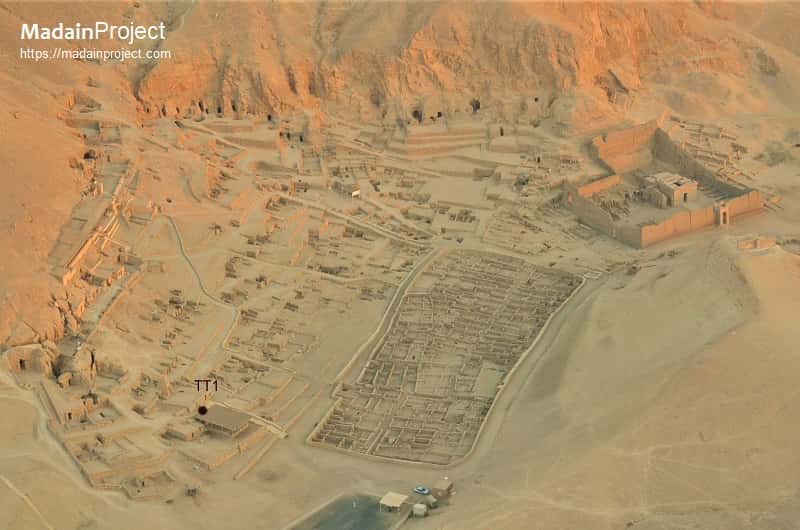
Deir el-Medina
Deir el-Medina, designated in antiquity as Set Maat ("The Place of Truth"), represents a unique socio-archaeological enclave within the Theban Necropolis, functioning as the specialized residential quarter and funerary district for the community of artisans and laborers responsible for the construction of the royal tombs. Unlike the surrounding elite burial sectors, this site offers an unparalleled evidentiary corpus of non-royal life, characterized by a highly literate population of draughtsmen, scribes, and stonemasons who maintained their own distinct necropolis featuring vaulted mud-brick chapels and intricate polychrome tomb decoration. The site's significance is further amplified by the recovery of thousands of ostraca and papyri, which provide a granular record of the community’s legal disputes, economic transactions, and religious practices, thereby facilitating a comprehensive reconstruction of the New Kingdom state’s bureaucratic and labor-management systems.
circa

Valley of the Kings
The Valley of the Kings, or Wadi el-Biban el-Moluk, serves as the preeminent royal funerary sector within the Theban Necropolis, functioning as the principal interment site for the burials of pharaohs of the Eighteenth through Twentieth Dynasties. Characterized by its geomorphological isolation and the presence of the pyramid-shaped peak of el-Qurn, the valley facilitated a significant departure from the visible pyramid complexes of the Old Kingdom and Middle Kingdom in favor of subterranean, rock-cut hypogea. These sepulchers, varying from simple shafts to complex multi-chambered corridors, were designed to safeguard the royal person and grave goods from depredation while serving as the setting for the Amduat and other esoteric funerary texts. The site remains a pivotal archaeological laboratory for the study of New Kingdom kingship, religious iconography, and the evolution of sophisticated ancient mining and decorative techniques.
circa

Valley of the Queens
The Valley of the Queens, known anciently as Ta-Set-Neferu ("The Place of Beauty"), functions as a specialized auxiliary necropolis within the Theban landscape, primarily dedicated for the interment of royal consorts, princes, and high-ranking members of the New Kingdom court. While initial burials in the district date to the Eighteenth Dynasty, the site reached its zenith during the Ramesside period, particularly under Ramesses II, when the architectural complexity and decorative programs of the tombs began to rival those of the Valley of the Kings. The valley is most academically significant for the tomb of Queen Nefertari (QV66), which exhibits an unparalleled mastery of polychrome relief and sophisticated theological narratives, emphasizing the queen’s transfiguration in the afterlife. Beyond its aesthetic achievements, the site provides critical data regarding the dynastic succession and familial hierarchies of the Nineteenth and Twentieth Dynasties, reflecting the nuanced socio-political status of the royal women and offspring within the broader Egyptian funerary tradition.
circa
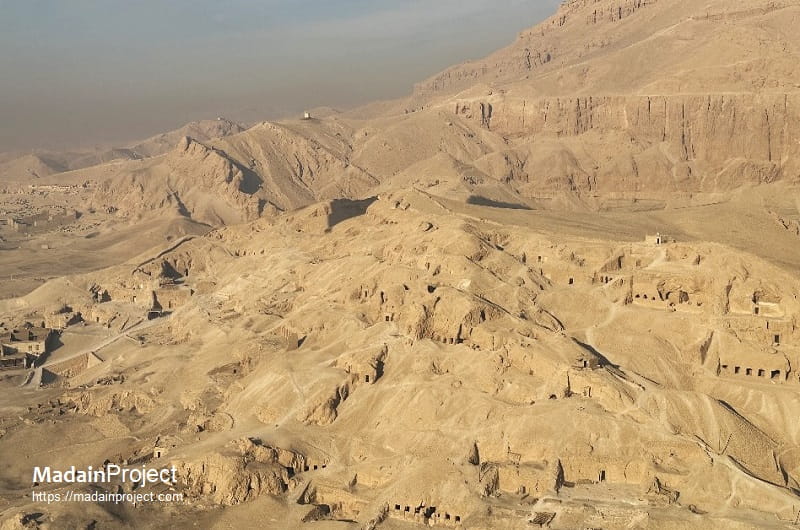
Sheikh abd el-Qurna
Sheikh abd el-Qurna represents the most densely concentrated elite funerary zone within the Tombs of the Nobles in Luxor area, situated on the central slopes of the Theban hills between the royal valleys and the mortuary temples. This district served as the primary necropolis for the high-ranking bureaucracy of the New Kingdom, housing the elaborate rock-cut tombs of viziers, high priests, and military commanders who administered the Egyptian empire. Architecturally, these tombs typically feature a T-shaped plan, but they are most significant for their extensive autobiographical inscriptions and vibrant wall paintings that depict terrestrial activities, ranging from agricultural management and foreign tribute to banquet scenes and artisan workshops. Consequently, Sheikh abd el-Qurna provides an essential prosopographical and iconographic record that supplements the more stylized theological focus of royal burials, offering profound insights into the administrative infrastructure and private religious expectations of the Theban aristocracy.
circa

Medinet Habu
Medinet Habu, situated at the southern terminus of the Theban Necropolis, serves as one of the most structurally integrated and historically significant religious complexes of the New Kingdom. While the site contains a small temple dedicated to Amon dating to the Eighteenth Dynasty, it is dominated by the colossal Mortuary Temple of Ramses III, which remains the best-preserved example of Ramesside commemorative architecture. Functioning as a "Mansion of Millions of Years", the complex was not merely a site for the royal funerary cult but also a fortified administrative center, featuring a massive mud-brick enclosure wall and a monumental migdol gateway inspired by Near Eastern military fortifications. The temple’s extensive relief cycles, particularly those documenting the victory over the Sea Peoples, provide a critical primary record of Late Bronze Age geopolitics and military history, while the site’s continued occupation through the Coptic period underscores its enduring role as a focal point of civil and religious authority in Western Thebes.
circa
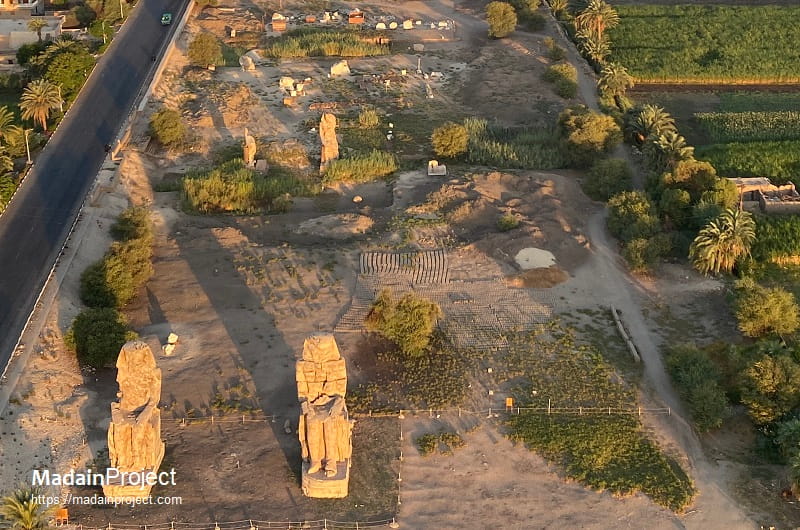
Kom el-Hetan
Kom el-Hetan, situated on the alluvial plain of the Western Theban landscape, marks the original site of the Mortuary Temple of Amenhotep III, which was historically the most expansive religious complex in the Theban Necropolis. Although largely decimated by seismic activity in antiquity and the subsequent quarrying of its masonry for later royal projects, the district is defined by its two remaining monoliths, the Colossi of Memnon, which functioned as monumental sentinels at the temple's first pylon. Recent archaeological investigations by the Colossi of Memnon and Amenhotep III Temple Project have revealed an immense corpus of lithic statuary and architectural elements, including "Sakhmet" statues and extensive geographical lists that document the global reach of the Eighteenth Dynasty Egyptian empire. This site is academically pivotal for understanding the transition toward solar-centric theology under Amenhotep III and represents a zenith in the scale and sophistication of New Kingdom cultic architecture prior to the Amarna period.
circa
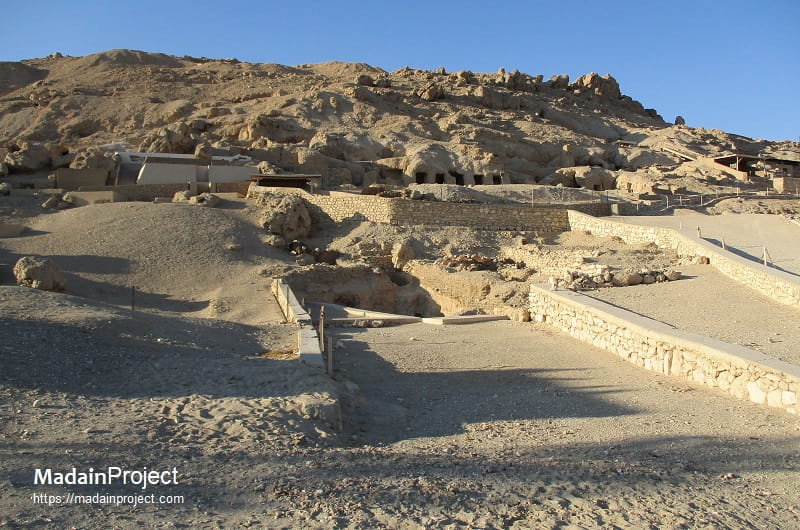
Dara Abu el-Naga
Dra' Abu el-Naga, located at the northernmost sector of the Theban Necropolis, serves as a critical archaeological link between the Middle Kingdom and New Kingdom, functioning as the ancestral burial ground for the Seventeenth Dynasty and the early Eighteenth Dynasty. This district is characterized by its distinctive landscape of saff-tombs and early rock-cut corridors that reflect the transition from provincial Theban traditions to the imperial grandeur of the New Kingdom. The area is particularly significant for the discovery of the "Dra' Abu el-Naga Treasure" and the royal burials of the Ahmoside line, which provided the foundational political and religious impetus for the reunification of Egypt. Furthermore, its continued use by high-ranking officials throughout the Ramesside period, such as the High Priests of Amun, underscores the site's enduring sanctity and its strategic role in the spatial development of the Theban funerary landscape.
Signup for our monthly newsletter / online magazine.
No spam, we promise.

The Madain Project is an online archive of Abrahamic History and Archaeology.
Abrahamic History & Archaeology is the study of history and archaeology with respect to the three Abrahamic Faiths without considering the religious and theological aspects. The goal of Abrahamic History is to understand how and why the religious doctrines and behaviours have evlovled and changed over time. Searching for patterns in the evolution of significant cultural events such as the development of farming, the emergence of cities, or the collapse of major civilizations for clues of why and how these have influenced the three major Abrahamic religions.
Cloud Drive -
About -
Help -
Editorial Policy -
AI Policy -
Privacy Policy -
Contact
Madain Project: Encyclopedia of Abrahamic History & Archaeology.
Copyright MadainProject 2017 - 2026.


