
A mortuary temple is a ritual complex in ancient Egyptian funerary architecture built to perform pre-burial rituals, facilitate the pharaoh’s integration into the afterlife, and maintain the cult of a deceased pharaoh or elite individual by serving as a site for ongoing ritual offerings. Located in proximity to the tomb (such as a pyramid or rock-cut sepulcher), the temple functioned as the institutional center for offerings, priestly rituals, and commemoration of the deceased, often integrating elements of royal ideology and solar theology. Mortuary temples commonly formed part of a larger funerary landscape that could include a valley temple, causeway, and tomb structure.
Mortuary temples occupied a central role in the religious and political framework of ancient Egypt. Similar to the funerary temples attached to private tombs, royal mortuary temples were conceived as enduring institutions, combining architectural grandeur with ritual function. They were strategically positioned, often on the west bank of the river Nile where the sun set, symbolically connecting the site to death and rebirth.
The design and scale of these temples reflected the pharaoh’s status and the prevailing religious ideology, serving both as a place for the veneration of the deceased ruler and as a demonstration of state power. The temples typically included chapels, sanctuaries, hypostyle halls, and open courtyards, creating a sequential spatial arrangement for ritual processions and offerings.

circa 2670-1155 BCE

The development of mortuary temples can be traced to the Old Kingdom, reaching an early architectural synthesis as an independent structure during the reign of Pharaoh Djoser in the Third Dynasty (circa 2670–2640 BCE). Djoser’s mortuary complex at Saqqara, designed by his architect Imhotep, combined a step pyramid with an adjoining temple complex, establishing a template for royal funerary architecture. Djoser's mortuary temple was oriented north to reflect the stellar orientation (aligned with the circumpolar stars). The pyramid temple of king Snefru (founder of Fourth Dynasty, circa 2600 BCE) at Meidum, though much smaller in size, is the oldest extant mortuary temple known to still stand. During this period the orientation of the mortuary temple changed from north to east, to reflect the solar-theological orientation rather than steller.
The tradition expanded during the Fourth Dynasty with the mortuary temple of Pharaoh Khafre at Giza, which also included a valley temple connected by a causeway to his pyramid, integrating the ritual landscape with monumental sculpture such as the Great Sphinx (which may have had its own dedicated temple). In the Old and Middle Kingdoms, the Valley Temple and the Mortuary Temple (or more specifically the Pyramid Temple) were physically and liturgically linked by a sacred causeway. The Valley Temple acted as the "reception hall" for the royal body, where pre-burial purification ritual, presentation of the body, the Opening of the Mouth ceremony and the funerary procession began, while the Mortuary Temple served as the "daily office" for the perpetual cult.
Following the Old Kingdom, the political reunification of Egypt under the Eleventh Dynasty introduced a significant transitional phase in the architectural and theological development of royal funerary complexes. The mortuary complex of Mentuhotep II at Deir el-Bahari represents the most important Middle Kingdom precedent in this evolution. Officially named Akh-sut-Nebhepetre (“Splendid are the cult places of Nebhepetre”), the complex departed from the strictly pyramid-centered funerary model of the Old Kingdom by integrating the royal tomb and mortuary temple within a single monumental structure built against the cliffs of the Theban necropolis. The temple was approached from the cultivation zone by a long processional causeway leading to a forecourt and successive colonnaded terraces, preserving the traditional ritual axis that likely began at a now-lost valley temple near the floodplain. Architecturally, the monument introduced a terraced arrangement that interacted with the surrounding landscape, anticipating the later temple forms constructed in the same valley during the New Kingdom.
Beyond its architectural innovation, the temple also introduced a significant theological development in the representation of royal cult practice. In contrast to earlier mortuary temples, where the deceased king primarily appeared as the passive recipient of offerings, the decoration and cultic program of Mentuhotep II’s complex depicted the ruler as an active ritual participant performing ceremonies for the gods, particularly for Amun-Ra. For this reason, the complex is widely regarded as the ideological precursor to the New Kingdom institution later known as the “House of Millions of Years”, in which the mortuary temple functioned simultaneously as a royal funerary monument and a living cult center integrated with the state religion of Amun. The monument is also associated with the early development of the Beautiful Festival of the Valley, during which the sacred barque of Amun crossed the Nile to visit the royal mortuary temples on the west bank, reinforcing the connection between divine and royal cult.
The New Kingdom saw further elaboration and consolidation particularly under Pharaoh Hatshepsut (circa 1479–1458 BCE), whose mortuary temple at Deir el-Bahari exemplified functional absorption of "Valley Temple" into the larger Mortuary Temple (now called the "Mansion of Millions of Years"), while the actual tomb was hidden in the Valley of the Kings. Even thought the function was absorbed by mortuary temple, she still maintained a physically separate Valley Temple which stood at the edge of the cultivation. It shows the evolution of the cult from being a literal "neighbor" to the body (Old Kingdom) to becoming a grand "imperial monument" (New Kingdom).
Even though in many New Kingdom complexes the distinct grand valley temples largely disappeared, smaller and less preserved "valley temples" continued to be built to act as the "water gate" from the river Nile. During this period the physical form and theological prominence greatly changed as the funerary landscape shifted from Memphis to Thebes and the processional route from the Nile still existed. The mortuary temple of Hatshepsut features a terraced, colonnaded structure harmonized with the cliffs of the Theban necropolis, blending funerary, ceremonial, and political functions. The New Kingdom temples were called ḥwt-nṯr n ḥḥw n rnpt, literally the "mansions of millions of years", (Temple de Millions d’Années) by the Egyptians during antiquity. Other significant examples include the mortuary temples of Thutmose III and Ramesses II, which emphasized monumental pylons, statuary, and detailed reliefs chronicling divine associations and royal exploits.
While the New Kingdom is mostly associated only with the massive mortuary temples at the edge of the desert (like the Ramesseum), the "Valley Temple" remained a critical, albeit often less preserved, component of the royal funerary complex. During this period the so-called "valley temples" may have also been used as resting or ritual stops for the sacred barque of Amun during the Beautiful Festival of the Valley.
During the subsequent Third Intermediate Period, the construction of independent mortuary temples entirely ceased and was never revived in its former monumental style. Rulers of the 21st and 22nd Dynasties at Tanis were interred in modest, largely subterranean limestone and granite tombs located directly within the enclosures of divine temples, such as the Temple of Amun. This "intramural" burial practice meant the divine temple itself fulfilled the protective and cultic roles previously split between valley and mortuary temples.
circa 2670-1155 BCE
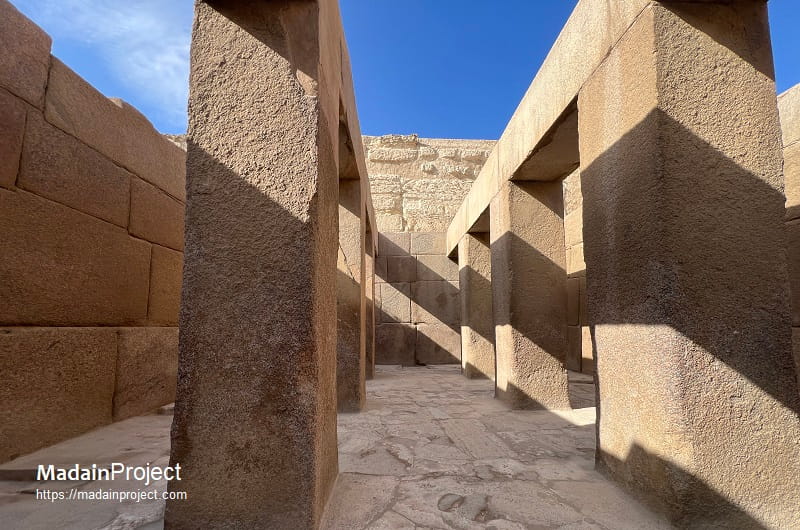
Mortuary temples exhibit a distinctive architectural vocabulary characterized by axial planning, massive stone construction, and symbolic ornamentation. Typically, the approach to the temple involved a causeway connecting the valley temple near the Nile to the elevated mortuary complex adjacent to the tomb. Temple facades often featured pylons adorned with reliefs of the pharaoh performing ritual acts or engaging with deities. Interior spaces were organized hierarchically, with open courtyards leading to hypostyle halls, chapels, and sanctuaries, often containing statues of the deceased ruler or cult images. Some of the first mortuary temples were built with mud, bricks, or reeds; these temples were discovered through artwork including pottery.
Relief decoration and inscriptions documented the pharaoh’s achievements, divine lineage, and funerary cult, reinforcing the sacred and political authority of the structure. Water features and sacred lakes were occasionally incorporated, reflecting symbolic notions of purification and regeneration. Construction materials predominantly included limestone and sandstone, with finer detailing in alabaster or granite for statues and cult statues.
circa 2670-1155 BCE
The primary purpose of mortuary temples was to facilitate the immediate pre-burial rituals and ongoing cultic veneration of the deceased pharaoh, ensuring his successful transition to the afterlife and continued participation in cosmic order. Priests performed daily offerings of food, drink, and incense to sustain the ka, or spiritual essence, of the ruler. Beyond their religious function, mortuary temples operated as instruments of royal propaganda, visually asserting the pharaoh’s divine authority, commemorating military and administrative accomplishments, and reinforcing the ideological connection between the monarchy, the gods, and the Egyptian people. By combining ceremonial space, monumental architecture, and ritual practice, mortuary temples embodied the intertwined dimensions of devotion, memory, and power central to ancient Egyptian civilization.
circa 2686–1700 BCE

Pyramid Funerary Temple
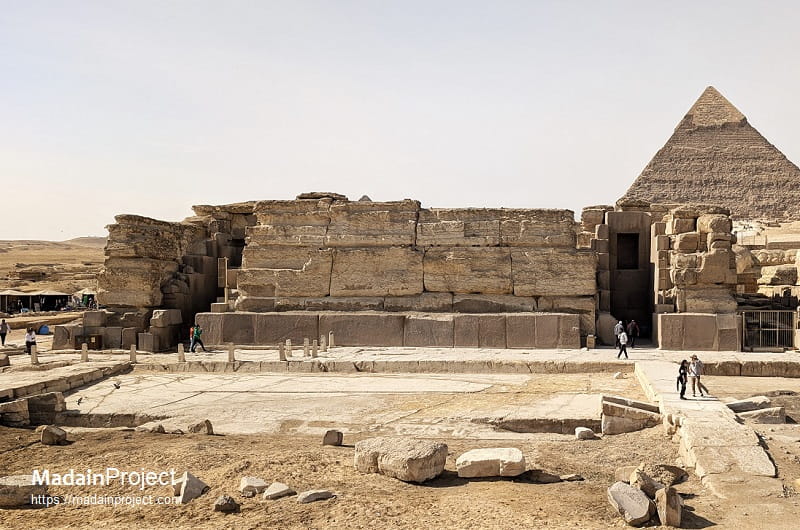
A pyramid mortuary temple, simply called the mortuary temple or pyramid temple, is the offering and ritual temple attached to a royal pyramid complex, most common during the Old and Middle Kingdoms. Built on the east side of the pyramid and connected to a valley temple by a covered causeway, it served as the principal site for the mortuary cult of the deceased king. The temple typically included offering halls, chapels, storerooms, and priestly service areas where daily rites, food offerings, and commemorative ceremonies were conducted to sustain the king’s ka (vital essence) in the afterlife.
circa 2686–1700 BCE
Valley Temple
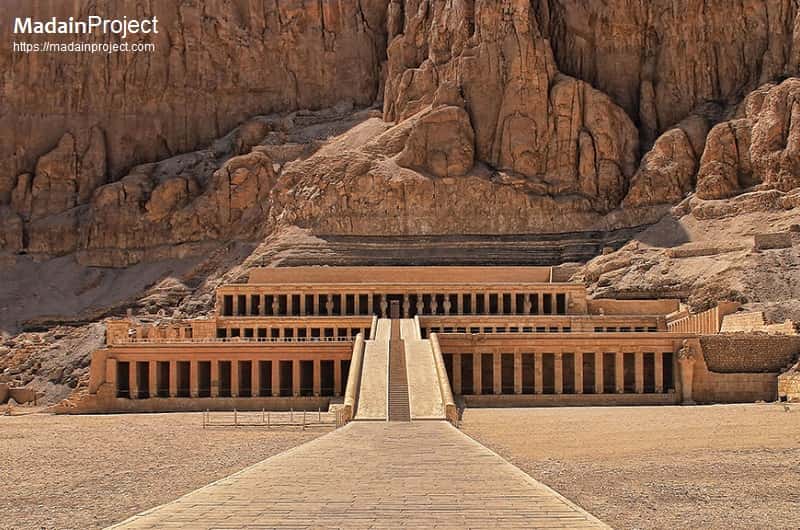
A valley temple is the ceremonial gateway structure located at the edge of the Nile floodplain within a royal funerary complex. Serving as the entry point to the pyramid or mortuary temple via a processional causeway, it functioned as the location for ritual purification, reception of the royal mummy during the funeral procession, and the storage and preparation of offerings transported from the Nile. Architecturally massive and often constructed with large stone blocks, valley temples also operated as transitional spaces linking the cultivated Nile valley with the desert necropolis. Even though the valley temples were an Old and Middle Kingdoms specific architectural features, they still continued to be built well in to the New Kingdom period as well. However, some of the theological and liturgical funcations were absorbed by the House of the Millions of Years.
circa 1700–1050 BCE
House of Millions of Years
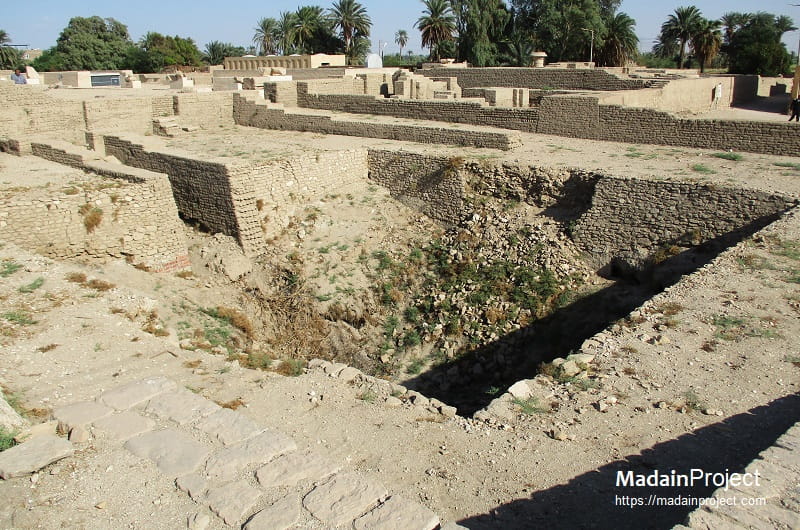
A “House of Millions of Years” (Egyptian: ḥwt-ḥḥw m rnpt), also called the "mansion of millions of years" was a type of royal mortuary temple developed primarily in the New Kingdom. It served simultaneously as a cult temple for the deceased pharaoh and a living temple for major state deities—especially Amun-Re—ensuring the eternal renewal of the king’s divine status. These complexes were usually located on the west bank of the Nile near royal burial grounds (notably at Thebes) but were architecturally and spatially separate from the king’s tomb in the Valley of the Kings. Characterized by monumental pylons, courtyards, processional axes, and extensive relief decoration, the Mansion of Millions of Years functioned as a major religious institution integrated into state cult practice.
Signup for our monthly newsletter / online magazine.
No spam, we promise.

The Madain Project is an online archive of Abrahamic History and Archaeology.
Abrahamic History & Archaeology is the study of history and archaeology with respect to the three Abrahamic Faiths without considering the religious and theological aspects. The goal of Abrahamic History is to understand how and why the religious doctrines and behaviours have evlovled and changed over time. Searching for patterns in the evolution of significant cultural events such as the development of farming, the emergence of cities, or the collapse of major civilizations for clues of why and how these have influenced the three major Abrahamic religions.
Cloud Drive -
About -
Help -
Editorial Policy -
AI Policy -
Privacy Policy -
Contact
Madain Project: Encyclopedia of Abrahamic History & Archaeology.
Copyright MadainProject 2017 - 2026.


