
The mortuary temple of Merenptah is the New Kingdom funerary complex erected on the west bank of the river Nile at ancient Thebes to sustain the posthumous cult of King Merenptah, fourth ruler of Egypt’s Nineteenth Dynasty, and to commemorate his reign through ritual, monumental architecture, and inscribed royal ideology.
Constructed during the late thirteenth century BCE, the mortuary temple of Merenptah formed part of the dense ceremonial landscape of western Thebes, where royal mortuary temples functioned as both cult centers for deceased kings and state-sponsored institutions tied to landholdings, priesthoods, and festivals. Like other Ramesside mortuary temples, it combined religious, commemorative, and political purposes, presenting the king as a divinely sanctioned ruler whose victories and piety endured beyond death. Although far less well preserved than neighboring monuments, the temple is archaeologically significant for its reuse of earlier royal material and for inscriptions that illuminate the ideological priorities of Merenptah’s reign.
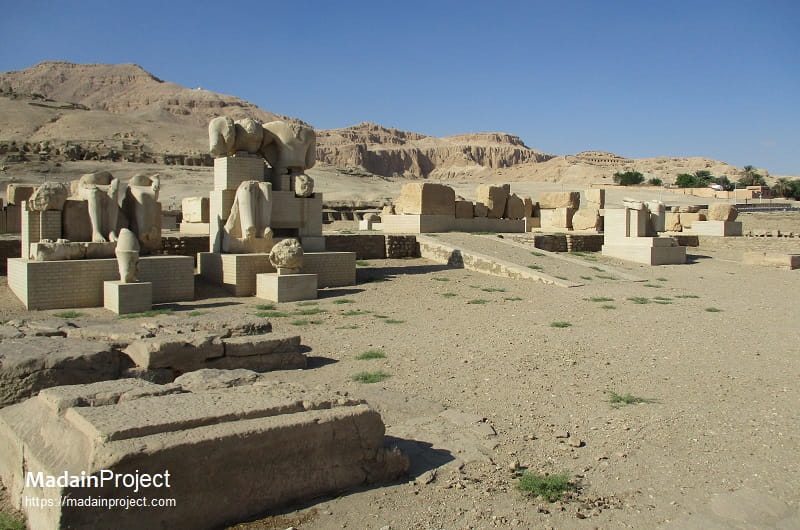
circa 1213-1203 BCE

Merenptah ascended the throne late in life after the long reign of his father, Ramesses II, and his building program reflects both continuity with Ramesside traditions and the practical constraints of a shorter reign. His mortuary temple was built at Thebes on a site north of the temple of Amenhotep III and south of the later mortuary temple of Ramesses III at Medinet Habu. Ancient textual and archaeological evidence indicates that large quantities of stone were quarried not anew but taken from the dismantled or decaying monuments of Amenhotep III, whose vast temple complex lay nearby. Colossal statues and architectural blocks originally carved for Amenhotep III were recut or reinscribed for Merenptah, a practice that was not unusual in periods of reduced resources.
The temple served as the focal point of Merenptah’s funerary cult, maintained by priests and administrators who oversaw offerings and rituals intended to ensure the king’s eternal sustenance and divine favor. Relief fragments and inscriptions found at the site include references to royal epithets and scenes of ritual performance, as well as reused blocks bearing earlier Eighteenth Dynasty imagery. The temple appears to have suffered early from Nile inundation and structural instability, contributing to its rapid decline. By the Third Intermediate Period, much of the complex was already dismantled or buried, and its stone continued to be quarried in antiquity.
Modern exploration began in the late nineteenth century CE, most notably with excavations by Flinders Petrie, who identified the site and documented its extensive reuse of Amenhotep III’s colossi. Subsequent Egyptian and international missions, including recent work by the University of Basel in cooperation with the Egyptian Ministry of Tourism and Antiquities, have clarified the layout of the temple and recovered monumental statuary fragments, significantly refining scholarly understanding of the complex.
circa 1213-1203 BCE
The mortuary temple of Merenptah followed the standard axial plan of Ramesside funerary temples at Thebes. It was oriented roughly east–west, facing the Nile floodplain, and was approached through a monumental pylon leading into an open courtyard. Beyond this lay additional courts and a hypostyle hall that provided access to the inner sanctuaries dedicated to the cult of the deified king and associated gods, particularly Amun-Re.
Construction materials consisted primarily of limestone and sandstone, much of it reused. Colossal statues that once flanked the entrance courts are among the most striking architectural elements; several were originally carved for Amenhotep III and later reinscribed with Merenptah’s names and titles. Relief decoration, now largely fragmentary, depicted the king making offerings to major deities and celebrating his legitimacy and military successes in accordance with New Kingdom royal iconography. The architectural scale of the temple, while impressive, was more modest than that of earlier Eighteenth Dynasty monuments, reflecting both economic realities and the compressed timeline of Merenptah’s reign.
circa 1213-1203 BCE
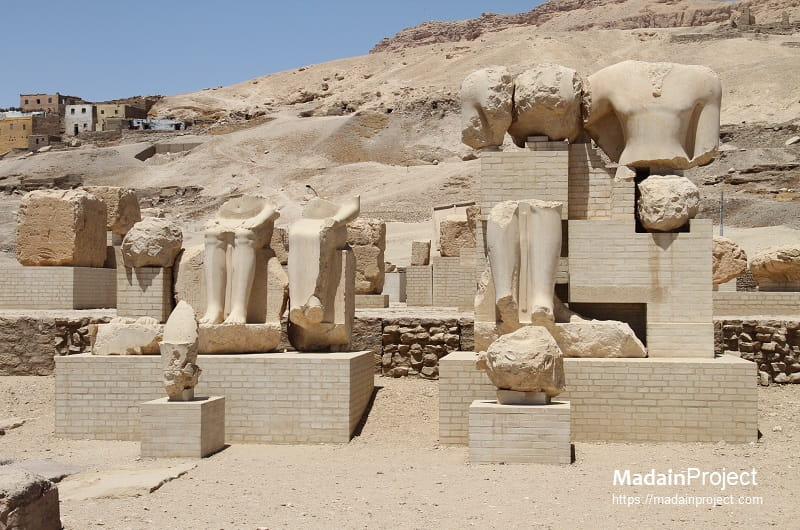
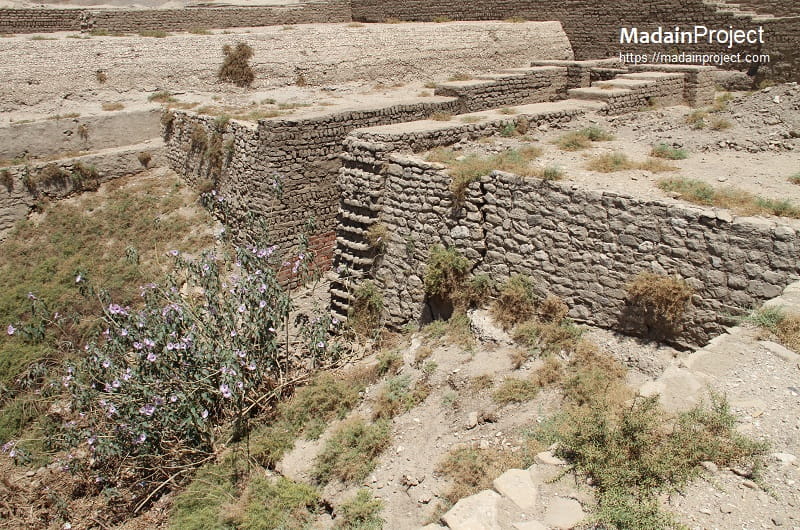
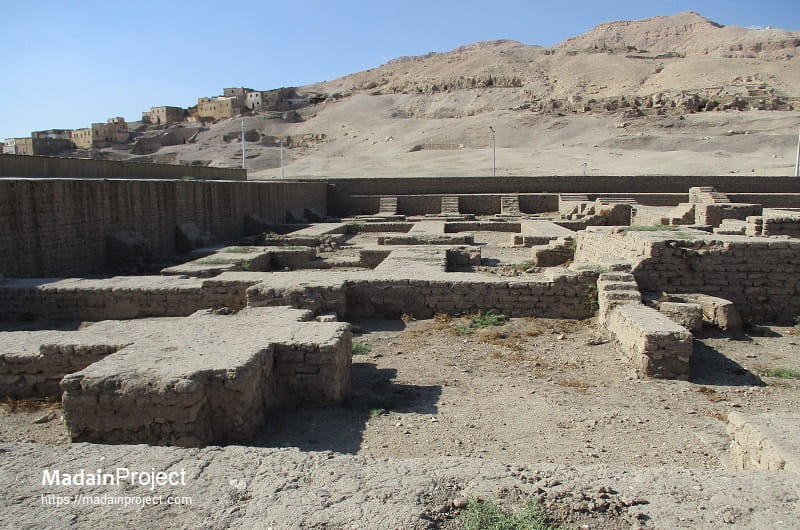
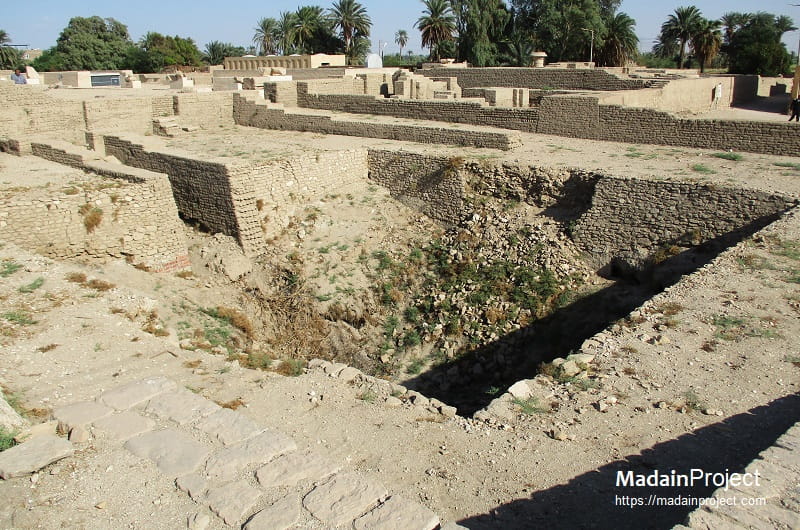
Today, the mortuary temple of Merenptah survives in a heavily ruined state. The ground plan can still be traced through foundation walls, column bases, and the remains of pylons and courtyards, but little of the superstructure stands intact. Scattered blocks, relief fragments, and shattered colossi dominate the site, many bearing traces of earlier inscriptions from the reign of Amenhotep III alongside later Ramesside modifications.
Archaeological work has stabilized portions of the remains and documented the extensive spolia that characterize the complex. The site offers valuable insight into ancient practices of reuse, the organization of royal cult temples, and the historical transition from the monumental exuberance of the Eighteenth Dynasty to the more pragmatic building strategies of the later Ramesside period. Despite its fragmentary condition, the mortuary temple of Merenptah remains a key source for understanding royal ideology, architectural adaptation, and the evolving sacred landscape of western Thebes.
circa 1213-1203 BCE

Merneptah Stele
The Merneptah Stele, discovered by Flinders Petrie in 1896 CE within the precinct of the Mortuary Temple of Merneptah at Thebes, stands as one of the most significant epigraphic finds in New Kingdom Egyptology. Carved from a massive block of black granite—originally the reverse side of a stela belonging to Amenhotep III—the inscription serves primarily as a poetic record of Merneptah’s military triumphs during his fifth regnal year (circa 1208 BCE). While the text focuses largely on the king's victory over a Libyan confederation, its concluding passage contains a brief register of a campaign in the Levant, providing a rare glimpse into the geopolitical dynamics of the Late Bronze Age transition.
The artefact is colloquially known as the "Israel Stele" because it contains the earliest known extra-biblical reference to a group identified as "Israel". Critically, the Egyptian determinative used for the name indicates a people or nomadic group rather than a settled city-state or kingdom, offering vital data for the study of ethnogenesis in the southern Levant.
The text utilizes a highly stylized "Victory Hymn" format, emphasizing the divine mandate of the Pharaoh and the restoration of Ma’at (cosmic order) through the subjugation of foreign enemies. The discovery of the stele in situ within the mortuary temple clarifies the king’s efforts to project his martial legitimacy within his own funerary cult, effectively linking his earthly victories to his eternal legacy. The reuse of Amenhotep III’s monument is a hallmark of the Nineteenth Dynasty’s economic and architectural strategy, illustrating a pragmatic approach to monumental construction during the transition to the Iron Age.
In the broader context of Syro-Palestinian archaeology, the Merneptah Stele serves as a terminus ante quem for the presence of an entity named Israel in Canaan, making it a foundational document for correlating Egyptian records with the archaeological record of the early Iron Age.
Signup for our monthly newsletter / online magazine.
No spam, we promise.

The Madain Project is an online archive of Abrahamic History and Archaeology.
Abrahamic History & Archaeology is the study of history and archaeology with respect to the three Abrahamic Faiths without considering the religious and theological aspects. The goal of Abrahamic History is to understand how and why the religious doctrines and behaviours have evlovled and changed over time. Searching for patterns in the evolution of significant cultural events such as the development of farming, the emergence of cities, or the collapse of major civilizations for clues of why and how these have influenced the three major Abrahamic religions.
Cloud Drive -
About -
Help -
Editorial Policy -
AI Policy -
Privacy Policy -
Contact
Madain Project: Encyclopedia of Abrahamic History & Archaeology.
Copyright MadainProject 2017 - 2026.


