
The "pyramid mortuary temple", a subtype of the broader "morturay temple" category, also referred to as the pyramid temple—comprised the primary ancient Egyptian sanctuary constructed in immediate proximity to a royal pyramid. Functioning as the central hub for the deceased monarch’s cult during the Old and Middle Kingdoms, these structures represent the earliest form of the funerary temple archetype, which later encompassed the valley temple and the New Kingdom Mansion of Millions of Years. Situated on the desert plateau, the mortuary temple was architecturally integrated into the complex, physically abutting the pyramid’s northern or eastern face to serve as a permanent interface for ritual and offering.
The pyramid mortuary temple was an integral component of a much larger unified funerary complex. Its architectural program evolved from the stellar-oriented north temples of the Old Kingdom, 3rd Dynasty, to a standardized solar-aligned model featuring an open court, five statue niches, and a sanctuary with a false door. This structure functioned as the permanent interface where the terrestrial and divine realms intersected, ensuring the king’s eternal transformation into an akh (effective spirit) while maintaining the cosmic order through perpetual ritual.
Distinct from the valley temple, which functioned as a maritime gateway for purification and possibly some mummification rites at the edge of the cultivation, the mortuary temple was situated on the desert plateau, physically abutting the pyramid's eastern face. This placement established a direct architectural and symbolic link to the king’s burial chamber, facilitating the daily presentation of offerings and the performance of secret liturgical rites intended to sustain the king’s ka in the afterlife.
Unlike the later New Kingdom "Mansion of Millions of Years", which were physically detached from the royal tombs in the Valley of the Kings and focused on the union of the king with the god Amun-Ra, the pyramid mortuary temple was an integral component of a unified funerary complex. Its architectural program evolved from the stellar-oriented north temples of the 3rd Dynasty to a standardized solar-aligned model featuring an open court, five statue niches, and a sanctuary with a false door. This structure functioned as the permanent interface where the terrestrial and divine realms intersected, ensuring the king’s eternal transformation into an akh (effective spirit) while maintaining the cosmic order through perpetual ritual.

circa 2670–2640 BCE
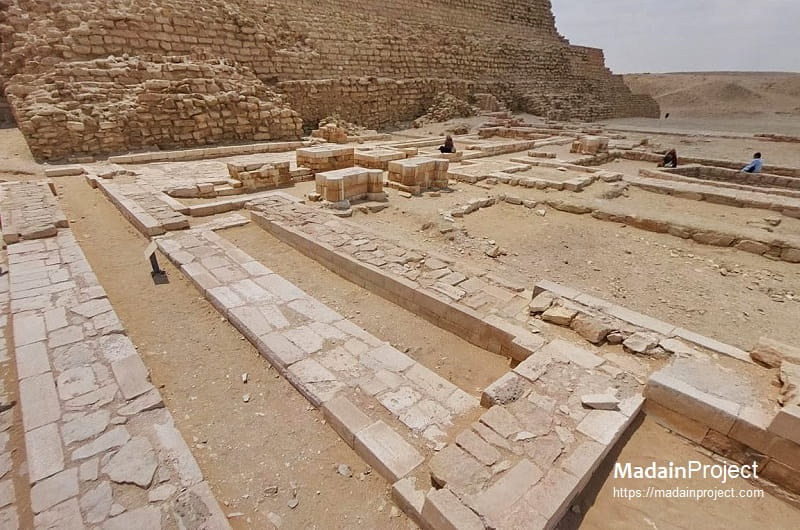
Djoser's Mortuary Temple
The mortuary temple of Djoser at Saqqara serves as the earliest and foundational architectural prototype for the pyramid temple, representing the first monumental transition from ephemeral mudbrick to permanent limestone masonry. Attributed to the vizier Imhotep during the Third Dynasty (circa 2670 BCE), the structure is uniquely situated against the northern face of the Step Pyramid to facilitate the King’s symbolic communion with the "Imperishable" circumpolar stars. Its internal program features a complex arrangement of galleries and two inner courtyards, characterized by engaged fluted columns that mimic organic bundle-reeds, a hallmark of early pharaonic lithic innovation. While later dynasties shifted to an eastern solar orientation, Djoser’s temple established the essential liturgical requirement for a permanent interface between the subterranean burial and the terrestrial offering cult, most notably through the adjacent serdab which housed the monarch’s ka statue.
circa 2613–2589 BCE
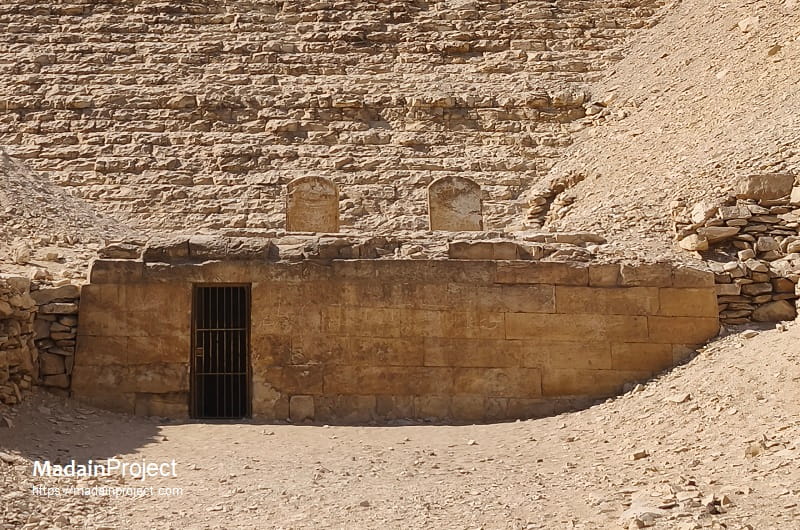
Meidum Pyramid Mortuary Temple
The mortuary temple of the Meidum Pyramid, widely attributed to the transition between the reigns of Huni and Sneferu (late Third to early Fourth Dynasty), represents a critical evolutionary stage in the development of the royal funerary complex. Unlike the sprawling, multi-chambered mortuary temples of the later 4th Dynasty, the Meidum structure is characterized by its minimalist limestone masonry and extreme architectural simplicity. Located on the eastern face of the pyramid—marking the definitive shift toward a solar-oriented cult—the temple is a compact, rectangular building measuring approximately 9.1 by 9 meters. Its exterior features high, inward-sloping (battered) walls, a precursor to the monumental pylon aesthetic, while the interior is comprised of a narrow entrance corridor leading to a small hypostyle hall with two pillars and an open-air offering courtyard.
The significance of the Meidum pyramid temple lies in its preservation of ritual intent despite its modest scale. Within the courtyard stand two large, rounded limestone stelae, which remain uninscribed, flanking a central offering table. This arrangement suggests that the temple was primarily designed as a locus for the presentation of food and libations to the monarch's ka. Archaeologically, the temple is unique because it appears to have been abandoned before final completion; the lack of inscriptions and the presence of 18th Dynasty graffiti—left by ancient tourists such as the scribe Aakheperreseneb—indicate that while the structural shell was finalized, the decorative program was never executed. This structure serves as the essential typological link between the north-facing funerary chapels of the 3rd Dynasty and the expansive, formalized mortuary temples of the Giza plateau.
circa 2589–2566 BCE

Khufu's Mortuary Temple
Khufu’s mortuary temple or the "pyramid temple", situated on the east side of the Great Pyramid at Giza, represents one of the earliest and most architecturally significant examples of Old Kingdom funerary temples from ancient Egypt. Constructed during the Fourth Dynasty (circa 2580–2560 BCE), this temple functioned as the principal site for the performance of rituals and offerings intended to sustain the pharaoh’s ka and facilitate his eternal life. Although only fragments survive today, archaeological evidence indicates that the temple formed a crucial component of a larger pyramid complex, which included the valley temple, causeway, and pyramid itself, creating an integrated ceremonial landscape along the west bank of the Nile.
The mortuary temple of Khufu was built primarily from locally quarried limestone, with portions of finer stone used for the cult statue and altar areas. Its layout followed the standard Old Kingdom pattern, consisting of a long, narrow hall leading from the pyramid’s base to the inner sanctuary, where offerings were presented and the king’s divine presence symbolically maintained. The temple’s interior walls likely bore reliefs and inscriptions, although these have largely been lost, depicting ritual scenes, deities, and the pharaoh’s accomplishments in line with Old Kingdom artistic conventions. The alignment of the temple with the pyramid emphasized the relationship between the king’s burial and his mortuary cult, reinforcing the cosmological symbolism of the pharaoh as both earthly ruler and divine intermediary.
Functionally, Khufu’s mortuary temple served as the locus for priests to perform daily offerings of food, incense, and libations, ensuring the perpetuation of the king’s spiritual essence. The temple also acted as a ceremonial stage for public veneration, linking the living and the dead through structured ritual practice. While less architecturally elaborate than later New Kingdom complexes, Khufu’s temple established foundational elements for the evolution of mortuary architecture, including axial planning, symbolic decoration, and the integration of temple, causeway, and pyramid into a cohesive funerary system.
circa 2558–2532 BCE

Mortuary Temple of Khafra
The mortuary temple or pyramid temple of Khafra, located on the Giza Plateau adjacent to the second pyramid of the Fourth Dynasty pharaoh Khafra (circa 2558–2532 BCE), exemplifies the development of Old Kingdom funerary architecture and ritual practice. Situated immediately east of the pyramid, the temple formed a key component of a larger mortuary complex, which included the pyramid itself, a causeway, and a valley temple near the river Nile. This spatial arrangement facilitated the performance of funerary rituals and underscored the pharaoh’s enduring presence as both a divine and political figure.
Architecturally, the temple demonstrates a more sophisticated design than that of Khufu, reflecting advances in stone construction and ceremonial planning. The structure was built primarily of limestone blocks with portions of fine-grained granite, particularly in the inner sanctuary and altar areas, enhancing the temple’s sacred character. The layout featured a central hall, open courts, and a sanctuary that likely housed a cult statue of the king, where priests could perform daily offerings to sustain Khafra’s ka. A causeway, extending from the temple to a valley temple near the Nile, functioned as a ceremonial corridor for transporting offerings and facilitating ritual processions. The temple walls were decorated with reliefs depicting the pharaoh in the presence of gods, engaging in ritual acts, and asserting his cosmic authority, though much of the original decoration has been lost over time.
The mortuary temple of Khafra is also thought to be closely associated with the Great Sphinx, which is located immediately adjacent to the complex and is thought to serve as both a symbolic guardian and an embodiment of royal power. The integration of monumental sculpture with architectural form demonstrates a heightened concern for symbolic representation and the projection of divine kingship.
Functionally, the temple served as the primary locus for the pharaoh’s mortuary cult, providing space for priests to conduct daily offerings, festival observances, and other rituals designed to maintain the king’s eternal life. Beyond its religious role, the temple also acted as a vehicle of political ideology, visually reinforcing the pharaoh’s authority and his association with the gods. The design and layout of Khafra’s mortuary temple would influence subsequent Old Kingdom temples, establishing architectural conventions that persisted through later dynasties.
Circa 2532–2503 BCE
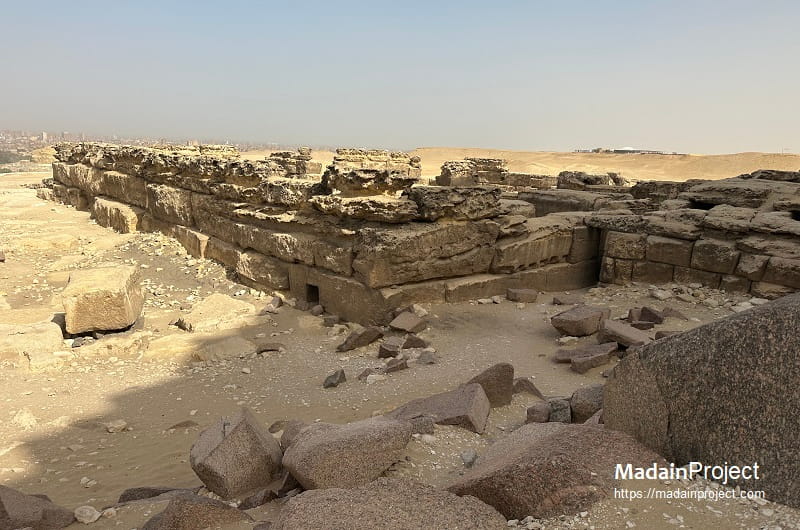
Menkaure's Mortuary Temple
The Mortuary Temple of Menkaure, situated adjacent to the eastern face of the third pyramid at Giza, represents a pivotal transition in Old Kingdom architectural evolution. Constructed during the Fourth Dynasty, the structure is notable for its departure from the traditional use of limestone in favor of massive megalithic granite blocks, some of which remain unfinished, providing critical archaeological insight into ancient construction techniques. The temple’s ground plan includes an open courtyard, a pillared hall, and a sanctuary, reflecting the ritual requirements for the posthumous cult of the pharaoh.
Significantly, while the core was initiated in stone, much of the final enclosure and interior storage chambers were completed in mudbrick by Menkaure’s successor, Shepseskaf, suggesting a hurried completion of the complex following the sovereign's death. Excavations by George Reisner in the early 20th century CE further revealed a sophisticated drainage system and a series of triad statues, which underscore the temple's dual function as a site for both theological veneration and the display of royal authority.
circa 1860–1814 BCE

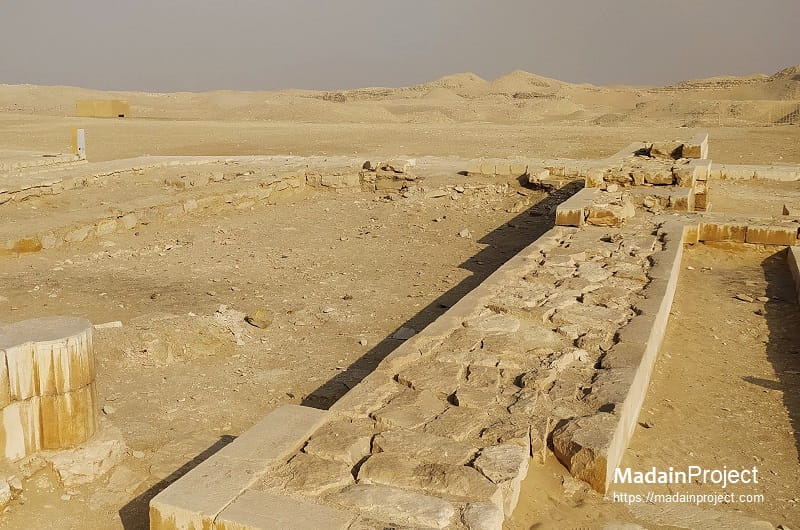
Hawara Mortuary Temple
The Hawara Mortuary Temple, constructed during the reign of Pharaoh Amenemhat III of the Twelfth Dynasty (circa 1860–1814 BCE), is situated in the Faiyum region of Middle Egypt, adjacent to the pyramid at Hawara. This temple exemplifies the Middle Kingdom’s architectural innovations and ritual developments, reflecting both continuity with earlier Old Kingdom traditions and experimentation in monumental funerary design. The temple is particularly notable for its complex interior layout, which has earned it the historical designation as the “Labyrinth” by ancient Greek historians such as Herodotus and Strabo, who described an intricate arrangement of courts, halls, and chambers.
The temple was constructed predominantly from mudbrick, with dressed limestone employed for critical structural and ceremonial elements, including the sanctuary and cult areas. Archaeological evidence indicates that the complex incorporated a series of corridors, hypostyle halls, and open courts, designed to accommodate ritual procession, offerings, and the performance of mortuary cult activities. Reliefs and inscriptions within the temple recorded the king’s divine authority, religious devotion, and administrative achievements, though much of this decoration has been lost or eroded over time. The integration of the temple with the pyramid and the surrounding causeways underscores the Middle Kingdom focus on creating a unified funerary landscape that reinforced the pharaoh’s enduring presence and power.

Signup for our monthly newsletter / online magazine.
No spam, we promise.

The Madain Project is an online archive of Abrahamic History and Archaeology.
Abrahamic History & Archaeology is the study of history and archaeology with respect to the three Abrahamic Faiths without considering the religious and theological aspects. The goal of Abrahamic History is to understand how and why the religious doctrines and behaviours have evlovled and changed over time. Searching for patterns in the evolution of significant cultural events such as the development of farming, the emergence of cities, or the collapse of major civilizations for clues of why and how these have influenced the three major Abrahamic religions.
Cloud Drive -
About -
Help -
Editorial Policy -
AI Policy -
Privacy Policy -
Contact
Madain Project: Encyclopedia of Abrahamic History & Archaeology.
Copyright MadainProject 2017 - 2026.


