
The Mansion of Millions of Years (Egyptian: ḥwt-nt-ḥḥ-m-rnpwt), or simply the House of Millions of Years, represents a specialized evolution of the mortuary temple archetype, primarily localized to the Theban West Bank. Unlike the pyramid temples of the Old Kingdom, which were structurally annexed to the royal pyramid or tomb, these sanctuaries were physically autonomous and situated away from the hidden rock-cut tombs in the Valley of the Kings. This spatial decoupling allowed the temple to function as a public-facing monument for the king’s state cult, while the burial remained protected. Theologically, these "Mansions" were not merely dedicated to the deceased monarch; they served as a syncretic locus where the living and deceased King was fused with the state deity, typically Amun-Ra, effectively manifesting the Pharaoh’s divine essence as an eternal, god-like entity.
Architecturally, the Mansion of Millions of Years adopted the pylon-and-court layout characteristic of New Kingdom state temples, often featuring monumental colossal statuary and extensive relief cycles depicting the King’s military triumphs and ritual piety. These structures, such as the Ramesseum of Ramesses II or the temple of Ramesses III at Medinet Habu, also functioned as significant economic hubs, housing vast granaries, administrative offices, and workshops. While the pyramid mortuary temple focused on the intimate maintenance of the king’s ka, the Mansion of Millions of Years served a broader nationalistic and solar purpose, acting as the terminal destination for the Beautiful Festival of the Valley, during which the cult statue of Amun crossed the Nile to visit the royal sanctuaries.
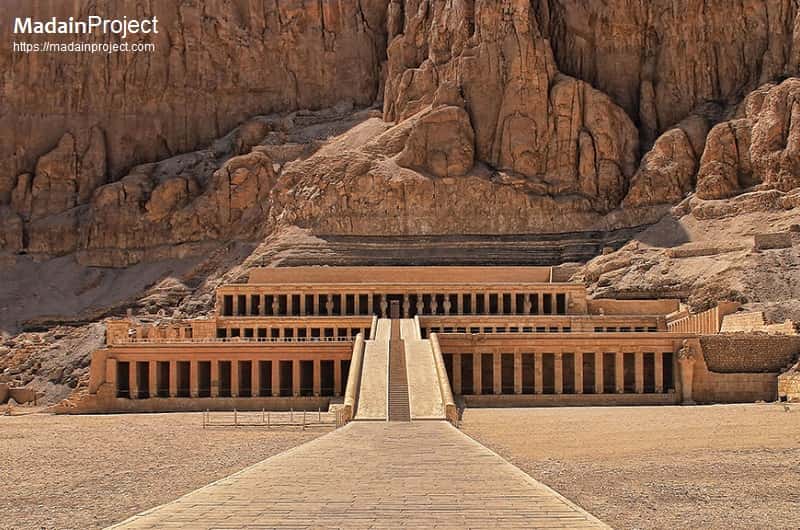
circa 2061–2010 BCE
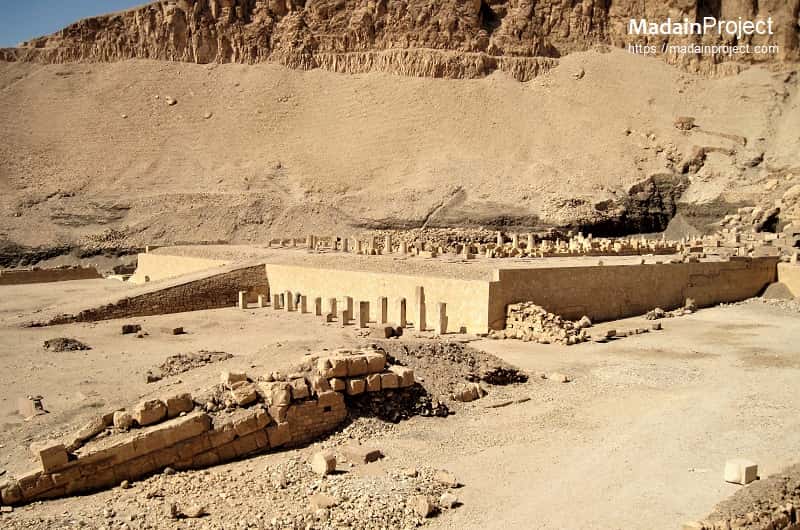
Mortuary Temple Mentuhotep II
The mortuary temple of Mentuhotep II, located at Deir el-Bahari on the west bank of the Nile near ancient Thebes, represents a seminal innovation in the evolution of Egyptian funerary architecture. Constructed during the Eleventh Dynasty (circa 2055–2004 BCE), this temple commemorates Pharaoh Mentuhotep II, the ruler credited with reunifying Egypt at the close of the First Intermediate Period. The complex reflects both continuity with Old Kingdom funerary traditions and the emergence of architectural experimentation that would influence New Kingdom mortuary constructions.
The temple is distinguished by its integration into the natural cliff face, creating a terraced arrangement that harmonizes with the surrounding landscape. The design comprises a series of terraces connected by ramps, leading to a central sanctuary and hypostyle hall. The terraces were adorned with colonnades and porticoes, while the sanctuary housed the cult statue of the king, symbolically linking him with the deity Amun and affirming his divine kingship. Surrounding the temple were courts and subsidiary chapels, which facilitated ritual activities, including offerings to sustain the pharaoh’s ka.
Architecturally, the mortuary temple of Mentuhotep II marked a departure from the flat, enclosure-oriented designs of Old Kingdom pyramidal complexes. The use of multiple levels, enclosed courts, and axial progression created a dynamic spatial experience that emphasized both ritual procession and visual impact. Extensive relief decoration on the temple walls depicted the pharaoh’s military triumphs, religious ceremonies, and divine interactions, reinforcing the ideological narrative of a ruler sanctioned by the gods.
The mortuary temple’s significance lies not only in its role as a site for funerary cult but also in its influence on subsequent Theban mortuary architecture, notably inspiring the terraced colonnaded design of Hatshepsut’s temple at Deir el-Bahari in the Eighteenth Dynasty. Functionally, the temple served as the locus for the pharaoh’s mortuary cult, providing space for daily offerings, festival observances, and the perpetuation of royal ideology, thereby ensuring Mentuhotep II’s continued presence within the religious and political landscape of ancient Egypt.
circa 1479–1425 BCE
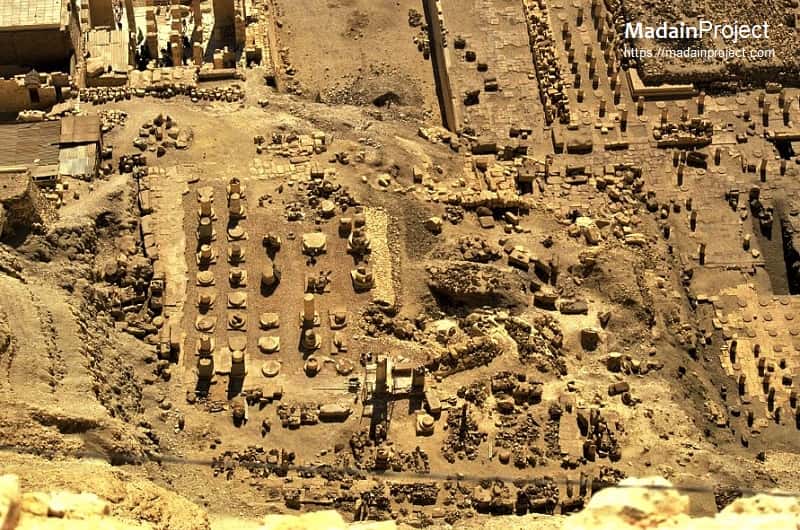
Mortuary Temple of Thutmose III
The mortuary temple of Thutmose III, located on the west bank of the Nile at Thebes near the later site of Deir el-Bahari, represents a pivotal development in New Kingdom funerary architecture. Constructed during the Eighteenth Dynasty (circa 1479–1425 BCE), the temple reflects both the consolidation of royal authority following Thutmose III’s military campaigns and the emergence of highly formalized ceremonial spaces designed to accommodate large-scale cultic activities. Unlike the compact and enclosed designs of earlier Old Kingdom temples, this structure integrated monumental pylons, extensive open courts, and a series of axial halls, creating a linear progression that emphasized ritual movement and visual impact.
Archaeological evidence indicates that the temple was constructed using limestone with finer sandstone detailing in the sanctuary areas, consistent with the period’s architectural practices. Relief decoration on walls and pylons depicted Thutmose III in dynamic interaction with major Egyptian deities, most prominently Amun-Ra, highlighting both the king’s martial achievements and his divine legitimacy. Notably, the temple included multiple chapels and subsidiary shrines dedicated to associated gods, suggesting a broader ritual program than seen in earlier mortuary complexes. The design facilitated large public festivals, such as the Opet and Sed ceremonies, which reinforced the pharaoh’s role as mediator between the divine and human realms. The mortuary temple of Thutmose III influenced subsequent Theban temple design, establishing conventions of monumental procession, hierarchical spatial organization, and the integration of divine iconography that would persist throughout the New Kingdom.
circa 1479–1458 BCE
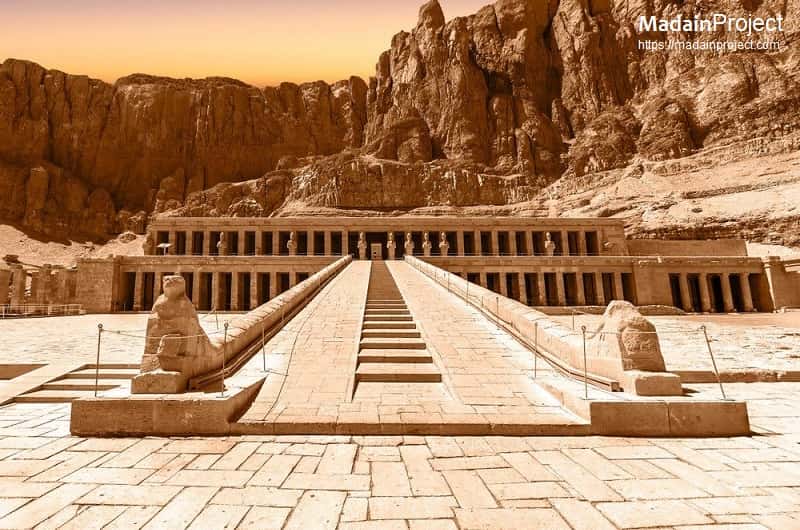
Mortuary Temple of Hatshepsut
The Mortuary Temple of Hatshepsut at Deir el-Bahari stands as a hallmark of New Kingdom architectural innovation and royal ideology. Constructed during the reign of Pharaoh Hatshepsut (circa 1479–1458 BCE) of the Eighteenth Dynasty, the temple occupies a dramatic natural setting, nestled against the limestone cliffs of the Theban necropolis. Its terraced design, connected by wide ramps, reflects a deliberate integration of monumental architecture with the surrounding landscape, creating a visual and symbolic dialogue between the natural world and the divine order the pharaoh embodied.
Hatshepsut’s temple departs from earlier mortuary complexes by emphasizing symmetry, proportion, and the ceremonial procession of spaces. The structure consists of three ascending terraces linked by ramps, each lined with colonnades and porticoes that lead the visitor toward the central sanctuary. The temple’s reliefs are especially noteworthy, depicting Hatshepsut’s divine birth, her expedition to the Land of Punt, and ritual interactions with deities such as Amun and Hathor. These images functioned not merely as decoration but as an assertion of the pharaoh’s legitimacy and her role as an intermediary between the gods and human subjects.
Beyond its visual grandeur, the temple served as a hub for the mortuary cult, where priests maintained the daily rituals and offerings essential for the perpetuation of Hatshepsut’s ka. Courtyards and chapels accommodated specific ceremonies, while carefully aligned sightlines and axial pathways orchestrated the movement of participants during festival processions. The temple’s combination of monumental terraces, sculptural programs, and functional ritual spaces created a comprehensive environment in which royal ideology, religious devotion, and ceremonial performance were inseparable.
circa 1386–1349 BCE
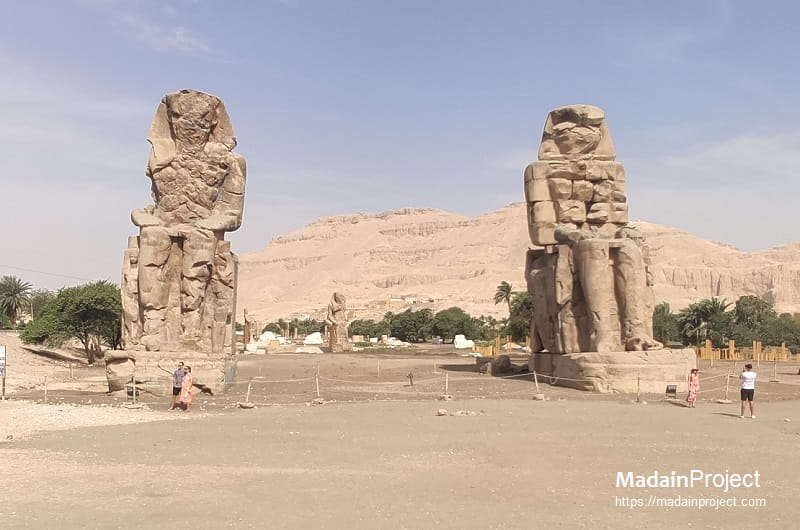
Mortuary Temple of Amenhotep III
The Mortuary Temple of Amenhotep III, located on the west bank of the river Nile at ancient Thebes, represents one of the most ambitious and monumental constructions of the Eighteenth Dynasty (circa 1390–1353 BCE). Known primarily through extensive archaeological reconstruction and the remnants of colossal statues, the temple was conceived as both a cultic center and a demonstration of the pharaoh’s unparalleled political and religious authority. The complex originally extended over an enormous area, incorporating vast courtyards, towering pylons, colonnaded halls, and sanctuaries dedicated to Amun and other state deities. Its sheer scale made it one of the largest mortuary temples in Egyptian history, rivaling and even surpassing many predecessors in spatial and symbolic complexity.
Amenhotep III’s temple is particularly notable for the integration of monumental statuary into its design. Colossal seated statues of the king (commonly known as the colossi of Memnon), some reaching over eight meters in height, flanked the entrance pylons and lined the central avenues, projecting royal power to both participants in ritual and observers from the valley below. The temple walls and pylons were covered with reliefs and inscriptions depicting the pharaoh’s achievements, religious festivals, and interactions with gods, serving simultaneously as devotional imagery and instruments of political messaging. The use of artificially elevated platforms, long processional avenues, and axial alignment with nearby river access points exemplified an advanced understanding of ceremonial choreography, allowing large-scale rituals to be conducted with dramatic visual impact.
The Mortuary Temple of Amenhotep III operated as a center for the royal cult, supporting daily offerings, festival ceremonies, and cultic observances that reinforced the king’s presence beyond death. The architectural arrangement facilitated movement through sequential ceremonial spaces, from vast open courts for public gatherings to enclosed sanctuaries for intimate ritual performance. Water installations, such as sacred pools and channels, were incorporated to symbolize renewal and purification, aligning with the pharaoh’s role as guarantor of cosmic order.
The significance of Amenhotep III’s temple extends beyond its function as a mortuary site. Its design, monumental scale, and integration of statuary and ceremonial space established a template for subsequent New Kingdom mortuary complexes, particularly those of Ramesses the Great. The temple stands as a testament to the Eighteenth Dynasty’s emphasis on royal grandeur, religious innovation, and the orchestration of architecture as a medium for ideological and cultic expression.
circa 1290-1279 BCE

Mortuary Temple of Seti I
The Mortuary Temple of Seti I, situated within the Theban necropolis at Qurna on the west bank of the Nile, represents a major achievement of the Nineteenth Dynasty during the late New Kingdom period (circa 1290–1279 BCE). Constructed under Seti I and completed with additions by his son Ramesses II, the temple exemplifies the apex of Egyptian religious architecture in its integration of ceremonial space, monumental sculpture, and elaborately inscribed decoration. Unlike earlier mortuary temples, Seti I’s complex exhibits a pronounced emphasis on interior ritual spaces and processional corridors, reflecting the pharaoh’s intent to consolidate both religious authority and dynastic prestige.
The temple’s architectural plan is characterized by a series of interconnected halls, chapels, and open courts arranged along a central axis, leading to a sanctum dedicated to the king and major Egyptian deities, notably Osiris, Amun-Ra, and Hathor. The walls are richly adorned with high-quality bas-reliefs and hieroglyphic inscriptions depicting Seti I performing rituals, offering to gods, and participating in funerary rites, thereby reinforcing his divine legitimacy. A distinctive feature of this temple is its extensive use of stone columns, precisely aligned to create a rhythm of light and shadow that enhanced the ceremonial ambiance. The temple also contained subsidiary shrines and chapels dedicated to members of the royal family, integrating dynastic ideology directly into the sacred architecture.
circa 1279-1213 BCE

Ramesseum (Mortuary Temple of Ramesses II)
The Ramesseum, the mortuary temple of Pharaoh Ramesses II, is situated on the west bank of the Nile at Thebes and represents one of the most monumental and ambitious royal funerary complexes of the Nineteenth Dynasty (circa 1279–1213 BCE). Constructed to commemorate the reign of Ramesses II and ensure the perpetuation of his mortuary cult, the temple exemplifies the New Kingdom’s emphasis on scale, ceremonial drama, and the integration of monumental sculpture with architectural design. The complex served simultaneously as a religious center, a site of dynastic propaganda, and a visual testament to the pharaoh’s political and military achievements.
The architectural layout of the Ramesseum is characterized by a large pylon entrance leading to expansive open courts, colonnaded halls, and inner sanctuaries aligned along a central axis. The temple’s walls and pylons were adorned with colossal reliefs depicting Ramesses II in divine company, scenes of the Battle of Kadesh, and ritual activities celebrating his association with gods such as Amun-Ra, Ptah, and Osiris. Among its most striking features was the massive seated statue of Ramesses II (commonly known as the Ozymandias Colossus), originally over 19 meters high, which dominated the first court and conveyed the pharaoh’s unparalleled authority. The combination of colossal statuary, monumental gateways, and intricately inscribed reliefs created a ceremonial environment designed to awe visitors and participants alike.
circa 1213-1203 BCE
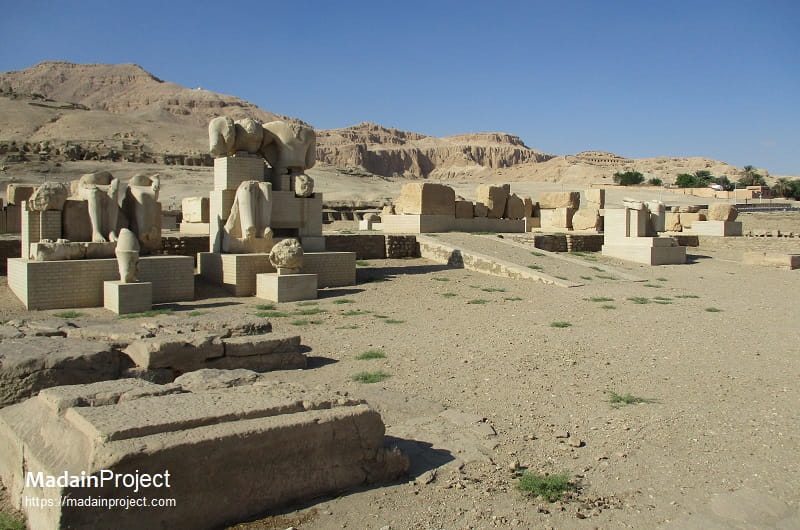
Mortuary Temple of Merneptah
The Mortuary Temple of Merneptah, situated on the West Bank of the Nile at Thebes, represents a significant architectural transition in the New Kingdom’s funerary tradition, specifically within the Nineteenth Dynasty. Often characterized by its extensive reuse of materials—primarily sourced from the nearby funerary complex of Amenhotep III—the temple served as the cultic center for the king’s mortuary worship and the veneration of the god Amun-Ra. Archaeologically, the site is most renowned for the discovery of the Merneptah Stele (or "Israel Stele") within its precincts, a monumental inscription that provides the earliest known extra-biblical reference to a people named "Israel" and offers critical insights into the geopolitical landscape of the late 13th century BCE.
The temple is a primary example of royal spoliation; Merneptah utilized the masonry, statuary, and foundations of Amenhotep III’s collapsed structures, a practice interpreted by modern scholars less as an act of iconoclasm and more as a pragmatic and symbolic continuity of sacred space.
The complex follows a standard New Kingdom template, featuring two successive courtyards, a hypostyle hall, and a tripartite sanctuary. However, its proximity to the Ramesseum suggests an intentional architectural dialogue with the legacy of his father, Ramesses II.
Beyond its funerary role, the temple functioned as a station for the Beautiful Festival of the Valley, reinforcing the king's legitimacy through his eternal participation in the Theban ritual cycle.
The meticulous excavation and subsequent restoration of the site by the Swiss Institute for Architectural and Archaeological Research have clarified the temple's stratigraphy, revealing how Merneptah adapted the grand scale of the 18th Dynasty to the specific theological and economic constraints of his own reign.
Signup for our monthly newsletter / online magazine.
No spam, we promise.

The Madain Project is an online archive of Abrahamic History and Archaeology.
Abrahamic History & Archaeology is the study of history and archaeology with respect to the three Abrahamic Faiths without considering the religious and theological aspects. The goal of Abrahamic History is to understand how and why the religious doctrines and behaviours have evlovled and changed over time. Searching for patterns in the evolution of significant cultural events such as the development of farming, the emergence of cities, or the collapse of major civilizations for clues of why and how these have influenced the three major Abrahamic religions.
Cloud Drive -
About -
Help -
Editorial Policy -
AI Policy -
Privacy Policy -
Contact
Madain Project: Encyclopedia of Abrahamic History & Archaeology.
Copyright MadainProject 2017 - 2026.


