
The Pyramid Complex of Menkaure is the funerary assemblage built for the Fourth Dynasty pharaoh Menkaure (reigned circa 2532–2503 BCE) on the Giza Pyramid Complex. As the third and smallest of the principal pyramids at Giza, the complex comprises the king’s pyramid, an associated mortuary temple, a long causeway extending toward a now largely buried valley temple, and three smaller subordinate pyramids commonly interpreted as pyramids of queens. It embodies the canonical Old Kingdom arrangement of royal tomb and cultic structures integrated along an axial processional route and reflects both the continuation and regional adaptation of pyramid‑complex design established earlier in the century.
Positioned on the southwestern periphery of the Giza plateau, the Pyramid Complex of Menkaure occupies a constrained topographical niche south of the larger pyramids of Khufu and Khafre. The relative reduction in scale of Menkaure’s pyramid—originally about 65 meters in height with a base roughly 102 × 104 metres—has been attributed to spatial limitations on the plateau and a deliberate architectural program that made prominent use of harder stone materials, including pink and red granite for casing and architectural features in the lower courses.
Archaeological investigation of the complex spans multiple centuries, with early documentation by nineteenth‑century CE explorers later supplemented by systematic excavations in the early twentieth century CE by teams associated with Harvard University and the Museum of Fine Arts, Boston. These efforts revealed much of the mortuary temple foundations, ancillary structures, and sculptural program, including statues and fragments now dispersed in museum collections, and provided insight into the adaptive construction history and cultic functioning of the complex following Menkaure’s death, which appears to have interrupted the finishing stages of both the pyramid casing and associated temple buildings.
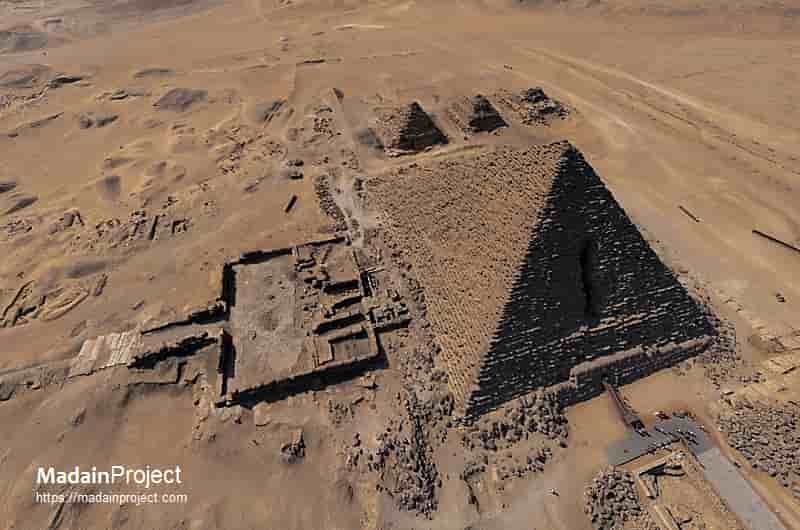
Circa 2532–Modern Period

As the son of Khafre and grandson of Khufu, Menkaure commissioned a complex that, while smaller in scale than those of his predecessors, introduced significant architectural and material innovations.
The pyramid originally rose to approximately 65.5 metres (215 feet) with a base of roughly 102.2 by 104.6 metres. Its construction progressed in distinct phases, involving a core of local limestone and a unique dual-material casing: the lower 16 courses were sheathed in red Aswan granite, while the upper portion was finished with fine white Tura limestone. Archaeological evidence suggests the internal substructure underwent three design changes, eventually resulting in a burial chamber lined with massive granite blocks and a vaulted ceiling.
Menkaure’s death appears to have occurred before the complex's completion, leaving several elements in an unfinished state, such as the unsmoothed granite casing blocks near the entrance. His successor, Shepseskaf, completed the mortuary temple and valley temple using more economical mudbrick over the original limestone and granite foundations. Inscriptions found within the mortuary temple explicitly state that Shepseskaf "made it as his monument for his father".
The tomb was likely robbed as early as the First Intermediate Period. The later history of the complex is marked by both restoration and attempted destruction. During the Saite Period (Twenty-sixth Dynasty), the pyramid underwent a restoration effort, evidenced by the discovery of an intrusive wooden coffin bearing Menkaure’s name, though radiocarbon dating confirms it was a Saite-era replacement. In 1196 CE, al-Aziz Uthman, the Ayyubid Sultan of Egypt, initiated a systematic attempt to dismantle the pyramid; however, after eight months of labor, the effort was abandoned, leaving the prominent vertical gash visible on the north face today.
In 1837 CE, Howard Vyse discovered a wooden anthropoid coffin bearing Menkaure's name, though radiocarbon dating later identified the remains as a Saite period (circa 600 BCE) replacement.
An original basalt sarcophagus, elaborately carved with a "palace facade" design, was discovered by Vyse but was lost at sea in 1838 CE when the ship Beatrice sank off the coast of Spain while transporting it to England. During the 1906–1910 CE excavations led by George Reisner, the Valley Temple yielded a significant corpus of Egyptian statuary, including the iconic schist "triads" and the "King and Queen" dyad, which provide the primary iconographic record for this reign.
Circa 2532–2503 BCE
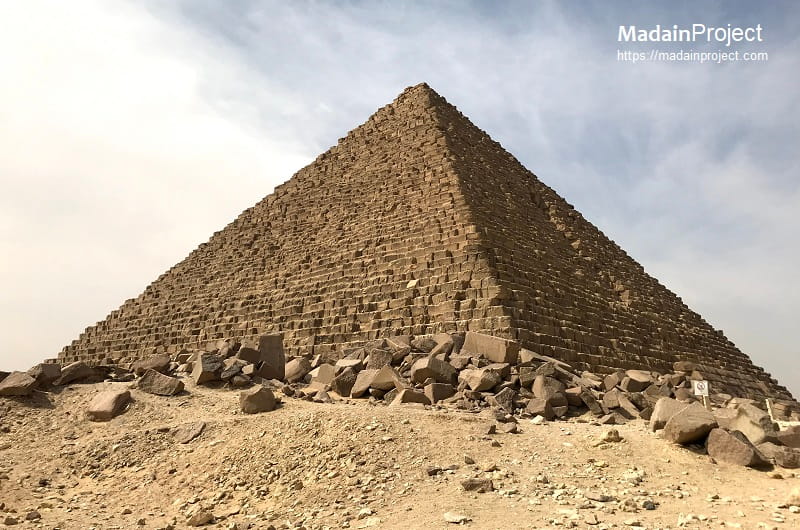
Menkaure's Pyramid
The Pyramid of Menkaure, known in antiquity as Netjer‑er‑Menkaure (“Menkaure is divine”), is the third and smallest of the major Giza pyramids, constructed as the pharaoh’s tomb during the Fourth Dynasty. Its original dimensions—approximately 65.5 meters in height with a base about 102 meters on a side—produce a relatively modest volume compared with its neighbours yet demonstrate careful geometric planning, with a slope angle of approximately 51°20′25″. The core masonry consists of local limestone blocks, while the lower courses of casing were clad in granite quarried at Aswan; higher casing likely employed fine limestone, although significant portions of both were left unfinished at the king’s death and have since been lost to erosion and stone robbing.
Internally, the pyramid follows the traditional Old Kingdom burial sequence. A descending corridor on the north face leads to a series of chambers, including an antechamber and a main burial chamber originally housing a massive stone sarcophagus, often described as basalt or granite, which was lost in transit to Europe in the nineteenth century CE, with a secondary wooden coffin discovered in situ at a later date. The interior spaces are lined with dressed stone, and the design adheres closely to the established typology of royal pyramids, albeit on a smaller scale, with limited decorative relief or inscription.
Circa 2532–2503 BCE
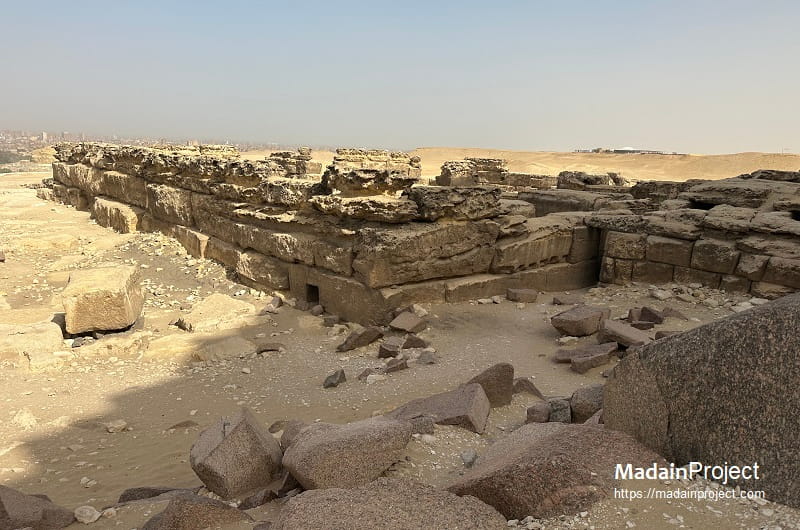
Mortuary Temple
The mortuary temple, also called the "pyramid temple"; attached to the eastern base of Menkaure’s pyramid served as the locus of the funerary cult, where priests conducted daily rituals and offerings to sustain the pharaoh’s ka in perpetuity. The architectural remains, primarily foundations and core masonry, indicate a layout featuring an entrance hall, courtyards, and subsidiary chambers for storerooms and ritual activity, though overall execution was less monumental than earlier Fourth Dynasty precedents, reflecting possible interruption of construction upon Menkaure’s death. Some surviving evidence, including red paint markings on core blocks and the presence of fine stone blocks that were never fully dressed or installed, suggests that the original design envisaged greater use of granite and limestone, with subsequent completion in mudbrick by his successor.
Circa 2532–2503 BCE
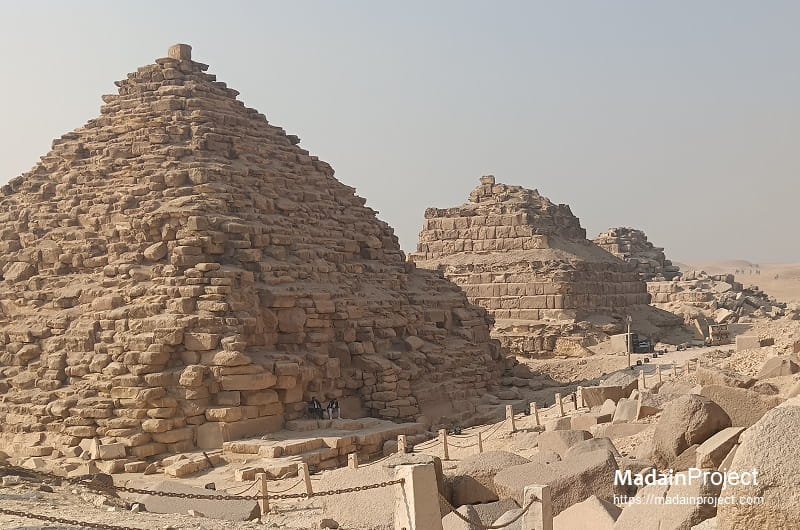
Queens' Pyramids
South of the main pyramid are three smaller pyramids designated G3‑a, G3‑b, and G3‑c. These structures form a subsidiary group typically interpreted as queens’ pyramids, likely intended as tombs for consorts or close royal relatives of Menkaure. G3‑a—the easternmost and largest—was more fully developed and featured partial granite casing and a pyramidion fragment, while G3‑b and G3‑c remain largely core structures with minimal casing and evidence of limited internal architecture. Scholarly debate persists regarding the exact function of G3‑a, with some proposing that it may have served as a ka pyramid—a symbolic abode for the king’s ka—before possible reuse as a queen’s burial; others maintain that all three were intended as tombs, as indicated by sarcophagi and funerary fittings found within or near them.
Circa 2532–2503 BCE
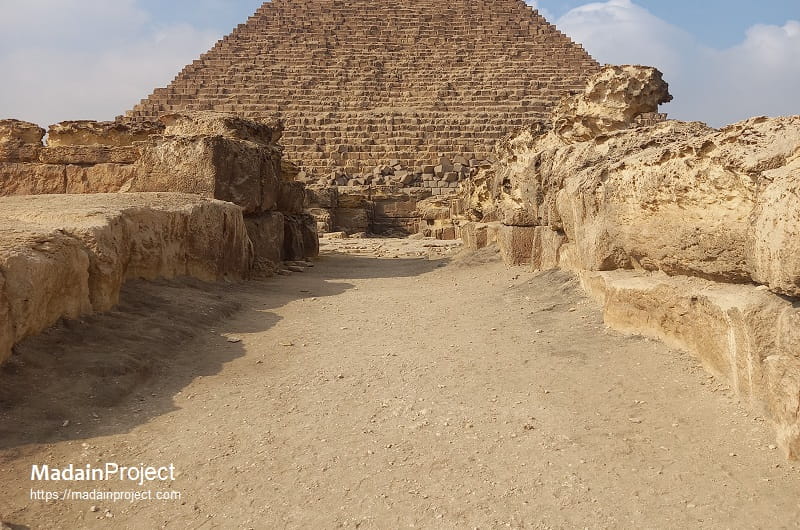
Causeway
Linking the valley temple near the ancient edge of the Nile floodplain to the mortuary temple, the causeway of Menkaure’s complex constituted the ceremonial processional route central to Old Kingdom funerary practice. Although much of its length is now buried beneath sand and subject to only fragmentary exposure, historical accounts indicate that it was constructed chiefly of mudbrick with stone paving at points and was aligned to the east‑west axis connecting the residential riverine landscape to the desert necropolis. The causeway facilitated the transportation of the king’s body from the valley temple to the mortuary temple and structured ritual movement integral to the funerary cult, in keeping with the broader typological pattern of all the pyramid complexes in Giza.

Signup for our monthly newsletter / online magazine.
No spam, we promise.

The Madain Project is an online archive of Abrahamic History and Archaeology.
Abrahamic History & Archaeology is the study of history and archaeology with respect to the three Abrahamic Faiths without considering the religious and theological aspects. The goal of Abrahamic History is to understand how and why the religious doctrines and behaviours have evlovled and changed over time. Searching for patterns in the evolution of significant cultural events such as the development of farming, the emergence of cities, or the collapse of major civilizations for clues of why and how these have influenced the three major Abrahamic religions.
Cloud Drive -
About -
Help -
Editorial Policy -
AI Policy -
Privacy Policy -
Contact
Madain Project: Encyclopedia of Abrahamic History & Archaeology.
Copyright MadainProject 2017 - 2026.


