
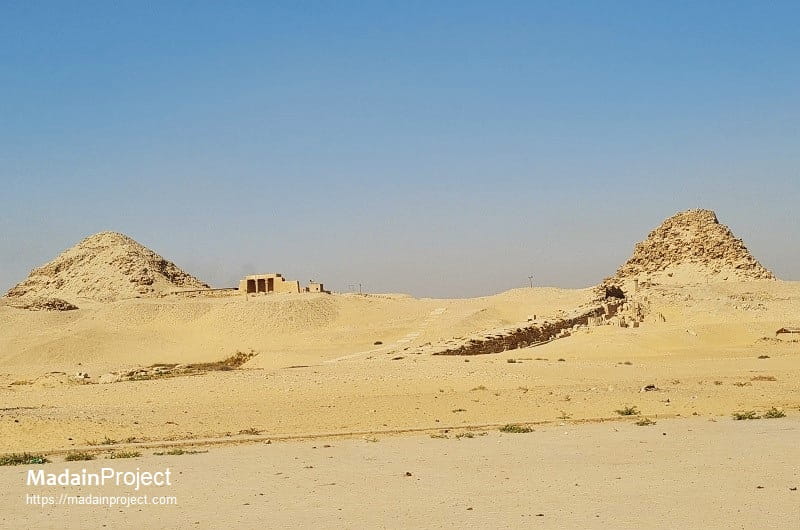
The funerary complex, or pyramid complex, of Sahure is a royal mortuary installation of the Egyptian Old Kingdom, constructed circa 2487–2475 BCE during the Fifth Dynasty at Abusir, within the broader context of the Early Bronze Age in the ancient Near East. It comprises a ppyramid, mortuary temple, causeway, valley temple, and associated storage and administrative facilities, forming an integrated architectural and ritual landscape dedicated to the king’s mortuary cult.
The complex is located on the desert plateau at Abusir, north of Saqqara necropolis and south of Giza. It reflects a transition in royal funerary architecture from the Fourth to the Fifth Dynasty, characterized by reduced pyramid scale and increased emphasis on elaborately decorated temple spaces, situating the complex within the Early Bronze Age of the ancient Near East. The core pyramid was constructed of local limestone blocks arranged in accretion layers, with a fine white limestone casing from Tura. The mortuary temple is especially notable for its extensive relief decoration depicting royal expeditions, tribute scenes, and ritual activities. The complex was connected to a valley temple (now largely destroyed) via a covered causeway aligned east–west, facilitating processional movement from the Nile floodplain to the pyramid plateau.
Sahure was the second ruler of the Fifth Dynasty, succeeding Userkaf. His reign is generally dated to circa 2487–2475 BCE. The construction of his funerary complex marks a consolidation of architectural principles first introduced under Userkaf, particularly the separation and functional expansion of the mortuary temple, or more specifically the pyramid mortuary temple. Archaeological investigation began in the early twentieth century under Ludwig Borchardt, who excavated and documented the site between 1902 and 1908 CE. Subsequent studies have refined understanding of the relief program, which provides significant evidence for Fifth Dynasty foreign relations, including expeditions to Punt and maritime activities along the Levantine coast in the interregional exchange networks during Early Bronze Age. The complex remained an active cult center into the later Old Kingdom but fell into decline thereafter.
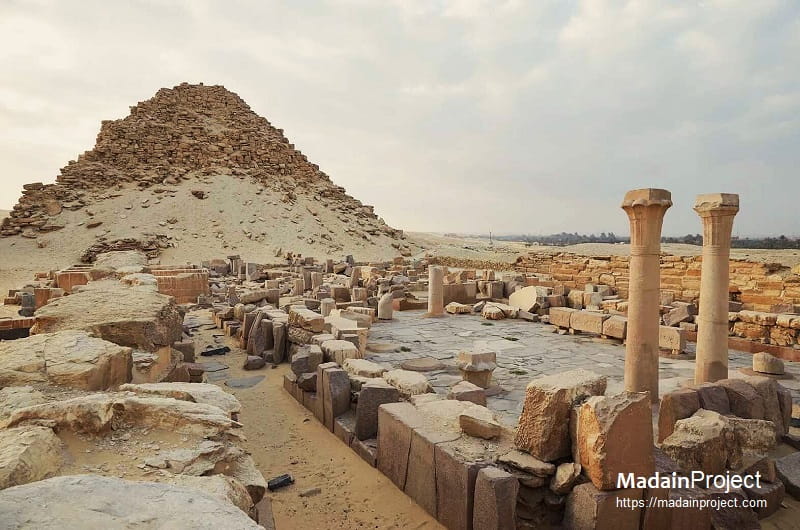
circa 2480–2460 BCE

Pyramid
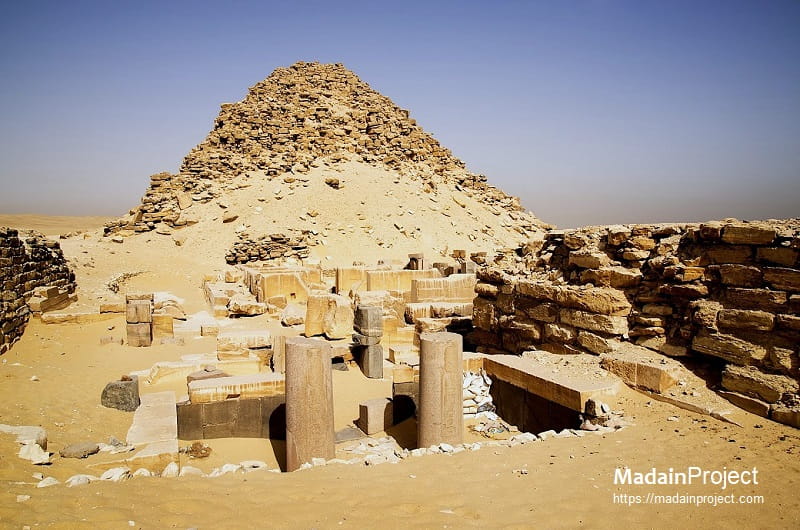
The pyramid of Sahure was constructed with a base length of approximately 78.5 meters and an original height of about 47 meters, with a slope angle of roughly 50° 11′. Its core was built using a system of accretion layers composed of roughly cut local limestone blocks, set around a central axis and filled with limestone debris and mortar. This method, characteristic of Fifth Dynasty construction at Abusir, contrasts with the more solid masonry techniques of earlier Fourth Dynasty pyramids and has contributed to the monument’s substantial structural degradation.
The outer casing consisted of fine white limestone quarried at Tura, carefully dressed and polished to create a smooth exterior surface. Most of this casing was removed in later periods for reuse, exposing the inner core. The pyramid’s substructure was accessed via a descending corridor on the north face, beginning at ground level and leading into a horizontal passage sealed by granite portcullis blocks. This passage opened into an antechamber and subsequently into the burial chamber.
The burial chamber was constructed with a gabled roof formed by large limestone beams arranged in an inverted V-shape to relieve structural pressure. The walls were lined with fine limestone, though no significant decorative program has survived. Remains of a basalt sarcophagus were reportedly found in situ, indicating the original placement of the royal burial. The internal arrangement follows a standardized Old Kingdom plan but demonstrates increasing reliance on less durable building methods.
circa 2480–2460 BCE
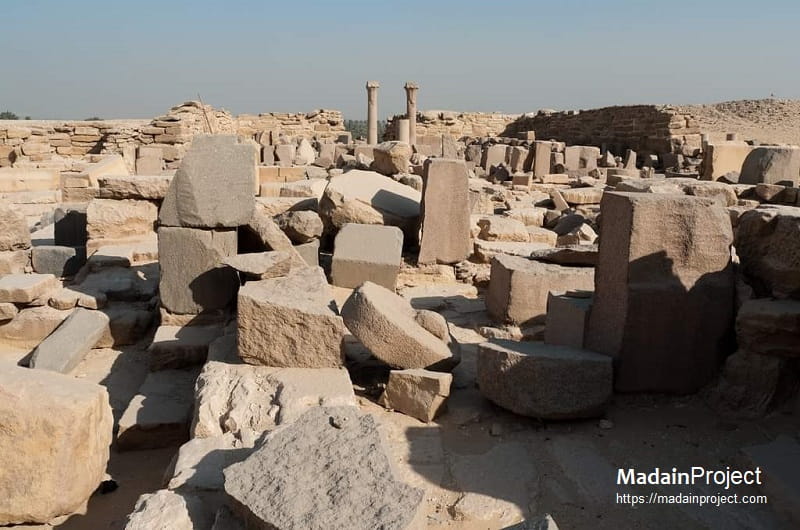
Mortuary Temple
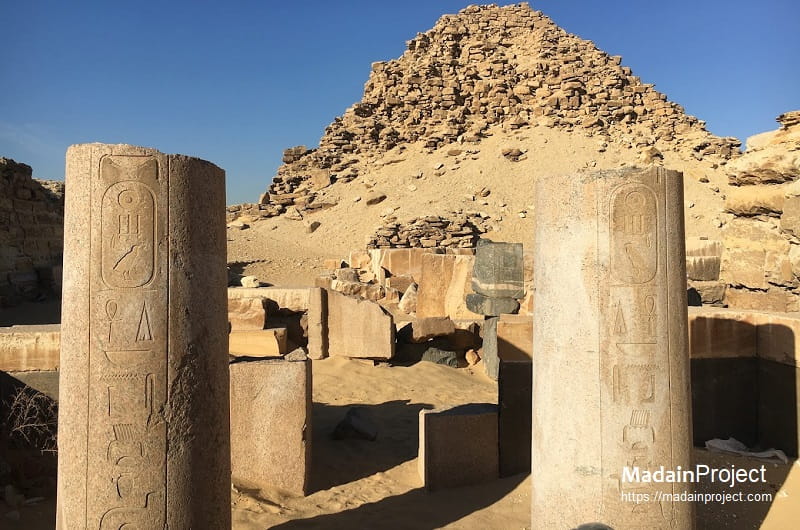
The mortuary temple or more specifically the pyramid mortuary temple is architecturally a sub-type of the cultic mortuary temples. The funerary temple of Sahure, located immediately east of the pyramid, is among the most extensively decorated temple complexes of the Old Kingdom and represents a critical development in royal cult architecture. Constructed primarily of fine limestone, with extensive use of granite for columns, architraves, and flooring elements, the temple was organized along an axial plan oriented east–west.
The entrance from the causeway led into a transverse hall supported by palmiform granite columns, followed by an open courtyard surrounded by colonnades. The courtyard featured a basalt-paved floor and was likely used for ritual purification and offering presentations. Beyond this space lay a series of offering halls, magazines, and a sanctuary area containing a false door and offering altar, which served as the focal point of the king’s mortuary cult.
The walls of the temple were decorated with high-quality raised reliefs, many of which were originally painted. These reliefs depict a wide range of scenes, including royal jubilee rituals, hunting expeditions, agricultural production, and foreign tribute. Particularly significant are the maritime expedition scenes showing ships dispatched to Punt, returning with myrrh trees, incense, ebony, and exotic animals. Additional reliefs depict interactions with Levantine populations, including tribute bearers and possibly captives, providing valuable evidence for Fifth Dynasty foreign relations.
The artistic program is notable for its narrative coherence and detailed representation of daily and ceremonial activities, marking a shift toward more complex iconographic schemes in royal monuments. Fragments recovered during excavations led by Ludwig Borchardt have been instrumental in reconstructing these scenes.
circa 2480–2460 BCE
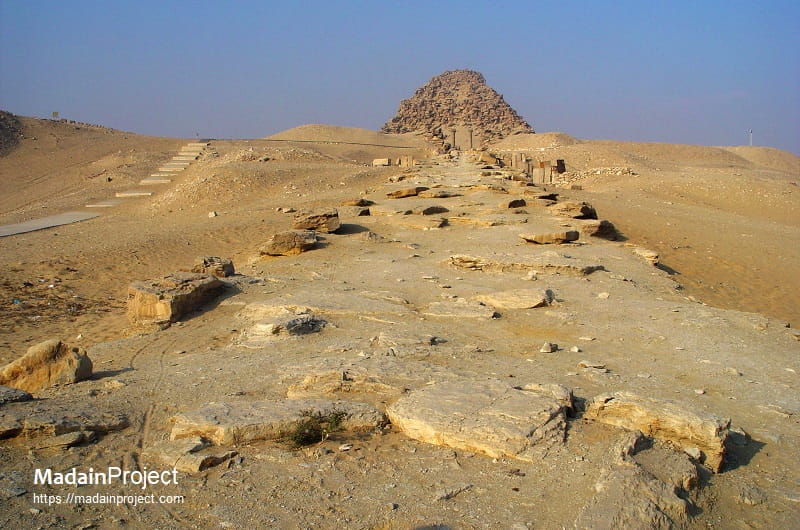
Causeway
The causeway of Sahure extended approximately 235 meters, connecting the valley temple—situated near the Nile floodplain—to the mortuary temple at the pyramid plateau. Constructed of limestone and originally roofed, the causeway functioned as a controlled processional corridor used during funerary rites and for the transport of offerings.
Its interior walls were decorated with painted reliefs, fragments of which indicate a diverse iconographic program. These scenes included processions of offering bearers, representations of agricultural labor such as harvesting and animal husbandry, and symbolic depictions of Egypt’s territorial divisions, often personified as bound figures or tribute bearers. The imagery reinforced the king’s authority over both Upper and Lower Egypt and emphasized the provisioning of the mortuary cult.
The causeway also likely featured clerestory openings or narrow slits to admit limited light, creating a controlled visual environment for ritual movement. Its slight upward incline from east to west symbolically and physically marked the transition from the Nile valley to the desert necropolis. Although the superstructure is largely ruined, the surviving foundation and relief fragments attest to its importance as both a functional and ideological element within the complex.
circa 2480–2460 BCE
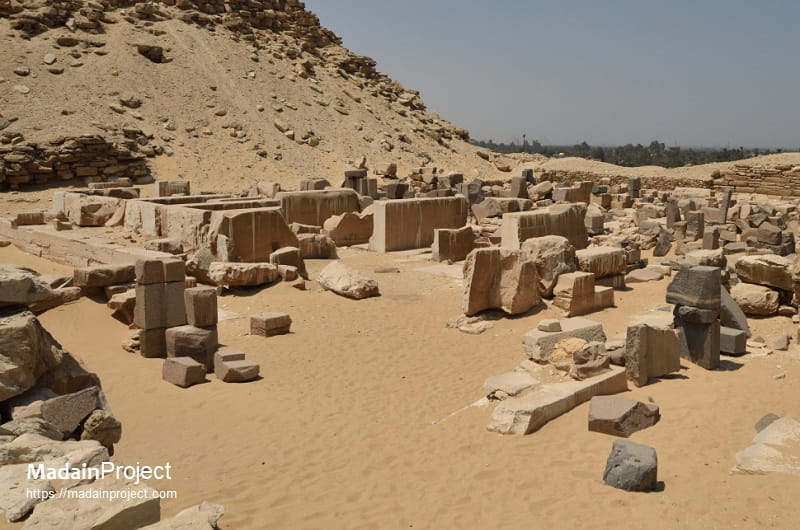
Storage Annexes
The storage annexes associated with Sahure’s mortuary temple formed an extensive complex of magazines and service rooms, reflecting the administrative sophistication of Fifth Dynasty mortuary cults. These annexes were arranged in a series of elongated chambers aligned parallel to the temple’s main axis, constructed primarily of limestone with supplementary use of mudbrick in less formal sections.
The magazines were designed to store a wide range of goods required for the perpetual maintenance of the royal cult, including grain, beer, meat, linen, oils, incense, and ritual equipment. Archaeological evidence, including storage jars, seal impressions, and administrative markings, indicates a highly organized system of inventory and distribution managed by temple personnel.
Access corridors connected the magazines directly to the offering halls, facilitating efficient movement of provisions during daily ritual performances. Some rooms were likely designated for specific categories of goods, while others served as administrative offices for scribes and officials overseeing the cult’s economic operations.
The scale and complexity of these annexes illustrate the institutionalization of the mortuary cult as a long-term economic entity, supported by agricultural estates and labor forces. This system ensured the persistence of ritual activities dedicated to Sahure well beyond his lifetime, embedding the complex within the broader administrative and economic framework of the Old Kingdom state.
circa 2480–2460 BCE

Valley Temple
The Valley Temple of Sahure at Abusir serves as the monumental gateway to the royal funerary complex, representing a sophisticated advancement in Fifth Dynasty hydraulic and ceremonial architecture. Situated at the edge of the cultivation, the structure originally functioned as a harbor, featuring two distinct landing quays: a primary eastern ramp and a secondary southern entrance, each providing access to the temple's internal chambers. The architectural program is characterized by the use of high-quality basalt flooring and monolithic red granite columns, which were carved into the form of date palms—a stylistic hallmark of Sahure’s reign. Internally, the walls were adorned with intricate bas-reliefs depicting the king as a sphinx trampling enemies or receiving the spoils of maritime expeditions, effectively bridging the transition from the secular world to the sacred processional causeway. This structure’s dual-entry system and decorative complexity reflect a highly organized synthesis of functional infrastructure and royal propagandistic iconography.
Signup for our monthly newsletter / online magazine.
No spam, we promise.

The Madain Project is an online archive of Abrahamic History and Archaeology.
Abrahamic History & Archaeology is the study of history and archaeology with respect to the three Abrahamic Faiths without considering the religious and theological aspects. The goal of Abrahamic History is to understand how and why the religious doctrines and behaviours have evlovled and changed over time. Searching for patterns in the evolution of significant cultural events such as the development of farming, the emergence of cities, or the collapse of major civilizations for clues of why and how these have influenced the three major Abrahamic religions.
Cloud Drive -
About -
Help -
Editorial Policy -
AI Policy -
Privacy Policy -
Contact
Madain Project: Encyclopedia of Abrahamic History & Archaeology.
Copyright MadainProject 2017 - 2026.


