
Abu Gorab (أبو غراب), literally meaning 'father of the crows' or 'father of the ravens' also spelled as Abu Gurab, Abu Ghurab) is a small locality and archaeological site from ancient Egypt. It is situated west of Abusir, and north-west of the larger Saqqara Necropolis. Archaeologically it forms part of the much larger Memphite Necropolis.
The archaeological site of Abu Gorab is situated approx 15 kilometers (9.3 miles) south of Cairo, between Saqqarah and Giza, about 1 kilometers (0.62 miles) north of Abusir, on the edge of the desert plateau on the western bank of the river Nile.
Six or seven temples are known to have existed at the archaeological site of Abu Ghurab; from various sources, including, inscriptions in the tombs of magnates and high officials from the fifth Dynasty, as well as papyri from the archives of the Abusir pyramid.
circa

The history of Abu Gorab is defined by its role as the northern gateway to the Memphite necropolis. Located on the edge of the Western Desert between modern-day Giza and Saqqara, this specific plot of land served as a high-ground stage for the religious and political evolution of the Old Kingdom.
The earliest known human activity at Abu Gorab-Abusir area stretches back to the Middle Paleolithic, when hunters first occupied the region. Although it was later inhabited by Neolithic settlers, the site's importance grew long before the sun temples dominated the horizon; just north of the later ruins lies a significant cemetery dating to the First Dynasty (circa 3100–2900 BCE). However, the area reached its peak significance during the Fifth Dynasty, when the founding pharaoh, Userkaf (reign circa 2513–2506 BCE), commissioned the construction of the sun temple Nekhen-Re.
During the 5th Dynasty (circa 2494–2345 BCE) of the Old Kingdom period, Abu Gorab transformed from an empty desert plateau into a specialized ritual hub. Unlike other locations used primarily for burials, this area was selected for its visibility and solar alignment. It became the exclusive site for "Sun Temples", a unique architectural phenomenon where the landscape itself was modified to worship the sun god, Ra. At least six (or according to some scholars seven) solar temples are known to have existed from this period; however, remains of only three (two belonging to pharaohs Nyussere and Userkaf and third has still not been confidently attributed) have survived and excavated.
The location offered an unobstructed view of the horizon. Builders utilized the natural limestone bedrock to elevate massive stone obelisks. The site was linked via causeways to the Nile valley, making it a seasonal center for harvest festivals.
By the New Kingdom, the specific structures at Abu Gorab had fallen into ruin, but the locality retained its "sacred memory". It shifted from a site of state-sponsored construction to a place of pilgrimage and quarrying. Archaeologists found evidence of private individuals leaving small tokens, honoring the site’s ancient "holy" reputation. As the focus of Egyptian power moved to ancient Thebes, the local stone from Abu Gorab was occasionally repurposed for nearby construction projects.
Following the collapse of the Pharaonic state, from the Greco-Roman until the Early Islamic period the location’s identity changed from religious to utilitarian. The area served as a boundary between the fertile Nile silt and the nomadic desert routes. Its elevated position made it a tactical spot for monitoring movement along the western bank of the Nile. Over centuries, the shifting sands of the Sahara partially buried the site, effectively "locking" it in time until the 19th century CE.
In the late 1800s CE, Abu Gorab became a foundational site for modern Egyptology. The locality was first systematically excavated by German teams (Ludwig Borchardt), which shifted the global understanding of Old Kingdom theology. Today, it exists as a protected archaeological zone, serving as a silent witness to the transition between the pyramid-building age and the rise of solar-centric religion.
circa 3150–2890 BCE
Early Dynastic Cemetery
This burial ground reveals that the locality was a vital part of the Memphite landscape during the Early Dynastic Period, serving as a final resting place for the varying "middle ranks" of society—officials, administrators, and specialized artisans who stabilized the newly unified Egypt. Situated north of the Nyuserre's causeway, the site primarily contains the simple, sand-dug pit and stairway tombs of lower-ranking officials, priests, and workers dating to the First Dynasty of the Early Dynastic Period. The cemetery seems to have been planned, containing a varity of tombs including small mastaba burials as well as larger structures with subsidiary burials.
One such example of a larger burial complex at the Abu Ghurab necropolis is the Mastaba XXVI, a mud-brick tomb dating back to the second half of the First Dynasty (circa 2950–2890 BCE). This structure is particularly significant for its associated boat burial, where a wooden vessel was interred within a specialized mud-brick enclosure. The presence of this vessel marks a continuation of an even older ritual practice, echoing the monumental boat graves discovered at Abydos and Tarkhan, which date to the very beginning of the First Dynasty and the preceding Dynasty 0. This reflects an established elite tradition of burying complete wooden boats near their tombs to facilitate the deceased's journey in the afterlife—a custom that originated in the Early Dynastic Period, flourished during the Old Kingdom, and persisted into the Middle Kingdom.
This reflects that the Early Dynastic boat construction techniques and mortuary practices continue up until the eve of the Fourth Dynasty (circa 2494 BCE), when boat-building methods changed significantly, and boat-graves became exclusive to the royal domain. This pivotal shift is seen in Khufu’s Ship, where advanced joinery replaced simpler binding methods and boat-graves became a prestige burial exclusive to the royal domain.
Another unique feature is the ritual internment of equids (donkeys) close to the tombs, which is quite unusual in the general Egyptian archaeological context. Ritual burial of donkeys is a principal practice premairly from the Hyksos period, in the region of Eastern Nile Delta, where the population was also of non-Egyptian origins.
Notable artefacts discovered include ivory labels and cylinder seals bearing the names of early kings like Djer and Den, linking the deceased to the royal administration.
circa 2485–2487 BCE
Userkaf's Sun Temple
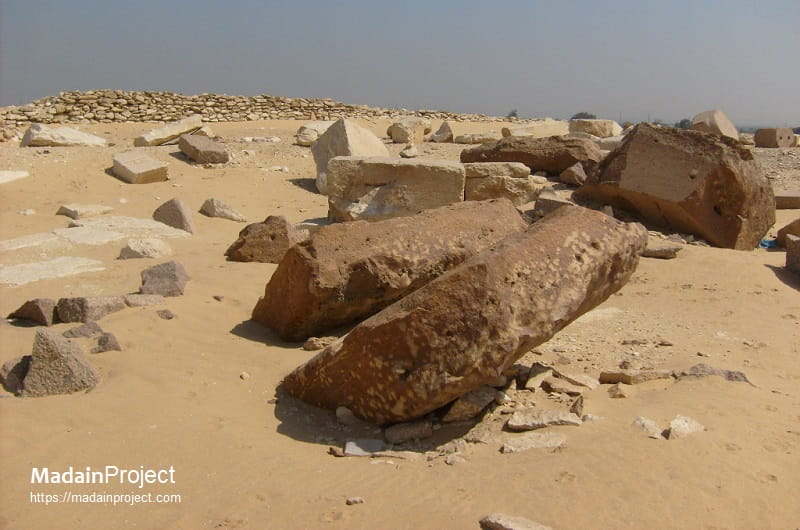
The Sun Temple of pharaoh Userkaf, known in antiquity as Nekhen-Re, represents a pivotal architectural and ideological shift at the inception of the Fifth Dynasty (circa 2494–2487 BCE). Located north of Saqqara, it was the first of six or seven recorded sun temples built during this period, signaling the elevation of the solar cult of Ra to a status nearly equal to that of the sovereign himself. Structurally, the complex departed from traditional funerary layouts by centering on a massive, squat obelisk—a symbolic representation of the benben stone—positioned atop a rectangular podium within an open-air enclosure. This design prioritized solar alignment and ritual offerings to the sun god over the preservation of the royal ka. Archaeological excavations reveal that the temple underwent at least two major construction phases, transitioning from mudbrick to limestone and red granite, reflecting the increasing economic investment in solar theology. The site’s unique lack of a burial chamber and its focus on the slaughterhouse and altar areas underscore its function as a theater for perpetual sacrificial devotion to the solar deity, fundamentally redefining the relationship between the pharaoh and the divine during the Old Kingdom.
circa 2487–2475 BCE
Sun Temple of Sahure
The second solar sanctuary, designated as the Sekhet-Re (Sḫt-Rꜥ) "Field of Re" and commissioned by Sahure, remains archaeologically unlocated. However, several limestone blocks inscribed with the temple's nomenclature were recovered from the structural masonry of Niuserre’s mortuary complex at Abusir. These findings suggest two primary hypotheses: the blocks represented surplus material from the completed structure, or Sahure’s temple remained unfinished, leading to the secondary appropriation of its prepared components. Regardless of its eventual state of completion, the presence of these lithic fragments implies that the original site was situated in close proximity to the Abusir necropolis.
circa 2460–2458 / 2431–2420 BCE
Raneferef's Sun Temple
The sun temple of Raneferef / Neferefre, identified in historical records as "The Offering Table of Ra", has yet to be located within the archaeological record. This absence is likely a consequence of the ephemeral nature of the pharaoh’s reign, which was likely of insufficient duration to permit the completion of such a complex architectural project. Epigraphic evidence for the monument is notably scarce, appearing only once in the inscriptions of the high-ranking official Ti's tomb at Saqqara. This suggests that construction was either terminated prematurely or that the intended site was eventually co-opted and restructured by a subsequent ruler.
In light of these possibilities, the substantial mud-brick foundations discovered by the von Bissing expedition beneath the later sun temple of Niuserre at Abu Ghurab represent a significant area of inquiry. These remains suggest a prior phase of construction that may correlate with Raneferef’s unfinished monument. Consequently, a more rigorous archaeological re-examination of the Abu Ghurab site is necessary to clarify the developmental sequence of Fifth Dynasty sun temples and to definitively establish the fate of Raneferef’s cultic foundation.
circa 2446–2438 BCE
Neferirkare's Sun Temple
The solar sanctuary of Neferirkare, pharaoh of the Fifth Dynasty, identified in ancient texts as the Set-ibre "Place of Re's Pleasure" or the "Favourite Seat of Ra", remains an unrecovered archaeological site. Evidence from contemporary inscriptions suggests this structure was likely the most substantial and largest sun temple erected during the Fifth Dynasty, as it is the most frequently documented monument of its class in the epigraphic record.
circa 2458–2422 BCE
Sun Temple of Nyuserre Ini
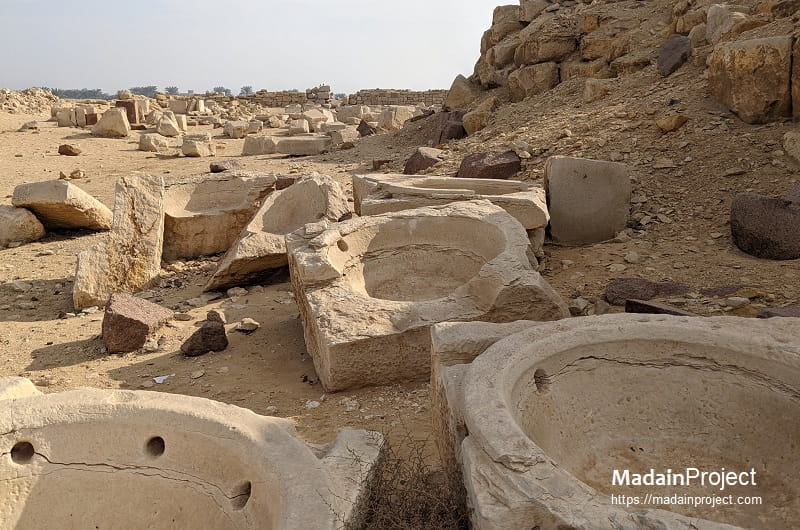
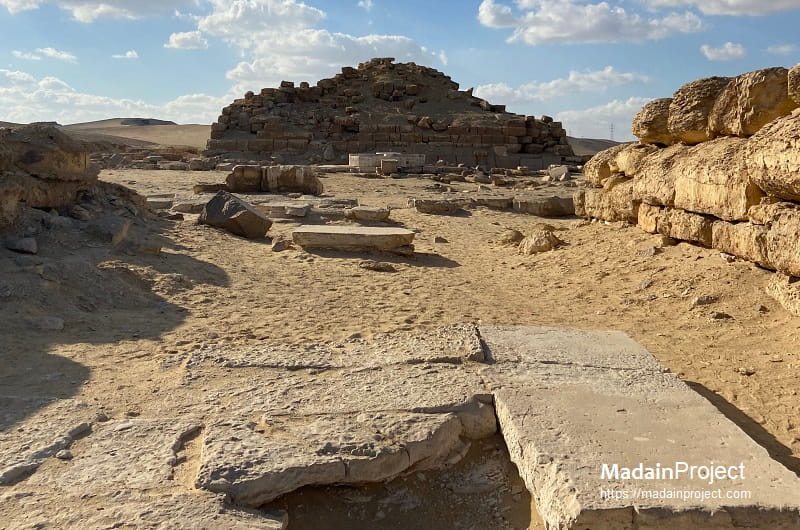
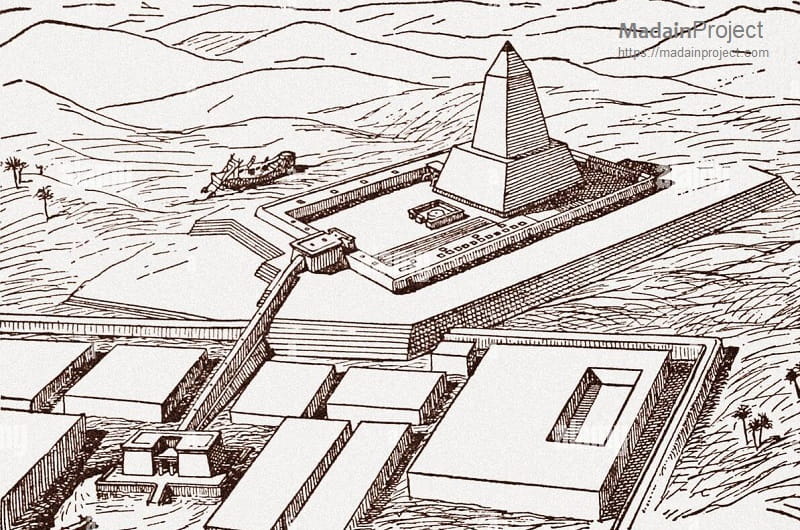
The Sun Temple of Nyuserre Ini, Shesep-ib-Re ("Joy of the Heart of Ra"), represents the most evolved and best-preserved example of solar architecture from the Fifth Dynasty (circa 2445–2421 BCE). The complex was constructed primarily of limestone and red granite, featuring a standard layout of a valley temple connected by a causeway to a larger upper enclosure. The temple’s focal point was a massive, non-monolithic obelisk—standing approximately 36 meters high—seated upon a 20-meter truncated pedestal. A critical liturgical element within the courtyard is the monumental alabaster altar, composed of four hetep-shaped blocks surrounding a central solar disk, symbolizing the satisfaction of Ra from all cardinal directions. Beyond its structural grandeur, the site is renowned for its sophisticated relief programs, most notably the "Room of the Seasons", which depicts highly detailed scenes of human and natural activity during the akhet (inundation) and shemu (harvest) periods. These carvings, along with depictions of the pharaoh’s Sed festival, served to integrate the royal cult with the cosmic cycles of rejuvenation and the eternal authority of the sun god.
circa 2421–2414 / 2389–2381 BCE
Sun Temple of Menkauhor
The final monument of this architectural tradition was commissioned by the ephemeral Pharaoh Menkauhor. His sun temple, cited in contemporary sources as Akhet-Re "The Horizon of Re" or "The Place where Re Issues Forth", remains unlocated despite ongoing archaeological efforts. This monument represents the conclusion of the genre, as the final rulers of the Fifth Dynasty, Djedkare Isesi and Unas, abandoned the practice of constructing independent solar temples.
circa
Modern Discoveries
The German archaeological expedition directed by Friedrich Wilhelm von Bissing uncovered the remains of substantial mudbrick structures beneath the sun temple of Nyuserre. These structures have been tentatively identified as the possible remains of the sun temple of Neferefre, known as Ra Hotep (“Ra’s Offering Table”); however, this attribution remains hypothetical.
In August 2022 CE, archaeologists from the Polish Academy of Sciences announced the discovery of a 4,500-year-old temple dedicated to the Egyptian sun god Ra. It was constructed directly beneath the Nyuserre's temple, with parts of it visible on the northern side. Constructed primarily of mudbrick, the temple measured approximately 60 meters in length and 20 meters in width. According to Massimiliano Nuzzolo, co-director of the excavation, the complex included storage facilities and additional chambers that may have served ritual or cultic functions.
The walls of the structure were coated with black-and-white plaster, while the L-shaped entrance portico featured two limestone columns and was partially constructed of white limestone. Excavations also yielded numerous well-preserved beer jars, finely crafted red-lined vessels, and several seal impressions, including seals associated with pharaohs of the Fifth Dynasty and Sixth Dynasty. One of the earliest seal impressions may be attributable to Shepseskare, who is believed to have ruled Egypt prior to Nyuserre.
Signup for our monthly newsletter / online magazine.
No spam, we promise.

The Madain Project is an online archive of Abrahamic History and Archaeology.
Abrahamic History & Archaeology is the study of history and archaeology with respect to the three Abrahamic Faiths without considering the religious and theological aspects. The goal of Abrahamic History is to understand how and why the religious doctrines and behaviours have evlovled and changed over time. Searching for patterns in the evolution of significant cultural events such as the development of farming, the emergence of cities, or the collapse of major civilizations for clues of why and how these have influenced the three major Abrahamic religions.
Cloud Drive -
About -
Help -
Editorial Policy -
AI Policy -
Privacy Policy -
Contact
Madain Project: Encyclopedia of Abrahamic History & Archaeology.
Copyright MadainProject 2017 - 2026.


