
Mastaba of Ti (also spelled Ty) is a non-royal funerary monument located in the Saqqara necropolis, approximately 500–700 meters northwest of the Step Pyramid of Djoser. Dating to the mid-5th Dynasty of the Old Kingdom (circa 24th century BCE, Early Bronze Age), it is widely regarded as one of the most important and beautifully decorated private tombs in ancient Egypt.
The Mastaba of Ti is renowned for its expansive layout—including a large pillared courtyard and hidden serdab chambers—but its primary fame lies in its exceptionally detailed low-relief carvings. these scenes provide an encyclopedic visual record of daily life, depicting everything from hippopotamus hunts in the marshes to bustling scenes of agriculture, shipbuilding, and trade, making it a cornerstone for our modern understanding of ancient Egyptian society.
The Mastaba of Ti was discovered in 1865 CE by the pioneering French archaeologist Auguste Mariette, the founder of the Egyptian Antiquities Service. Located in the Saqqara necropolis, the tomb was found almost entirely submerged in desert sand, which had remarkably preserved its vibrant low-relief carvings for over 4,000 years. Following its discovery, the monument underwent extensive clearance and documentation in the late 19th and early 20th centuries CE, notably by Georg Steindorff, who published a comprehensive architectural and artistic record of the site in 1913 CE. These early excavations revealed a complex internal layout, including two serdabs (statue chambers) and a hidden burial shaft, solidifying the tomb's status as a primary source for understanding Old Kingdom funerary customs and administrative life.

circa 2400 BCE
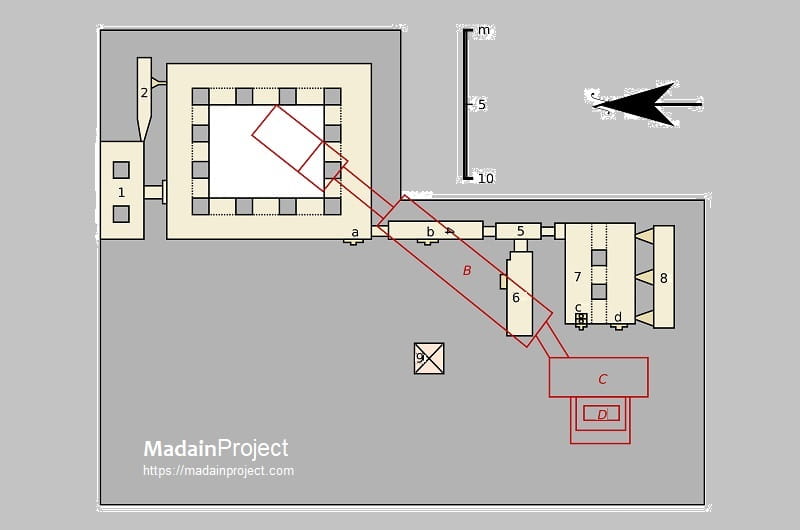
circa 2400 BCE
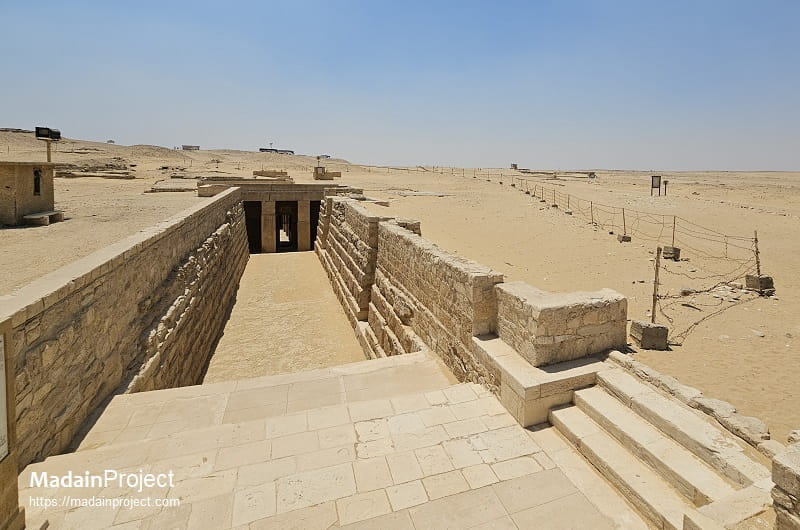
Superstructure
The architecture of the Mastaba of Ti represents the pinnacle of non-royal funerary design during the Old Kingdom’s 5th Dynasty. Its sophisticated multi-room layout and integration of functional cult spaces demonstrate the evolution from the simple, solid rectangular blocks of the early dynastic periods to the complex, articulated structures of the high Memphite necropolis.
The superstructure was a massive rectangular block of fine limestone, oriented nearly perfectly north-south, and measures approximately 40 meters by 34 meters. Unlike earlier, more compact mastabas, Ti’s monument was most likely characterized by a "stepped" or multi-phase expansion. This superstructure however has not survived.
The primary entrance is through a northern portico supported by two square pillars. On each side, Ti is depicted in high relief, accompanied by his primary titles as a royal official.
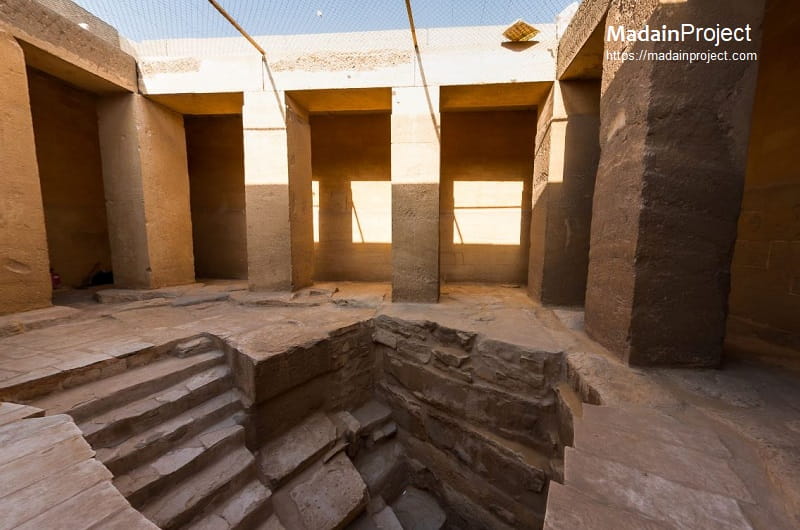
A distinguishing feature of this tomb is its expansive open courtyard (inspect), featuring 12 square pillars arranged in a peristyle-like fashion. This space was likely added as a secondary phase of construction and served as a semi-public area for funerary rituals. In the center of this courtyard floor is a shaft leading to the burial chamber, a layout choice that allowed the cult activities to remain separate from the tomb's core.
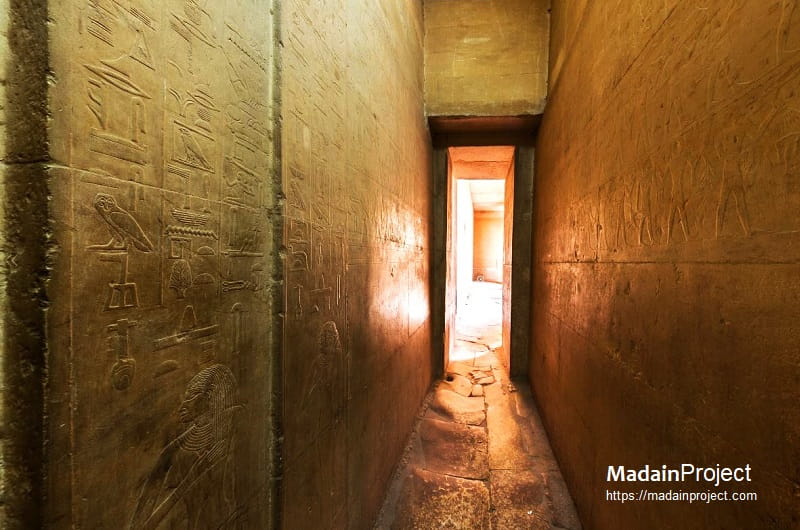
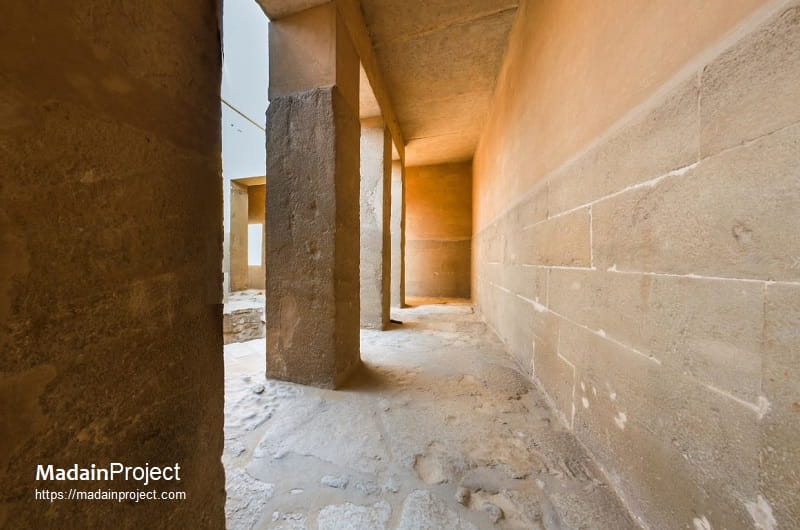
From the courtyard, a series of two successive corridors lead into the interior of the massif. Off these corridors are dedicated storerooms intended to house the physical offerings and equipment required for the perpetual maintenance of Ti’s mortuary cult.
circa 2400 BCE
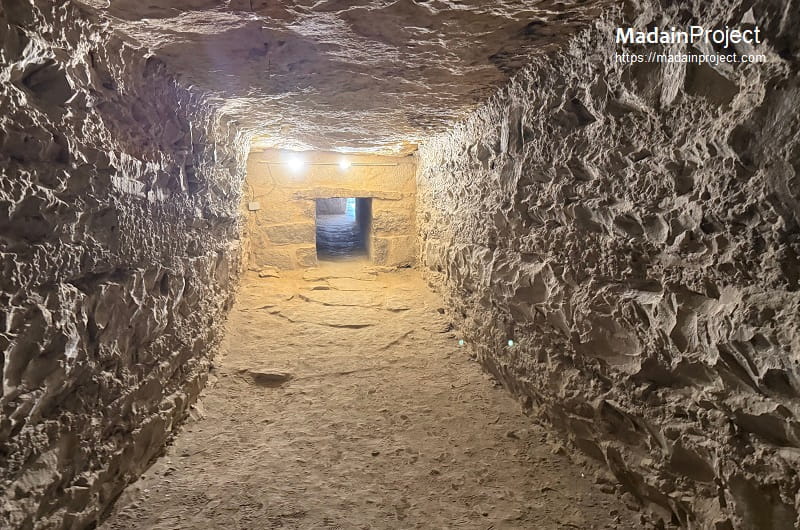
Substructure
The substructure is functionally distinct from the superstructure and was intended to remain inaccessible after the funeral.
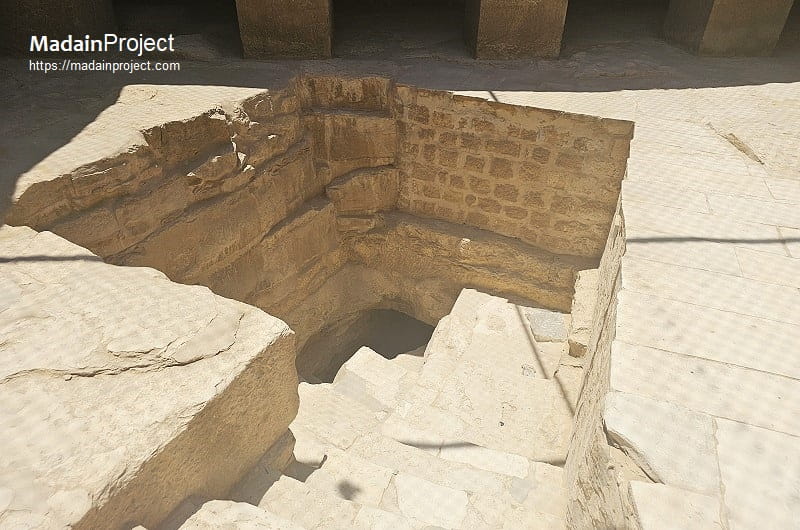
A descent (inspect) from the center of the pillared courtyard leads to a long, sloping corridor.
This subterranean room is located directly beneath the southern portion of the superstructure. It is a stark contrast to the decorated rooms above, consisting of a simple chamber that houses Ti’s massive, undecorated limestone sarcophagus.
circa 2400 BCE
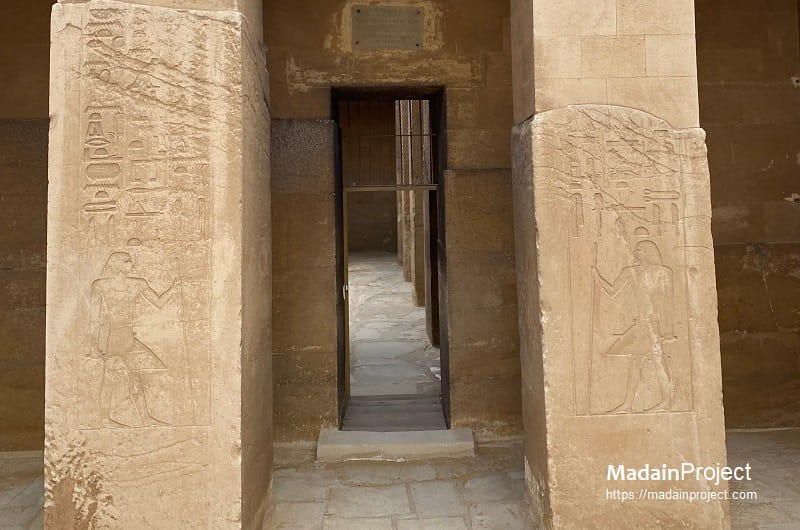
Entrance Portico
The primary entrance is through a northern portico supported by two square pillars. On each side, Ti is depicted in high relief, accompanied by his primary titles as a royal official.
circa 2400 BCE
Pillared Hall
A distinguishing feature of this tomb is its expansive open courtyard, featuring 12 square pillars arranged in a peristyle-like fashion. This space was likely added as a secondary phase of construction and served as a semi-public area for funerary rituals. In the center of this courtyard floor is a shaft leading to the burial chamber, a layout choice that allowed the cult activities to remain separate from the tomb's core.
circa 2400 BCE
Storeroom
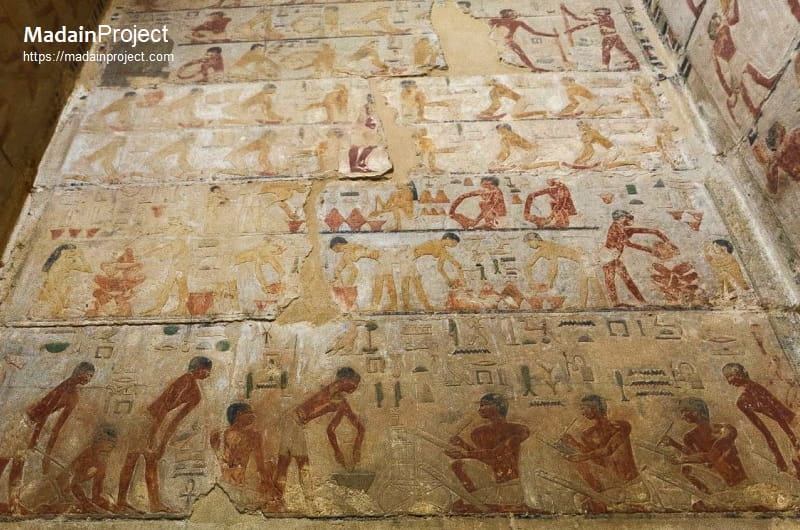
This chamber functioned as a storeroom, intended for the storage of offerings and objects required for cult worship. Its decorative program reflects this practical purpose, presenting detailed visual inventories and scenes associated with provisioning and economic activity.
The east wall, which forms the entry wall above the doorway, is entirely occupied by representations of pottery arranged in seven registers. The two lowest registers are notably shorter, as they are constrained by the space around the entrance. Although much of the original coloration has faded, certain hues remain visible, including the red used for some offering tables and the upper portions of several vases in the third register on the left, as well as a dark brown applied to other tables. Near the entrance on the adjoining south wall stands a prominent figure of Ti, depicted at a scale spanning three registers. He wears a short, squared beard and holds a long staff in his left hand, while in his right he carries a folded piece of linen. At his feet stands his second son, also named Ti, identified as the chief of duck breeders; the child holds a duck in his right hand and grasps his father’s staff with his left. Behind Ti, his wife Neferhetepes kneels in a gesture of intimacy and support, clasping his right leg with her left hand while resting her right arm upon her thigh.
Another significant decorative element is the parade of porters, comprising a total of sixty-eight figures that are remarkably well preserved. With the exception of six men carrying pairs of poultry, nearly all the porters are individually differentiated, despite sharing a common structural model. This variation suggests that the artist worked with separate compositional templates for body forms and arm positions, adapting them according to the specific offerings being carried.
The west wall (inspect), directly facing the visitor upon entering, is among the most celebrated compositions in Egyptian funerary art. Exceptionally well preserved, it presents a comprehensive depiction of the production processes behind essential goods such as bread, beer, and pottery, along with the administrative recording of these outputs by scribes attached to the estate. The entire wall functions as a cohesive summary of economic activity. Its seven registers are organized from bottom to top in a logical sequence: the lowest register shows scribes documenting deliveries; above this, three registers illustrate the stages of bread production; the next two registers depict the brewing of beer; and the top register is devoted to pottery making. Together, these scenes provide an integrated view of production, management, and supply within the funerary estate.
circa 2400 BCE
First Corridor
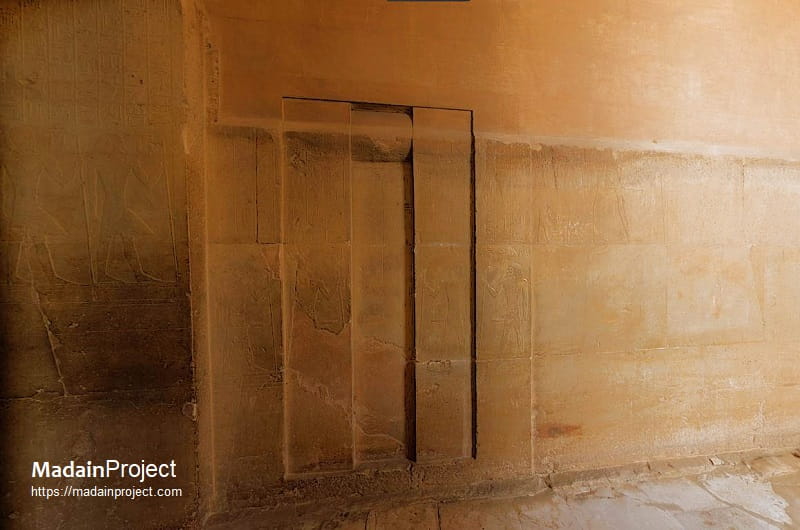
A prominent feature within the first corridor is the false door stela dedicated to Neferhetepes, the wife of Ti. This finely executed monument presents her in a consistent and idealized form: she wears a close-fitting dress with two shoulder straps that, while intended to cover the body, subtly reveal the contours of her breasts as a symbolic expression of femininity. Her adornments include a broad, multi-row usekh necklace across her chest, a tight choker encircling her neck, and bracelets on both wrists and ankles. She is further distinguished by a long tripartite wig, completing her elegant and formal appearance. Structurally, the stela is composed of a central panel flanked by two pairs of upright panels, with the outer uprights rising higher than the inner ones. An inner lintel spans the central and inner uprights and incorporates an offering scene above the main panel, while an upper lintel extends across the full width of the composition.
The south wall of the corridor, positioned above the entrance to the second section, has suffered significant damage over time. Much of its original color has faded, leaving only faint traces, with the figure of Ti retaining some visible pigment. Although the quality of the engraving remains high, the details are difficult to discern due to this deterioration; modern visual reconstructions have therefore been employed to clarify the outlines of the original relief.
Access to the second corridor is provided by a doorway set slightly off-center to the right. This opening measures approximately 0.75 meters in width and 2.10 meters in height. Its passage narrows further due to a recessed section designed to accommodate a door at the end of the first corridor, emphasizing both the controlled movement through the space and its architectural planning.
circa 2400 BCE
Offering Chapel
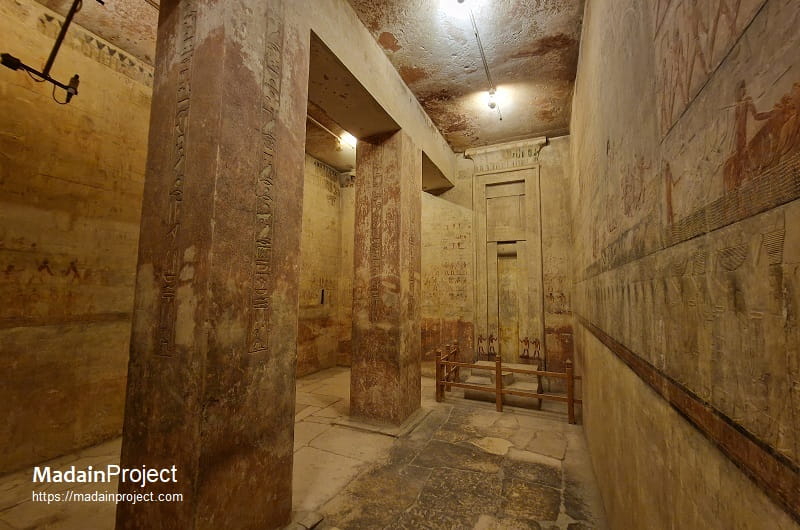
The entry from the second corridor opens into the north-east corner of the offering chapel, the most sacred space within the superstructure, also referred to as the Offering Hall. Positioned at the southwestern end of the interior corridor system, this chamber served as the focal point for ritual activity. Its roof is supported by two square pillars aligned along an east–west axis, which also uphold a transverse stone beam extending across the room. On the western wall are two large false-door stelae, symbolic portals through which the Ka (spirit) of Ti was believed to pass in order to receive offerings. The south wall contains openings leading to the second serdab of the mastaba, further emphasizing the chapel’s ritual importance.
The chapel’s decorative scheme is carefully organized. The upper edges of the walls are adorned with a narrow frieze composed of a simple geometric pattern, while the lower dado zone, rising to approximately 1.5 meters, was painted in red, though much of this color has faded over time. Above this base, the walls are covered with engraved and painted registers of exceptional quality, some of which rank among the finest artistic achievements of the monument.
A central decorative field, extending from the top of the domain procession to the frieze, is dominated by a single, striking scene. Here, Ti appears disproportionately small as he stands on the raised deck of a fragile papyrus skiff navigating through towering papyrus plants. Despite his reduced scale, he maintains the same authoritative posture and attire seen in terrestrial scenes, holding his staff of office prominently. The composition is animated by accompanying figures: at the rear, a boatman steers with a long pole, while at the front another attendant turns respectfully toward Ti, possibly alerting him to activity ahead. Nearby, a fisherman sits in a reed chair, holding a hand line, somewhat awkwardly placed due to spatial constraints. Beneath them, the Nile is rendered through blue zigzag lines filled with a lively variety of fish. On the right, a group of hippopotami emerges, their presence symbolically charged, as such creatures often represented chaotic or hostile forces, though sometimes also beneficial powers. The motif of hippopotamus hunting, already well established in the Old Kingdom, carries a dual significance that persisted into later periods.
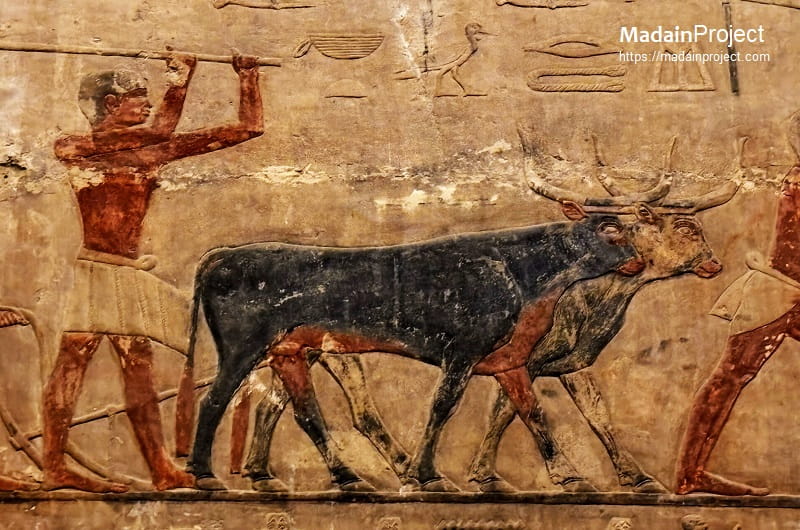
The left side of the east wall presents an extensive series of agricultural scenes associated with the harvest season, organized into ten registers. The sequence begins at the top with five registers illustrating the harvesting of various crops, including flax, barley, and emmer wheat. Below these, two registers depict the transportation of the harvested produce by donkeys, followed by a register showing the stacking of the crops. The next-to-bottom register illustrates threshing, carried out by livestock such as donkeys and cattle trampling the grain. Finally, the lowest register shows the process of winnowing, where the grain is separated from the chaff, completing the agricultural cycle. Together, these scenes provide a comprehensive and vivid representation of ancient Egyptian farming practices.
circa 2400 BCE
Serdabs
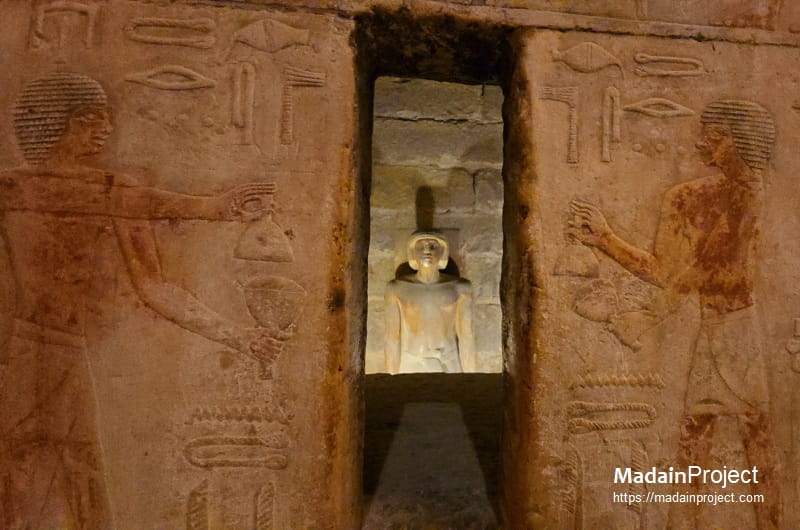
The mastaba contains two serdabs—sealed, internal chambers that housed the statues of the deceased. The primary serdab, located behind the southern wall of the chapel, is famous for its three spy-holes (apertures). These allowed the life-sized statue of Ti to symbolically "see" out into the chapel and witness the rituals performed in his honor.
Signup for our monthly newsletter / online magazine.
No spam, we promise.

The Madain Project is an online archive of Abrahamic History and Archaeology.
Abrahamic History & Archaeology is the study of history and archaeology with respect to the three Abrahamic Faiths without considering the religious and theological aspects. The goal of Abrahamic History is to understand how and why the religious doctrines and behaviours have evlovled and changed over time. Searching for patterns in the evolution of significant cultural events such as the development of farming, the emergence of cities, or the collapse of major civilizations for clues of why and how these have influenced the three major Abrahamic religions.
Cloud Drive -
About -
Help -
Editorial Policy -
AI Policy -
Privacy Policy -
Contact
Madain Project: Encyclopedia of Abrahamic History & Archaeology.
Copyright MadainProject 2017 - 2026.


