
Khafre Enthroned is a royal "ka statue" representing the Fourth Dynasty pharaoh Khafre, who reigned circa 2558–2532 BCE during Egypt’s Old Kingdom. The sculpture, carved in the round from dark anorthosite gneiss, was created for the Valley Temple of Khafre’s pyramid complex at Giza and is presently preserved in the Egyptian Museum in Cairo. Intended to function as a substitute physical vessel for the king’s ka—the vital spiritual essence believed to survive death—the statue exemplifies the formalized and highly idealized conventions of Old Kingdom royal sculpture.
The statue formed part of the sculptural program associated with Khafre’s funerary complex at Giza necropolis, which included the second pyramid of the plateau and the Valley Temple situated near the Great Sphinx. These temples housed numerous royal statues used in mortuary ritual, where offerings were presented to sustain the deceased king in the afterlife. If the king’s mummified body were damaged, such statues could serve as alternate dwelling places for the ka, ensuring the continuity of royal identity and the perpetuation of funerary cult practices. The belief was closely connected to the elaborate Egyptian process of mummification, a ritual procedure lasting approximately seventy days that sought to preserve the body for eternal existence.
The material chosen for the statue underscores its symbolic purpose. It was carved from anorthosite gneiss, an exceptionally hard and dark stone quarried in the Eastern Desert west of Gebel el-Asr, a source sometimes referred to as the “Khafre quarries”. The stone was transported roughly 1,000 kilometers down the river Nile to Giza, reflecting both the logistical capabilities of Old Kingdom administration and the prestige associated with rare and durable materials. Discovered in 1860 CE by the French Egyptologist Auguste Mariette in a pit within the Valley Temple, the statue was among a group of royal sculptures originally installed within that building.

circa 2558-2532 CE
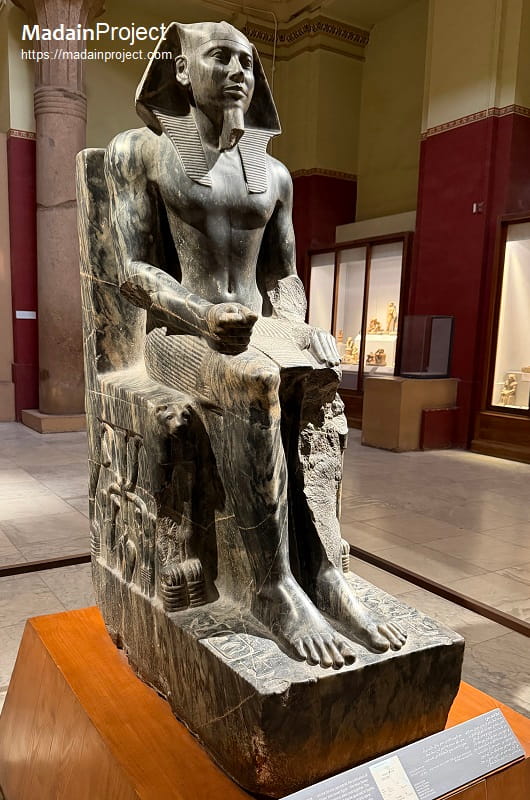
The sculpture depicts Khafre seated upon a monumental throne, rendered fully in the round rather than in relief. The king sits upright in a rigid frontal posture with both hands resting upon his thighs, facing directly forward. His body is idealized according to the conventions of Old Kingdom royal portraiture: the torso appears youthful and muscular, with broad shoulders and a defined chest, while the facial features are calm, symmetrical, and devoid of individualized expression. This idealization was not intended to record a specific likeness but rather to proclaim the divine and timeless nature of Egyptian kingship.
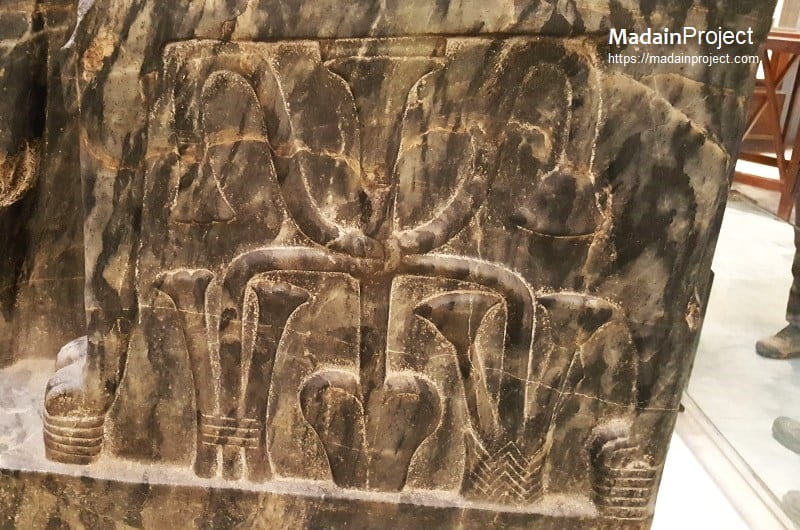
Khafre wears the royal nemes headdress, whose pleated cloth frames the face and falls over the shoulders, together with the ceremonial false beard attached to the chin. A short kilt encircles his waist, leaving the upper body bare. The throne itself incorporates symbolic decoration. Stylized lion forms shape the throne’s sides, emphasizing strength and royal authority, while the space between the legs of the throne displays the sema-tawy motif (inspect)—intertwined lotus and papyrus plants representing Upper and Lower Egypt—symbolizing the political unity of the Egyptian state under the pharaoh.
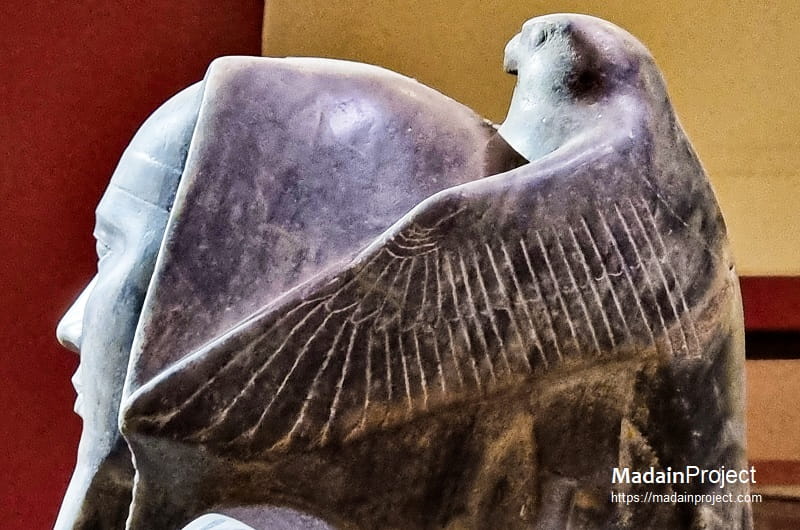
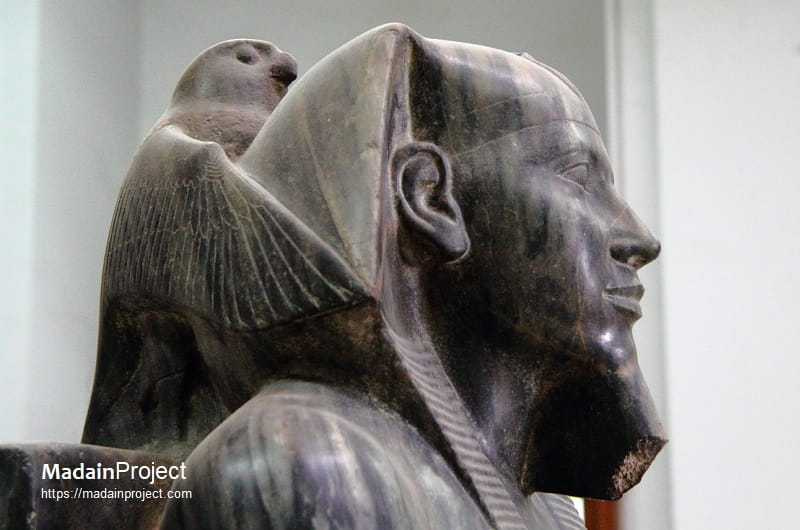
Behind the king’s head appears the falcon god Horus (inspect), carved in high relief with wings outstretched around the back of the headdress. Although not visible from a frontal view, the bird’s presence signifies divine protection and affirms the identification of the living king with Horus. Beneath the king’s feet lies a flat base engraved with the motif of the “Nine Bows”, a traditional representation of Egypt’s enemies, symbolizing royal dominance over foreign and domestic adversaries.
The composition emphasizes compactness and permanence. The king’s body is closely integrated with the throne block, with minimal projecting elements, creating a unified mass of stone intended to endure indefinitely. The statue is bilaterally symmetrical along a central vertical axis, suppressing movement and temporal change in favor of stillness and order. Only the subtle difference of the clenched right fist interrupts the otherwise perfect symmetry. The polished surface of the dark stone further enhances the impression of solidity and eternal presence. The completed sculpture stands approximately 1.68 meters (five feet six inches) in height, embodying the Old Kingdom ideal of a royal image designed to exist perpetually both in the earthly temple and in the realm of the afterlife.
Signup for our monthly newsletter / online magazine.
No spam, we promise.

The Madain Project is an online archive of Abrahamic History and Archaeology.
Abrahamic History & Archaeology is the study of history and archaeology with respect to the three Abrahamic Faiths without considering the religious and theological aspects. The goal of Abrahamic History is to understand how and why the religious doctrines and behaviours have evlovled and changed over time. Searching for patterns in the evolution of significant cultural events such as the development of farming, the emergence of cities, or the collapse of major civilizations for clues of why and how these have influenced the three major Abrahamic religions.
Cloud Drive -
About -
Help -
Editorial Policy -
AI Policy -
Privacy Policy -
Contact
Madain Project: Encyclopedia of Abrahamic History & Archaeology.
Copyright MadainProject 2017 - 2026.


