
The G 7101 (Tomb of Qar) is an ancient Egyptian funerary monument located in the eastern sector of the Giza Necropolis, near the northern edge of the Eastern Cemetery and north of the double mastaba of Kawab. The monument belongs to Qar, an elite official of the Old Kingdom. Architecturally, the tomb represents a non-standard mastaba design in which a largely ruined mud-brick superstructure originally stood above a subterranean complex consisting of a staircase, an open courtyard, rock-cut chapels, subsidiary chambers, and multiple burial shafts.
The Tomb of Qar was first excavated between December 1924 and January 1925 by George Andrew Reisner and Alan Rowe under the direction of the Harvard University Museum of Fine Arts Expedition. Reisner, who served as director of the expedition, departed the site on 24 January 1925. Subsequent visits to the tomb were undertaken in 1951, 1973, 1974, and 1975 in order to revise documentation, correct architectural drawings, and conduct additional excavation.
Most of the above-ground superstructure of the mastaba has collapsed, leaving only minimal architectural remains. The primary surviving element of the superstructure is the entrance stairway descending from the surface into the subterranean complex. As a result, archaeological investigation has focused largely on the underground components of the tomb.
The mastaba originally consisted of a mud-brick upper structure and a lower complex carved into the bedrock. The subterranean portion comprises a walled courtyard with rock-cut chapels and burial shafts leading to burial chambers. Approximately seven shafts are associated with the complex, one of which served as the burial shaft of Qar himself. Excavations also revealed a shaft belonging to Qar’s wife, indicating that the monument functioned as a family burial complex.

circa 2280 BCE

The architectural plan of the Tomb of Qar differs from the more typical mastaba forms of earlier dynasties. The superstructure, constructed primarily of mud brick, once rose above ground level but has largely disintegrated. The extant remains consist mainly of the stairway entrance descending from the surface.
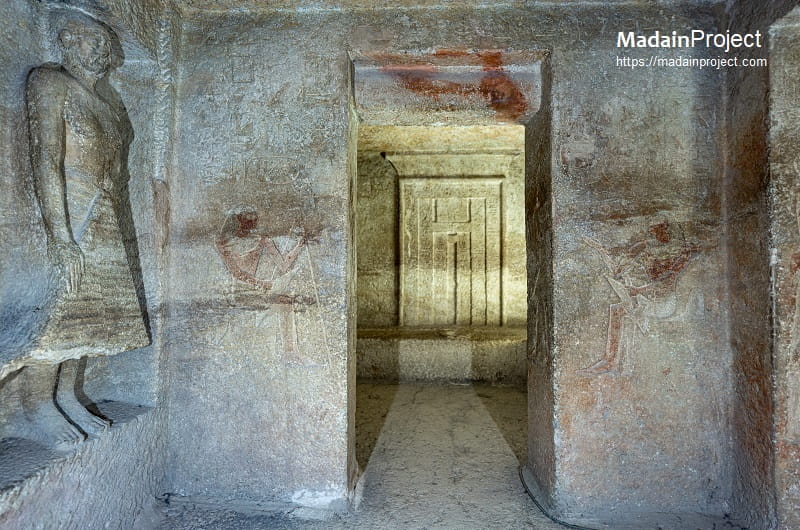
The staircase leads downward to an open courtyard carved into the natural bedrock. This courtyard forms the central space of the subterranean complex and functions as the focal point from which several additional chambers are accessed. Four small rooms are arranged around the courtyard, each containing decorated walls, though many of the reliefs have suffered varying degrees of damage or loss.
In addition to the main chapel associated with Qar, a second chapel was discovered within the complex and is generally interpreted as belonging to his wife. Several burial shafts are distributed within the courtyard and surrounding spaces, each leading to underground burial chambers. These shafts likely accommodated members of Qar’s family and dependents.
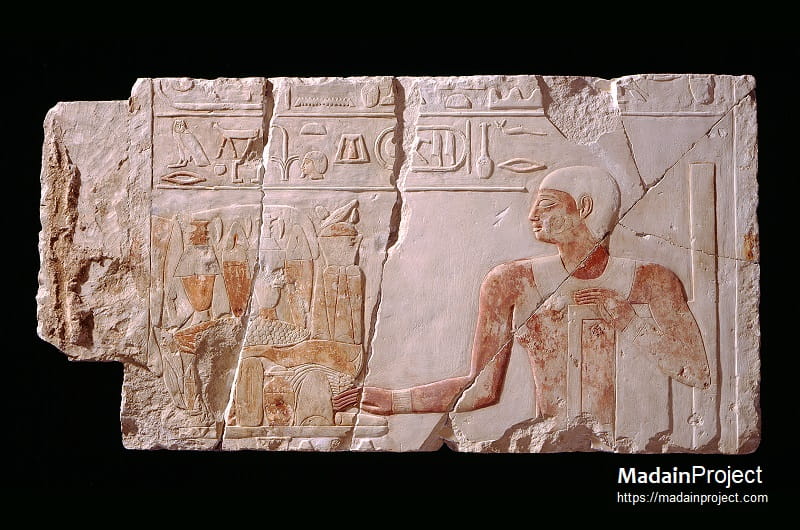
The wall surfaces within the courtyard and adjacent chambers were decorated with carved scenes. Some reliefs were executed on limestone blocks that were subsequently inserted into the natural rock, while others were carved directly into the bedrock. Many of the limestone blocks have become displaced or fragmented over time, resulting in incomplete decorative compositions.
circa 2280 BCE
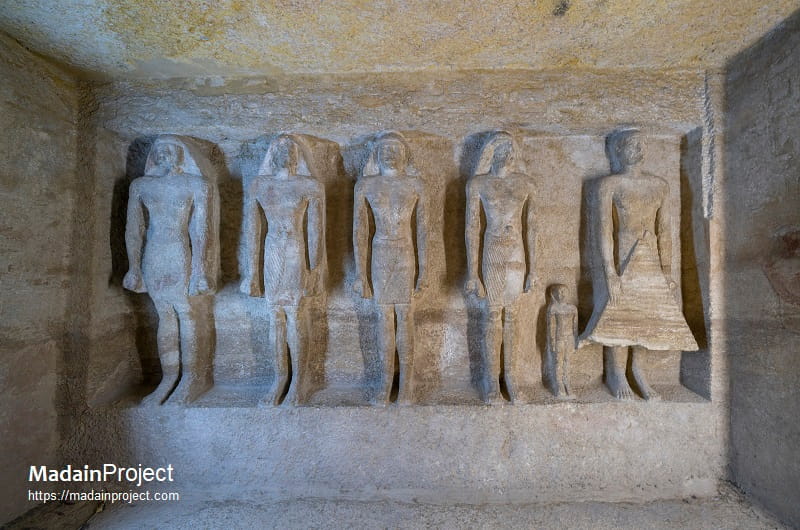
The decorative program of the Tomb of Qar centers on representations of Qar, members of his family, and several dependents or officials associated with his household. Due to the destruction of the superstructure, the preserved decoration begins primarily along the descending staircase and continues throughout the courtyard and its adjoining rooms.
One of the earliest scenes encountered within the tomb depicts Qar and his son Idu engaged in a fowling scene. Both figures are shown wearing wigs, short beards, broad collars, bracelets, and short kilts. Qar stands facing right and holds a throw stick in his right hand, while Idu, also facing right, carries a throw stick and holds three birds in his left hand. Inscriptions above the figures identify both individuals. The scene emphasizes elite ideals of provisioning and the ability to supply food resources.
Another prominent scene occurs in Room E on the north wall, where Qar is depicted seated beside his mother, Khenout (ḫnwt). Both figures wear similar attire consisting of short wigs, broad collars, bracelets, and pleated skirts. They sit before a table laden with bread and offerings. Such scenes represent the traditional funerary motif of the offering table, symbolizing the sustenance desired by the deceased in the afterlife.
The tomb decoration also includes depictions and inscriptions identifying several members of Qar’s family:
In addition to family members, several dependents and officials connected with Qar’s household are represented with their titles, including individuals named Idu, Nekheti, Nesouhor, Rensi, and Kheti. These titles include positions such as lector priest, scribe, overseer of ka-servants, overseer of the portal, and director of the dining hall.
Together, these scenes form a typical Old Kingdom funerary decorative program emphasizing kinship ties, social hierarchy, administrative roles, and the provisioning of the deceased for the afterlife.
Signup for our monthly newsletter / online magazine.
No spam, we promise.

The Madain Project is an online archive of Abrahamic History and Archaeology.
Abrahamic History & Archaeology is the study of history and archaeology with respect to the three Abrahamic Faiths without considering the religious and theological aspects. The goal of Abrahamic History is to understand how and why the religious doctrines and behaviours have evlovled and changed over time. Searching for patterns in the evolution of significant cultural events such as the development of farming, the emergence of cities, or the collapse of major civilizations for clues of why and how these have influenced the three major Abrahamic religions.
Cloud Drive -
About -
Help -
Editorial Policy -
AI Policy -
Privacy Policy -
Contact
Madain Project: Encyclopedia of Abrahamic History & Archaeology.
Copyright MadainProject 2017 - 2026.


