
The Funerary Complex of Mastaba al-Firoun refers to the monumental mortuary precinct of King Shepseskaf (circa 2503–2498 BCE), the final ruler of ancient Egypt’s Fourth Dynasty, located in South Saqqara necropolis. Distinguishing itself from the canonical solar-centric pyramids of the Giza Plateau, the primary monument is a massive sarcophagus-shaped mastaba—an architectural regression to the archaic "butic" shrine form.
The complex encompasses a limestone-core tomb, a mortuary temple constructed of limestone and mudbrick, and a unique vaulted causeway that approaches the site from a non-traditional southern orientation. Defined by its dual mudbrick enclosure walls, the site represents a significant ideological and economic shift in the late Old Kingdom, reflecting a potential departure from the dominant cult of Ra in favor of more traditional Osirian or Memphite funerary practices.
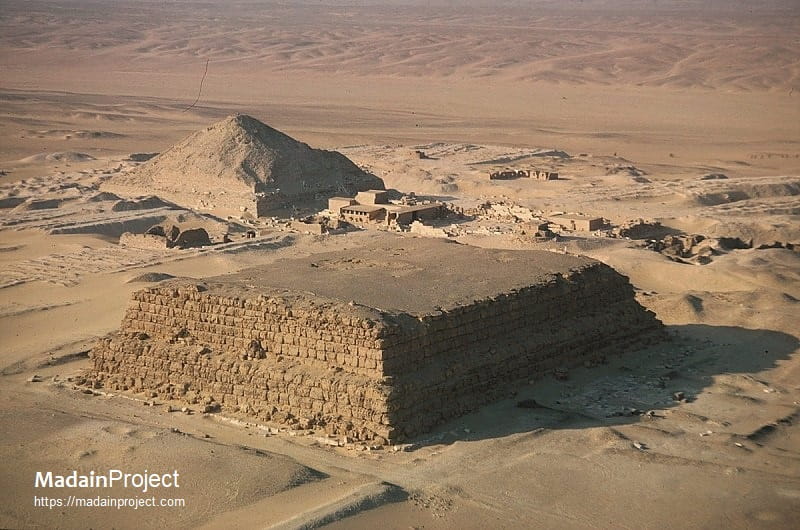
circa 2500 BCE
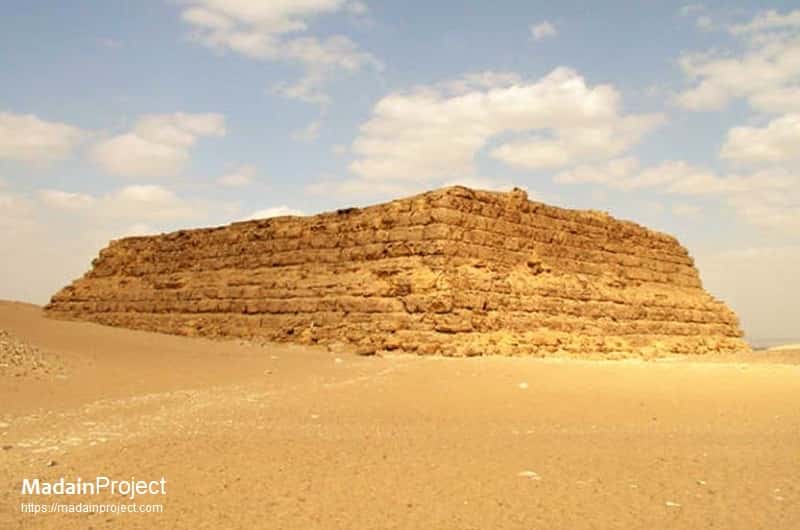
Mastaba
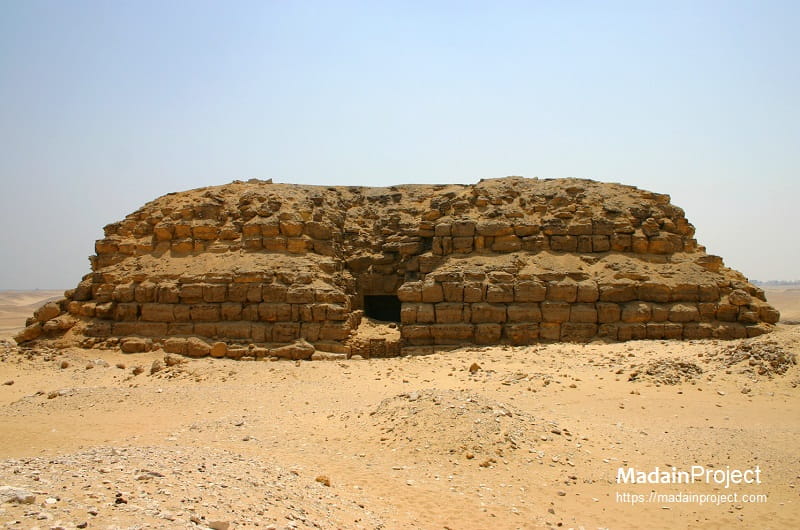
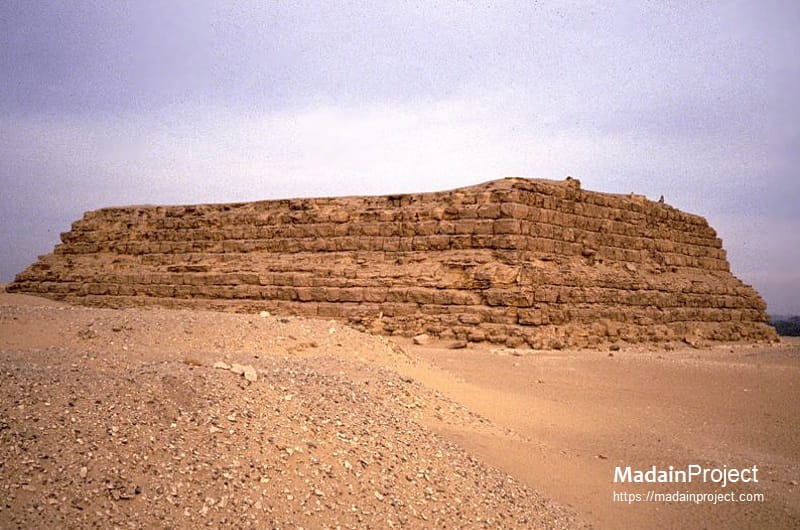
The mastaba-structure is a massive, rectangular stone block measuring approximately 99.6 by 74.4 metres at its base and rising to a contemporary height of roughly 18 metres. Its most striking feature is its sarcophagus-like silhouette, characterized by a curved, vaulted roof and straight vertical ends that scholars believe may emulate a traditional Buto-style shrine from Lower Egypt. The core is constructed from yellow-grey limestone or red sandstone sourced from Dahshur, originally encased in a base layer of pink granite and upper layers of fine Tura limestone. Internally, a northern descending corridor leads to a granite-clad antechamber and a burial chamber featuring a pointed roof shaped into a barrel vault, where fragments of a greywacke or basalt sarcophagus were recovered. This regressive form and the exclusion of the sun-god "Ra" from Shepseskaf’s name suggest a profound religious or political shift away from the solar cult dominant in the earlier Fourth Dynasty.
Mortuary Temple
The mortuary temple (or the funerary cult temple) of the Mastabat al-Fir’aun, is situated against the eastern face of the monument and represents a transitional phase in Old Kingdom funerary architecture. Unlike the elaborate stone temples of his predecessors at Giza, this structure was built in two distinct stages: an initial phase using limestone and a secondary, hasty completion in whitewashed mudbrick, likely finished by his successor to ensure the cult's operation after Shepseskaf’s short reign. The temple layout features a small open courtyard paved with limestone that originally housed an altar in its northwest corner, leading to a western offering hall shaped like an inverted "T". This hall contained a false door—the spiritual threshold for the king's ka—and was flanked by several storage magazines intended for cult equipment and offerings.
Causeway
The causeway of the Mastabat al-Fir’aun is a unique architectural feature that departs from the standard linear designs seen in the pyramid complexes of Giza. The causeway does not lead directly to the main entrance of the mortuary temple; instead, it approaches from the east and skirts the southeastern corner of the outer enclosure wall, running along the southern perimeter before finally emerging into the courtyard. Archaeologists such as Gustave Jéquier found evidence that the structure was composed of whitewashed mudbricks and was likely designed to resemble a long, enclosed corridor with a vaulted ceiling. This aesthetic choice, possibly imitating a reed-shrine or traditional Lower Egyptian architecture, reinforces the theory that Shepseskaf sought to distance his funerary monument from the solar-focused pyramid traditions of his predecessors.
While the upper portion of the causeway near the mastaba has been identified, the rest of its length and the possible associated valley temple remain unexcavated and are no longer visible on the surface. Some modern surveys suggest the causeway may have extended eastward for approximately 300 metres toward the cultivation line, though its full trajectory is still a subject of archaeological inquiry. The use of mudbrick for such an extensive royal project, rather than the red granite or limestone typical of the earlier Fourth Dynasty, underscores the short reign of Shepseskaf and the likely economic or temporal pressures to complete the funerary complex quickly. Despite these humbler materials, the vaulted design and whitewashed finish provided a sophisticated, monumental approach to the "Pharaoh's Bench" within the sacred landscape of South Saqqara.
Enclosure Walls
The funerary monument of King Shepseskaf was surrounded by massive double enclosure walls constructed primarily of mudbrick. Archaeological surveys, most notably those by Gustave Jéquier, reveal that the innermost mudbrick wall stands approximately 10 metres from the limestone core of the mastaba and maintains a thickness of 2.05 metres. A second, outer enclosure wall encompasses the entire funerary precinct at a distance of roughly 48 metres, defining the sacred space and separating the royal cult area from the surrounding desert. These walls were integral to the complex's architectural program, as the later phases of the mortuary temple and the long causeway—which was whitewashed to resemble a vaulted corridor—were also executed in mudbrick rather than stone.
From a geoarchaeological perspective, the use of mudbrick in this high-status context represents a significant logistical and symbolic choice during the late Old Kingdom. While the primary tomb was constructed from yellow-grey limestone and red sandstone, the mudbrick components likely allowed for rapid completion of the expansive enclosure and temple additions during Shepseskaf’s brief four-year reign. These sun-dried bricks, likely composed of a traditional Egyptian recipe of Nile mud, chopped straw, and sand, provided a versatile medium for the temple's elaborate interior niches and the causeway's decorative vaulted profile. The preservation of these mudbrick traces at South Saqqara continues to offer scholars insights into the transition between stone and brick masonry in royal monumental architecture.
Signup for our monthly newsletter / online magazine.
No spam, we promise.

The Madain Project is an online archive of Abrahamic History and Archaeology.
Abrahamic History & Archaeology is the study of history and archaeology with respect to the three Abrahamic Faiths without considering the religious and theological aspects. The goal of Abrahamic History is to understand how and why the religious doctrines and behaviours have evlovled and changed over time. Searching for patterns in the evolution of significant cultural events such as the development of farming, the emergence of cities, or the collapse of major civilizations for clues of why and how these have influenced the three major Abrahamic religions.
Cloud Drive -
About -
Help -
Editorial Policy -
AI Policy -
Privacy Policy -
Contact
Madain Project: Encyclopedia of Abrahamic History & Archaeology.
Copyright MadainProject 2017 - 2026.


