
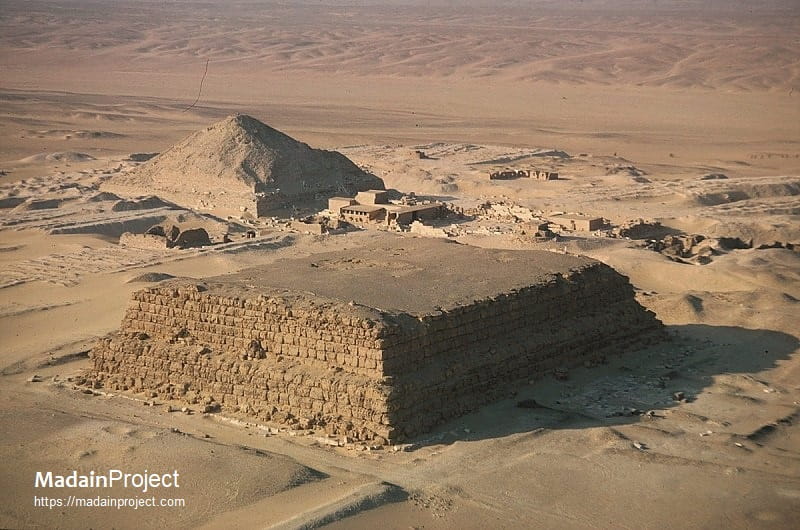
The Mastabat al-Firaun (مصطبة الفرعون) is the monumental mastaba-style tomb of the ancient Egyptian king Shepseskaf (reign circa 2510–2503 BCE), the last pharaoh of the Fourth Dynasty during the Old Kingdom period of ancient Egypt. It is situated in the Saqqara necropolis between the Pyramid of Djoser and the pyramids of Sneferu. The mastaba is located approx. 150 meters south-east to the pyramid complex of Pepi II, a ruler of the Sixth Dynasty.
Qebeh Shepseskaf
The Mastabat al-Firʿaun, known as Qebeh Shepseskaf (meaning "Shepseskaf is pure"), was first documented in the mid-nineteenth century CE by John Perring. Although Karl Richard Lepsius subsequently located the monument, he did not undertake a detailed examination. The initial exploration of its subterranean components was conducted by Auguste Mariette in 1858 CE. Comprehensive excavation of the entire complex was later carried out by Gustave Jéquier in 1924–1925. Jéquier was also the first to attribute the monument to Shepseskaf, based on the discovery of a fragmentary stele. Prior to this identification, the structure had been incorrectly ascribed to Unas, the final ruler of the Fifth Dynasty.
The stone quarry from where the stone for the mastaba-tomb structure was procured is located west of the Red Pyramid of king Sneferu.
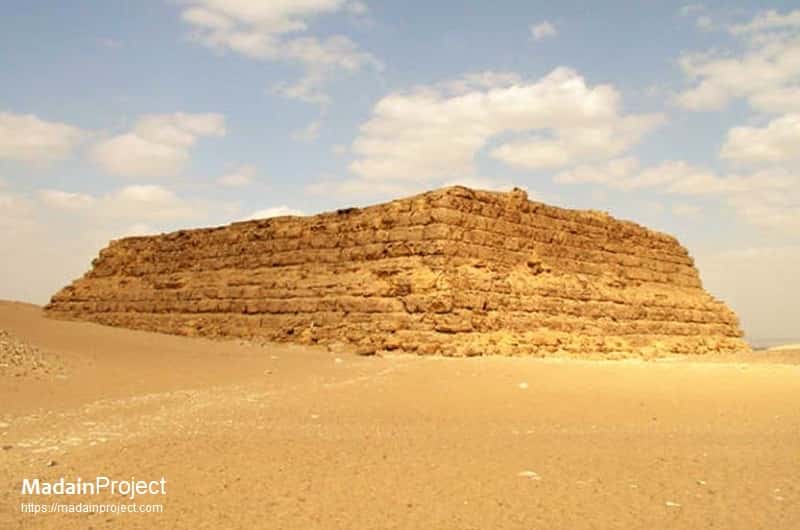
circa 2400 BCE
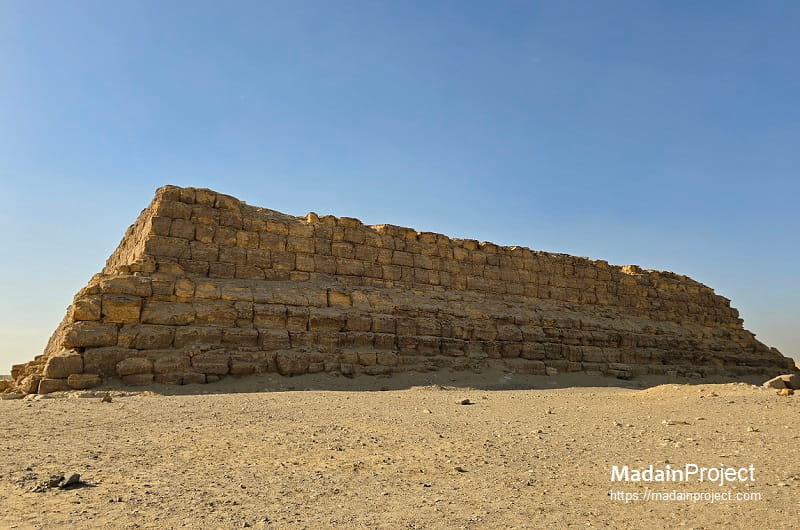
Exterior
The external architecture of the Mastabat al-Fir’aun represents a radical departure from the Fourth Dynasty's pyramid-building tradition, manifesting instead as a monumentalized version of a predynastic sarcophagus or a traditional Upper Egyptian shrine (pr-wr). Seated upon a massive two-stepped base of yellow-grey limestone, the structure measures approximately 99.6 by 74.4 metres, with its preserved height reaching roughly 18 metres. Its most distinctive feature is the vaulted roof, which was originally shaped into a gentle curve flanked by two vertical end-walls, creating a silhouette that mimics a royal coffin or a vaulted tent.
The core masonry consists of exceptionally large blocks of local sandstone and limestone, which were originally encased in a sophisticated dual-material façade: a base course of red Aswan granite—traces of which remain at the lowest levels—and upper courses of polished fine Tura limestone. This choice of materials provided a stark visual contrast between the dark, enduring granite and the gleaming white limestone, a common trope in royal funerary aesthetics. The steep inclination of approximately 70 degrees on its long sides further emphasizes its box-like, non-pyramidal form, signaling a deliberate ideological shift in the late Old Kingdom toward a more traditional, perhaps Osirian or Memphite, funerary iconography that eschewed the solar-centric geometry of the Giza plateau.
circa 2400 BCE

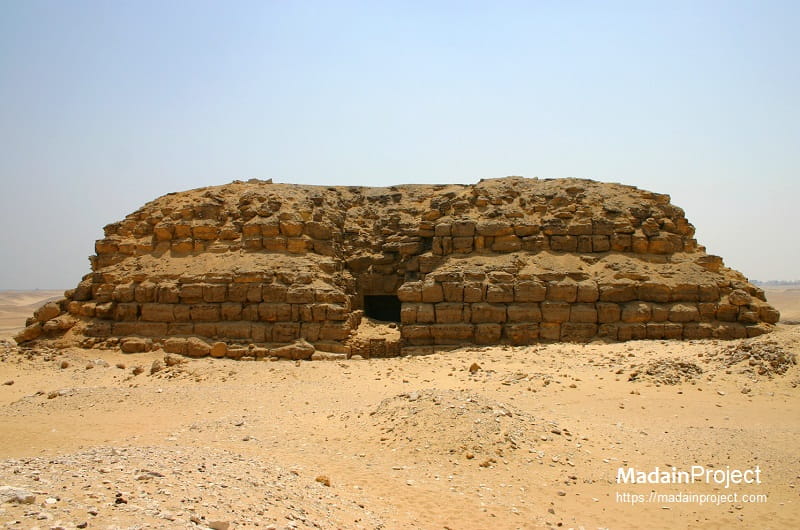
Entrance and the Subterranean Structure
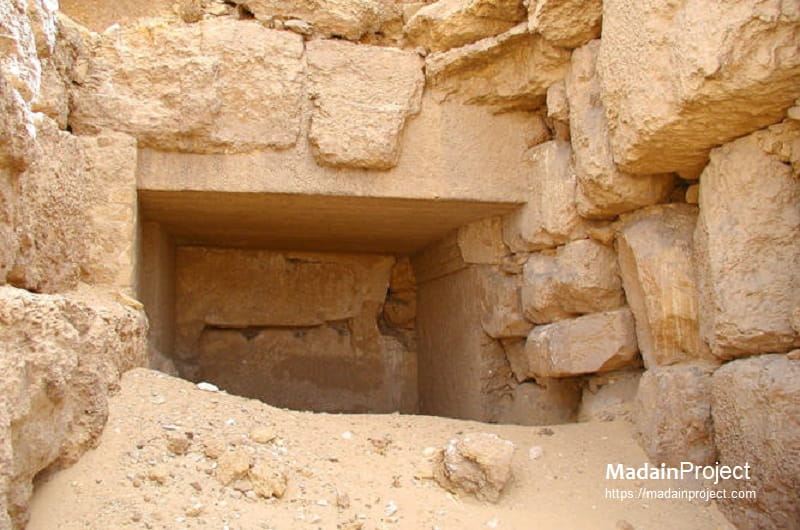
The entrance (inspect) to the subterranean system of the Mastabat al-Firʿaun is located on the northern face of the monument, approximately 2.5 metres above the original ground level. From this point, a descending corridor inclined at 23°30′ leads into the bedrock. This passage was originally about 20.75 metres in length, though structural collapse has reduced its accessible extent to 16.3 metres. It was initially lined with fine limestone casing, much of which has since been removed. At the base of the descent, the corridor continues horizontally, forming a small chamber measuring 2.67 metres in length and 2 metres in height.
Beyond this chamber, three granite portcullis stones remain anchored in the ceiling, representing a security mechanism designed to seal the burial complex after interment. At this stage, the passage measures approximately 1.1 metres in width and narrows in height to 1.27 metres, with walls and ceiling clad in granite. Past the portcullis system, the height increases again, although the floor becomes uneven due to the absence of plastering. Following a further constriction to a height of 1.2 metres, the horizontal passage extends to a total length of 19.46 metres before terminating at the antechamber.
The antechamber, constructed entirely of granite, measures 8.31 metres along an east–west axis, 3.05 metres in width, and 5.55 metres in height. It is roofed with a pointed granite ceiling designed to distribute the structural load. From its western end, a short passage, 1.54 metres in length and inclined at 10°30′, leads to the burial chamber. This chamber measures 7.79 metres in length, 3.85 metres in width, and approximately 4.9 metres in height. Its roofing system combines a pointed external form with an internally carved barrel-vaulted ceiling, an architectural solution that both mitigates pressure from the superstructure and evokes the form of a shrine or sarcophagus interior. Only fragments of the sarcophagus survive, likely originally fashioned from greywacke or basalt. The granite lining of both the antechamber and burial chamber remains largely unpolished.
A secondary corridor extends southward from the southeastern corner of the antechamber for 10.62 metres, with a width of approximately 1.14 metres and a height ranging between 2.1 and 2.3 metres. This passage provides access to a series of storage niches arranged along its sides. Four niches are situated on the eastern wall and one on the western wall opposite the southernmost eastern niche. The eastern niches measure between 2.1 and 2.27 metres in length, approximately 0.8 metres in width, and 1.4 metres in height, while the western niche is larger, measuring 2.65 metres in length and 1.16 metres in width. These spaces likely functioned as magazines intended to house funerary equipment and offerings, forming an integral component of the monument’s overall funerary design.
Signup for our monthly newsletter / online magazine.
No spam, we promise.

The Madain Project is an online archive of Abrahamic History and Archaeology.
Abrahamic History & Archaeology is the study of history and archaeology with respect to the three Abrahamic Faiths without considering the religious and theological aspects. The goal of Abrahamic History is to understand how and why the religious doctrines and behaviours have evlovled and changed over time. Searching for patterns in the evolution of significant cultural events such as the development of farming, the emergence of cities, or the collapse of major civilizations for clues of why and how these have influenced the three major Abrahamic religions.
Cloud Drive -
About -
Help -
Editorial Policy -
AI Policy -
Privacy Policy -
Contact
Madain Project: Encyclopedia of Abrahamic History & Archaeology.
Copyright MadainProject 2017 - 2026.


