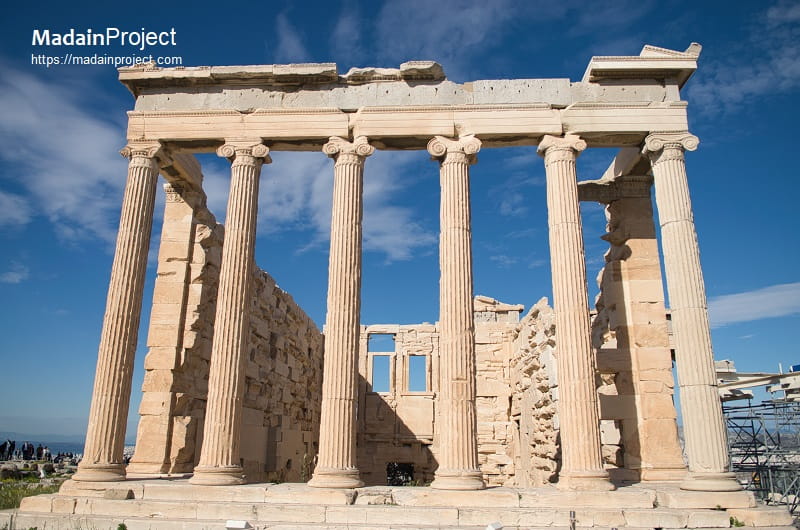
The Ionic order or Ionian Order refers to a codified system of classical Greek architecture that emerged in the mid-sixth century BCE, distinguished primarily by its slender proportions and the iconic volutes, or scroll-like ornaments, that crown its capitals. Its structural and decorative grammar is further defined by a tripartite architrave and a continuous frieze, an uninterrupted horizontal band that allows for fluid narrative relief sculpture and complex ornamental moldings such as the egg-and-dart and bead-and-reel.
The Ionic order, emerging in the mid-sixth century BCE along the coast of Asia Minor and the Aegean Islands, represents a shift toward a more slender, decorative architectural "syntax" compared to the earlier Doric style. It is characterized by its most distinctive feature: the volute capital, which consists of spiral, scroll-like ornaments inspired by natural forms like seashells or ram horns. Unlike the Doric order, the Ionic column is typically supported by a molded base (such as the Attic base) and features a more attenuated shaft with twenty-four deep flutes separated by flat fillets. This increased height-to-diameter ratio—often 1:8 or 1:9—contributes to an aesthetic of elegance and verticality that Vitruvian theory famously categorized as "feminine" in character.
Beyond the column itself, the Ionic entablature introduces a tripartite architrave divided into three horizontal bands, or fasciae, which effectively lighten the visual load of the superstructure. Above this sits a continuous frieze, a significant departure from the punctuated Doric system of triglyphs and metopes; this uninterrupted space allowed for the inclusion of complex, linear narrative relief sculptures. The integration of ornamental moldings, such as the egg-and-dart and bead-and-reel, further emphasizes the order's focus on sculptural richness and refined detail. These elements reached their zenith in the late fifth century BCE with the construction of the Erechtheion, where the Ionic order was adapted to a complex, multi-leveled site, showcasing its inherent flexibility and sophisticated decorative potential.
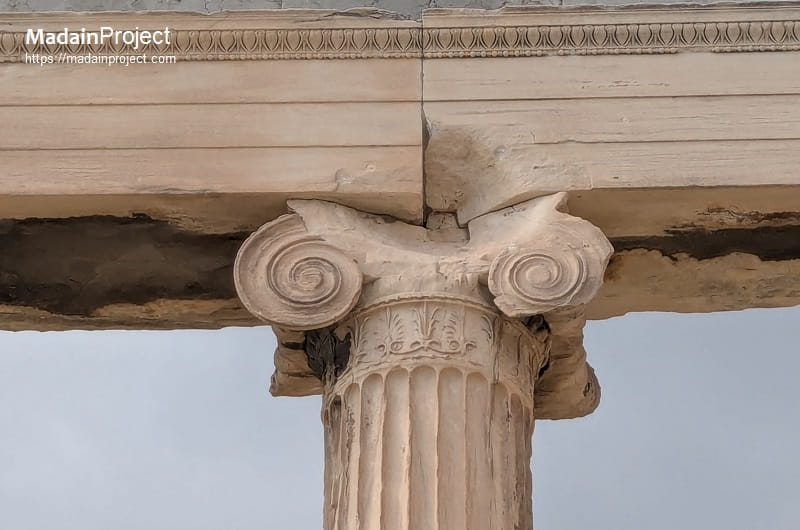
circa 650 BCE-

Origins in Archaic Ionia
The Ionic order emerged in the Greek-speaking regions of western Anatolia, particularly in Ionia, during the 7th to mid-6th centuries BCE. This region, encompassing coastal settlements and islands of the eastern Aegean, fostered a distinct architectural idiom shaped by cross-cultural exchange with Anatolian, Near Eastern, and Egyptian traditions. Unlike the heavier and more austere Doric order of mainland Greece, the Ionic order developed a vocabulary emphasizing verticality, surface articulation, and ornamental refinement.
The earliest monumental expressions of the Ionic order appear in large-scale temple construction. The Temple of Hera on Samos (circa 570–560 BCE), designed by Rhoikos, represents one of the first fully realized Ionic temples. Its short lifespan—terminated by earthquake—does not diminish its importance as a prototype: it established key features such as column bases, fluted shafts, and volute capitals.
More enduring was the Temple of Artemis at ancient Ephesus (6th century BCE), later recognized among the Seven Wonders of the Ancient World. This structure exemplified the monumentalization of the Ionic order: its vast scale, double peristyle (dipteral plan), and richly carved column bases and capitals demonstrate both technical mastery and aesthetic ambition. The Ionic capital, with its characteristic volutes, likely derived from earlier Near Eastern motifs, though its canonical form was systematized in this period.
Diffusion to Mainland Greece
By the 5th century BCE, the Ionic order had spread into mainland Greece, particularly ancient Athens, where it was integrated into major civic and religious projects. Its adoption coincided with the political and cultural ascendancy of Athens following the Persian Wars.
The Ionic order appears alongside Doric elements in the Parthenon (447–432 BCE). Although fundamentally Doric in its exterior colonnade, the Parthenon incorporates Ionic features internally, including a continuous frieze—an Ionic characteristic—running along the cella. This hybridization reflects not merely stylistic experimentation but also the ideological ambition of Athenian architecture to synthesize Greek traditions.
A more fully Ionic expression is found in the Erechtheion (421–406 BCE), also on the Athenian Acropolis. Here, the order is deployed with notable sophistication: slender columns, elaborately carved bases, and refined volutes define a structure that accommodates complex religious functions and irregular topography. The Erechtheion demonstrates the Ionic order’s adaptability and its association with sacred and culturally prestigious contexts.
Formalization and Hellenistic Developments
During the late Classical era and Hellenistic period, the Ionic order underwent increasing formalization. Architects such as Hermogenes of Priene contributed to proportional systems and modular planning, particularly in his work on the Temple of Artemis at Magnesia on the Maeander. Hermogenes is associated with the refinement of the pseudodipteral plan and the rationalization of column spacing, suggesting a more theoretical approach to architectural design.
The Ionic order in this period became more standardized yet also more elaborate in detail. Capitals exhibited deeper carving, bases became more complex (e.g., Attic-Ionic bases), and entablatures were enriched with continuous friezes. The order was increasingly used in stoas, civic buildings, and libraries, aligning it with intellectual and urban life.
Late 4th-3rd centuries BCE
The conquests of Alexander the Great (reigned circa 336–323 BCE) facilitated the diffusion of Greek architectural forms across the eastern Mediterranean and into South Asia. The Ionic order, along with other Hellenistic forms, was transmitted through new urban foundations and cross-cultural exchanges.
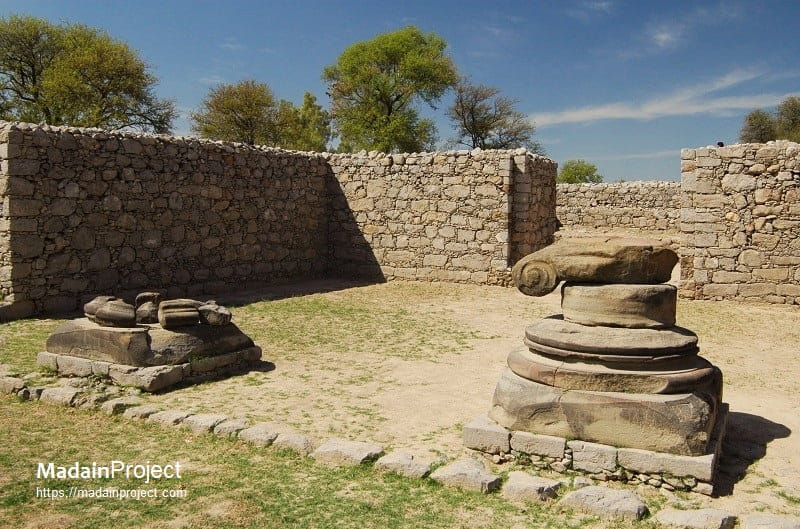
In the northwestern Indian subcontinent, the Jandial Temple, near Taxila present day Pakistan, presents one of the clearest examples of Ionic influence. Its use of columns with Ionic capitals (inspect) indicates not merely stylistic borrowing but the presence of Hellenistic architectural knowledge in the region.
Further east, elements resembling Ionic capitals appear in Mauryan imperial contexts. The Pataliputra capital (3rd century BCE) and the Sarnath capital exhibit features described as “Perso-Ionic” or “quasi-Ionic”, suggesting a synthesis of Achaemenid Persian and Greek forms. These hybridizations demonstrate that the Ionic order functioned as a transferable and adaptable visual language within imperial and cross-cultural settings.
Roman Interpretation
By the late Republic and early Empire, Roman architects had assimilated and systematized the Ionic order within a broader canon of classical architecture. The most influential theoretical account is that of Vitruvius, whose treatise De Architectura (late 1st century BCE) remains the only complete architectural text from antiquity.
Vitruvius famously interprets the Ionic order anthropomorphically, associating it with feminine proportions—more slender and ornamented than the Doric style, yet less elaborate than the Corinthian. While he does not cite explicit sources, this interpretive framework likely derives from Hellenistic theoretical traditions. His account also codifies proportional relationships and details, contributing to the later standardization of the order.
A well-preserved Roman example is the Temple of Portunus (traditionally called the Temple of Fortuna Virilis), which displays a canonical Ionic façade with engaged columns and a high podium (inspect), illustrating the Roman adaptation of Greek forms to Italic temple typologies.
Renaissance and Early Modern Period
The rediscovery of Vitruvius during the Renaissance led to a renewed theoretical and practical engagement with the Ionic order. Architects and theorists such as Andrea Palladio and Giacomo Barozzi da Vignola systematized the classical orders into prescriptive rules, drawing heavily on Vitruvian principles.
In this period, the Ionic order acquired symbolic associations: it was understood as “matronly”, embodying balance, learning, and civility. Consequently, it was frequently employed in buildings associated with intellectual and legal functions, such as libraries and courts.
A key moment in the dissemination of a canonical Ionic model was the publication of Les édifices antiques de Rome (1682 CE) by Antoine Desgodetz. His detailed engravings of Roman monuments, including the Temple of Portunus, provided accurate visual references that were widely copied across Europe, standardizing the Ionic order in early modern architectural practice.
circa 650 BCE-
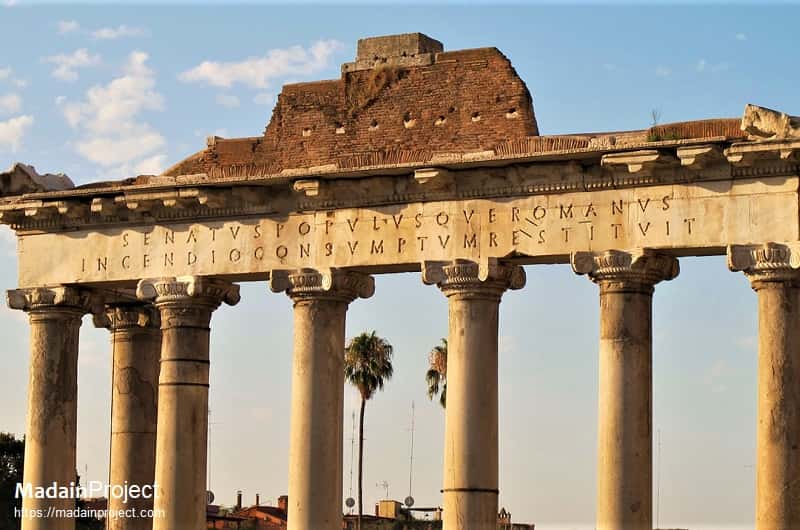
Entablature
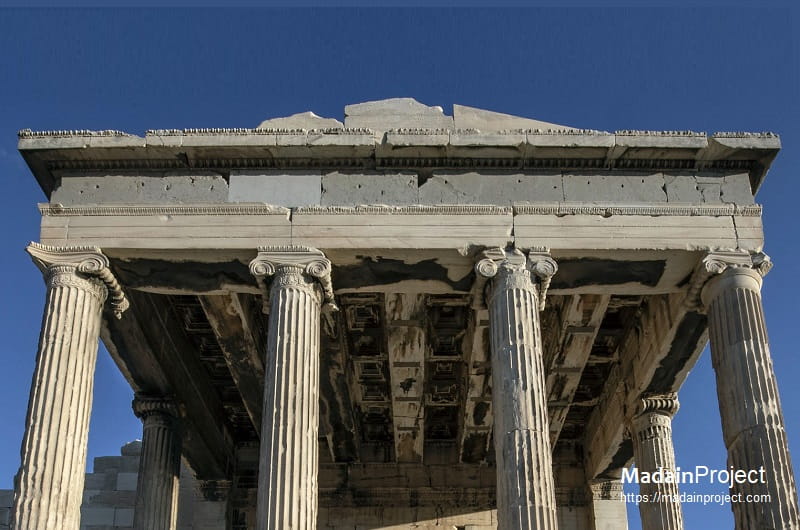
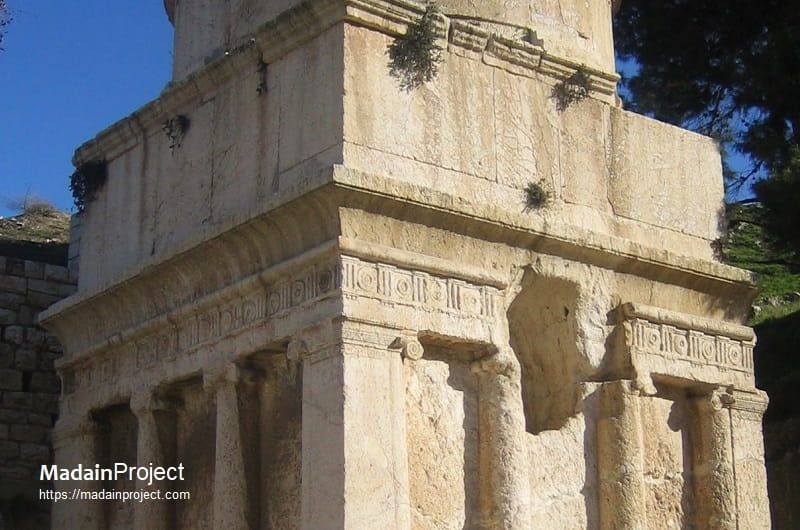
The entablature of the Ionic order (inspect) is distinguished by its tripartite horizontal division into architrave, frieze, and cornice, each articulated with a degree of refinement absent in earlier Doric precedents. The architrave is typically subdivided into three horizontal fasciae, slightly projecting one over the other, producing a graduated visual effect that emphasizes linear continuity and proportional clarity. Above this, the frieze is characteristically continuous, in contrast to the triglyph–metope alternation of the Doric order, and was frequently employed as a sculptural field for narrative reliefs, as exemplified in the Greek Erechtheion temple as well as the Roman Temple of Saturn. The cornice projects outward to protect the structure and is often enriched with dentils—small, regularly spaced rectangular blocks—forming a distinctive decorative motif associated with the Ionic order. This entablature composition reflects both structural logic and aesthetic elaboration, aligning with the Ionic preference for surface articulation and ornamental continuity.
circa 650 BCE-
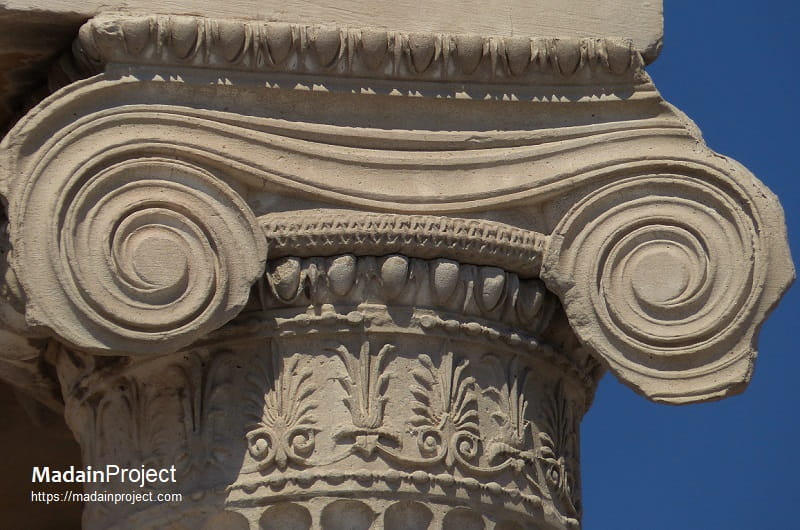
Capital
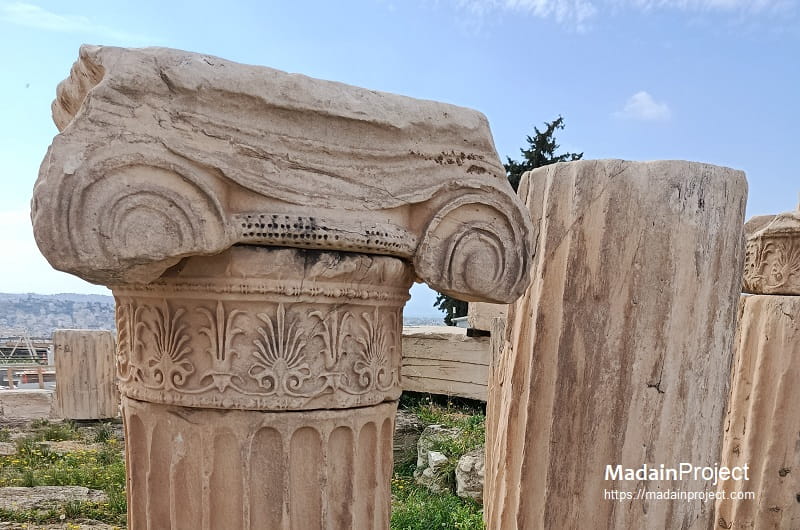
The Ionic capital is defined by its bilateral volutes, which spiral outward from a central axis, forming the most recognizable feature of the order. These volutes are connected by a curved echinus, often decorated with egg-and-dart ornamentation, and support a relatively thin abacus compared to that of the Doric order. The capital mediates between the vertical shaft and the horizontal entablature, resolving structural transition through both geometry and ornament. Its origins are often linked to Near Eastern prototypes, though its canonical form was established in Archaic period Ionia and refined in major monuments such as the Temple of Artemis at Ephesus. A persistent technical challenge in Ionic design was the treatment of corner capitals, as the standard volute arrangement presents a frontal orientation; this led to later innovations, including the development of angled or diagonal volutes in the Classical and Hellenistic periods. The Ionic capital thus represents both a formal and technical evolution within Greek architectural practice.
circa 650 BCE-
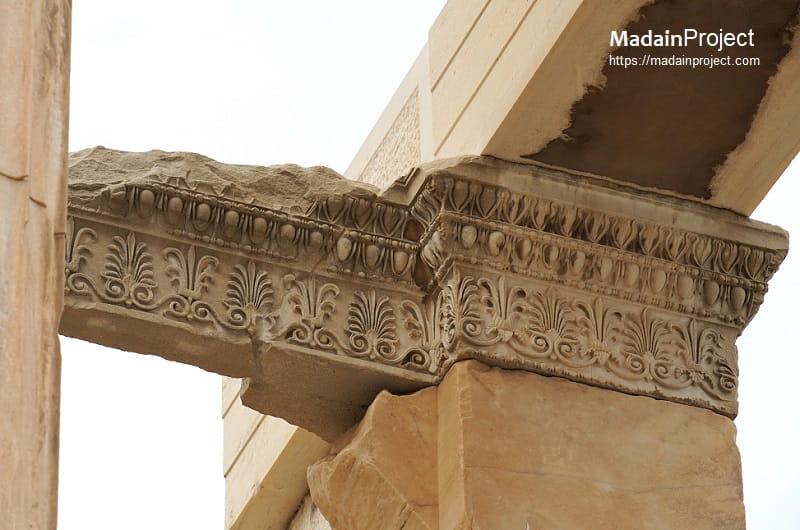
Ionic Anta Capital
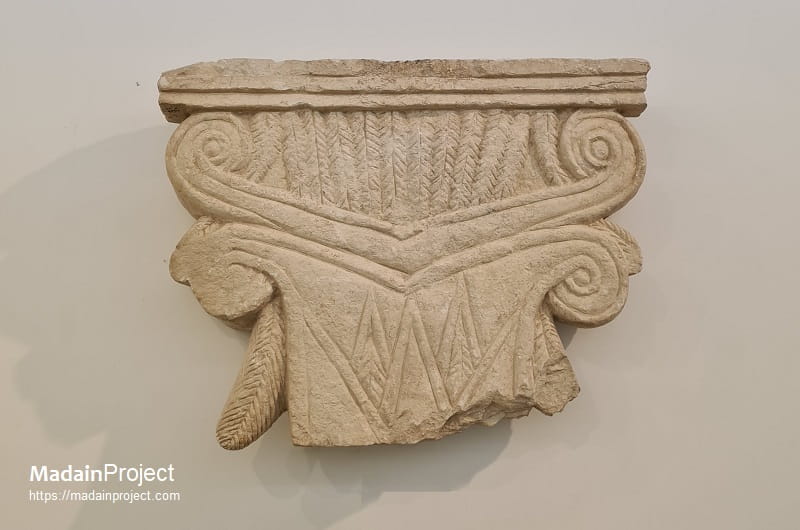
The anta capital in the Ionic order, positioned atop the antae (terminal walls of a structure), constitutes a distinct variation within the Ionic order, differing significantly from the columnar capital in both form and function. It was used where the sides terminated in walls rather than columns. And instead of employing volutes, the Ionic anta capital is typically composed of a series of horizontal moldings, often including a cyma reversa profile and decorative bands such as palmettes or anthemia. This rectilinear emphasis corresponds to the planar nature of the wall it terminates, creating a coherent visual transition between vertical wall surfaces and the entablature. Examples of Ionic anta capitals are evident in Asia Minor and mainland Greek architecture, and their influence can be traced in later adaptations such as the Pataliputra capital, which exhibits formal affinities with Ionic anta prototypes. The anta capital demonstrates the adaptability of the Ionic decorative system to different architectural elements while maintaining stylistic coherence.
circa 650 BCE-
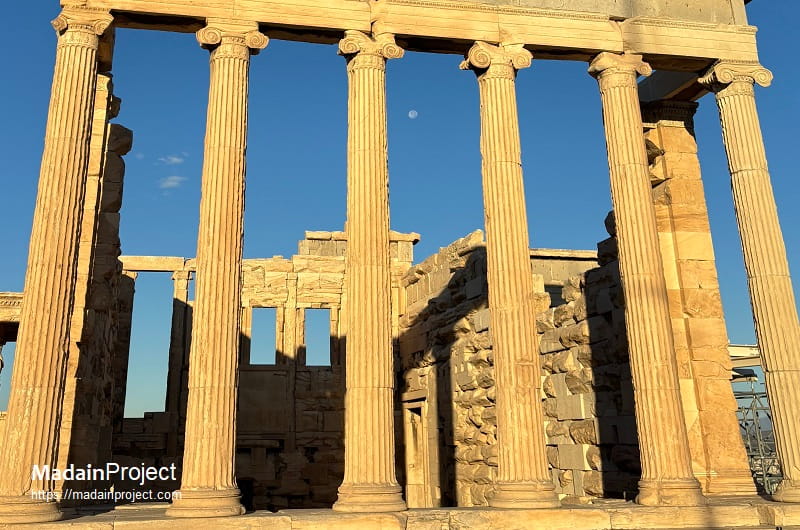
Column
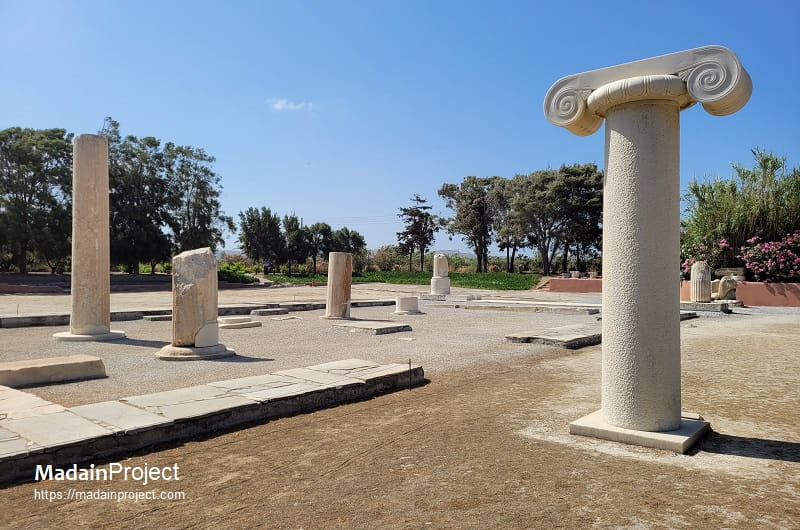
The Ionic column is characterized by its comparatively slender proportions, typically ranging from eight to nine diameters in height, contributing to an overall impression of elegance and verticality. It stands on a molded base—commonly the Attic base—composed of alternating torus and scotia elements, distinguishing it from the base-less Doric column. The shaft is usually fluted with twenty-four narrow, closely spaced channels separated by fillets, enhancing the play of light and shadow across its surface. This articulation reinforces the column’s visual lightness and rhythmic refinement. The Ionic column was widely employed in both sacred and civic architecture, as seen in structures such as the Parthenon, where Ionic elements complement a primarily Doric scheme. Its development reflects a synthesis of structural necessity and decorative intent, establishing it as a versatile and enduring component of classical architectural vocabulary.



Signup for our monthly newsletter / online magazine.
No spam, we promise.

The Madain Project is an online archive of Abrahamic History and Archaeology.
Abrahamic History & Archaeology is the study of history and archaeology with respect to the three Abrahamic Faiths without considering the religious and theological aspects. The goal of Abrahamic History is to understand how and why the religious doctrines and behaviours have evlovled and changed over time. Searching for patterns in the evolution of significant cultural events such as the development of farming, the emergence of cities, or the collapse of major civilizations for clues of why and how these have influenced the three major Abrahamic religions.
Cloud Drive -
About -
Help -
Editorial Policy -
AI Policy -
Privacy Policy -
Contact
Madain Project: Encyclopedia of Abrahamic History & Archaeology.
Copyright MadainProject 2017 - 2026.