
The Philippeion is an ancient tholos structure located in the sanctuary of Olympia in Greece, renowned for both its historical and architectural significance. It was originally built in the 4th century BCE and stands as an emblematic symbol of the confluence of Greek religious devotion, artistic innovation, and political expression. It was erected by King Philip II of Macedon to commemorate his victories and to honor his family, including his son, Alexander the Great. The Philippeion represents a distinctive blend of Greek tradition and Macedonian royal prestige, situated in the heart of one of the ancient world's most important religious and athletic centers.
The Philippeion of Olympia, commissioned by Philip II of Macedon following the Battle of Chaeronea in 338 BCE and completed by Alexander the Great, is a landmark tholos (circular building) within the sacred Altis. Situated west of the Temple of Hera, it is the only circular structure in the sanctuary and represents a critical transition toward Hellenistic architectural forms by blending diverse orders and royal iconography.
The Philippeion, formally called the Philippeion of Olympia (Φιλιππείο Αρχαίας Ολυμπίας), is a circular, Ionic temple that was built in the sanctuary of Olympia, specifically within the precinct dedicated to Zeus. It was intended not only as a monument to honor the Macedonian royal family but also as an important symbol of the expanding influence of Macedon in the Greek world. The temple's connection to the royal family of Macedonia is especially notable, as it was commissioned by Philip II to celebrate his military achievements, particularly his victory at the Battle of Chaeronea in 338 BCE. The building also housed statues of Philip, his wife Olympias, and their famous son, Alexander the Great, thus further emphasizing the dynastic nature of the structure.
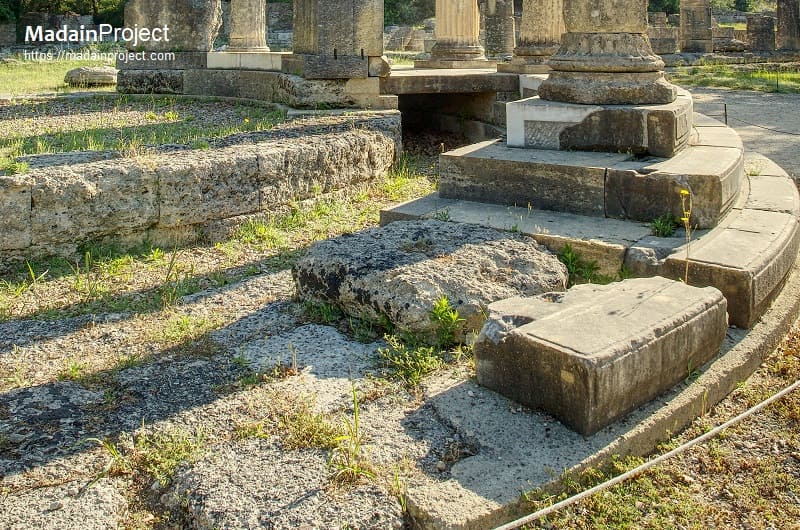
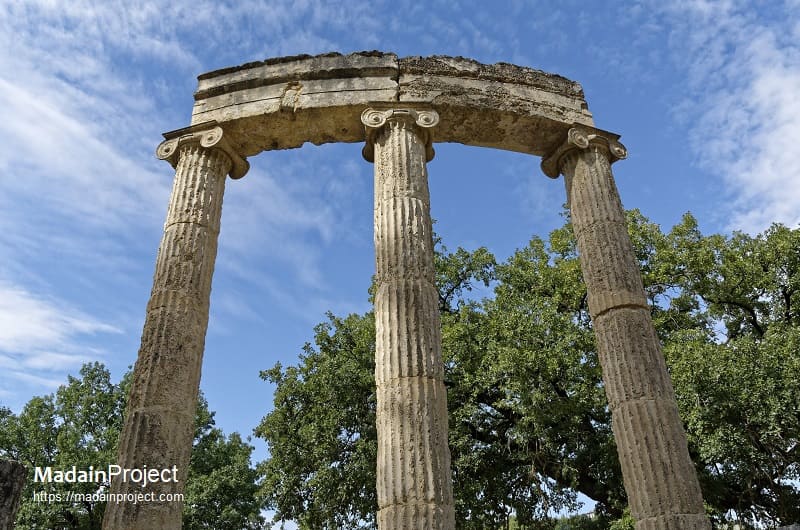
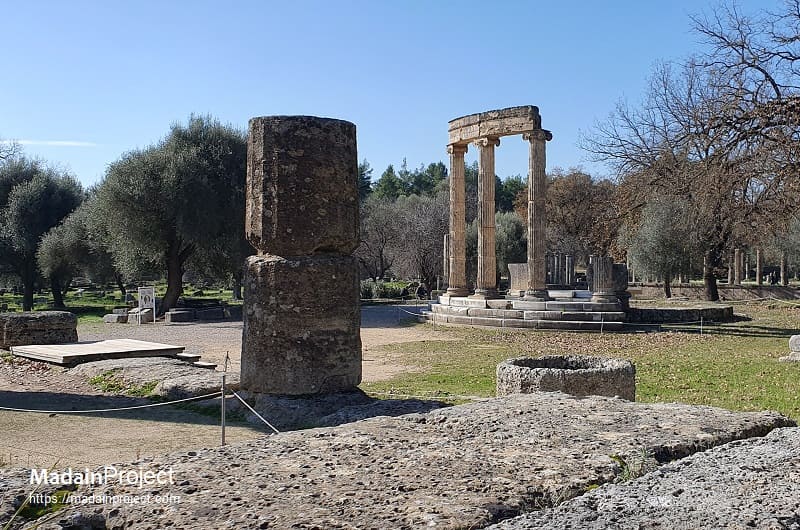
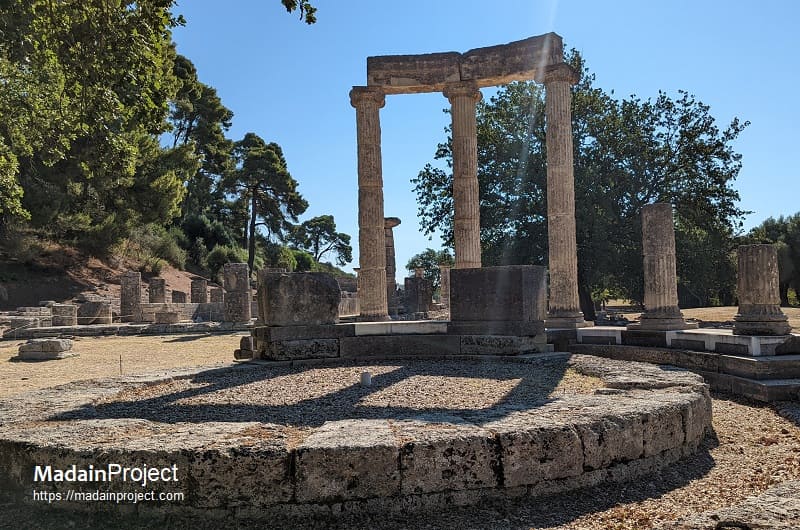
As of 2026, the monument exists in a partially restored state. A significant restoration campaign was facilitated by the Berlin Museum's 2004 return of ten original architectural members, including fragments of the base, columns, a Corinthian capital, and portions of the marble roof. Visitors to the site can observe the foundations, the restored portions of the three-stepped base, and selected re-erected columns.

circa 337 BCE

The construction of the Philippeion was directly tied to the military successes and political ambitions of Philip II, the king of Macedon. After his decisive victory at the Battle of Chaeronea in 338 BCE, where he defeated the Greek ancient city-states of Athens and Thebes, Philip sought to further solidify his dominance over Greece. His establishment of the Corinthian League, a federation of Greek states under his leadership, was a clear political maneuver aimed at unifying the Greek world under Macedonian hegemony.
As part of his efforts to reinforce his power and prestige, Philip also sought to associate himself with the religious and cultural unity that the Altis precinct of the Sanctuary of Olympia represented. By commissioning the Philippeion, Philip not only commemorated his own military accomplishments but also elevated his family’s status within the context of Greek religious life. His connection to the ancient gods and heroes was underscored by the construction of this monument, which was placed in a site already revered by Greeks for its association with Zeus and the Olympic Games.
The temple was completed after Philip’s assassination in 336 BCE, under the reign of his son, Alexander the Great, who took over the leadership of Macedonia. Alexander’s influence on the monument is notable not just because his own image was featured within the temple, but because the completion of the Philippeion marked a significant moment in the transition of power from Philip to his son, whose legacy would eventually reshape the entire known world. The temple thus served both as a memorial to the achievements of Philip and a symbol of the new era under Alexander.
During the Roman period, the Philippeion continued to be regarded as an important structure. However, over the centuries, it fell into disrepair and was eventually destroyed. Today, only the foundations of the temple remain, and it is a site of archaeological interest. The remnants of the Philippeion are crucial in understanding the Macedonian influence on Greek architecture, as well as the ways in which political and religious power were visually represented in the ancient world.
circa 337 BCE
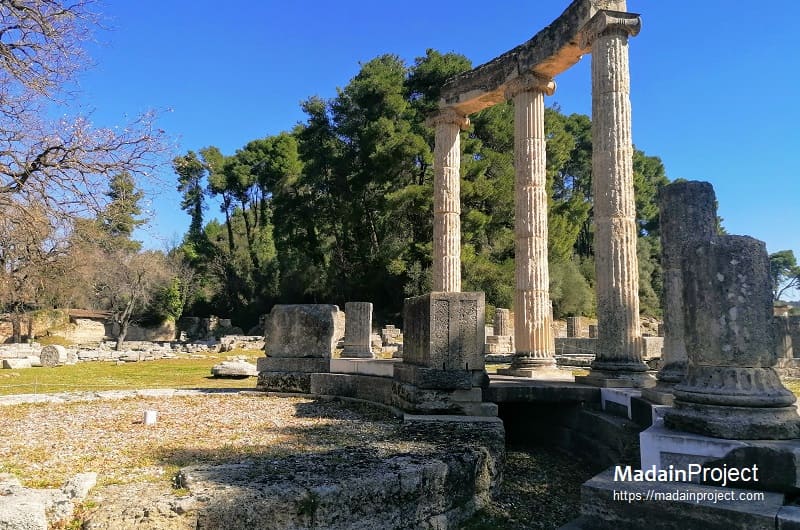
The architecture of the Philippeion is distinguished by a refined yet ideologically charged design that combines Macedonian royal self-representation with established Greek architectural forms. The building is a circular structure, or tholos, an uncommon choice within Greek sacred architecture and particularly striking in the largely rectilinear architectural landscape of the sanctuary of ancient Olympia. Measuring approximately 15.3 meters in diameter, it rests on a three-stepped marble stylobate that elevates the monument both physically and symbolically above its surroundings, underscoring its exceptional status among the sanctuary’s buildings.
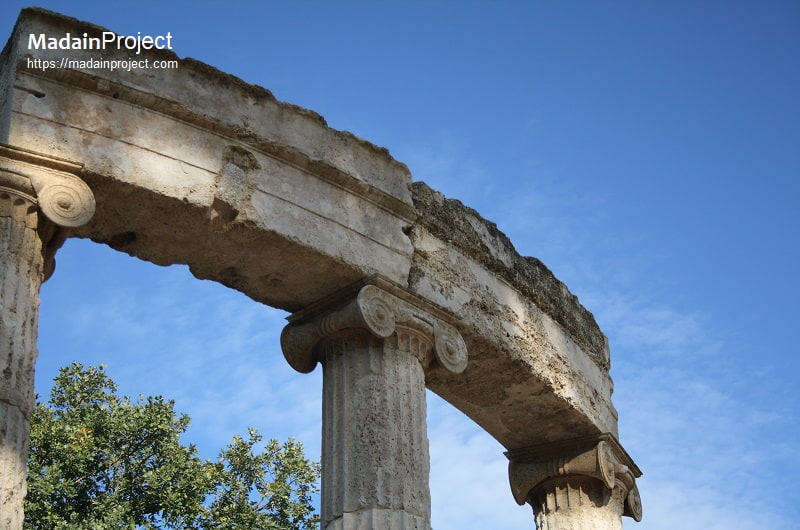
The primary exterior elevation is articulated by a peripteral colonnade of eighteen Ionic columns (inspect) of the Attic type, rather than the larger number traditionally assumed in earlier reconstructions. These columns, crafted from Pentelic marble, encircle the structure and lend it a sense of rhythmic balance and visual lightness consistent with Ionic ideals of proportion and elegance. The use of the Ionic order situates the Philippeion firmly within the mainstream of Greek architectural tradition, even as its circular plan marks a deliberate departure from conventional temple design. This synthesis allowed the monument to assert Macedonian prestige while remaining intelligible within a panhellenic religious context.
Behind the colonnade lies the cella, or naos, whose interior decoration is unusually elaborate for the period. The inner wall is articulated by nine engaged Corinthian half-columns, representing an early and notably lavish use of the Corinthian order. This choice anticipates later Hellenistic preferences and contributes to the monument’s air of innovation and luxury. Adding to this distinctiveness, the naos was pierced by two windows, a feature rare in Greek tholoi and otherwise attested in monumental architecture such as the so-called Hera II temple at Paestum. These openings would have modulated light within the interior, enhancing the visual impact of the sculptural group housed inside.
The material palette of the Philippeion reinforces its elite character. While the exterior columns and base were executed in high-quality Pentelic marble, the interior walls were constructed primarily of poros limestone blocks. The roof was covered with marble tiles and supported an ornate stone entablature adorned with antefixes and marble sima fitted with lion-head spouts for water drainage. At the apex of the conical roof stood a decorative bronze finial, described as a poppy-head or floral ornament, which provided a conspicuous crowning element visible from afar.
The interior surfaces of the cella were finished with red stucco marked by fine white joints, an illusionistic treatment intended to imitate carefully laid brickwork and to enhance the visual richness of the space. Directly opposite the entrance stood a semi-circular podium bearing five chryselephantine statues sculpted by Leochares. These figures represented Philip II of Macedon, his wife Olympias, their son Alexander the Great, and Philip’s parents, Amyntas III and Eurydice. The choice of gold and ivory, materials traditionally reserved for cult statues of gods, is of particular significance, as it suggests a deliberate elevation of the Argead dynasty toward a quasi-divine status. Within the sacred landscape of Olympia, the Philippeion thus functioned not merely as an architectural curiosity, but as a powerful visual statement of dynastic legitimacy, innovation, and the emerging ideology of ruler veneration.
Signup for our monthly newsletter / online magazine.
No spam, we promise.

The Madain Project is an online archive of Abrahamic History and Archaeology.
Abrahamic History & Archaeology is the study of history and archaeology with respect to the three Abrahamic Faiths without considering the religious and theological aspects. The goal of Abrahamic History is to understand how and why the religious doctrines and behaviours have evlovled and changed over time. Searching for patterns in the evolution of significant cultural events such as the development of farming, the emergence of cities, or the collapse of major civilizations for clues of why and how these have influenced the three major Abrahamic religions.
Cloud Drive -
About -
Help -
Editorial Policy -
AI Policy -
Privacy Policy -
Contact
Madain Project: Encyclopedia of Abrahamic History & Archaeology.
Copyright MadainProject 2017 - 2026.


