
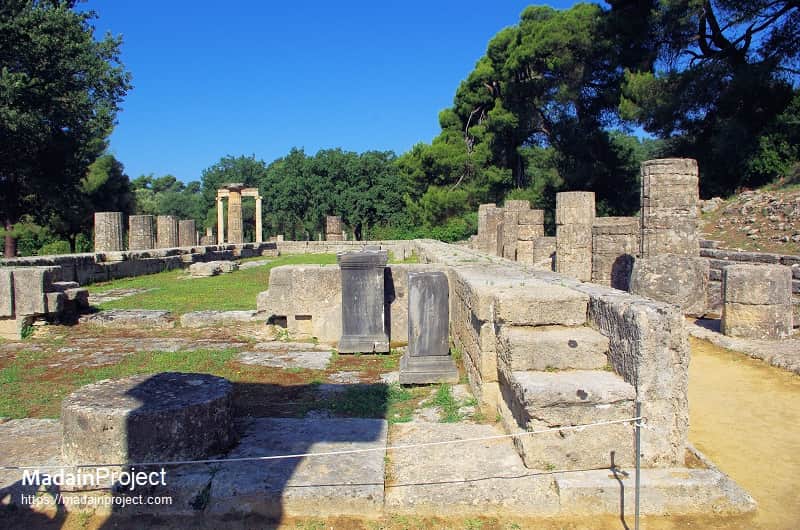
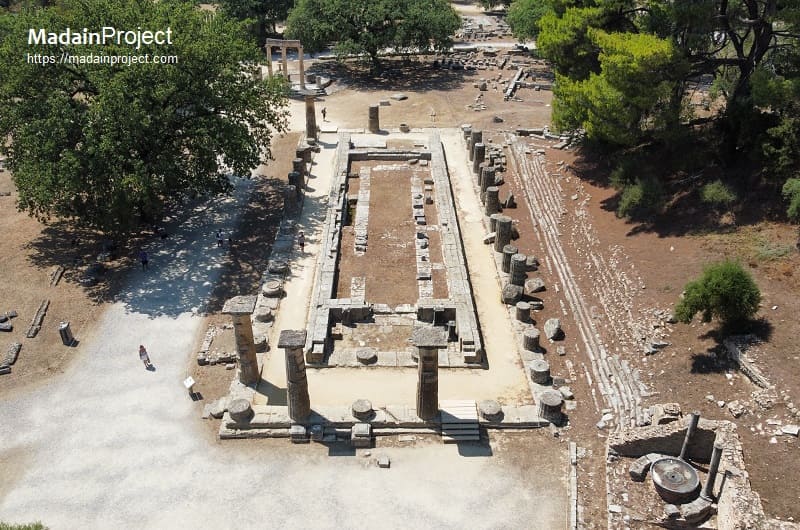
The Temple of Hera (Ναός της Ήρας) at ancient Olympia is an ancient Greek religious structure dedicated to Hera, the queen of the Olympian gods, situated within the sanctuary of Olympia in the region of Elis, on the western Peloponnesian peninsula of Greece. As one of the earliest monumental temples in the Doric order, it embodies the architectural and ritualistic conventions of Archaic Greece while serving as a central site for cult practices and Panhellenic athletic festivities.
Located at the southern end of the Altis precinct, the sacred precinct of Olympia, the Temple of Hera functioned primarily as a place of worship and ritual observance, particularly connected to the Olympic Games and the veneration of Hera as a divine patroness of women and marriage. Constructed entirely in local limestone and later coated with stucco to imitate marble, the temple exemplifies early Doric proportions, demonstrating a transition from the wooden prototypes of the 8th and 7th centuries BCE to more durable stone construction. The temple’s form and scale reflect both religious and civic significance: its presence dominated the Altis, marking the space as sacred while also symbolizing communal dedication to the Olympian pantheon.
circa 337 BCE

The Temple of Hera was constructed circa 590 BCE during the Archaic period under the direction of architects and artisans from the Peloponnesus, though specific names of the builders remain unrecorded in surviving historical sources. Ancient literary references, including Pausanias’ Description of Greece in the 2nd century CE, attest to its central role in ancient Olympia and note its status as one of the oldest temples within the sanctuary. Over the centuries, the temple underwent minor restorations and modifications, particularly during the Classical period, when elements such as the roof tiles were replaced and interior cult statues were refurbished.
The temple’s longevity is also evidenced by Roman-era interventions, including repairs and dedications, reflecting continued veneration well into the Imperial period. Its historical significance is compounded by its association with the Heraia, the female athletic competitions held in honor of Hera, which paralleled the male Olympic Games. Excavations by the German Archaeological Institute in the 19th and 20th centuries CE revealed extensive foundations, column drums, and fragments of the entablature, confirming the temple’s early Archaic origins and providing insight into construction techniques of the period.
circa 337 BCE
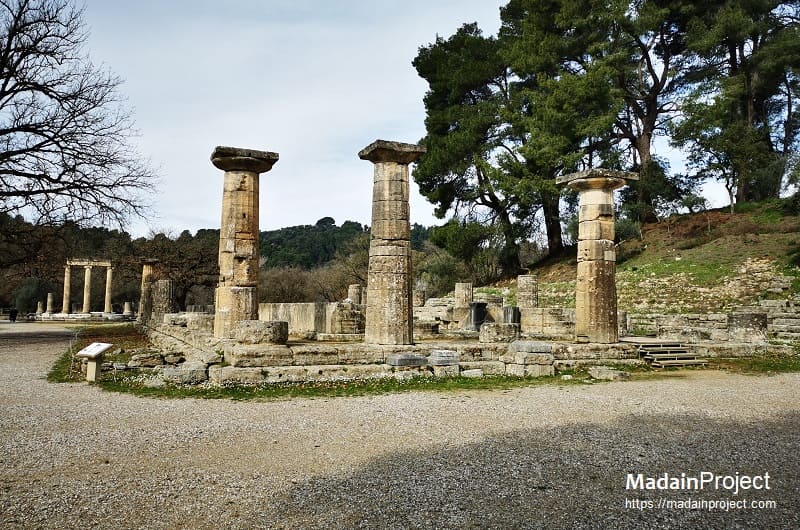
The Temple of Hera at Olympia is a peripteral Doric order temple measuring approximately 50 meters in length and 18.75 meters in width, with a total of 6 columns at the façade (hexastyle) and 16 along the flanks. Its floor plan follows a typical Archaic formula with a pronaos (front porch), a naos or cella (central cult chamber), and an opisthodomos (rear porch), though the interior layout also includes two rows of interior columns supporting a wooden roof structure. The columns are monolithic limestone drums with shallow fluting characteristic of early Doric design, standing at roughly 7.5 meters in height and capped with simple echinus and abacus capitals.
The entablature, partially preserved, originally featured a plain architrave with a frieze composed of alternating triglyphs and metopes, the latter of which may have been adorned with painted reliefs depicting mythological scenes, as suggested by remnants of pigment and descriptions by ancient travelers. The roof consisted of terracotta tiles with antefixes, and the interior housed a cult statue of Hera, likely made of wood (xoanon), clothed and decorated in accordance with ritual conventions. Despite its relatively austere decorative scheme compared to later Classical period temples, the temple’s proportions, column spacing, and stylistic details demonstrate a careful balance of aesthetic harmony and structural stability characteristic of early Doric architecture.




Signup for our monthly newsletter / online magazine.
No spam, we promise.

The Madain Project is an online archive of Abrahamic History and Archaeology.
Abrahamic History & Archaeology is the study of history and archaeology with respect to the three Abrahamic Faiths without considering the religious and theological aspects. The goal of Abrahamic History is to understand how and why the religious doctrines and behaviours have evlovled and changed over time. Searching for patterns in the evolution of significant cultural events such as the development of farming, the emergence of cities, or the collapse of major civilizations for clues of why and how these have influenced the three major Abrahamic religions.
Cloud Drive -
About -
Help -
Editorial Policy -
AI Policy -
Privacy Policy -
Contact
Madain Project: Encyclopedia of Abrahamic History & Archaeology.
Copyright MadainProject 2017 - 2026.


