
The Leonidaion (Λεωνιδαίο) of Olympia is an ancient Greek architectural complex within the sanctuary of Olympia (today an archaeological site) that served as distinguished lodging for visitors (athletes) attending the Olympic Games. It stands as one of the most substantial secular structures in the sanctuary, reflecting both the architectural ambitions of the late Classical period and early Hellenistic period and the social transformations of Olympia as a pan-Hellenic religious and athletic center.
The Leonidaion occupies a prominent location at the southwest edge of the Altis precinct, the sacred precinct dedicated to Zeus in Olympia. Constructed about 330 BCE, the building was both funded and designed by Leonidas of Naxos, a Greek architect and benefactor whose name it bears.
Its placement outside the central cultic axis and its substantial footprint made it visible to visitors arriving at the sanctuary, emphasizing its role as a central hub for hospitality rather than a temple or ritual monument. Throughout antiquity, the Leonidaion was repeatedly adapted to suit changing needs, but its primary function remained tied to hosting elite visitors—athletes, officials, and dignitaries—during the Olympic festivals including Olympic Games.

circa 337 BCE

The inception of the Leonidaion occurred during a transformative moment in Greek history. Following the rise of Macedonian power after the battle of Chaeronea in 338 BCE, Olympia saw a renewed wave of building activity. Local elites and benefactors contributed monumental structures that both enhanced the sanctuary and demonstrated their own prestige.
The Leonidaion was established around 330 BCE through the patronage of Leonidas of Naxos, who may also have been responsible for its overall conception. From its inception in the late Classical to early Hellenistic period, the building functioned as a prestigious hospitality complex positioned southwest of the sacred Altis. It was intended to accommodate eminent visitors to Olympia, including athletes, officials, and benefactors attending the Panhellenic Games. In this context, the Leonidaion formed part of a broader wave of large-scale, non-cultic construction that reflected the increasing institutional and social complexity of major Greek sanctuaries during the Hellenistic age.
Following the Roman annexation of Greece, the Leonidaion underwent a substantial change in function and status. Rather than serving as a communal guesthouse associated with the Games, it was transformed into an elite residence for Roman administrators and high-ranking visitors to the sanctuary. This phase was characterized by an emphasis on comfort, display, and controlled leisure, aligning the building more closely with Roman ideals of aristocratic living. The shift in use illustrates the broader reorientation of Olympia under Roman rule, where traditional Greek religious practices persisted but were increasingly framed within an imperial administrative and cultural landscape.
The active residential life of the Leonidaion came to an end in the later third century CE. A major earthquake, likely occurring during the reign of Diocletian, one of the Roman emperors, severely damaged the structure and rendered it uninhabitable. This destruction coincided with a period of heightened insecurity in the region, exacerbated by incursions attributed to the Herulians. In the aftermath, the abandoned complex was systematically dismantled, and its building materials were reused in the construction of defensive works intended to fortify the core of the sanctuary. This process of spoliation marks the final stage of the Leonidaion’s integration into the living fabric of Olympia.
Excavations undertaken by German teams between 1878 and 1881 CE revealed the northern portion of the structure, and further work between 1954 and 1956 CE under the direction of Emil Kunze extended the understanding of its plan and construction. Despite its scale and prominence, the Leonidaion has lacked a comprehensive formal architectural survey until recent archaeological interest revived scholarly attention to its design and history.
In modern scholarship, the Leonidaion continues to play a significant role in the archaeological understanding of Olympia’s development beyond its monumental temples. Since 2014 CE, a long-term research initiative led by the German Archaeological Institute has applied non-invasive methods, including geophysical survey and LiDAR analysis, to reassess the site. Ongoing studies focus on the building’s infrastructure and its adaptation over time, with particular attention to changes in resource management between the Late Classical and Hellenistic periods. As of 2025 CE, this work underscores the Leonidaion’s value as evidence for the evolving social, administrative, and practical demands placed on major sanctuaries in antiquity.
circa 337 BCE

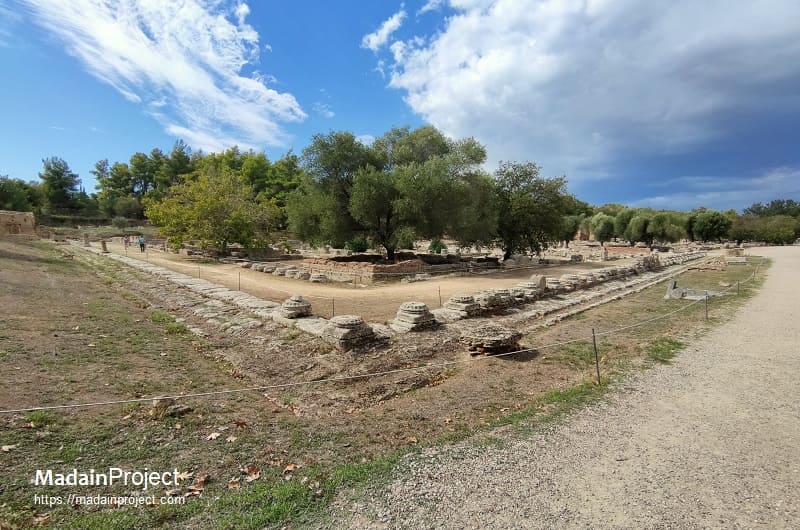
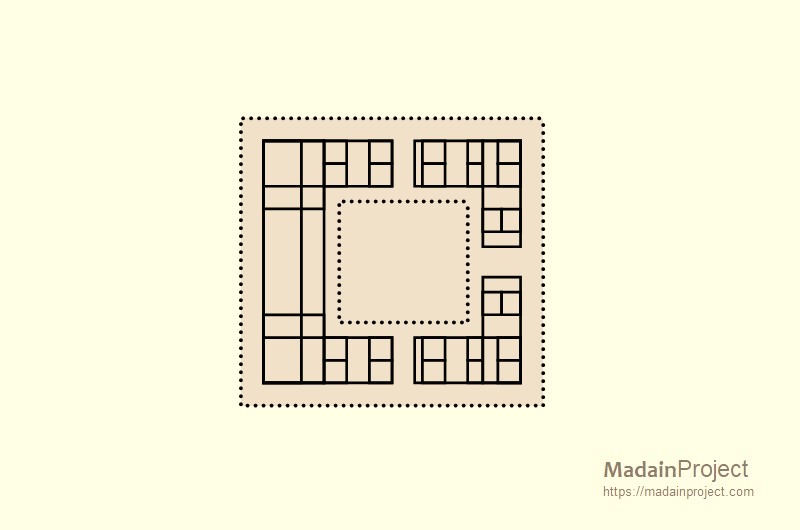
The Leonidaion of Olympia is distinguished by its exceptional scale and carefully articulated architectural organization, representing the most extensive non-sacral structure within the sanctuary. The building is laid out on a rigorous rectangular plan measuring approximately 74.1 by 81.1 meters, enclosing a total area of more than 6,000 square meters. Its design reflects a deliberate emphasis on symmetry, axial clarity, and controlled circulation, qualities appropriate to a monumental residence intended for elite occupancy within a panhellenic setting.
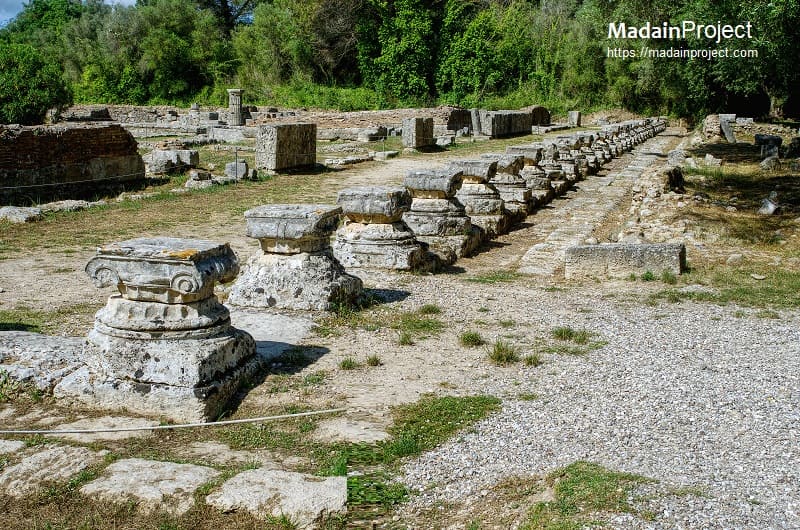
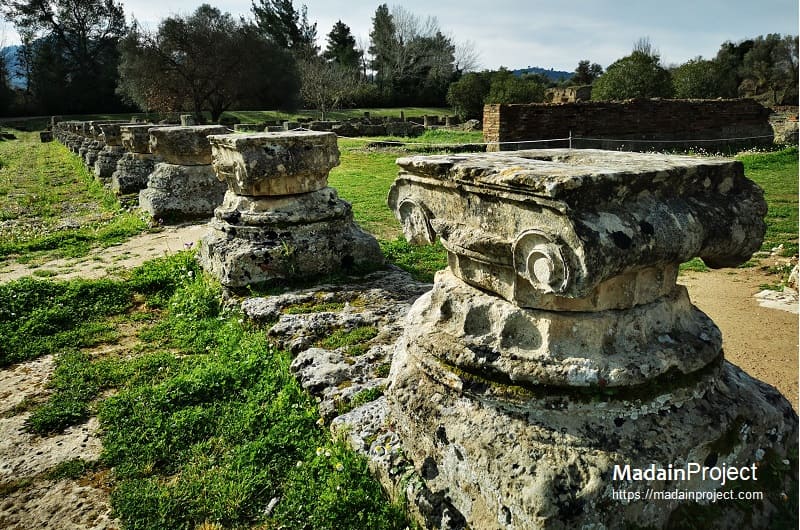
The exterior of the complex is defined by a continuous Ionic colonnade running along all four sides, forming a peristyle of 138 columns, each rising to a height of roughly 5.55 meters. This enveloping colonnade creates a monumental ambulatory that mediates between the interior spaces and the surrounding sanctuary, offering both protection from the elements and a strong visual presence. The exclusive use of the Ionic order on the exterior establishes a refined and cosmopolitan character, while also distinguishing the outer façade from the more restrained internal architectural language.
Behind the outer colonnade, the internal organization is structured around a large open courtyard that functions as the spatial and functional core of the complex. This courtyard is surrounded by a Doric order peristyle composed of 44 columns, arranged evenly along its four sides. The contrast between the Ionic exterior and Doric interior exemplifies a sophisticated interplay of architectural orders, a characteristic feature of large-scale Greek buildings of the late Classical and early Hellenistic periods. The courtyard facilitated light, ventilation, and movement, serving as the primary distribution space for the surrounding rooms.
Residential and service spaces were arranged in continuous bands between the inner and outer colonnades, extending along all four sides of the building. These rooms were designed with varying depths, indicating a hierarchy of accommodation. The west wing is notably deeper, measuring approximately 15 meters compared to the roughly 10-meter depth of the other sides, allowing for larger and more prestigious suites. Access to the complex was provided through formal entrances on the north and south sides, reinforcing the building’s axial symmetry and facilitating controlled movement into the interior.
In later architectural phases, the central courtyard was substantially reconfigured, replacing the original open space with a landscaped garden dominated by an ornamental water feature and an intricate system of channels. This transformation introduced a more visually elaborate and sensorial environment, aligning the interior with Roman residential aesthetics while retaining the fundamental structural framework of the building. The integration of a nearby bath complex further expanded the architectural ensemble, linking the Leonidaion to a broader system of amenities through coordinated planning. Despite subsequent damage and dismantling, the preserved foundations and architectural fragments attest to the Leonidaion’s original coherence, scale, and architectural ambition.
Signup for our monthly newsletter / online magazine.
No spam, we promise.

The Madain Project is an online archive of Abrahamic History and Archaeology.
Abrahamic History & Archaeology is the study of history and archaeology with respect to the three Abrahamic Faiths without considering the religious and theological aspects. The goal of Abrahamic History is to understand how and why the religious doctrines and behaviours have evlovled and changed over time. Searching for patterns in the evolution of significant cultural events such as the development of farming, the emergence of cities, or the collapse of major civilizations for clues of why and how these have influenced the three major Abrahamic religions.
Cloud Drive -
About -
Help -
Editorial Policy -
AI Policy -
Privacy Policy -
Contact
Madain Project: Encyclopedia of Abrahamic History & Archaeology.
Copyright MadainProject 2017 - 2026.


