
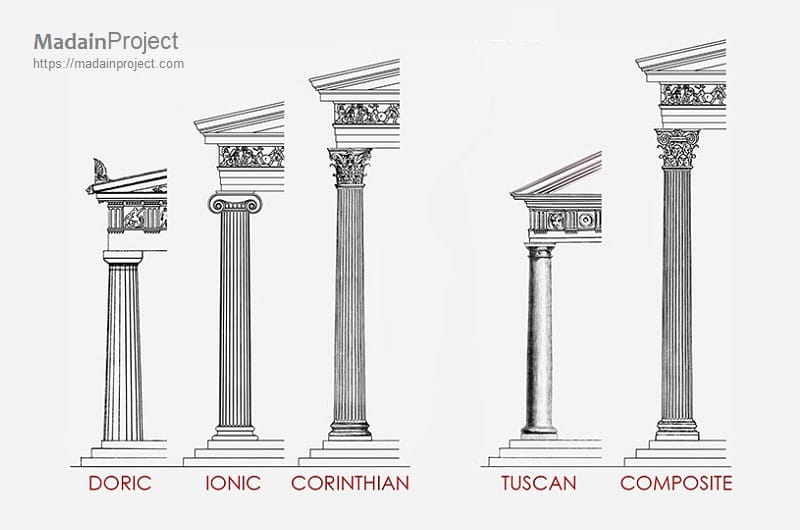
The Classical Order referes to a standardized system of architectural elements, proportions and decorative motifs that governs the relationship between a vertical column (the support) and a horizontal entablature (the load). Originating in the Classical Greco-Roman they represent the styles of classical architecture, each distinguished by its characteristic profiles, proportions and sculptural details. It serves as a grammatical framework for classical design, ensuring that every element—from the base of the column to the apex of the roofline—is harmoniously scaled. Each order is distinguished by its specific profile, the ornamentation of its capital, and its unique mathematical ratios, which are typically based on the diameter of the column shaft.
The orders represent the first systematic attempt to codify beauty through geometry and symmetry. Originating in ancient Greece and later refined by the Romans, these styles were more than mere decoration; they were viewed as an expression of cosmic order. During the Renaissance, architects like Palladio formalised these styles into a strict hierarchy. The orders are traditionally ranked by their complexity and perceived "gender": the sturdy Doric is often associated with strength, the scrolled Ionic with matronly grace, and the leafy Corinthian with youthful elegance.
circa 700–31 BCE
Greek Order
The classical period Greek orders evolved from the transition of religious architecture from wood and thatch to permanent limestone and marble during the Archaic period and subsequent Classical period. This process, known as petrifaction, saw wooden beams and pegs "fossilized" into the stone features we see today, such as triglyphs and guttae. Historically, the Greek Canon is defined by a search for "The Correct Ratio", where the height and spacing of columns were dictated by the diameter of the base.
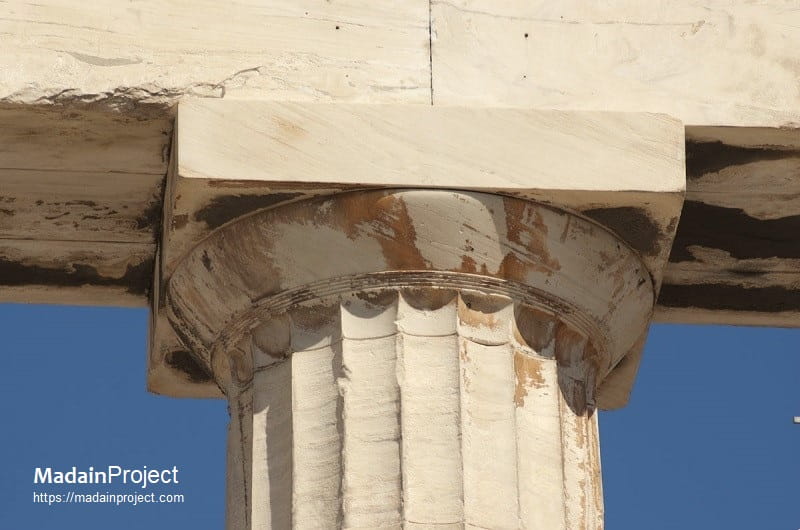
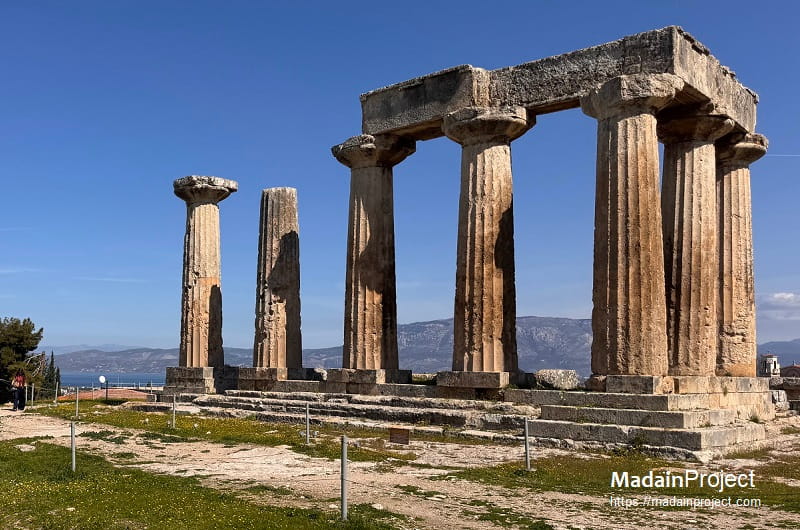
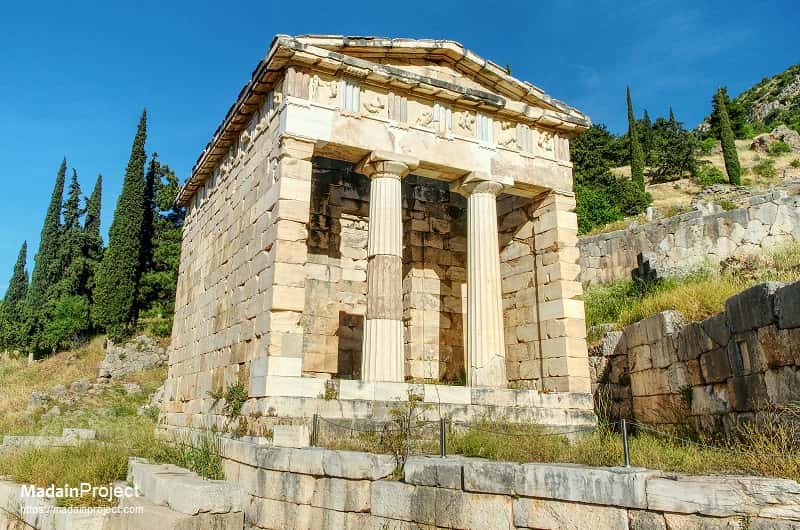
Architecturally, the Greek system is strictly trabeated (post-and-lintel), meaning the columns are always structural. The Doric order is the most austere, featuring a fluted shaft with no base and a simple, cushion-like capital (inspect). The Ionic order, appearing later in the 6th century BCE, introduced a more slender profile, a molded base, and the iconic volutes (scrolls) representing a more "feminine" elegance. The Corinthian was the final Greek development (circa 5th century BCE), characterized by a tall capital adorned with acanthus leaves, though it remained rare in Greek exterior architecture compared to its later Roman popularity.
circa 100 BCE- 476 CE

Roman Order
While the Romans inherited the Greek vocabulary, they transformed it from a structural necessity into a decorative system capable of massive scale. Historically, the Roman Canon flourished during the Imperial Period (27 BCE – 476 CE), as emperors used architecture to project power across a vast empire. Unlike the Greeks, the Romans integrated the orders with the arch and vault, often using "engaged" columns—half-columns attached to walls—that served no structural purpose other than to organize the building's visual surface.
The Romans expanded the canon into five distinct orders by adding the Tuscan and the Composite. The Tuscan is a simplified, unfluted version of the Doric, prized for its strength and utility. The Composite is a late Imperial invention (circa 1st century CE) that merges the scrolls of the Ionic with the leaves of the Corinthian to create the most ornate of all styles. A hallmark of the Roman Canon is superposition, where different orders are stacked on a single facade—starting with the "heaviest" (Tuscan or Doric) at the base and moving to the "lightest" (Corinthian or Composite) at the top, as seen in the Colosseum.

Signup for our monthly newsletter / online magazine.
No spam, we promise.

The Madain Project is an online archive of Abrahamic History and Archaeology.
Abrahamic History & Archaeology is the study of history and archaeology with respect to the three Abrahamic Faiths without considering the religious and theological aspects. The goal of Abrahamic History is to understand how and why the religious doctrines and behaviours have evlovled and changed over time. Searching for patterns in the evolution of significant cultural events such as the development of farming, the emergence of cities, or the collapse of major civilizations for clues of why and how these have influenced the three major Abrahamic religions.
Cloud Drive -
About -
Help -
Editorial Policy -
AI Policy -
Privacy Policy -
Contact
Madain Project: Encyclopedia of Abrahamic History & Archaeology.
Copyright MadainProject 2017 - 2026.


