
The Classical Roman order refers to the expanded five-part architectural canon established through the Roman appropriation and modification of the three Greek orders—Doric, Ionic, and Corinthian—supplemented by the addition of the Tuscan and Composite variants.
Unlike the Greek system, which functioned primarily as a structural post-and-lintel grammar, the Roman order evolved into a sophisticated decorative vocabulary often applied as "engaged" columns or pilasters to the face of concrete arches and vaults. This transition shifted the orders from purely tectonic necessities to a hierarchical system of surface articulation, where the five styles were organized by increasing levels of ornamentation and height-to-diameter ratios.

circa 500 BCE-
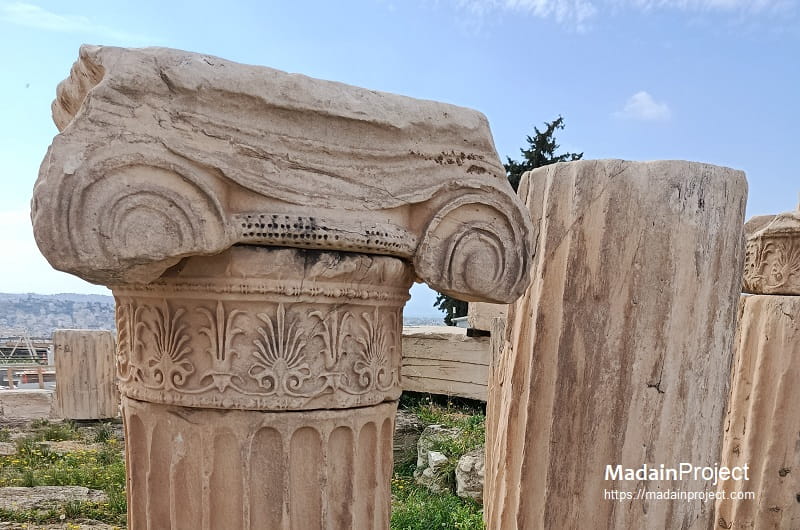
Greek Vocabulary
The Roman order adopted the three canonical Greek orders and expanded them by adding or modifying them. The Roman adaptation of the Greek vocabulary refers to the transformation of the traditional Doric, Ionic, and Corinthian systems from purely structural necessities into a versatile decorative grammar. Unlike the Greek application, where columns functioned as essential load-bearing elements in a post-and-lintel framework, the Roman approach decoupled the column from its tectonic duty, frequently employing it as an aesthetic veneer—such as engaged columns or pilasters—applied to the face of concrete arches and vaults. This transition allowed Roman architects to preserve the visual "decorum" and rhythmic symmetry of the Greek tradition while leveraging the structural freedom of advanced engineering. By standardizing the proportions of the original Greek trio into a rigid, mathematical hierarchy, Rome successfully repurposed these ancient forms into a universal imperial language capable of articulating the immense scale of its monumental public works.
circa 500 BCE-
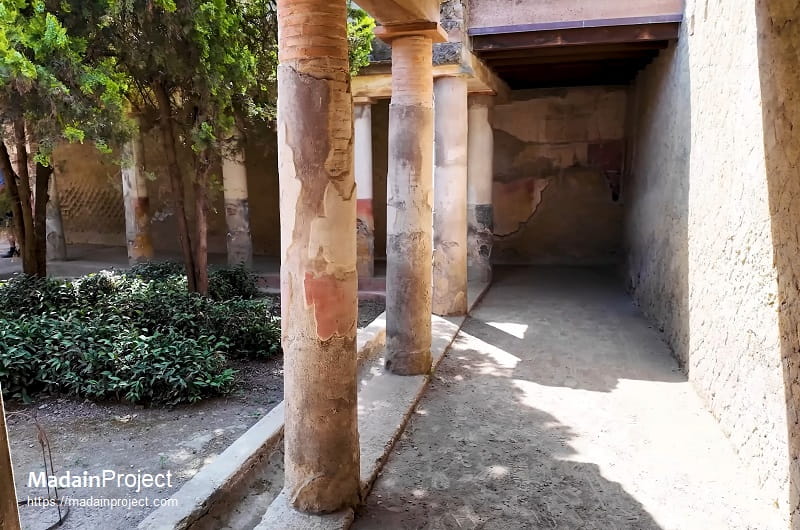
Tuscan Order
The Tuscan Order represents a specifically Roman simplification of the Doric, rooted in the architectural traditions of the Etruscans and popularized by the theorist Vitruvius. It is characterized by its notable absence of decorative detail; the column shaft is typically unfluted, standing upon a simple, circular base and supporting a minimalist capital composed of a plain echinus and abacus. This lack of ornamentation, paired with its robust proportions, led later Renaissance theorists to classify the Tuscan as the most "primitive" or "masculine" of the orders. Consequently, it was strategically employed in military or utilitarian structures, such as city gates and granaries, to project a sense of unadorned strength and structural permanence.
circa 500 BCE-
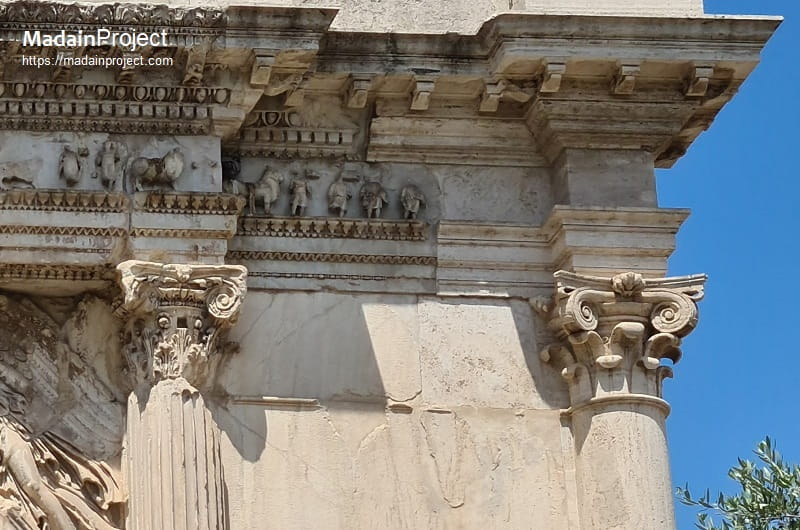
Composite Order
The composite order stands as the most elaborate and structurally complex addition to the Roman canon, emerging during the Imperial period as a sophisticated hybridization of the Ionic and Corinthian styles. The defining feature of the Composite is its capital, which fuses the large, prominent volutes of the Ionic order with the lush, double-tiered acanthus leaves of the Corinthian. This synthesis created a singular, highly decorative element that provided a visual "weight" and richness exceeding its Greek prototypes. Used predominantly in monumental public works like the Arch of Titus, the Composite order functioned as the ultimate architectural signifier of imperial grandeur, representing the apex of Roman stylistic evolution and its capacity to synthesize disparate classical forms into a unified, opulent whole.

Signup for our monthly newsletter / online magazine.
No spam, we promise.

The Madain Project is an online archive of Abrahamic History and Archaeology.
Abrahamic History & Archaeology is the study of history and archaeology with respect to the three Abrahamic Faiths without considering the religious and theological aspects. The goal of Abrahamic History is to understand how and why the religious doctrines and behaviours have evlovled and changed over time. Searching for patterns in the evolution of significant cultural events such as the development of farming, the emergence of cities, or the collapse of major civilizations for clues of why and how these have influenced the three major Abrahamic religions.
Cloud Drive -
About -
Help -
Editorial Policy -
AI Policy -
Privacy Policy -
Contact
Madain Project: Encyclopedia of Abrahamic History & Archaeology.
Copyright MadainProject 2017 - 2026.


