Classical Greek Order referes to a codified architectural system comprising a specific set of proportions, structural elements, and decorative motifs that govern the relationship between a vertical support—the column—and its horizontal entablature. Architecturally developed during the Archaic era and subsequent Classical period, these orders (Doric, Ionic, and Corinthian) serve as a standardized grammatical framework for monumental stone architecture, ensuring aesthetic harmony and structural clarity.
Each order is defined by its unique columniation, including the base, shaft, and capital, as well as the specific arrangement of the architrave, frieze, and cornice above. Beyond mere ornamentation, the Greek orders reflect an evolution of tectonic expression, transitioning from timber precedents to a sophisticated stone language that prioritizes symmetry, mathematical ratios, and a hierarchical visual logic.
circa 500 BCE-

Doric Order
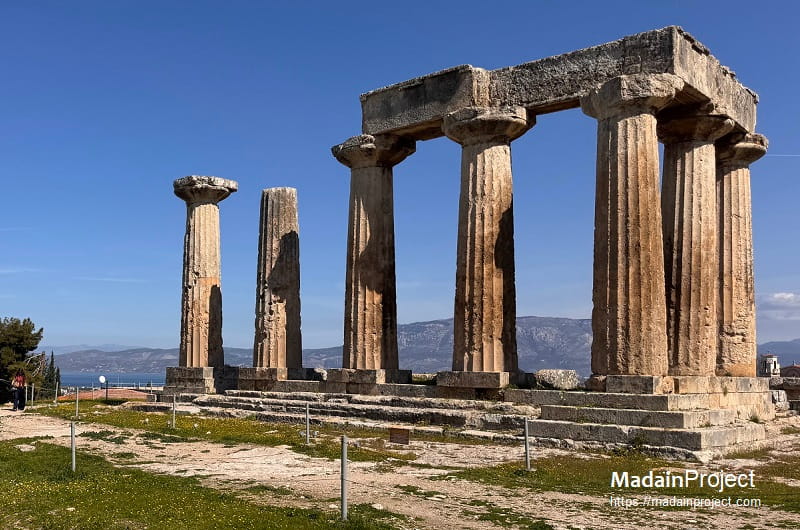
The Doric order represents the foundational, oldest and most robust phase of classical Greek architectural development, emerging in the seventh century BCE as monumental construction transitioned from ephemeral timber to permanent stone. Architecturally, it is distinguished by a strictly defined structural hierarchy where sturdy, fluted columns—traditionally lacking a base—sit directly upon the stylobate. The column shaft tapers toward a minimalist capital composed of a convex echinus and a square abacus, which serves as the primary load-bearing interface for the horizontal entablature. This order is characterized by a specific tectonic language; for instance, the frieze's alternating triglyphs and metopes are widely interpreted by scholars as petrified vestiges of earlier wooden post-and-beam construction, effectively translating functional carpentry into a formal aesthetic system.
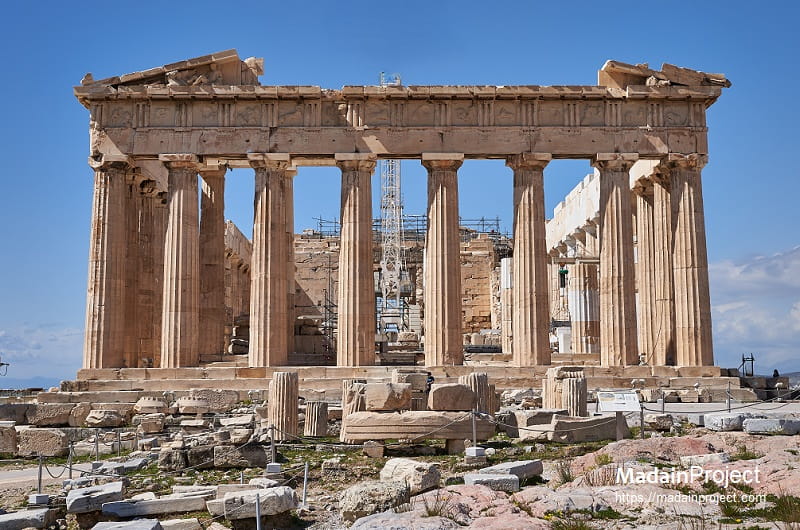
Beyond its physical properties, the Doric order serves as a primary index for the evolution of classical aesthetics and proportional theory. Vitruvian tradition and later architectural theorists frequently associate the Doric with "masculine" proportions, characterized by a lower height-to-diameter ratio—typically 1:6 or 1:7—compared to the more slender Ionic and Corinthian styles. This perceived robustness reflects a cultural emphasis on stability, gravity, and "noble sobriety", leading to its frequent deployment in temples dedicated to powerful deities and, later, in Neoclassical civic architecture to symbolize institutional strength. The order reached its refined peak in the fifth century BCE with the Parthenon, where architects Iktinos and Kallikrates utilized sophisticated mathematical ratios and optical "refinements", such as entasis, to correct visual distortions and achieve a state of perceived architectural perfection.
circa 500 BCE-

Ionic Order
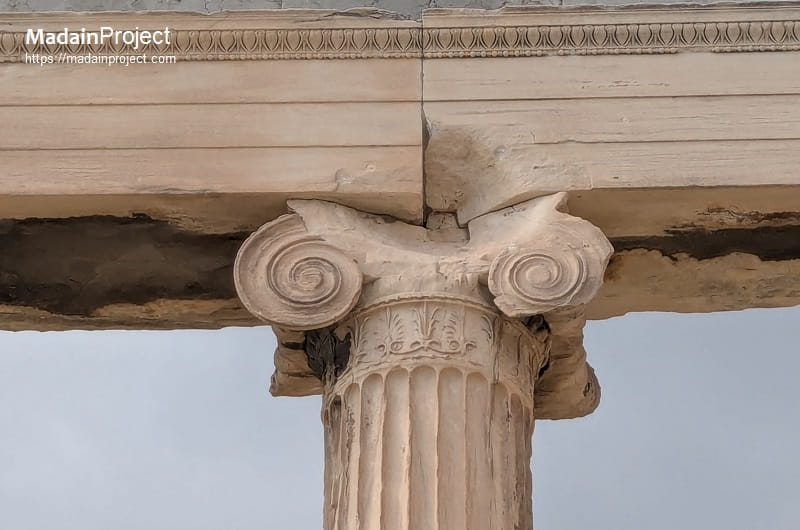
The Ionic order, originating in the mid-sixth century BCE within the Greek colonies of Ionia and the Aegean Islands, represents a sophisticated shift toward more slender proportions and elaborate ornamentation compared to the preceding Doric style. This order is defined by its distinctive volutes—spiral, scroll-like (inspect) ornaments located on the capital—which are traditionally interpreted as stylizations of ram horns, seashells, or curled botanical forms. Unlike the Doric column, the Ionic shaft is typically more attenuated, featuring twenty-four deep, semicircular flutes separated by flat fillets, and it stands upon a molded base (often the Attic or Samian type) rather than resting directly on the stylobate.
Architecturally, the Ionic entablature introduces a tripartite architrave consisting of three overlapping horizontal bands, or fasciae, which serve to mitigate the visual weight of the superstructure. Above this sits a continuous frieze, a significant departure from the Doric triglyph-and-metope system, providing an uninterrupted canvas for narrative relief sculpture. This decorative continuity, coupled with the inclusion of egg-and-dart or bead-and-reel moldings, reflects a heightened interest in linear elegance and sculptural richness. The Ionic order thus facilitates a more fluid and decorative architectural "syntax", allowing for a greater degree of aesthetic complexity in monumental structures such as the Erechtheion on the Athenian Acropolis.
Historically and theoretically, the Ionic order is frequently characterized in Vitruvian discourse as "feminine", a categorization based on its lighter proportions—typically a height-to-diameter ratio of 1:8 or 1:9—and its more graceful, curvilinear profiles. This perceived delicacy made it a preferred choice for temples dedicated to goddesses or for interior spaces where a more refined atmosphere was desired. The order's evolution demonstrates a critical transition in Greek tectonic thought, moving away from the rigid, earthbound stability of the Archaic period toward a more intellectualized and visually dynamic architectural language. This versatility ensured its enduring influence, as it was readily adapted by Roman architects and later became a cornerstone of the Renaissance and Neoclassical revivals.
circa 500 BCE-

Corinthian Order
The Corinthian order, emerging in the late fifth century BCE as the most ornate of the three classical canons, represents the aesthetic culmination of Greek architectural refinement. Unlike the Doric and Ionic orders, the Corinthian is primarily distinguished by its foliate capital, characterized by two tiers of deeply carved acanthus leaves from which slender stalks, or cauliculi, rise to support four corner volutes. This design solved the "corner problem" inherent in the Ionic order, as the Corinthian capital is radially symmetrical and visually consistent from all four cardinal points. The shaft typically follows Ionic proportions—a height-to-diameter ratio often reaching 1:10—standing upon a molded base and supporting an entablature frequently enriched with elaborate modillions and dentils, reflecting a shift toward architectural opulence and sculptural complexity.
While initially reserved for interior spaces or singular monuments in ancient Greece, the Corinthian order gained structural and symbolic dominance during the Roman and Herodian periods. A significant archaeological expression of this transition is found in the massive Corinthian capitals recovered from the Temple Mount in Jerusalem. These specimens, dating to the late First Century BCE renovations under Herod the Great, demonstrate a sophisticated fusion of Hellenistic craftsmanship with local Judean limestone. These capitals are noted for their monumental scale and "stiff-leaf" carving style, illustrating how the Corinthian order served as a primary visual language for articulating imperial authority and sacred grandeur across the Mediterranean and the Near East.
Signup for our monthly newsletter / online magazine.
No spam, we promise.

The Madain Project is an online archive of Abrahamic History and Archaeology.
Abrahamic History & Archaeology is the study of history and archaeology with respect to the three Abrahamic Faiths without considering the religious and theological aspects. The goal of Abrahamic History is to understand how and why the religious doctrines and behaviours have evlovled and changed over time. Searching for patterns in the evolution of significant cultural events such as the development of farming, the emergence of cities, or the collapse of major civilizations for clues of why and how these have influenced the three major Abrahamic religions.
Cloud Drive -
About -
Help -
Editorial Policy -
AI Policy -
Privacy Policy -
Contact
Madain Project: Encyclopedia of Abrahamic History & Archaeology.
Copyright MadainProject 2017 - 2026.