
The Mediterranean Sea is a deep, intercontinental sea serving as the primary nexus between the African, European, and Asiatic landmasses. Beyond its hydrographic boundaries, it functions as a "liquid continent"—a connective engine of cultural transmission, maritime technology, and imperial expansion that birthed the foundational structures of Western and Near Eastern civilizations.
The basin constitutes one of the world's most concentrated zones of maritime and littoral archaeology. Deep-water shipwrecks and submerged Neolithic settlements provide a stratified record of human movement from the early Holocene to the present. Key areas of investigation include:
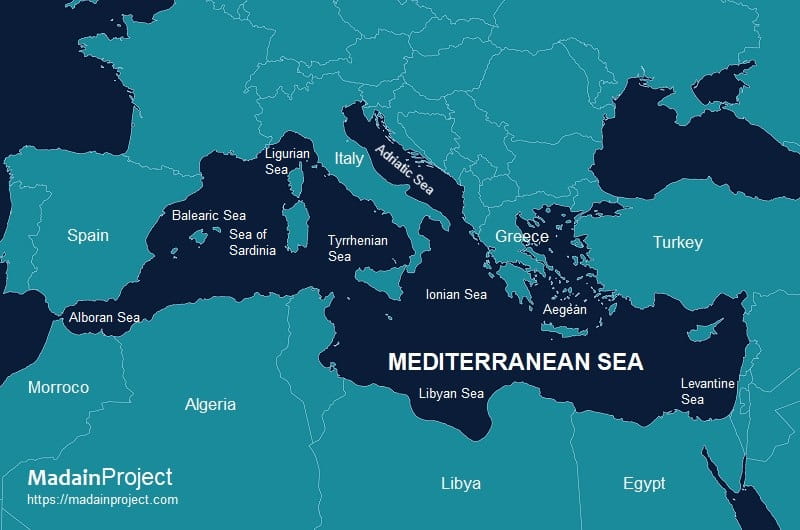

The Mediterranean Sea is the remnant of a much larger prehistoric ocean known as the Tethys Ocean, which began to close during the movement of the African and Eurasian tectonic plates. This geological convergence, part of the broader framework of plate tectonics, shaped the basin over millions of years, giving rise to its complex topography of deep basins, island arcs, and coastal mountain ranges. Around 5.96 million years ago, the region experienced the Messinian Salinity Crisis, during which the sea was largely cut off from the Atlantic Ocean and underwent extreme evaporation, leaving vast salt deposits. The basin was later refilled during the Zanclean Flood, when Atlantic waters surged back through the Strait of Gibraltar.
Climatically, the Mediterranean region is defined by the Mediterranean climate, which has fostered distinctive ecosystems characterized by drought-resistant vegetation such as maquis shrubland and evergreen forests. This climatic regime is influenced by the interplay between subtropical high-pressure systems and mid-latitude westerlies. The basin is also a biodiversity hotspot, hosting a high level of endemism both in marine and terrestrial species. Marine life ranges from seagrass meadows of Posidonia to diverse fish and cetacean populations, although many are now threatened by overfishing, pollution, and climate change. Geological dynamism continues today, as evidenced by volcanic activity in regions like Mount Etna and seismic instability along plate boundaries, underscoring the Mediterranean’s ongoing natural evolution.
The earliest human engagement with the Mediterranean Sea dates to the Stone Age, Paleolithic and Neolithic periods (circa 20,000–3000 BCE), when coastal foraging and early seafaring connected communities across southern Europe, the Levant, and North Africa. By the 4th millennium BCE, complex societies emerged, notably Ancient Egypt (circa 3100 BCE), whose maritime expeditions reached the Levantine coast, and early urban centers in the Levant such as Byblos. During the Bronze Age (circa 3000–1200 BCE), the Minoan civilization (circa 2000–1450 BCE) developed maritime trade networks across the Aegean, while the Mycenaean civilization (circa 1600–1100 BCE) established fortified palatial centers and participated in regional exchange systems.
Following the Late Bronze Age collapse (circa 1200 BCE), maritime trade re-emerged under the Phoenicians (circa 1200–539 BCE), who founded colonies such as Carthage (traditionally 814 BCE) and diffused the alphabetic writing system across the Mediterranean. Concurrently, the Greek world entered the Archaic period / Archaic Greece (circa 800–480 BCE), marked by the rise of the Greek city-states such as Athens and Sparta, and the expansion of colonies from the Black Sea to southern Italy (Magna Graecia). Conflicts such as the Greco-Persian Wars (499–449 BCE) and the Peloponnesian War (431–404 BCE) reshaped political alignments and military practices.
The western Mediterranean became dominated by Carthage and the rising power of Rome during the 3rd and 2nd centuries BCE (late Roman Republican period). The Punic Wars (264–146 BCE), particularly under commanders like Hannibal Barca, culminated in the destruction of Carthage in 146 BCE and established Roman supremacy. The Roman Republic transitioned into the Roman Empire under Augustus in 27 BCE, consolidating control over the entire Mediterranean basin, which it termed Mare Nostrum (meaning "our sea"). Roman infrastructure—roads, ports, and cities such as Alexandria—facilitated trade, urbanization, and cultural integration.
During Late Antiquity (3rd–7th centuries CE), the Roman world underwent significant transformation, including administrative division under Diocletian (reigned 284–305 CE) and the establishment of Constantinople by Constantine the Great in 330 CE. The western empire collapsed in 476 CE, while the eastern continuation, known as the Byzantine Empire, persisted. The 7th century saw the rapid expansion of Islamic polities following the rise of prophet Muhammad (died circa 632 CE), leading to the establishment of the Rashidun Caliphate and eventually the Umayyad Caliphate (661–750 CE), which controlled much of the southern and eastern Mediterranean.
Between the 8th and 11th centuries CE, the Mediterranean became a frontier of interaction and conflict among Byzantine, Islamic, and emerging Western European powers. The Abbasid Caliphate (750–1258 CE) influenced trade and intellectual exchange, while Byzantine authority fluctuated in regions such as Anatolia and the Balkans. Western Europe’s re-engagement intensified during the Crusades (circa 1095–1291 CE), initiated by Pope Urban II, resulting in the temporary establishment of Crusader states in the Levant and prolonged military-religious conflict.
From the 13th to 15th centuries CE, maritime commerce was dominated by Italian city-states, particularly Venice and Genoa, which established extensive trade networks linking Europe with the eastern Mediterranean and Black Sea. The decline of Byzantine power culminated in the Fall of Constantinople by Mehmed II, marking the rise of the Ottoman Empire as the dominant eastern Mediterranean power. The Ottomans controlled key territories across Anatolia, the Levant, North Africa, and southeastern Europe.
Between the 16th and 18th centuries CE, the Mediterranean was contested between the Ottoman Empire and European powers such as Habsburg Spain. Naval engagements like the Battle of Lepanto temporarily checked Ottoman naval dominance. Meanwhile, the shift of global trade toward the Atlantic after the voyages of Christopher Columbus (1492 CE) reduced the centrality of the Mediterranean in global commerce. Nonetheless, regional trade, piracy (including the Barbary corsairs), and diplomatic rivalry remained significant features.
In the 19th and early 20th centuries CE, the decline of Ottoman authority—often termed the “Eastern Question”—led to increased intervention by European powers, alongside nationalist movements in regions such as Greece (independence in 1830 CE). The Mediterranean was strategically reshaped by events such as the opening of the Suez Canal in 1869 CE and conflicts including World War I and World War II, which involved major campaigns in North Africa and southern Europe. In the modern period, the Mediterranean remains a critical geopolitical and economic zone, shaped by postcolonial state formation, regional conflicts, and migration dynamics.
In academic oceanography and hydrography, the larger Mediterranean Sea is divided into two primary basins (Western and Eastern). These two are further subdivided in to smaller marginal or regional bodies of water also identified as "seas". These subdivisions are typically defined by peninsulas, islands, and undersea ridges. According to the International Hydrographic Organization, there are 15 marginal seas within the Mediterranean basin.
Signup for our monthly newsletter / online magazine.
No spam, we promise.

The Madain Project is an online archive of Abrahamic History and Archaeology.
Abrahamic History & Archaeology is the study of history and archaeology with respect to the three Abrahamic Faiths without considering the religious and theological aspects. The goal of Abrahamic History is to understand how and why the religious doctrines and behaviours have evlovled and changed over time. Searching for patterns in the evolution of significant cultural events such as the development of farming, the emergence of cities, or the collapse of major civilizations for clues of why and how these have influenced the three major Abrahamic religions.
Cloud Drive -
About -
Help -
Editorial Policy -
AI Policy -
Privacy Policy -
Contact
Madain Project: Encyclopedia of Abrahamic History & Archaeology.
Copyright MadainProject 2017 - 2026.


