
A Minoan palace is a large administrative, economic, and ceremonial architectural complex constructed on the island of Crete during the Minoan civilization of the Bronze Age. These complexes functioned as central nodes for political authority, storage and redistribution of agricultural products, craft production, and religious activity. The term “palace” was introduced in the early twentieth century by Arthur Evans following his excavations at Knossos beginning in 1900 CE, although the designation does not necessarily imply a royal residence in the later Near Eastern or Classical sense. Archaeological evidence—including extensive storage facilities, administrative archives written in Linear A and later Linear B, and evidence of craft specialization—indicates that these complexes functioned as administrative and economic centers coordinating the production and redistribution of goods across surrounding territories.
The earliest palace complexes on Crete were constructed during the Protopalatial period, circa 1900–1700 BCE. Major early examples include Knossos in north-central Crete, Phaistos in the Mesara plain, and Malia on the north coast. These structures were destroyed around circa 1700 BCE, probably as a result of earthquakes, and subsequently rebuilt on a larger and more elaborate scale during the Neopalatial period, circa 1700–1450 BCE. Additional palatial centers established or expanded during this period include Zakros and Galatas.
These complexes served as focal points for regional administration and long-distance exchange networks linking Crete with the Aegean Sea, Anatolia, Egypt, and the Levant. Archaeological evidence from storage magazines, sealings, and inscribed tablets indicates that palatial authorities managed agricultural production, stored commodities such as olive oil, wine, and grain, and supervised craft activities including metallurgy, textile production, and pottery manufacture. Many palaces were destroyed around circa 1450 BCE, possibly in connection with political upheaval and the expansion of Mycenaean Greece, although the complex at Knossos continued to function until approximately 1375 BCE.

circa 3600-1450 BCE

Palaces
Scholars studying the Bronze Age civilization of Crete use the term “palace” in a technical and restricted sense. Rather than applying the term to every large building, they typically use it only for five major central complexes (Knossos, Phaistos, Malia, Zakros, and Galatas) that functioned as the primary administrative and economic centers of the Minoan civilization.
Minoan palaces share a number of consistent architectural features despite regional variation in size and layout. The defining element of each complex is a large rectangular central courtyard, typically oriented along a north–south axis and serving as the principal organizational feature of the surrounding architectural units. At Knossos the central court measures approximately 52 × 28 meters, while the court at Phaistos measures roughly 55 × 25 meters. Around this courtyard were arranged administrative rooms, ceremonial spaces, workshops, storage magazines, and residential quarters.
The western sector of many palaces contains a large open area commonly referred to as the west court. At Knossos and Phaistos these courts include paved surfaces and alignments of low stone features interpreted as ritual installations or processional pathways. Adjacent to the west court are long rows of narrow storage magazines equipped with stone bases that once supported large storage jars known as pithoi. These magazines functioned as facilities for the accumulation and redistribution of agricultural products.
Residential and ceremonial suites are commonly located in the eastern portions of the palaces and often include the architectural arrangement known as the Minoan hall. This configuration consists of a central room connected to an open light well and separated by pier-and-door partitions that could be opened or closed to regulate light and circulation. Multi-story construction was common, particularly in the eastern wings where terracing accommodated sloping terrain.
Several distinctive architectural features are characteristic of Minoan palatial complexes. Lustral basins—sunken rectangular chambers accessed by a short flight of steps—occur in a number of palaces, including Knossos and Phaistos, and are generally interpreted as spaces associated with ritual purification. Pillar crypts, small subterranean chambers containing central pillars and benches, are also present and likely served religious functions.
The decorative programs of Minoan palaces include extensive wall paintings executed in true fresco technique. At Knossos, fragments depict scenes of bull-leaping, processions, marine imagery, and ceremonial gatherings. Architectural surfaces were further embellished with gypsum ashlar masonry, painted plaster, and elaborately carved stone doorframes. The combination of complex spatial organization, integrated administrative facilities, and elaborate decorative schemes reflects the multifaceted political, economic, and ceremonial roles played by Minoan palaces within the broader landscape of Bronze Age Crete.
Palace-Like Structures
In addition to the five principal complexes conventionally designated as palaces, archaeological research on Crete has identified a number of monumental buildings that incorporate architectural elements associated with palatial architecture but do not conform fully to the form, scale, or administrative role of the canonical palaces. Such buildings are commonly described as “palace-like structures” in modern scholarship. Sites including Petras, Zominthos, Makrygiallos, Kommos, Monastiraki, and Archanes contain large monumental buildings with features such as central courts or ashlar masonry, yet their overall architectural organization and archaeological context differ significantly from those of the established palatial centers.
At ancient Gournia, a substantial Neopalatial building incorporated several architectural features characteristic of palatial architecture, including a public court and an ashlar façade. The structure may have fulfilled certain administrative functions comparable to those associated with the palaces. Nevertheless, its internal layout and the quality and arrangement of its masonry diverge from the architectural patterns observed at sites such as Knossos or Phaistos, and it therefore is not classified as a palace.
A comparable situation exists at Petras, where a large multistory complex combines canonical palatial elements with architectural features derived from earlier regional building traditions. The structure functioned as an administrative center and contained a central court and archives, but it also displays characteristics not typical of the major palaces, including fortification features such as watchtowers. The central court itself was unusually small, measuring approximately 6 × 13 meters and reduced to about 4.9 × 12 meters in later construction phases, dimensions considerably smaller than the courts of the principal palaces.
Another significant example occurs at Kommos, where a monumental complex known as Building T was constructed around a paved rectangular court surrounded by large architectural wings in a layout reminiscent of palatial complexes. The structure is comparable in overall scale to the palace at Phaistos, and its façade was constructed using some of the largest ashlar blocks employed in Minoan architecture. The presence of such monumental palatial architecture at Kommos is noteworthy because the settlement appears to have been politically dependent on nearby centers such as Phaistos and Ayia Triada. The excavator Joseph Shaw has suggested that the building may represent either a localized adaptation of the palatial architectural form or a complex designed for specialized functions, possibly related to maritime commerce.
These examples illustrate that while palace-like structures share certain architectural and functional features with the major palaces—such as courts, ashlar construction, and administrative facilities—they differ in scale, organization, and regional role. As a result, they are generally interpreted as regional administrative, ceremonial, or specialized economic centers that participated in the broader palatial system but did not constitute primary palatial institutions themselves.
circa 1900-1700 BCE

Knossos
The Minoan palace at Knossos, located near modern Heraklion, is the largest and most extensively excavated Minoan complex. Initially constructed during the Protopalatial period, circa 1900–1700 BCE, it was rebuilt in the Neopalatial period, circa 1700–1375 BCE, following widespread destruction. The complex is organized around a central rectangular court measuring approximately 52 × 28 meters, which serves as the principal spatial and ceremonial axis. Knossos contains extensive storage magazines, residential suites, administrative rooms, workshops, lustral basins, pillar crypts, and multi-story halls. Fresco fragments, including bull-leaping and marine imagery, and sophisticated ashlar masonry demonstrate the aesthetic and ritual functions of the site alongside its administrative and economic roles.
circa 1900-1700 BCE

Malia
The palace at Malia is situated on the north coast of central Crete and was first constructed circa 1900 BCE. The central courtyard, roughly 45 × 25 meters, anchors a complex of storage rooms, workshops, residential areas, and ceremonial spaces. Malia’s architectural organization reflects the characteristic Minoan integration of administration, production, and ritual. Notably, the complex includes lustral basins and ashlar-built facades, while fresco decoration, particularly in the west wing, attests to the ceremonial and symbolic importance of the site. The palace functioned as a regional administrative hub, controlling agricultural production and local craft activities.
circa 1900-1700 BCE
Phaistos
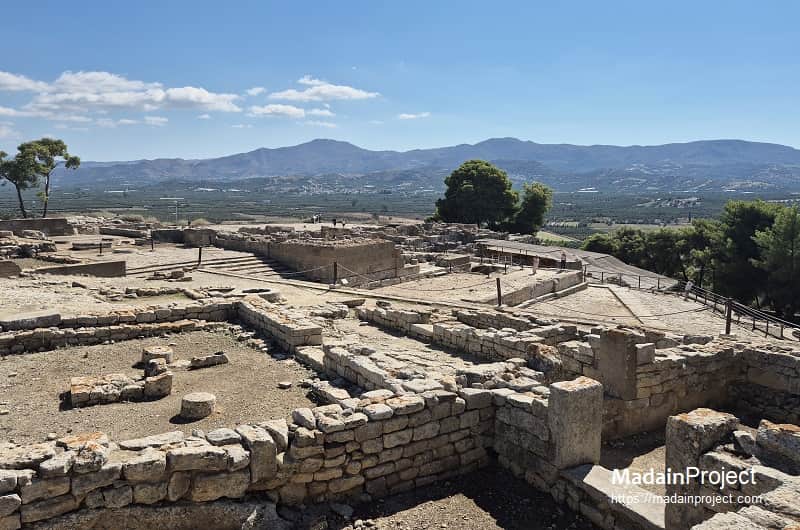
The Minoan palace at Phaistos, located on the southern Messara plain, was established during the Protopalatial period circa 1900 BCE and rebuilt after destruction around 1700 BCE. Its central court, approximately 55 × 25 meters, is surrounded by storage magazines, workshops, administrative rooms, and residential quarters. Architectural features include lustral basins, pillar crypts, and a series of ceremonial halls, while frescoes and painted plaster indicate ritual and decorative functions. Phaistos served as a major administrative center, coordinating the collection and redistribution of agricultural and craft products within the region and maintaining links with surrounding settlements such as Ayia Triada.
circa 1900-1700 BCE
Zakros
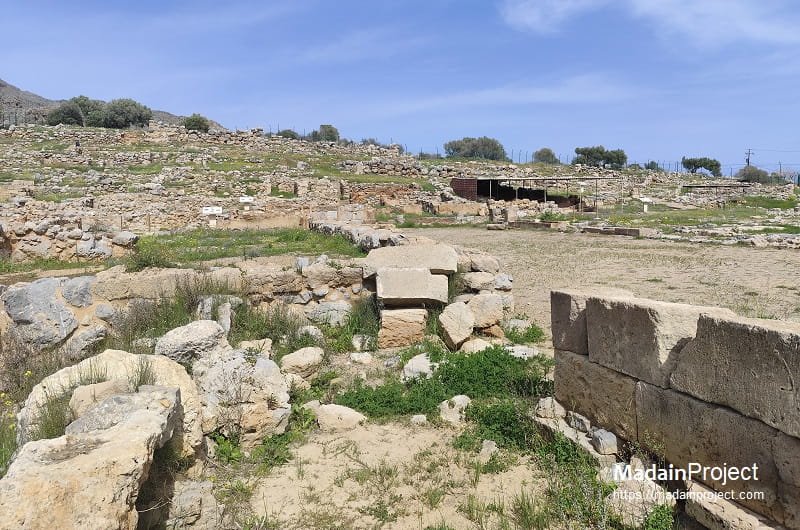
The palace at Zakros, located on the northeastern coast, dates primarily to the Neopalatial period, circa 1700–1450 BCE. Its central court measures approximately 26 × 17 meters and is surrounded by magazines, workshops, and residential quarters. Zakros is distinctive for its east-west alignment of storage rooms and the high concentration of sealing and administrative archives, suggesting a strong focus on economic and bureaucratic control. Decorative programs include fresco fragments depicting ceremonial processions, and the palace layout emphasizes functional organization, linking production, storage, and administrative spaces efficiently.
circa 1900-1700 BCE

Galatas
The palace at Galatas, situated in central Crete, was constructed during the Neopalatial period, circa 1700–1450 BCE. Its central court, approximately 28 × 22 meters, is encircled by storage magazines, workshops, and residential suites. The complex incorporates architectural features typical of Minoan palaces, including lustral basins, pillar crypts, and ashlar masonry. Excavations indicate administrative and ceremonial functions, with evidence of local craft production and storage of agricultural goods. While smaller than Knossos or Phaistos, Galatas illustrates the regional reach of the Minoan palatial system in central Crete.

Signup for our monthly newsletter / online magazine.
No spam, we promise.

The Madain Project is an online archive of Abrahamic History and Archaeology.
Abrahamic History & Archaeology is the study of history and archaeology with respect to the three Abrahamic Faiths without considering the religious and theological aspects. The goal of Abrahamic History is to understand how and why the religious doctrines and behaviours have evlovled and changed over time. Searching for patterns in the evolution of significant cultural events such as the development of farming, the emergence of cities, or the collapse of major civilizations for clues of why and how these have influenced the three major Abrahamic religions.
Cloud Drive -
About -
Help -
Editorial Policy -
AI Policy -
Privacy Policy -
Contact
Madain Project: Encyclopedia of Abrahamic History & Archaeology.
Copyright MadainProject 2017 - 2026.


