
The Doric order is the earliest and simplest of the classical Greek architectural orders, characterized by heavy, fluted columns that rest directly on the stylobate without a base. It is defined by a plain, cushion-like capital and an entablature featuring a frieze of alternating triglyphs and metopes. Traditionally associated with masculine proportions and structural austerity, the order represents the foundational formalization of Greek stone construction from earlier timber precedents.
The Doric order represents the inaugural phase of the tripartite system of classical Greek architecture, distinguished by its rigorous adherence to tectonic simplicity and geometric monumentality. Morphologically, the order is identified by stout, fluted shafts that lack a formal base, descending directly to the stylobate, and terminating in a simplistic echinus and abacus. Its entablature maintains a strict structural rhythm, defined by a frieze of vertically channeled triglyphs and interstitial metopes, which together articulate the transition from archaic timber construction to refined lithic expression.
Frequently characterized in architectural theory by its "masculine" proportions, the Doric order serves as the primary formalization of the Greek canon, prioritizing structural clarity and proportional sobriety over ornamental complexity.
circa 500 BCE-
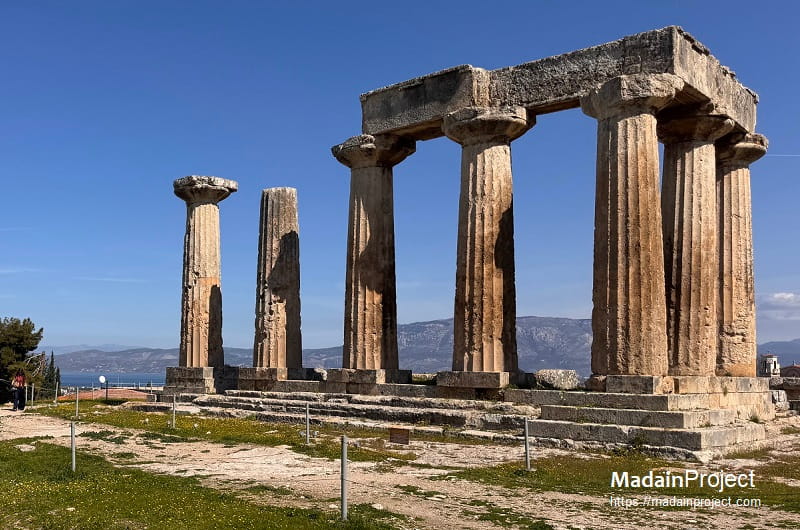
The historical trajectory of the Doric order is fundamentally characterized by the transition from ephemeral timber construction to permanent lithic monumentalization, a process often described in architectural theory as petrification. Emerging in the seventh century BCE within the Peloponnese and subsequently proliferating across the Greek mainland and western colonies, the order’s early manifestations—such as those found at the Temple of Apollo at Thermon and the Sanctuary of Hera at Argos—retain skeuomorphic vestiges of their wooden predecessors. The Roman architect Vitruvius famously postulated that the distinctive triglyphs served as stylized representations of wooden beam-ends, while the guttae beneath them mirrored the pegs used to secure these structural members. While modern scholarship, notably the work of Barbara Barletta, scrutinizes the linearity of this "evolutionary" model, the consensus remains that the Doric order represents the first formalization of stone temple architecture in the Hellenic world.
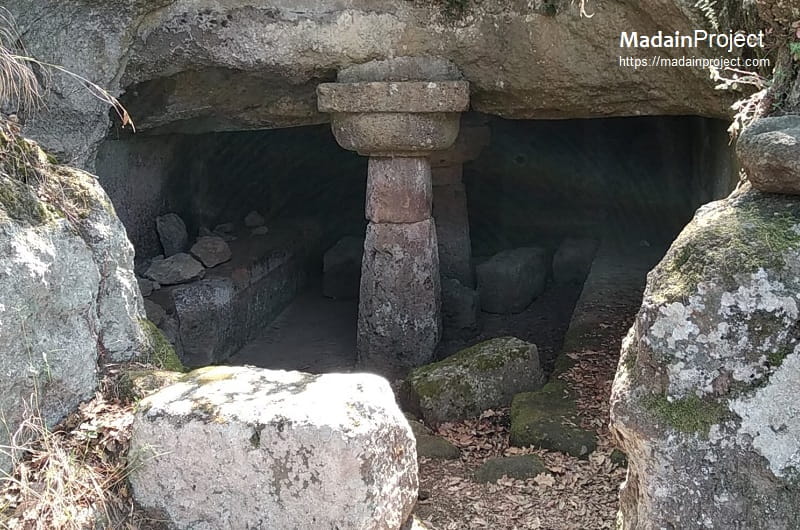
During the Archaic period / Archaic Greece (circa 750–480 BCE), the order underwent a rapid formal refinement, shifting from the "awkward" and heavy-handed proportions of early stone experiments to the mathematically codified canons of the Classical period. This maturation reached its zenith in the mid-fifth century BCE with the construction of the Parthenon on the Acropolis of Athens, where architects Iktinos and Kallikrates integrated sophisticated optical refinements—such as entasis and corner contraction—to resolve inherent structural and aesthetic tensions, notably the Doric corner conflict. Following this peak, the order’s dominance waned as the more ornate Ionic and Corinthian orders gained favor for their versatility and slender proportions. Nevertheless, the Doric order’s legacy persisted through the Roman era and was later revived during the Renaissance and Neoclassical periods as a primary symbol of structural integrity and rational design.
circa 500 BCE-
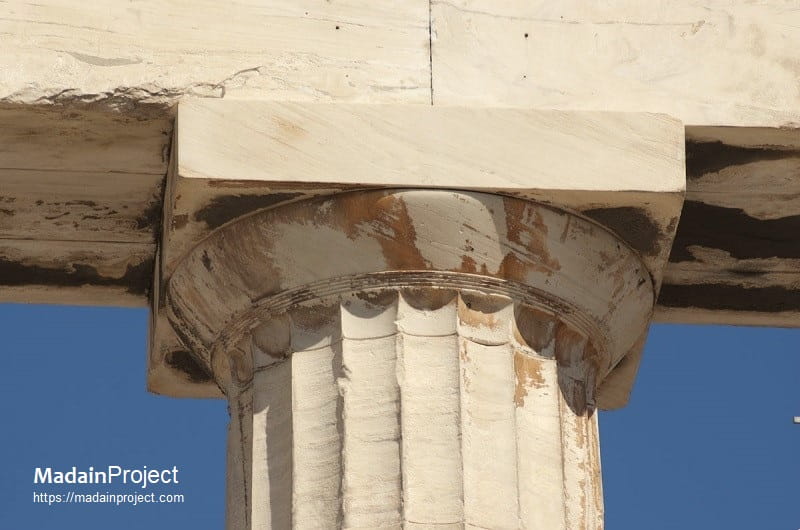
The columnar morphology of the Doric order is defined by its robust, fluted shafts that lack a formal base, resting directly upon the stylobate. Typically, the shaft is articulated with twenty shallow flutes that meet at sharp edges, or arrises, emphasizing the verticality of its otherwise squat proportions. The column terminates in a minimalistic capital, composed of a circular, cushion-like echinus and a square abacus. In early Archaic examples, the echinus displays a pronounced, flattened profile, whereas Classical iterations exhibit a more restrained, steep curvature, reflecting a transition toward heightened proportional rigor.
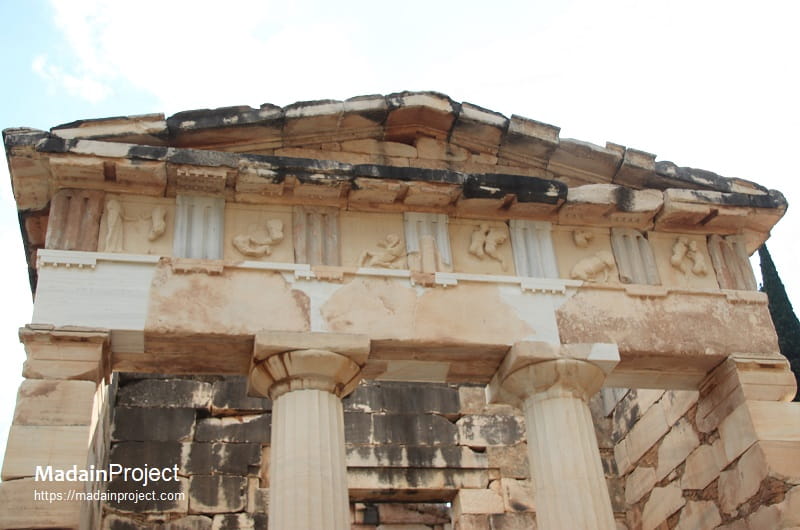
The entablature constitutes a complex horizontal system divided into three distinct registers: the architrave, the frieze, and the cornice. The architrave, the lowest band, is characterized by its stark, unadorned surface. Above this, the frieze provides the order’s primary rhythmic identity through the alternation of triglyphs—projecting blocks with three vertical channels—and metopes, which were either left plain or decorated with high-relief sculpture. This rhythmic division is underscored by guttae, small cylindrical pegs located beneath the triglyphs on the regula, which serve as skeuomorphic remnants of the order’s timber origins.
At its highest level of refinement, the Doric order employs sophisticated optical corrections to mitigate visual distortions inherent in large-scale masonry. The most prominent of these is entasis, a subtle convex tapering of the column shaft that prevents the illusion of concavity when viewed from a distance. Furthermore, the stylobate and entablature often feature a slight upward curvature to ensure they appear perfectly horizontal, while the columns themselves may lean slightly inward to enhance the perception of structural stability. These mathematical adjustments, alongside the corner contraction used to resolve the Doric corner conflict, represent the apex of Greek architectural rationalism.
circa 500 BCE-
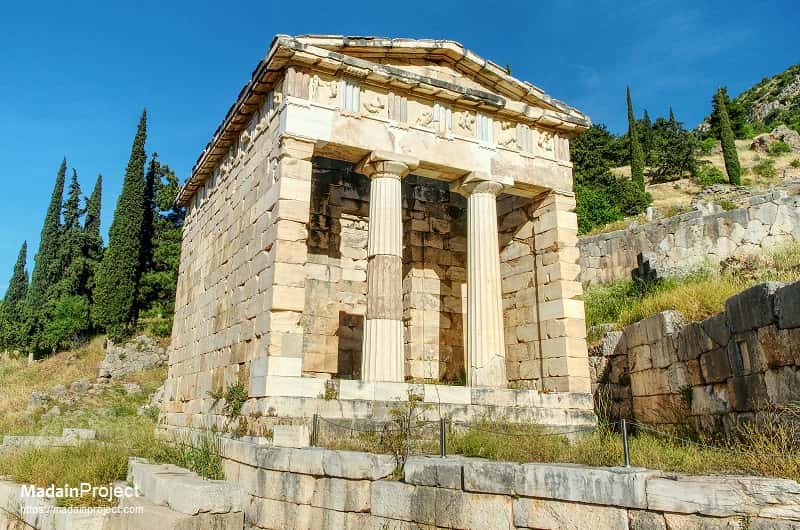
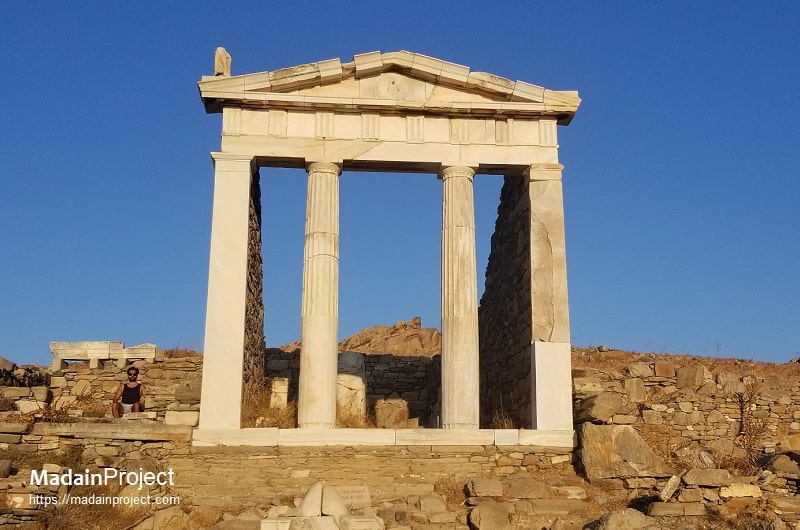
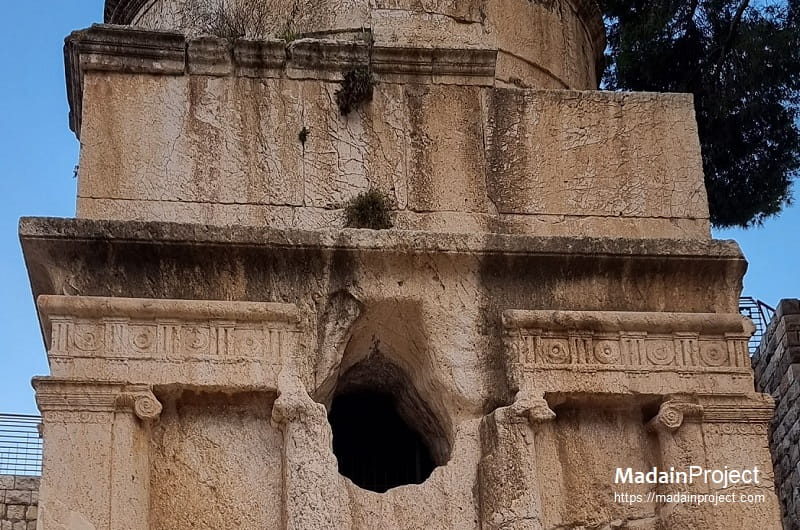
Characterized by its robust proportions and restrained ornamentation, the Doric order became a defining feature of numerous ancient buildings. The structures listed below illustrate its widespread adoption and architectural importance across different regions and periods.
Signup for our monthly newsletter / online magazine.
No spam, we promise.

The Madain Project is an online archive of Abrahamic History and Archaeology.
Abrahamic History & Archaeology is the study of history and archaeology with respect to the three Abrahamic Faiths without considering the religious and theological aspects. The goal of Abrahamic History is to understand how and why the religious doctrines and behaviours have evlovled and changed over time. Searching for patterns in the evolution of significant cultural events such as the development of farming, the emergence of cities, or the collapse of major civilizations for clues of why and how these have influenced the three major Abrahamic religions.
Cloud Drive -
About -
Help -
Editorial Policy -
AI Policy -
Privacy Policy -
Contact
Madain Project: Encyclopedia of Abrahamic History & Archaeology.
Copyright MadainProject 2017 - 2026.


