
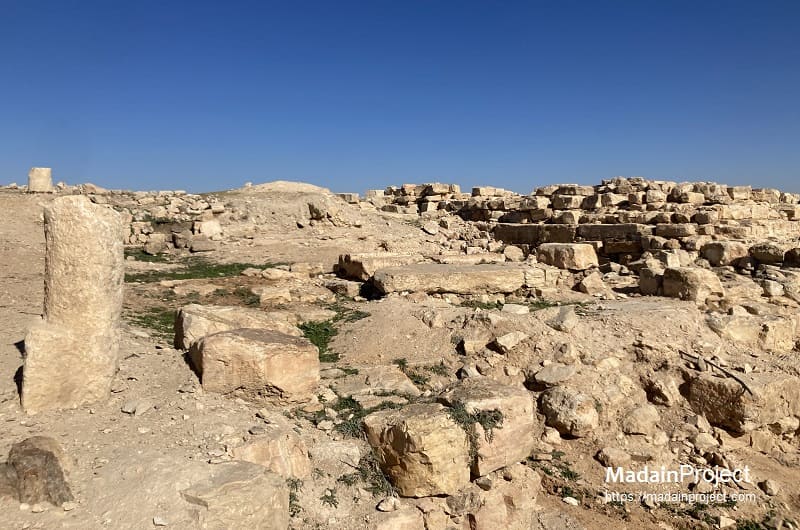
Tell Dhiban (تل ذيبان), or Tal Dhiban, is a multi-period archaeological mound in the Dhiban Protectorate, central Jordan, identified with the ancient city of Dibon, a major urban, political, and religious center of the Iron Age kingdom of Moab and a site with stratified occupation extending from the Bronze Age through the Islamic periods.
Tell Dhiban lies on the Madaba Plains approximately three kilometers north of the modern town of Dhiban and east of the Dead Sea escarpment. The tell occupies a strategic position overlooking the Wadi Mujib (biblical Arnon), a major natural boundary and trade corridor in ancient Transjordan. Covering roughly twenty-five hectares at its maximum extent, the site is among the largest archaeological tells in the region. Its long occupational history reflects shifting patterns of settlement, political control, and economic integration within southern Levantine networks.
Archaeological research has demonstrated that Tell Dhiban functioned not merely as a local town but at times as a regional capital with administrative, cultic, and defensive infrastructure.
Systematic archaeological investigation at Tell Dhiban began in the mid-twentieth century CE, with major excavations conducted by American and Jordanian teams, most notably the Dhiban Excavation Project initiated in the 1950s CE. These excavations established the site’s stratigraphic sequence and confirmed its identification with ancient Dibon. More recent research has emphasized landscape archaeology, urban development, and the social history of the site, contributing significantly to the understanding of Moabite state formation and Transjordanian urbanism.
circa 3500 BCE-

Early and Middle Bronze Age
The earliest securely attested occupation at Tell Dhiban dates to the Early Bronze Age (circa 3500-2000 BCE), when small-scale settlement activity appears on the mound, likely associated with emerging urbanization across the Transjordanian plateau. Architectural remains from this period are fragmentary, consisting primarily of domestic structures and associated ceramic assemblages typical of Early Bronze III–IV southern Levantine traditions. During the Middle Bronze Age (circa 2000-1500 BCE), occupation intensified, and the site appears to have been integrated into the network of fortified settlements that characterized the period. Evidence includes more substantial architectural remains, defensive features, and imported ceramics, suggesting participation in regional trade systems linking the Jordanian plateau with the Jordan Valley and southern Levantine city-states.
Late Bronze Age
Occupation at Tell Dhiban during the Late Bronze Age (circa 1500-1200 BCE) was more limited but continuous. Archaeological layers indicate a reduced settlement footprint, consistent with broader patterns of demographic contraction in Transjordan during this period. Material culture includes locally produced pottery alongside limited imported wares, reflecting continued, though diminished, connectivity with Egyptian-administered territories in Canaan. While the site does not appear to have been a major political center during this time, its persistence suggests a degree of local stability and agricultural viability.
Iron Age I–II
Tell Dhiban reached its greatest political and historical significance during the Iron Age (circa 1200-586 BCE), particularly in Iron Age II (circa 1000–586 BCE), when it became the principal city of the Moabite kingdom. Identified with biblical Dibon, the city is explicitly named in the Mesha Stele, discovered at the site in 1868 CE. The inscription recounts King Mesha’s rebellion against the northern Kingdom of Israel (Samaria), a pivotal event referenced in 2 Kings 3 in the Bible. This monumental basalt inscription, commissioned by King Mesha of Moab in the ninth century BCE, records Moab’s rebellion against Israelite domination and the restoration and fortification of Dibon as a royal center. Archaeological evidence from this period includes massive fortification walls, administrative buildings, industrial installations, and cultic structures, reflecting its role as a capital city.
Excavations have revealed urban planning indicative of centralized authority, including storage facilities and water-management systems adapted to the semi-arid environment. The Iron Age ceramic assemblage is distinctly Moabite in character, with forms and decorative traditions that distinguish it from contemporaneous Israelite and Ammonite material culture. The city’s prosperity during this period was closely tied to its control of agricultural hinterlands and trade routes connecting the Arabian interior with the Dead Sea basin.
Neo-Assyrian and Neo-Babylonian Periods
Following the expansion of the Neo-Assyrian Empire (circa 911-609 BCE) into the southern Levant in the eighth century BCE, Tell Dhiban experienced political subjugation and administrative restructuring. While the site remained occupied, archaeological indicators suggest a reduction in monumental construction and a shift toward more utilitarian architecture. Assyrian influence is visible primarily through changes in material culture and settlement organization rather than through direct imperial architectural imposition. The subsequent Neo-Babylonian Empire period likely saw further decline, although occupation continued, reflecting the resilience of local communities despite imperial disruptions.
Persian and Hellenistic Periods
During the Persian Achaemenid Empire period (circa 539-330 BCE), Tell Dhiban persisted as a modest settlement within the administrative framework of the Trans-Euphrates satrapy. Archaeological remains from this era are limited but include ceramics consistent with Persian-period assemblages across Transjordan. In the Hellenistic period, following the conquests of Alexander the Great, the site remained occupied, though it did not attain urban prominence comparable to newly founded or redeveloped Hellenistic cities in the region. Material evidence points to gradual cultural integration rather than intensive colonization.
Roman and Byzantine Periods
Under Roman rule (roughly 63 BCE to 395 CE), the focus of regional settlement shifted toward newly established urban centers such as Madaba. Tell Dhiban functioned primarily as a rural or secondary site, with evidence of agricultural activity and small-scale habitation. During the Byzantine period, occupation continued intermittently, and the surrounding landscape became increasingly integrated into a Christianized rural economy. Architectural remains from these periods are sparse but attest to continuity rather than abandonment.
Early Islamic Period
Tell Dhiban remained inhabited into the early Islamic period (circa 660 CE onwards), when it formed part of the agrarian hinterland supporting larger towns in central Jordan. Umayyad and Abbasid ceramics and architectural fragments indicate continued use of the site, though by this time settlement was dispersed and lacked the urban density of earlier periods. Eventually, occupation shifted away from the tell itself toward surrounding areas, leading to its gradual abandonment as a residential center.
circa 100 CE
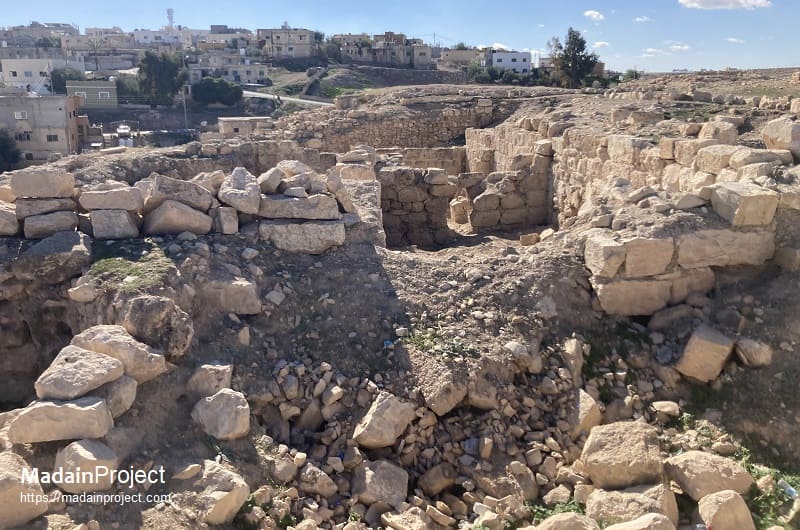
Tell Dhiban is a large, stratified settlement mound characterized by a high central tel (acropolis) and extensive lower slopes, reflecting successive phases of urban expansion and contraction over more than three millennia. The tell rises prominently above the surrounding plateau, with steep sides formed by accumulated occupational debris and erosion. Archaeological stratigraphy demonstrates dense superimposed architectural remains, particularly on the summit and upper terraces, where administrative and defensive functions were concentrated. The site covers roughly 15 hectares (approximately 30 acres) and rises 40 meters (130 feet) above the surrounding landscape. It possesses a complex occupational sequence spanning over 6,000 years, with evidence of human activity from the Early Bronze Age through the Ottoman period.
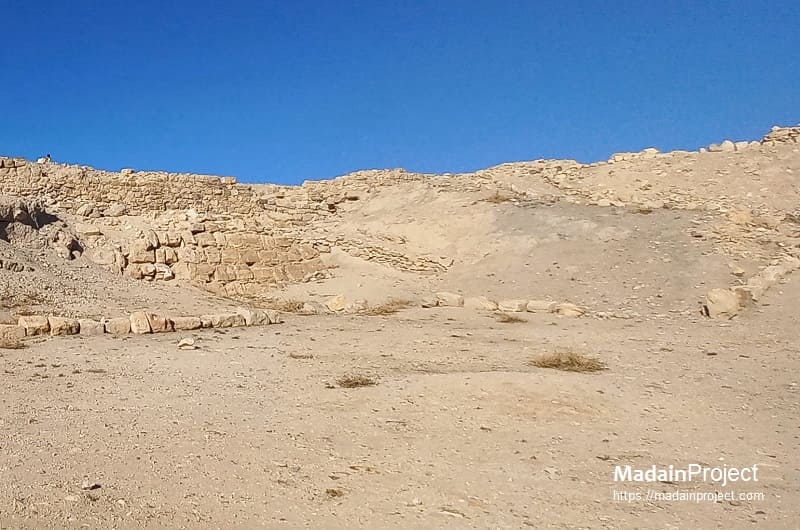
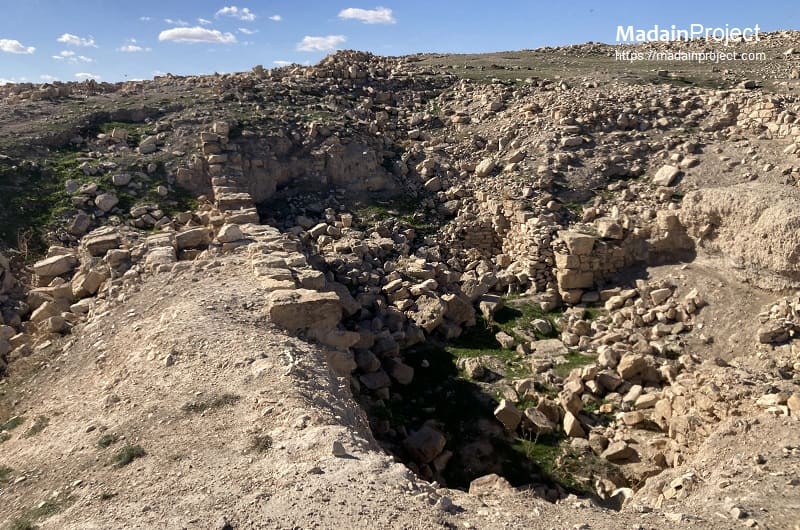
The most prominent architectural features identified at the site date to the Iron Age II, when Dhiban functioned as the capital of the Moabite kingdom. Excavations have revealed substantial fortification systems, including segments of a city wall constructed of large limestone blocks, in places preserved to several courses in height. These fortifications follow the natural contours of the mound and indicate a deliberate effort to enclose and defend the urban core. Associated with the wall are remains interpreted as towers and possible gate complexes, although erosion and later disturbance have limited full reconstruction of their plans.
The Citadel (Acropolis/Field L): This elevated northern sector was the focus of monumental building projects during the Iron Age II (circa 9th–8th centuries BCE). It features massive retaining walls, towers, and a monumental city wall constructed to artificially enlarge the summit. Within the fortified area, archaeologists have identified large architectural complexes interpreted as administrative or elite buildings. One such structure, often referred to as an Iron Age administrative complex, consists of thick stone walls, large rooms, and evidence for controlled access, suggesting centralized authority and bureaucratic activity. The scale and construction quality of this complex distinguish it from surrounding domestic architecture and support its association with royal or state administration during the reigns of Moabite kings such as Mesha.
Domestic architecture at Tell Dhiban is represented by clusters of stone-built houses, typically organized around small courtyards and constructed using local limestone. These structures vary in size and complexity, reflecting social differentiation within the population. Interior installations such as hearths, storage bins, and grinding stones attest to household-based agricultural processing and food preparation. The density of domestic remains is greatest on the upper slopes of the tell during the Iron Age, indicating a nucleated urban settlement.
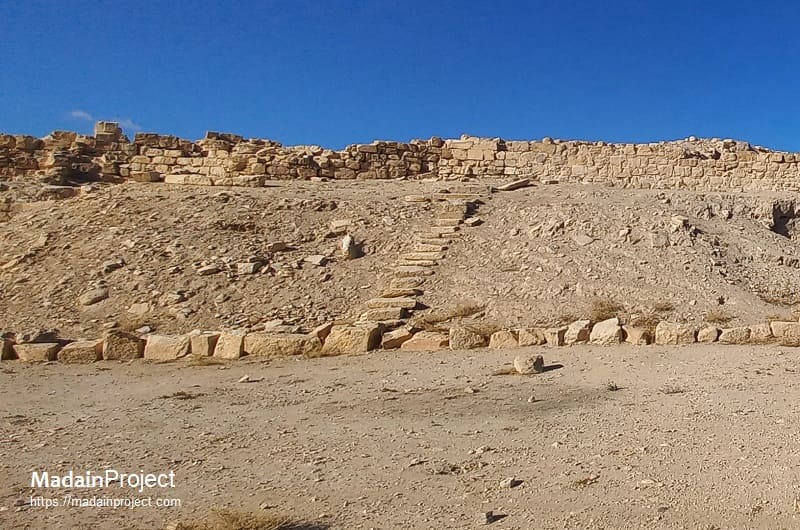
Nabataean Temple: Located on the acropolis, this structure includes a podium with distinct Nabataean masonry, a monumental stairway, and an associated aqueduct. It indicates the site's transformation into a significant Nabataean center during the 1st century BCE/CE.
Industrial and economic activities are evidenced by installations for food processing and storage, including silos, plastered pits, and work surfaces. The presence of large storage facilities suggests surplus agricultural production and centralized collection, consistent with the site’s role as a political capital. Ceramic assemblages recovered from these contexts include locally produced Moabite wares as well as limited imports, providing insight into economic organization and external contacts.
Cultic architecture at Tell Dhiban is less securely identified, though textual evidence from the Mesha Stele indicates the existence of sanctuaries dedicated to the Moabite deity Chemosh. Archaeological remains possibly associated with ritual activity include isolated architectural features and cultic objects, but no unequivocal temple structure has been fully exposed. The ambiguity reflects both the complexity of the stratigraphy and the incomplete excavation of key areas.
Later periods are represented by more modest architectural remains. Persian, Hellenistic, Roman, and Byzantine phases are characterized by fragmentary walls, reused building materials, and dispersed installations, indicating reduced urban density and a shift toward rural or semi-rural occupation. Early Islamic remains consist mainly of domestic structures and agricultural features, often built directly atop earlier ruins, demonstrating continuity of land use rather than urban redevelopment.
Roman Bathhouse: A Roman-era public bath facility has been identified, signaling the site's continued importance as a settled village under Roman administration.
Byzantine Churches: Excavations have uncovered the remains of two significant church buildings dating to the Byzantine era, reflecting a period of population growth and religious transition.
Field O Farmhouse Complex: A Middle Islamic (Ayyubid-Mamluk) residential and economic unit consisting of vaulted rooms and one-room farmhouses built against one another. These structures face a common open-air courtyard containing two shared cisterns and dedicated food preparation areas.
Qarho (The High Place): Although not yet definitively isolated as a standalone architectural remain, the Mesha Stele refers to "Qarho" as the acropolis where King Mesha established a sanctuary or "high place" for the Moabite god Chemosh.
The Necropolis: A large cemetery situated to the northeast of the tell contains multi-generational burials with funerary offerings, including anthropomorphic clay coffins contemporary with the Iron Age building phases.
Signup for our monthly newsletter / online magazine.
No spam, we promise.

The Madain Project is an online archive of Abrahamic History and Archaeology.
Abrahamic History & Archaeology is the study of history and archaeology with respect to the three Abrahamic Faiths without considering the religious and theological aspects. The goal of Abrahamic History is to understand how and why the religious doctrines and behaviours have evlovled and changed over time. Searching for patterns in the evolution of significant cultural events such as the development of farming, the emergence of cities, or the collapse of major civilizations for clues of why and how these have influenced the three major Abrahamic religions.
Cloud Drive -
About -
Help -
Editorial Policy -
AI Policy -
Privacy Policy -
Contact
Madain Project: Encyclopedia of Abrahamic History & Archaeology.
Copyright MadainProject 2017 - 2026.


