
Mihrab (Arabic: محراب, pl. maḥārīb) is a fundamental architectural and liturgical element of a mosque, typically manifesting as a concave or semi-circular niche set into the qibla wall to indicate the precise direction of the Kaaba in Mecca. While the term originally denoted a high-status "throne room", "private quarters" or a "place of battle" in pre-Islamic and early-Islamic contexts, its religious institutionalization began in the early 8th century CE, traditionally attributed to the Umayyad caliph al-Walid I during renovations of the Prophet's Mosque in Medina. A mihrab is almost alway situated adjacent to a "Minbar" which is used by the imam to address the congregation.
The mihrab is the primary architectural and liturgical focal point of the mosque, typically manifesting as a concave, semicircular niche set into the qibla wall to indicate the direction of the Kaaba in Mecca. While the term originally denoted a place of honor or a private sanctuary in pre-Islamic Arabic language, its specific architectural form as a recessed niche emerged during the Umayyad caliphate. Academic consensus identifies the renovation of the Prophet’s Mosque in Medina (circa 706–709 CE) under Caliph al-Walid I as the definitive introduction of the mihrab mujawwaf (hollowed niche). This innovation likely synthesized existing Roman exedrae or Christian apsidal forms with Islamic directional requirements, providing a visual and symbolic "gateway" to the divine while serving the practical function of designating the Imam’s station during congregational prayer.
Evolutionarily, the mihrab transitioned from a simple commemorative marker into the most decorated element of Islamic spatial design. Beyond its role as a directional pointer, the niche historically functioned as an acoustic resonator, amplifying the prayer leader's voice back into the hall. Symbolically, it is frequently adorned with Surat al-Nur (The Verse of Light), reinforcing the niche’s association with divine illumination. Regional variations—ranging from the monumental "mihrab room" of the Great Mosque of Córdoba to the intricate muqarnas (stalactite) vaulting of Ottoman and Safavid examples—demonstrate the mihrab's versatility as an artistic canvas. Ultimately, it serves as a synthesis of theological orientation and architectural mastery, anchoring the spiritual geometry of the mosque.

circa 622 CE
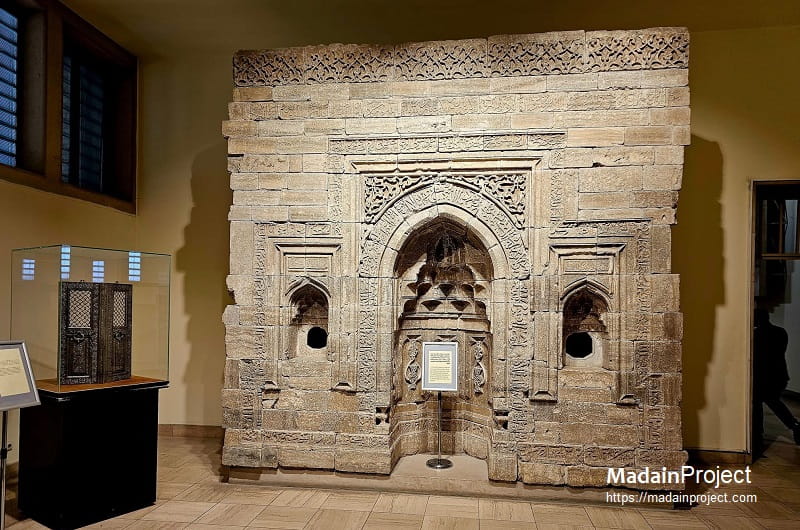
The architectural history of the mihrab represents a transition from a functional directional indicator to a highly stylized liturgical focal point. Etymologically, the term is rooted in pre-Islamic Arabic, where it denoted a place of honor, a palace throne room, or a private oratory. In its earliest Islamic context, the mihrab was not a physical niche but a concept. The earliest mosques—such as the Prophet’s Mosque in Medina (circa 622 CE) or the original mosque at Kufa—lacked a concave indentation, relying instead on the orientation of the qibla wall, stone plaque, or a simple marker, like a painted line or a wooden staff, to signify the direction of Mecca.
The emergence of the concave niche (mihrab mujawwaf) occurred during the Umayyad caliphate. Academic consensus identifies the reconstruction of the Mosque of the Prophet in Medina (706–709 CE) under Caliph al-Walid I as the definitive moment of introduction. Supervised by Umar ibn Abd al-Aziz, this architectural innovation likely drew inspiration from the exedrae of Roman architecture or the apses of Christian basilicas. Scholars such as Oleg Grabar have argued that this specific form served a dual purpose: it honored the spot where the Prophet stood to lead prayer and provided a symbolic "doorway" to the divine, thereby institutionalizing a visual focal point within the expansive prayer hall.
By the Abbasid and Fatimid periods, the mihrab evolved into the mosque's most decorative element, often featuring elaborate stucco carvings, marble inlays, and Quranic epigraphy. The decorative programs frequently utilized Sura 24:35 (The Verse of Light), reinforcing the niche's symbolic association with divine illumination. Structurally, the concave form also offered acoustic benefits, acting as a natural resonator to project the Imam’s voice back into the congregation. In certain regions, such as al-Andalus, the mihrab expanded into an entire room, as seen in the Great Mosque of Córdoba, where the horseshoe arch and Byzantine-inspired mosaics elevated the niche to a monumental architectural triumph.
Throughout the Middle and Late Islamic periods, the mihrab reflected regional stylistic shifts, from the complex muqarnas (stalactite vaulting) of the Seljuks to the vibrant Iznik tilework of the Ottomans. Despite its late introduction—which led some early traditionalists to view it as a bid’ah (innovation)—the mihrab became an indispensable component of Islamic architecture. It transitioned from a commemorative marker of the Prophet’s presence into a universal symbol of the Qibla, synthesizing theological necessity with sophisticated spatial design.
circa 625 CE

Mihrab Nabawi
The Mihrab al-Nabawi (المحراب النبوي) constitutes the primary liturgical focal point of Masjid an-Nabawi, identifying the specific location from which the Prophet Muhammad led congregational prayers following the redirection of the Qibla toward Mecca. Situated within the Rawdah al-Sharifah, the current architectural manifestation is a lavishly decorated concave niche, though scholars emphasize that the original prophetic station was a spatial area marked by the Prophet’s physical standing position rather than a recessed structure. The formalization of this space occurred significantly later, most notably during the Umayyad reconstruction overseen by Umar ibn Abd al-Aziz, who introduced the concave niche to Islamic architecture to honor the Prophetic legacy. Today, the site is distinguished by its intricate Mamluk-era marble mosaics and Ottoman calligraphic friezes, serving as a physical link to the foundational period of Islamic communal worship. It remains one of several significant mihrabs within the Prophet's Mosque—such as the Mihrab al-Uthmani, which serves as the current functional niche, and the Mihrab al-Tahajjud—each of which marks a distinct historical expansion or a specific site of prophetic devotion.
circa 965 CE
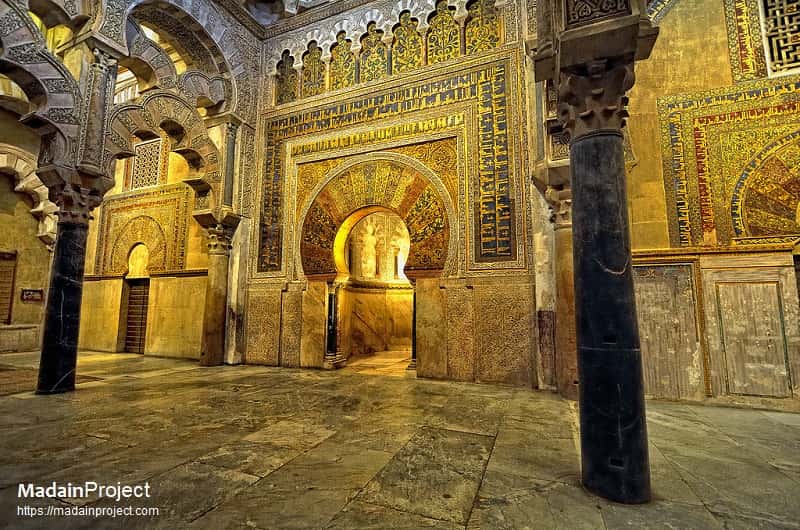
Mihrab of Cordoba Mosque
Signup for our monthly newsletter / online magazine.
No spam, we promise.

The Madain Project is an online archive of Abrahamic History and Archaeology.
Abrahamic History & Archaeology is the study of history and archaeology with respect to the three Abrahamic Faiths without considering the religious and theological aspects. The goal of Abrahamic History is to understand how and why the religious doctrines and behaviours have evlovled and changed over time. Searching for patterns in the evolution of significant cultural events such as the development of farming, the emergence of cities, or the collapse of major civilizations for clues of why and how these have influenced the three major Abrahamic religions.
Cloud Drive -
About -
Help -
Editorial Policy -
AI Policy -
Privacy Policy -
Contact
Madain Project: Encyclopedia of Abrahamic History & Archaeology.
Copyright MadainProject 2017 - 2026.


