
The Kiswa of the Kaaba (كسوة الكعبة) is the ceremonial cloth covering of the Kaaba in the Masjid al-Haram in present day Mecca, Saudi Arabia. It consists of a specially woven silk textile embroidered with Qur’anic inscriptions in gold and silver, renewed annually as an integral component of the ritual and visual culture of Islam.
Functioning simultaneously as a sacred object, a work of monumental textile art, and a symbol of custodianship over Islam’s holiest sanctuary, the Kiswa envelops the cuboid structure of the Kaaba in the Masjid al-Haram. Its deep black color, standardized over centuries, provides a visual frame for the white marble courtyard and emphasizes the Kaaba’s centrality in Islamic worship. Beyond its physical presence, the Kiswa embodies continuity of tradition, political authority, and religious devotion, as responsibility for its production and installation has historically signified sovereignty over Mecca.


The practice of covering the predates Islam. Early Islamic historians record that the Himyarite king of ancient Yemen, Tubbaʿ Asʿad Abu Karib, was among the first known rulers to clothe the Kaaba, reportedly using Yemeni textiles in the late pre-Islamic period. During the era of the Quraysh, the Kaaba was covered collectively by the tribe, with contributions from various clans. The Prophet Muhammad, after the conquest of Mecca in 630 CE, maintained the tradition and is reported to have used a Yemeni cloth. Under the Rashidun caliphs, the Kiswa continued to be replaced periodically, with materials sourced from different regions of the expanding Islamic polity.
A decisive transformation occurred under the Umayyad caliph Muʿawiya ibn Abi Sufyan, who is credited with instituting a regular replacement schedule and commissioning fine textiles from state resources. The Abbasid period introduced the now-familiar black silk covering, replacing earlier white and colored fabrics, and established inscriptions as a defining feature. Control over Kiswa production later shifted to Egypt under the Fatimids and subsequently continued under the Mamluks, who founded the Dar al-Kiswah in historic city of Cairo (Fustat) and organized an annual ceremonial caravan accompanying the Kiswa to Mecca. This tradition continued under Ottoman rule, with the Kiswa dispatched from Cairo alongside the mahmal, a symbolic palanquin representing imperial patronage. Following the incorporation of the Hijaz into the Saudi state, King Abdulaziz ordered the establishment of a local production facility in Mecca in 1927 CE, ending external manufacture and situating the entire process within the sanctuary’s immediate geographic context.
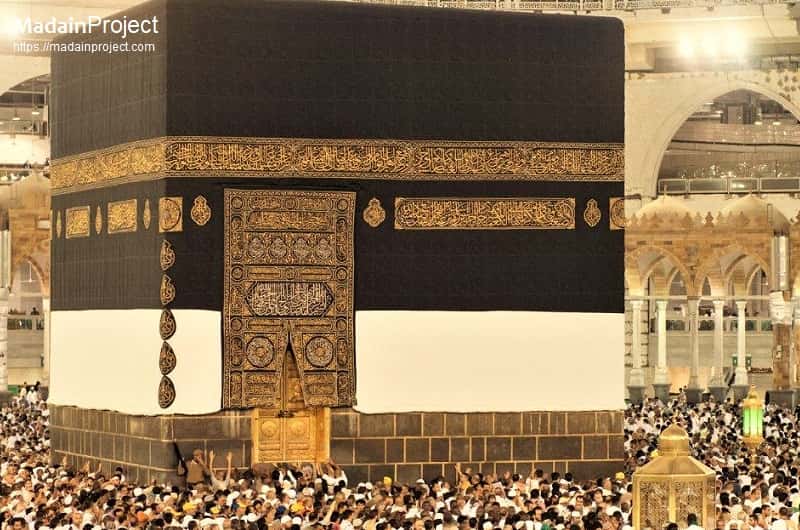
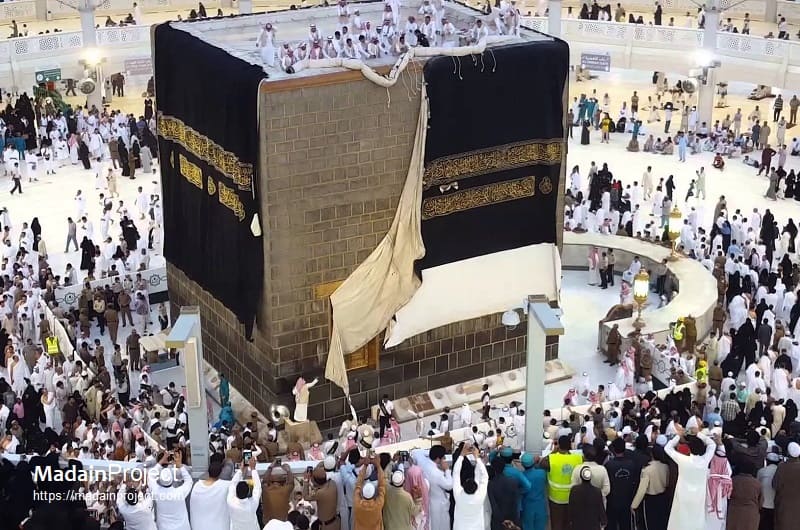
The Kiswa consists of several large panels of black silk, tailored to fit the Kaaba’s cubic form and suspended from a rope fixed near the roof. The exterior surface is densely embroidered with Qur’anic verses, invocations, and decorative motifs executed in raised calligraphy. The structure of the textile balances uniformity with hierarchical emphasis, drawing attention to specific architectural and symbolic elements of the Kaaba.
Hizam
The Hizam (inspect) is a broad embroidered band encircling the upper third of the Kaaba. Woven separately and later affixed, it bears elongated panels of Qur’anic text, including verses such as Ayat al-Kursi and declarations of divine unity. The Hizam serves both decorative and symbolic functions, visually anchoring the composition of the Kiswa while marking the transition between the Kaaba’s plain upper walls and the more elaborately inscribed lower sections. Its calligraphy is executed in thuluth script, chosen for its legibility and monumental character.

Sitar al-Kaaba
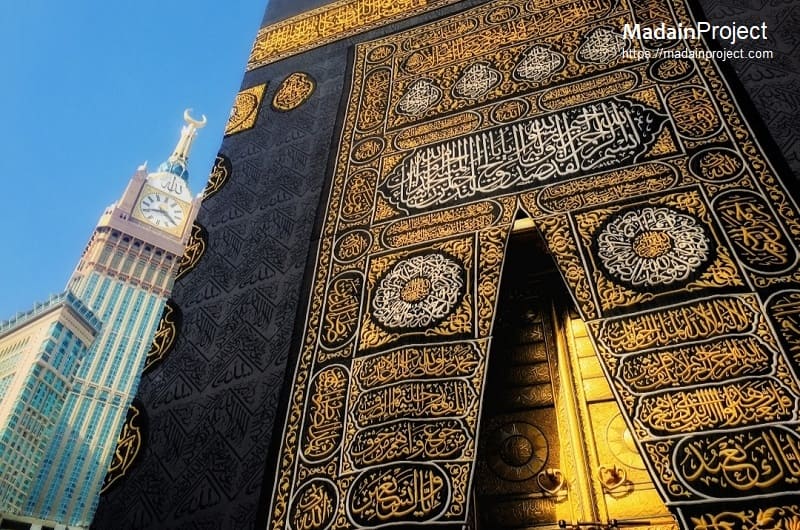
The Sitar al-Kaaba is the ornate curtain covering the Kaaba’s door, distinguished as the most elaborate component of the Kiswa. Rectangular in form and heavily embroidered, it contains layered panels of Qur’anic verses, the shahada, and supplications, framed by intricate vegetal and geometric designs. The density of gold and silver thread in the sitar exceeds that of other sections, reflecting the door’s ritual prominence as the threshold of the sanctuary’s interior.
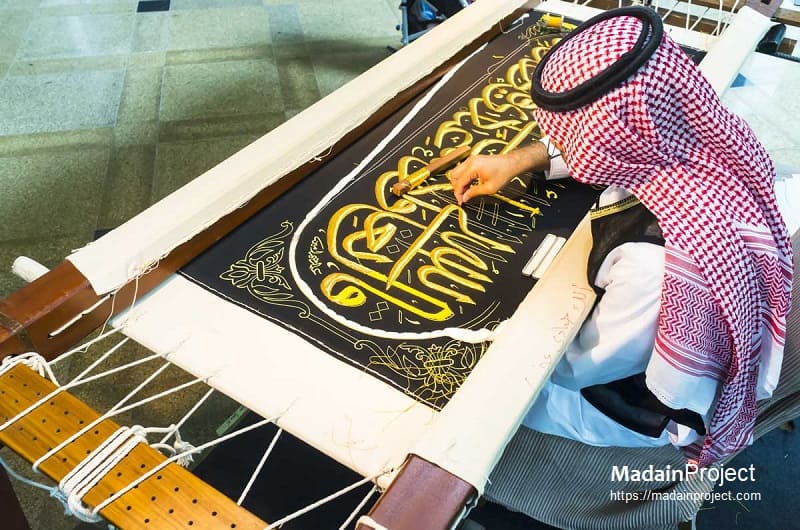
The Kiswa is produced at a dedicated facility at the King Abdulaziz Complex for Manufacturing the Kiswa of the Kaaba in Mecca, located in the Umm al-Joud district. The process integrates traditional craftsmanship with modern textile technology. High-quality natural silk, dyed to a uniform black, forms the base fabric, with approximately several hundred kilograms required for a single covering.
Calligraphic designs are first prepared by specialists, then transferred onto the fabric, where skilled artisans embroider the inscriptions using gold-plated silver threads. The embroidery is executed by hand to achieve the raised relief characteristic of the Kiswa’s surface. Individual panels are woven, embroidered, and lined before being assembled into the complete covering, ensuring precision in both dimensions and ornamentation.

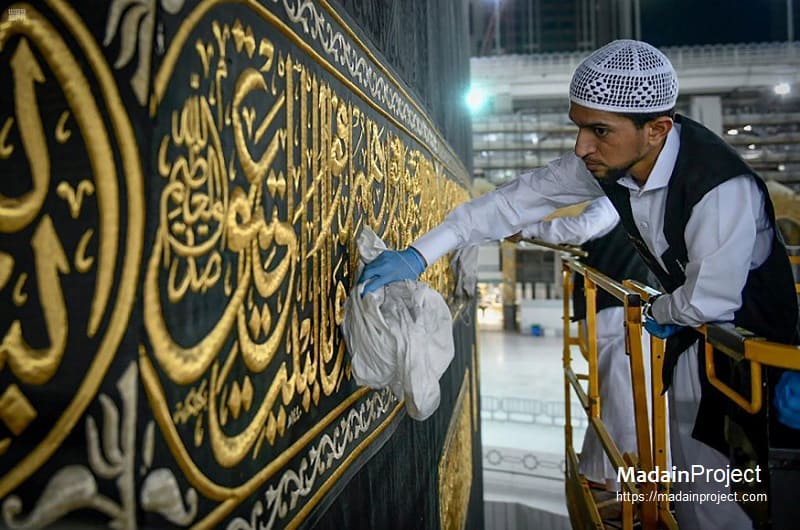
Historically, the delivery of the Kiswa to Mecca was marked by elaborate processions spanning vast distances, particularly during the Mamluk Sultanate and Ottoman Empire periods, when the annual caravan from Fustat (Cairo) was a major political and religious event. In the city of contemporary Saudi context, the procession has been transformed into a localized ceremonial transfer within Mecca itself. On the 9th of Dhu al-Hijjah, the Day of ʿArafah, the old Kiswa is removed and the new one installed in a carefully coordinated operation conducted by trained teams within the Masjid al-Haram. Although devoid of the long-distance caravans of earlier centuries, this modern procession retains its symbolic weight, reaffirming continuity with a tradition that links craftsmanship, ritual timing, and custodianship of Islam’s most sacred site.

Signup for our monthly newsletter / online magazine.
No spam, we promise.

The Madain Project is an online archive of Abrahamic History and Archaeology.
Abrahamic History & Archaeology is the study of history and archaeology with respect to the three Abrahamic Faiths without considering the religious and theological aspects. The goal of Abrahamic History is to understand how and why the religious doctrines and behaviours have evlovled and changed over time. Searching for patterns in the evolution of significant cultural events such as the development of farming, the emergence of cities, or the collapse of major civilizations for clues of why and how these have influenced the three major Abrahamic religions.
Cloud Drive -
About -
Help -
Editorial Policy -
AI Policy -
Privacy Policy -
Contact
Madain Project: Encyclopedia of Abrahamic History & Archaeology.
Copyright MadainProject 2017 - 2026.


