
The history of the Masjid al-Aqsa as an architectural monument starts from the very early period of Islam. The first mosque built on the site, historically identified as the Temple Mount, was a crude structure, constructed out of wooden trusses. It was constructed in year 636/637 CE, after the conquest of Jerusalem by Muslim forces.
Expansions, reconstructions rebuildings, repairs and additions were undertaken throughout the mosque's history over a period of nearly 15 centuries by the Ayyubids, Mamluks, Ottomans, the Supreme Muslim Council, and Jordan.

circa 636- CE
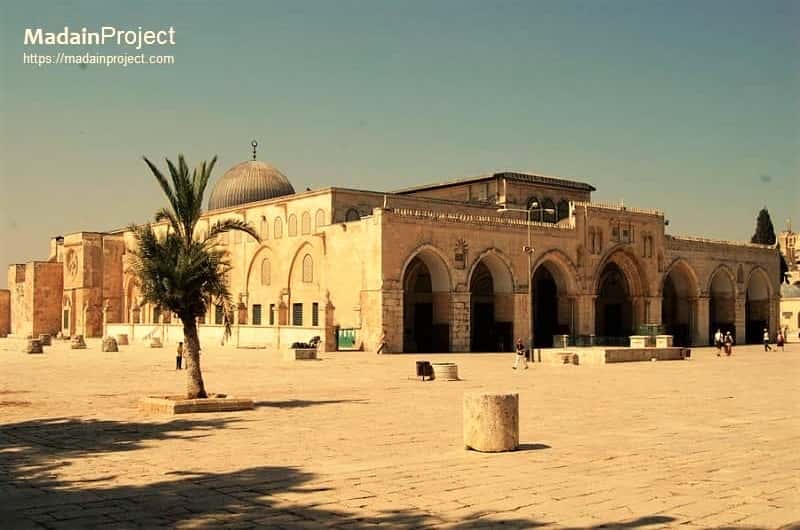
Rashidun Era
The first mosque built on the site was a crude structure, constructed out of wooden trusses. It was constructed in year 636/637 CE, after the conquest of Jerusalem by Muslim forces.
The Rashidun Era (circa 634–661 CE) marks the transition of the site from a neglected Byzantine-era wasteland (Sterquilinus) into a functional Islamic sanctuary, characterized by structural simplicity and the re-establishment of the site’s sanctity following the Muslim conquest in 637/638 CE.
Historical accounts, most notably by Theophanes the Confessor and later Muslim chroniclers like al-Tabari, describe the Caliph 'Umar ibn al-Khattab’s entry into Jerusalem (Aelia) as an act of ritual purification (However this idea of ritual purification is retroactive imposition and does not reflect the contemporary ideology). Upon discovering the Temple Mount covered in refuse—a deliberate act of desecration by the Byzantine authorities to marginalize the Jewish legacy—'Umar personally assisted in clearing the debris. This period is defined not by monumental masonry, but by the identification of the Sakhra (the Rock) and the establishment of a prayer space at the southern end of the platform, aligned toward the Qibla in Mecca, effectively reclaiming the site as the Masjid al-Aqsa mentioned in the Quranic Isra’ narrative.
The physical structure during the Rashidun period was a rudimentary, timber-based congregational hall, often referred to as the "Mosque of 'Umar." The most critical contemporary description comes from the Gallic bishop Arculf, who visited around 670 CE (shortly after the Rashidun era). He described a "quadrangular house of prayer" constructed of wooden planks and large beams over older ruins, capable of holding approximately 3,000 worshippers. This primitive structure lacked the sophisticated masonry, domes, and mosaics of the later Umayyad period, prioritizing functional utility for the garrisoned troops and the early Muslim community in Jerusalem over imperial display.
Architecturally and theologically, the Rashidun phase was a period of re-consecration. By placing the prayer hall at the southern extremity of the plateau, 'Umar ensured that worshippers would face Mecca without the Rock (the former Qibla) intervening between them and the Kaaba, thereby clarifying the Islamic hierarchy of sacred spaces. This era established the foundational waqf (endowment) concepts for the site and integrated the "Farther Mosque" into the administrative fabric of the Jund Filastin (Military District of Palestine), setting the stage for the Marwanid monumentalization that would follow under the Umayyads.
Umayyad Era
During the Umayyad era first proper building was constructed on the site of the make-shift mosque of Umar. ibn Marwan initiated the mosque project where the Masjid Umar stood; constructed some seventy years earlier. First Umayyad mosque at the site was completed during the reign of ibn Marwan's son al-Walid.
The Umayyad Period (661–750 CE) represents the foundational era of the Masjid al-Aqsa complex, where the site was transformed from a rudimentary prayer space into a sophisticated architectural expression of the nascent Islamic state’s sovereignty and theological claims.
The systematic monumentalization of the southern sector of the Haram al-Sharif began under Abd al-Malik ibn Marwan (reigned circa 685–705 CE) and was completed by his son, al-Walid I (reigned circa 705–715 CE). Unlike the centrally planned, commemorative Dome of the Rock to the north, the Umayyad Masjid al-Aqsa was designed as a congregational musalla (prayer hall). Architectural analysis, supported by the Aphrodito Papyri (administrative documents from Egypt), confirms that specialized laborers and vast resources were diverted from across the empire to construct this "Great Mosque". The Umayyad structure was significantly larger than the current mosque, featuring a hypostyle layout with approximately 15 naves running perpendicular to the qibla wall, a design intended to accommodate the burgeoning Muslim population of Iliya (early Arabic name, from Roman Aelia Capitolina, for Jerusalem used after the 638 CE Muslim conquest).
Umayyad urban planning integrated the mosque directly with the Dar al-Imara (Palatine complex) located just outside the southern wall of the Haram. A private bridge or walkway connected the caliph’s palace to the mosque, allowing the ruler to enter near the mihrab (prayer niche) for security and symbolic authority. During this period, the Double Gate and Triple Gate (today collective called the Hulda Gates) served as the primary subterranean entrances for pilgrims arriving from the south. These gates led into a monumental vestibule with ornate shallow domes—remnants of which are still visible today—demonstrating the high level of stone masonry and Hellenistic-influenced decorative programs characteristic of the Marwanid Renaissance.
The Umayyad construction was not merely functional but was a deliberate "architectural response" to the monumental Christian churches of Jerusalem, specifically the Church of the Holy Sepulchre and the Nea Church. By employing Byzantine-style mosaics and marble polychromy within a distinctly Islamic spatial framework, the Umayyads asserted the supersession of Islam. This era also saw the formalization of the fadail (merits) of Jerusalem literature, which emphasized the site’s connection to the Isra’ and Mi’raj (Night Journey and Ascension).
Abbasid Era
The Abbasid Period (750–969 CE) is characterized by significant structural restorations necessitated by seismic activity and a shift in the site’s political-theological utility following the transfer of the caliphal seat from Damascus to Baghdad.
In 747–748 CE, shortly before the Abbasid takeover, a major earthquake severely damaged the Umayyad-era structure. Upon his pilgrimage in 758 CE, the second Abbasid caliph, al-Mansur, found the mosque in disrepair. To fund the reconstruction, he ordered the stripping of the gold and silver plating from the Umayyad gates of the Haram to be minted into coin and the expenses of the construction be paid with that money. The resulting structure retained the basic plan of the earlier mosque but was rebuilt with a focus on structural stability. This period marked the beginning of the Abbasid policy of maintaining the site as a symbol of religious legitimacy, despite Jerusalem's diminished status as a provincial city compared to its role under the Umayyads.
Following another earthquake in 774 CE, the caliph al-Mahdi initiated a more ambitious reconstruction during his visit in 780 CE. Historical accounts from al-Muqaddasi indicate that al-Mahdi found the mosque too long and narrow; he ordered the length reduced and the width increased. The mosque was expanded to include fifteen aisles (naves), with the central nave being significantly wider and topped by a high wooden roof. This era established the monumental "T-plan" architecture, where the wider central aisle and the transept along the qibla wall emphasized the mihrab area, a hallmark of Abbasid congregational mosque design.
Under al-Ma'mun (reigned 813–833 CE), the Abbasids further solidified their imprint on the Haram al-Sharif. Al-Ma'mun is notably associated with the extensive restoration of the Dome of the Rock and the gates of the al-Aqsa compound. In an attempt to claim the architectural legacy of the site, he famously ordered the replacement of the Umayyad caliph Abd al-Malik’s name with his own in the mosaic inscriptions of the Dome of the Rock, though the original date of 72 Hijri was inadvertently left unchanged by the craftsmen. Architecturally, this period saw the refinement of the mosque's eastern and western porticos, integrating the sanctuary more cohesively with the urban fabric of Jerusalem.
By the mid-9th century CE, as central Abbasid authority waned, the mosque’s maintenance was increasingly managed by local governors or through the waqf (endowment) system. In 846 CE, another earthquake led to repairs under al-Mutawakkil. The final major Abbasid-style renovation occurred under the Tulunids (nominal Abbasid vassals), who reinforced the structure before the eventual Fatimid conquest in 969 CE. The Abbasid legacy at al-Aqsa is defined by this transition from a royal Umayyad shrine to a standardized, multi-aisled congregational mosque that prioritized communal prayer and structural resilience over the singular dynastic opulence of the previous era.
Fatimid Era
A further reconstruction was executed during the Fatimid period, in the 11th century.
The Fatimid Period (969–1099 CE) at Masjid al-Aqsa was defined by a transition from the expansive, multi-aisled Abbasid layout to a more condensed, structurally reinforced footprint, driven by the catastrophic earthquake of 1033 CE and the Fatimids' specific Isma'ili theological aesthetic.
The most transformative event of this era was the earthquake of 1033 CE, which leveled large portions of the mosque. The Seventh Fatimid Caliph, al-Zahir li-i'zaz Din Allah, initiated a radical architectural contraction. Finding the previous fifteen-aisle Abbasid structure structurally unsound and perhaps overly vast for the contemporary population, al-Zahir reduced the mosque to seven aisles: a dominant, wide central nave flanked by three aisles on either side. This structural consolidation defined the "Fatimid footprint", which remains the core basis of the mosque's dimensions today. The central nave was heightened and crowned with a monumental wooden dome (reconstructed in 1035 CE), replacing the earlier Abbasid versions with more sophisticated Fatimid joinery and lead exterior plating.
Under the Fatimids, the mosque became a canvas for Isma'ili Shia political and theological assertions. Al-Zahir commissioned elaborate floral and geometric mosaics in the drum of the dome and the qibla wall, interspersed with Kufic inscriptions. A critical extant artifact of this period is the mosaics of the arch, which bear the name of al-Zahir and the date circa 1035 CE (426 Hijri). These inscriptions functioned as "state documents in stone", emphasizing the Caliph's role as the "Imam of the Age" and the rightful guardian of the Haram. This era also saw the introduction of the fatimid arch—a slightly pointed, keel-shaped profile—which became a recurring motif in the mosque’s arcades.
Toward the late 11th century, the Fatimids encouraged the development of the northern and eastern perimeters of the Al-Aqsa platform as centers for learning and asceticism. This period saw the formalization of zawiyas (spiritual retreats) and the enhancement of the Mihrab Zakariya and other commemorative stations within the mosque. The Fatimid administration also focused on the water infrastructure of the site, restoring the subterranean cisterns (the Al-Kas or "The Cup") to facilitate the ritual ablutions required for the high-frequency Fatimid ceremonial processions.
The most precise primary source for this period is the Persian traveler Nasir-i Khusraw, who visited in 1047 CE. He described the mosque as a marvel of engineering, noting the use of massive stone pillars and the transition from the wood-heavy Abbasid style to a more stone-intensive Fatimid construction. He recorded that the mosque's interior was adorned with "colored carpets" and that the central nave featured a series of enormous chandeliers, reflecting the Fatimid obsession with "Light" (Nur) as a manifestation of the Divine Imamate.
Ottoman Era
The Ottomans also invested a lot of care in al-Qibly Mosque, especially Sultan Suleiman the Magnificent who carried out a comprehensive renovation of the building, as well as Sultan Mahmud II, Sultan Abdul Aziz, and Sultan Abdul Hamid II who furnished the Mosque with carpets and provided it with new lanterns.
British Period
During the British Mandate Period Islamic Higher Council undertook some restoration works in 1922 and 1924 CE. The first renovation in the 20th century was carried out in 1922, when the Supreme Muslim Council under Amin al-Husayni (the Grand Mufti of Jerusalem) commissioned Turkish architect Ahmet Kemalettin Bey to restore al-Aqsa Mosque and the monuments in its precincts. The council also commissioned British architects, Egyptian engineering experts and local officials to contribute to and oversee the repairs and additions which were carried out in 1924–25 by Kemalettin.
Jordanian Period
During the Jordanian era a few of the restoration works were undertaken, premarily in 1952, 1959 and 1964 CE.
circa 1969 CE

Israeli Period
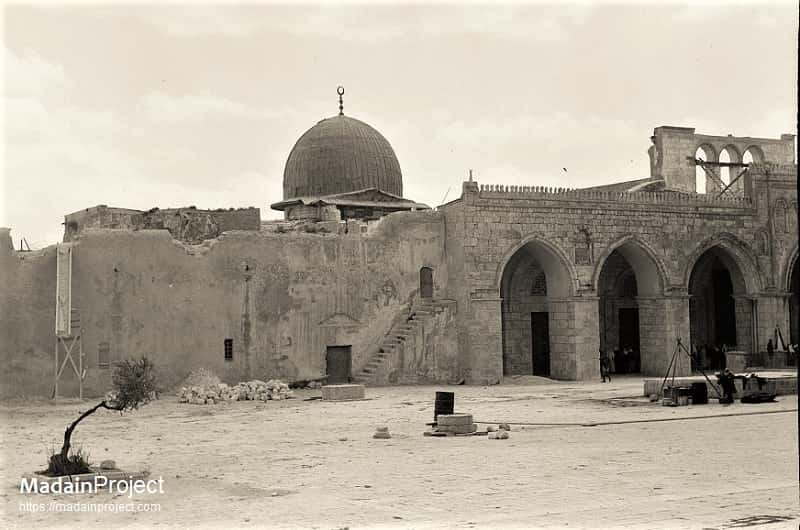
On 21 August 1969 CE, a fire was started by a visitor from Australia named Denis Michael Rohan. Rohan was a member of an evangelical Christian sect known as the Worldwide Church of God. He hoped that by burning down al-Aqsa Mosque he would hasten the Second Coming of Jesus, making way for the rebuilding of the Jewish Temple on the Temple Mount. Rohan was subsequently hospitalized in a mental institution.
Extensive restoration works had to be undertaken, due the damage caused by the arson attack. The programme of extensive conservation began with the damaged dome and its paintings. The ribbed aluminium outer covering was replaced with lead to match the original. The 14th-century painted decorations of the dome interior, thought to be irreparably lost, were brought to light and completely reconstructed using the trateggio technique, a method that uses fine vertical lines to distinguish reconstructed areas from original ones.


Signup for our monthly newsletter / online magazine.
No spam, we promise.

The Madain Project is an online archive of Abrahamic History and Archaeology.
Abrahamic History & Archaeology is the study of history and archaeology with respect to the three Abrahamic Faiths without considering the religious and theological aspects. The goal of Abrahamic History is to understand how and why the religious doctrines and behaviours have evlovled and changed over time. Searching for patterns in the evolution of significant cultural events such as the development of farming, the emergence of cities, or the collapse of major civilizations for clues of why and how these have influenced the three major Abrahamic religions.
Cloud Drive -
About -
Help -
Editorial Policy -
AI Policy -
Privacy Policy -
Contact
Madain Project: Encyclopedia of Abrahamic History & Archaeology.
Copyright MadainProject 2017 - 2026.


