
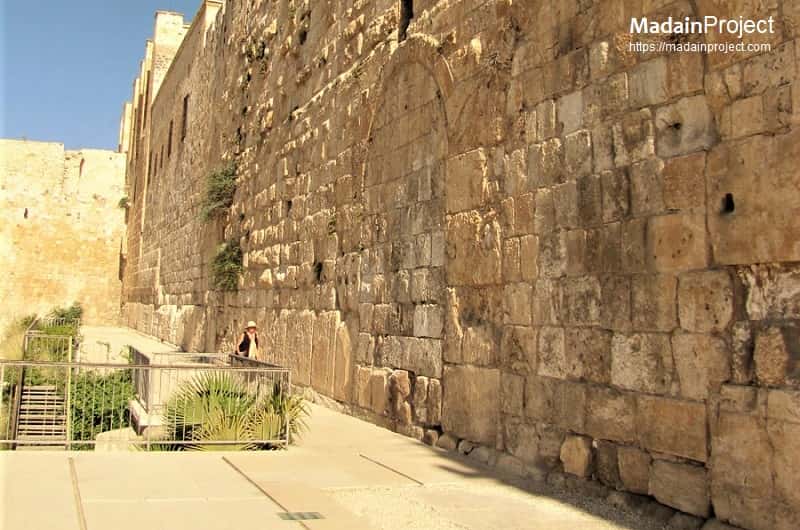
The Huldah Gates (Hebrew: Sha‘arei Hulda, שערי חולדה), are the two sets of now-blocked gates in the Southern Wall of the Temple Mount, situated in Jerusalem's Old City. The gates and passageways are now part of Masjid al-Aqsa al-Qadimi and Masjid al-Marwani. The term is currently being used for the remains of two later sets of gates, the Triple Gate and the Double Gate, known together as the Huldah Gates, built as part of the much extended Herodian Temple Mount. There still are a few Herodian architectural elements visible outside and inside the gates, while most everything else of what we see today is later, Muslim-period work.
Originally integral to the access system of the Temple Mount, they were closely linked with the monumental southern steps and the Ophel district, facilitating pilgrimage and ritual movement toward the Temple proper. The appellation “Huldah” derives from the Mishnah’s description of the Temple Mount and is traditionally associated with the prophetess Huldah of the reign of King Josiah, though alternative etymological explanations link the name to the Hebrew for “mole” or “mouse”, evoking the subterranean character of the passageways.
Archaeological and historical inquiry into the Huldah Gates reveals their complex life cycle of construction, enlargement, closure, and transformation. While the base of the southern wall into which they are set reflects Herodian enlargement of the Temple platform in the late first century BCE, much of the visible fabric today derives from later Muslim-period modifications. Both the Triple and Double Gates were sealed in the medieval period, yet structural and decorative remnants — such as Herodian lintels, jambs, and vaulting — persist beneath later masonry, attesting to their original form and function.

circa 100 CE

Eastern Huldah Gates
The Eastern Huldah Gates, commonly referred to as the Triple Gate (inspect), occupy the eastern portion of the southern wall’s southern face. Characterized originally by three adjacent arches leading into a vaulted passage beneath the Temple platform, this gate’s western jamb is of Herodian provenance, while much of the visible masonry is Umayyad in date. The triple‑arched configuration facilitated ingress beneath the Royal Stoa toward the Temple Mount surface. Medieval closure of the arches converted the portal into part of the qibla wall of Masjid al‑Marwani (the so‑called “Solomon’s Stables”), and the internal passageways now serve as part of that mosque’s subterranean structure.
The eastern set is a triple arched gate, which is now walled up and constitues the qibla wall of Masjid al-Marwani (Solomon's Stables). Although walled up, the passageways are still functional and allow access to the recently built (circa 1996 CE) Masjid al-Marwan. The Triple Gate was blocked in the 11th century CE, during the Crusader period. The western jamb is Herodian, while the rest of what we see today is Umayyad. Inside the Triple Gate, in Herodian times there must have been a passageway identical to the one inside the Double Gate.
circa 100 CE

Western Huldah Gates
Each arch of the double gate led into an aisle of a passageway leading from the gate into the Mount, and to steps leading to the Mount's surface; when the al-Aqsa Mosque was built, the old steps were blocked, and the eastern aisle lengthened so that new steps from its end would exit north of the Mosque. The eastern portal of the double gate is now walled up and constitues the qibla wall of Masjid Aqsa al-Qadimi, the western portal although open it allowd entry in to a Fatimid era fortification tower's base, where recently a libray was established.
The Western Huldah Gates, known as the Double Gate, stood to the west of the Triple Gate and were defined by two side‑by‑side arches leading into parallel aisles of a passageway ascending to the Temple Mount esplanade. Herodian elements — including parts of the lintel and relieving arch — survive intermixed with Umayyad and later construction. The western arch is incorporated into a medieval fortification adjacent to the al‑Aqsa Mosque, and its base houses a small library established within the remains of the tower. Internally, the vaulted corridor supported by columns and early domes reflects a complex chronological layering of architectural interventions.
circa 100 CE

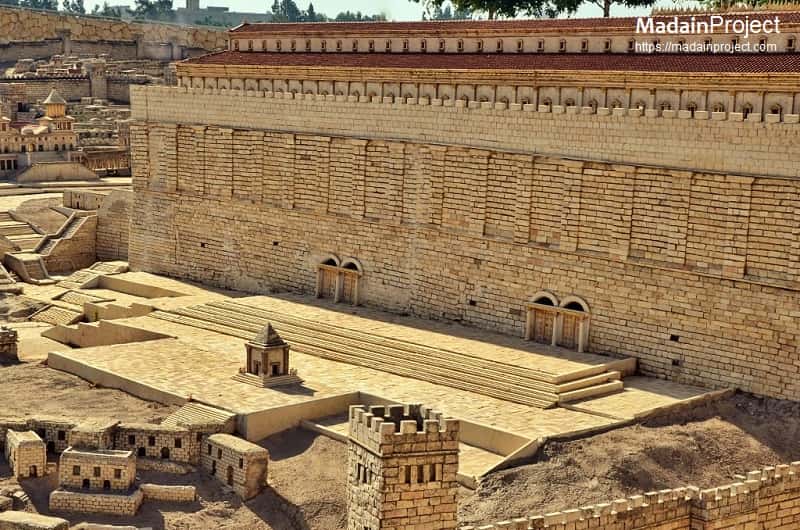
The Huldah Gates are also depicted in the Holyland Model of Jerusalem, which was designed, circa 1970 CE, by Israeli historian and geographer Michael Avi-Yonah based on the writings of Flavius Josephus and other historical sources. The Huldah gates in the model were depicted as having two arched portals each, but modern studies have shown that the eastern gates had three arched portals. Since its construction a number of changes have been made to correct the model according to the latest finds. This area in front of the southern wall constitues the Ophel mentioned in the Bible.
Signup for our monthly newsletter / online magazine.
No spam, we promise.

The Madain Project is an online archive of Abrahamic History and Archaeology.
Abrahamic History & Archaeology is the study of history and archaeology with respect to the three Abrahamic Faiths without considering the religious and theological aspects. The goal of Abrahamic History is to understand how and why the religious doctrines and behaviours have evlovled and changed over time. Searching for patterns in the evolution of significant cultural events such as the development of farming, the emergence of cities, or the collapse of major civilizations for clues of why and how these have influenced the three major Abrahamic religions.
Cloud Drive -
About -
Help -
Editorial Policy -
AI Policy -
Privacy Policy -
Contact
Madain Project: Encyclopedia of Abrahamic History & Archaeology.
Copyright MadainProject 2017 - 2026.


