
Ancient Caere, known to the Etruscans as Cisra and to the Greeks as Agylla, was one of the largest and most influential city-states of the Etruscan League, located near the Tyrrhenian coast in present-day Cerveteri. As a preeminent maritime power, it served as a vital nexus for Mediterranean trade and cultural exchange, maintaining unique diplomatic ties with Rome and the Hellenic world. The site is most historically significant for its vast necropoleis, such as the Banditaccia, which feature tumuli and rock-cut tombs that provide unparalleled archaeological evidence of Etruscan urban planning, social hierarchy, and funerary architecture.
Caere—also referred to in Latin as Caisra and Cisra—was an important ancient city in southern Etruria, identified with modern-day Cerveteri about 50–60 kilometers northwest of Rome. The Etruscans called it Cisra, the Greeks knew it as Agylla, and Phoenician sources refer to it as 𐤊𐤉𐤔𐤓𐤉𐤀 (kyšryʼ).
In antiquity, Caere was one of the major Etruscan city-states, both large and influential, with a territory far exceeding that of the present-day town—roughly fifteen times larger. At its peak around 600 BCE, it was comparable in power only to Tarquinia and was a key member of the Etruscan League. The city maintained an important coastal port and the sanctuary at Pyrgi, which played a significant role in Mediterranean trade. Today, Cerveteri is especially known for its extensive Etruscan necropolis and rich archaeological remains.
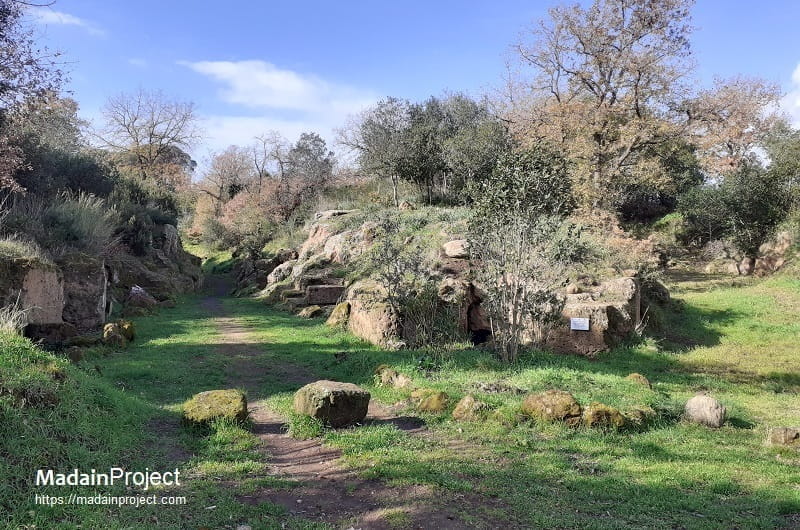
circa 900 BCE - 100 CE

Villanovan period
During the Early Iron Age (Villanovan period, 9th–8th centuries BCE), the settlement at Caere transitioned from scattered clusters to a centralized proto-urban center on the tufaceous plateau. Primary evidence for this phase is derived from the Sorbo and Cava della Pozzolana necropoleis, where biconical impasto urns used for cremation burials demonstrate the initial stages of social stratification. These early burials, often containing bronze fibulae and basic weaponry, indicate a society organized around kinship groups with an emerging warrior elite. Archaeological findings indicate stable economic activity, including permanent habitation and associated Etruscan necropolis settlements.
Orientalizing Period
In the mid-8th century BCE, trade between Greeks and Etruscans increased significantly, as shown by standardized urns and pottery found in burials. By the late 8th century BCE (advanced Iron Age period), the transition to the Orientalizing period signaled a shift in both funerary rites and economic complexity. The introduction of inhumation alongside traditional cremation, coupled with the appearance of luxury imports such as Euboean skyphoi, confirms Caere’s early integration into Mediterranean maritime networks. By the 7th century BCE, the town had developed into a major Etruscan trading center, with expanding connections to Greek colonies in Southern Italy and Sicily, as well as to Corinth. Locally produced goods began to imitate imported Greek pottery, particularly after Greek artisans migrated into Etruria. The earliest Bucchero ceramics are associated with Caere, suggesting their development or first large-scale production occurred there. This era also saw the development of permanent domestic architecture and the exploitation of the Tolfa Hills for metal ores, establishing the economic foundation for Caere's eventual rise as a dominant Etruscan maritime power.
Archaic Period
The Archaic period (circa 600–480 BCE) marked the apogee of Caere’s economic and political hegemony, characterized by intensified maritime mercantilism and sophisticated urban development. The transition from the late Orientalizing phase is epitomized by the Regolini-Galassi tomb (circa 675–650 BCE), whose inventory of granulated gold jewelry and Near Eastern imports serves as a definitive marker of an entrenched, hereditary aristocracy. By the mid-6th century BCE, this wealth facilitated a distinct shift in funerary architecture; the transition to standardized cube tombs arranged in a rectilinear, "orthogonal" street grid at the Banditaccia necropolis reflects a move toward civic regulation and a broadening middle class of gentilitial families.
Caere’s geopolitical status was cemented through its strategic alliance with ancient Carthage, culminating in the Battle of the Alalia (circa 540 BCE). Caere first appears in recorded history in 540 BCE in connection with the Battle of Alalia. After the conflict, prisoners were executed by stoning, an act later believed to have caused a plague, leading to the institution of annual athletic games in their honor. In 509 BCE, after the fall of the Roman monarchy, Lucius Tarquinius Superbus and his sons went into exile in Caere. Despite wider difficulties in Etruria, trade revived during the 5th century BCE, largely due to strong relations with Rome, supported by road connections such as the Via Aurelia and Via Clodia.
This naval engagement successfully checked Phocaean Greek expansion in the Tyrrhenian Sea, securing Caere’s control over vital trade routes. Unique among Etruscan polities, Caere maintained a reputation for eunomia (civic justice) and famously abstained from systemic piracy, as noted by Greek historians like Strabo. This cultural prestige is evidenced by the dedication of the Treasury of the Agyllaioi at the Panhellenic sanctuary of Delphi, an exceptional diplomatic concession granted to a non-Greek state.
During the late 6th century BCE, the city became a major center for Ionian-style artistic production. The presence of resident Greek craftsmen is confirmed by the Caeretan Hydriae, a series of black-figure vases characterized by vibrant polychromy and mythological narratives produced exclusively within Caeretan workshops. This period of artistic florescence coincided with the peak of the Pyrgi sanctuary, where the discovery of the Pyrgi Tablets—bilingual texts in Etruscan and Phoenician—provides critical evidence of the deep-seated syncretism between Caeretan religious life and the wider Mediterranean commercial world.
Classical Period
At the beginning of the Classical Period Caere was affected by the broader crisis in southern Etruria following the naval defeat at the Battle of Cumae in 474 BCE. However, recovery is evident in the early 4th century BCE, supported by continued ties with ancient Rome. The city provided refuge to Roman priests and Vestal Virgins after the Gallic sack of Rome in 390 BCE, and Roman aristocrats were educated there. The Tabulae Caeritum dates from this period, recording inhabitants granted Roman citizenship without voting rights (ius Caeritum).
Late Classical to Early Hellenistic Period
In 384/383 BCE, Dionysius attacked Pyrgi; although Caere offered support, it was defeated. In 353 BCE, allied with Tarquinii, Caere lost a war with Rome and forfeited key territories, including coastal regions and ports. By around 300 BCE, the city had come under Roman control following a series of conflicts. A long truce is reported, after which most of Etruria fell under Roman dominance by 295 BCE. During the First Punic War, Caere supplied provisions but contributed little otherwise.
Roman Imperial Period
The city experienced a brief revival under Augustus (Principate period) or Tiberius (empire period), but by the first century CE it had lost its economic strength and political significance.
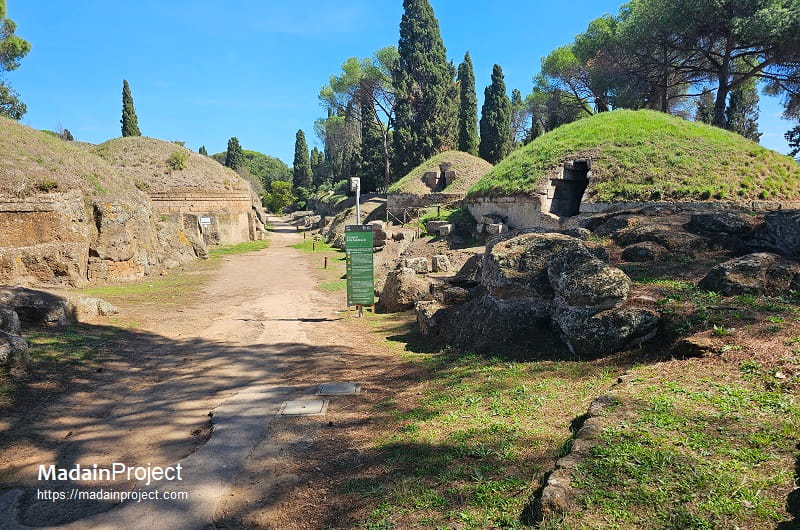
Banditaccia Necropolis
The Banditaccia Necropolis at Cerveteri stands as one of the most significant archaeological manifestations of Etruscan funerary culture, offering an unparalleled evolutionary record of domestic architecture translated into stone. Inscribed as a UNESCO World Heritage site, this sprawling city of the dead mirrors the urban planning of the living, featuring tumuli and rock-cut tombs that span the ninth to the third centuries BCE. By replicating the interior layouts, decorative motifs, and structural details of contemporary residences, the site provides critical insights into the social hierarchies, belief systems, and daily lives of the Etruscan elite. Consequently, the Banditaccia remains a foundational site for understanding the intersection of Mediterranean funerary practices and the sophisticated craftsmanship of pre-Roman Italy.
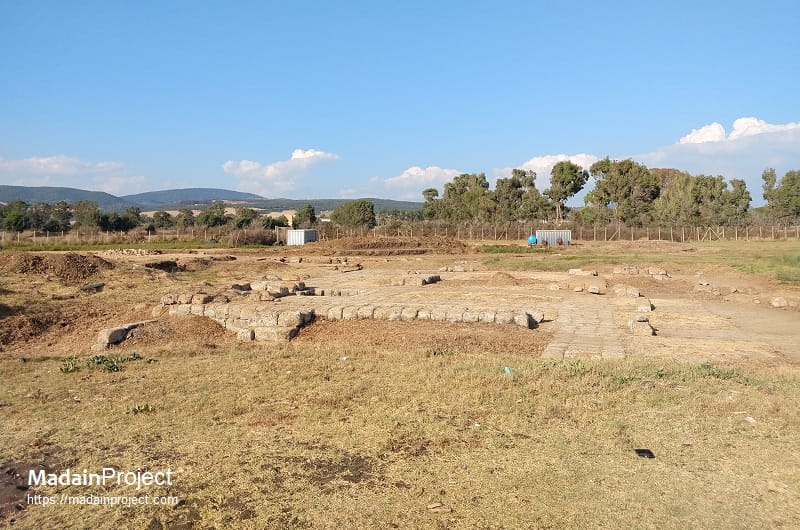
Pyrgi (Port Settlement)
The Pyrgi port settlement represents a critical nexus of maritime commerce and cross-cultural exchange in the ancient Mediterranean, serving as the primary gateway for the Etruscan city-state of Caere. Functioning as both a strategic naval base and a major emporium, the site is distinguished by its monumental sanctuary complex, which reveals a unique architectural and religious synthesis between Etruscan and Phoenician traditions. The discovery of the bilingual Pyrgi Tablets—inscribed in both Etruscan and Phoenician—provides an indispensable epigraphic record of the political and cultic ties that linked the central Italian coast to the broader Levant. Thus, the archaeological remains at Pyrgi offer essential evidence for the economic vitality and diplomatic sophistication that characterized Etruscan maritime dominance during the sixth and fifth centuries BCE.
Signup for our monthly newsletter / online magazine.
No spam, we promise.

The Madain Project is an online archive of Abrahamic History and Archaeology.
Abrahamic History & Archaeology is the study of history and archaeology with respect to the three Abrahamic Faiths without considering the religious and theological aspects. The goal of Abrahamic History is to understand how and why the religious doctrines and behaviours have evlovled and changed over time. Searching for patterns in the evolution of significant cultural events such as the development of farming, the emergence of cities, or the collapse of major civilizations for clues of why and how these have influenced the three major Abrahamic religions.
Cloud Drive -
About -
Help -
Editorial Policy -
AI Policy -
Privacy Policy -
Contact
Madain Project: Encyclopedia of Abrahamic History & Archaeology.
Copyright MadainProject 2017 - 2026.


