
The Archaeological Site of Delphi, situated on the southwestern slope of Mount Parnassus in Phocis, Greece, constitutes a premier pan-Hellenic sanctuary complex of the classical world. Characterized by its unique topographic integration and architectural density, the site serves as a primary archaeological record of the Sanctuary of god Apollo and the Sanctuary of Athena Pronaia. Its spatial organization reflects a complex evolution of ritualized space, featuring the remains of the Doric Temple of Apollo, an extensive theatre, and a stadium, all linked by the Sacred Way.
The Archaeological Site of Delphi, a UNESCO World Heritage property situated on the south-western slopes of Mount Parnassus, exists as an exceptionally preserved monumental ensemble that maintains its "outstanding universal value" through a strict regime of conservation and spatial protection. The site is topographically and functionally bisected by a modern road into two primary sectors: the Sanctuary of Apollo to the north and the Sanctuary of Athena Pronaia (Marmaria) to the south, the latter containing the iconic circular tholos.
The upper sanctuary is characterized by the Sacred Way, which ascends past numerous city-state treasuries—most notably the almost entirely reconstructed Treasury of the Athenians—to the central Temple of Apollo, the historical seat of the Delphic Oracle. Higher elevations house the Ancient Theatre and the Stadium, which served as the primary venues for the Pythian Games.
Currently, the site’s integrity is managed by the Ephorate of Antiquities of Phocis under the Greek Ministry of Culture, focusing on mitigating long-standing geomorphological risks, including rockfalls from the Phaedriades cliffs and seismic instability from the Central Greece tectonic fault. Modern interventions are restricted to small-scale restorations following the Charter of Venice principles, ensuring that the architectural authenticity and the "sacred landscape"—defined by its harmony with the Pleistos Valley and the Crisaean Gulf—remain largely unchanged since antiquity.
Recent developments include the implementation of comprehensive fire protection systems and digital accessibility initiatives, such as virtual tour applications for the adjacent Delphi Archaeological Museum, which houses critical finds like the Charioteer of Delphi.
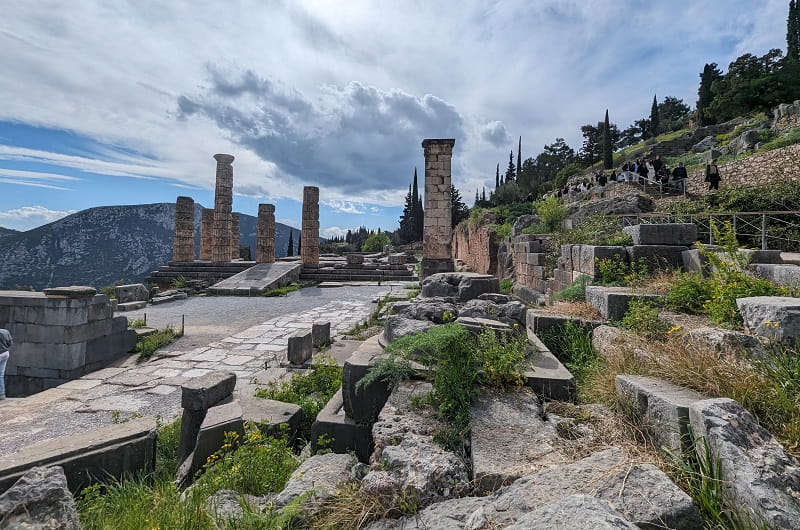
circa 580 BCE

Kastalian Spring
The purifying water of the Kastalian spring gushed from the slopes of the Phaedriada, called Hyampeia in antiquity, and flowed in to a narrow gorge, where myth had it that the dread guardian of the oracle Python, the son of Earth, had its lair. The stone fountain of the same name was built along the side of the riad that led to the precinct of Apollo in the early sixth century BCE. It supplied thesacred oracle with water, which served for the purification both of priests as well as the faithful who entered the sanctuary. According to local tradition,the spring took its name either from the local hero Kastalios or the nymph Kastalia, the daughter of the river god Achelous.
During its long use over centuries, the Kastalian spring of the archaic period / Archaic Greece, which is mentioned by Herodotus, Pindar, and many other poets, underwest many repairs and alterations. During the modern era it was restored in 1959 CE by the Greek architect Anastasios Orlandos, and again in 1977 CE by the French Archaeological School. In its present-day preserved form,it consists of a rectangular basin divided in to a central and two side chambers. The water was channelled in to the central section of the basin through a rock-cut water channel. The facade of the central chamber was decorated with semi-columns and four (or seven) bronze lion-headed spouts. In the area in front of the central chamber, a paved courtyard was created at a lower level with stone benches along the walls.
In the first century BCE, the archaic fountain was replaced by another construction deep in the rock, at a distance of about fifty meters from the earlier one. The later fountain was entire cout out of the natural porous bedrock, and for this reason is often called the "rock-fountain". The system for collecting and supplying water, and the formation ofits spaces, was nearly identical with that of the earlier fountain. Water was collected in a long and narrow basin (approx ten meters in length) cut in to the bedrock. Seven metal spouts and stone semi-columns to the right and left of the spouts adorned the basin's facade. Water flowed from the spouts to the rectangular paved courtyard (11x3.6 meters), with eight rock-cut descending steps. The niches above the basin, which were also rock-hewn, received minor votive by pilgrims, normally figurines offered to the water-nymph Kastalia.
During the Ottoman period, one of the three large niches was converted in to the apse of a small church dedicated to Saint John the Baptist.
The cold, clean waters of the Kastalian spring continue to flow even today from a smaller and to be sure less impressive fountain, refreshing visitors on their way to the sanctuary.
circa 550 BCE
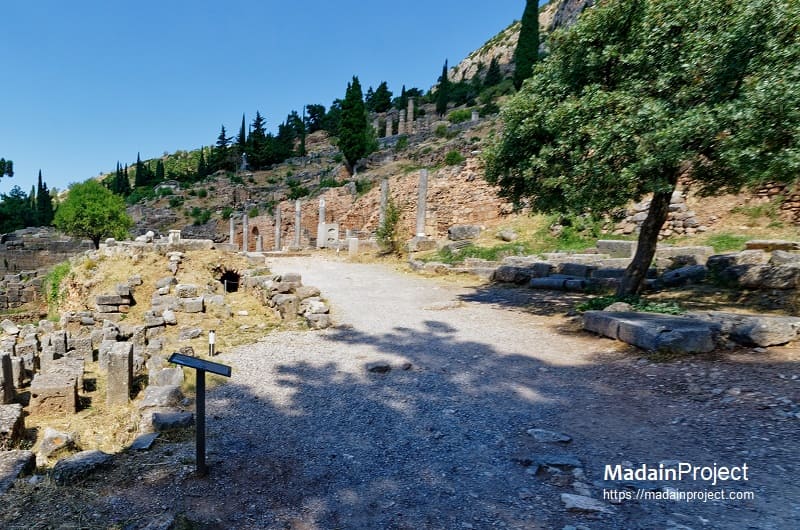
Sacred Way
The Sacred Way of ancient Delphi is among the most architecturally and symbolically significant features of the Delphi archaeological site, serving as the principal processional avenue that winds upward through the Sanctuary of Apollo. Beginning at the southeastern entrance and ascending toward the Temple of Apollo, the path measures roughly 200 meters in length and is laid with carefully cut stone slabs that follow a steep, curving trajectory through terraces filled with religious monuments. Its deliberate design was both practical and ceremonial: as pilgrims climbed, successive bends in the route gradually unveiled the sanctuary’s sacred core, creating a theatrical sense of revelation that culminated at the temple where the Oracle of Delphi delivered her prophecies. On either side of the Sacred Way once stood an extraordinary concentration of treasuries, votive statues, stelae, and commemorative tripods, each offered by city-states or individuals seeking divine favor or commemorating military triumphs. Among these, the Athenian and Siphnian Treasuries remain the most prominent, exemplifying the artistic and political rivalry that shaped the sanctuary’s landscape. The Sacred Way thus functioned not merely as a route of movement but as a narrative corridor, embodying the spiritual hierarchy and civic pride of the Greek world while visually and ritually integrating the physical ascent with the sacred act of approaching Apollo’s divine presence.
circa 525 BCE

Siphnian Treasury
The Treasury of Siphnians is situated adjacent to the Sikyonian Treasury on the western side. it was a small building, the offering of the inhabitants of Siphnos around 525 BCE. According to the historian Herodotus (circa fifth century BCE) and the traveller Pausanias (circa second century CE), the treasury was built with the dekate, i.e. one-tenth of the income from the exploitation of Siphnos' gold and silver mines. Apart from its foundations, it was built entirely of shining, transparent marble and stood out for its richness and elegance in the sanctuary of Apollo. Its facade is distinguished for its exceptional ornamental richness. Two Korai, set between parastades (i.e. the ends of the side walls) on the western facade, supported the weight of its lavishly decorated entablature. The frieze with its masterful scenes surrounded the entire structure to a length of about thirty meters. The greater part of this frieze is preserved and is on exhibit in the Archaeological Museum of Delphi.
circa 510 BCE
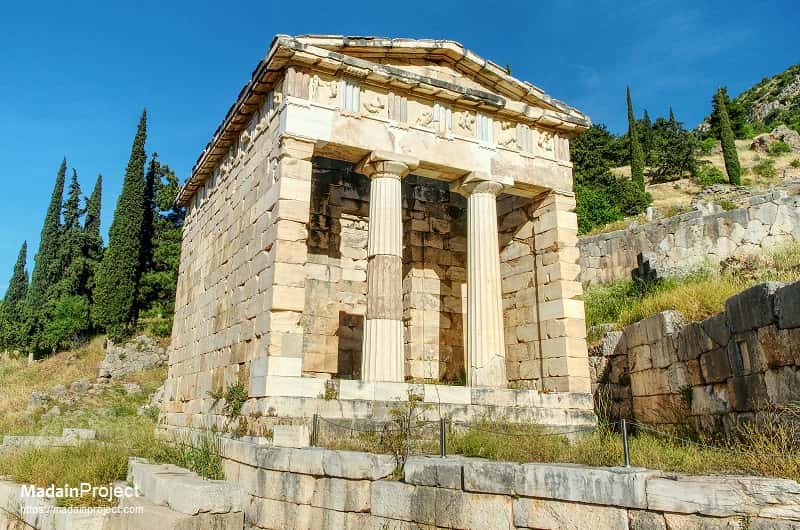
Treasury of the Athenians
The Athenian Treasury, best preserved monument of the Apollonian sanctuary, built of white marble from the island of Paros, was dedicated to Apollo Pythios by Athenian citizens; it commemorated either the establishment of democracy in the city-state of Athens following the collapse of the Peisistratid tyranny (circa 510 BCE) or the Athenian victory agains the Persians at the Battle of Marathon (circa 490 BCE). It is believed that the edifice served as a treasury for the Athenian offerings to Apollo including trophies seized after the great military victories of Athens.
The small temple-like structure is of Doric order, with two columns between the facade pilasters. The treasury was initially restored in 1903-1906 CE with funds granted by the municipality of Athens; a second restoration undertaken by the Ministry of Culture and Tourism was completed in 2004 CE. The relief metopes of its frieze represented the exploits of two celebrated heroes, Herakles and Theseus. The original sculpted decoration is exhibited in the Archaeological Museum of Delphi.
The walls of the treasury were covered with numerous inscriptions, including two paeans to Apollo supplemented with the musical notation of the ancient melody, on the south wall. On a triangular platform next to the south side of the treasury of the Athenians exposed the spoils from their victory in Marathon.
In the second and third centuries CE the monument was used as the Delphi pawn-brokers' office, according to epigraphical sources.
circa 500 BCE

Sikyonian Treasury
The Sikyonian Treasury, also spelled as Sicyonian Treasury, was built around 500 BCE. It was of porous stone, in the Doric order with two columns on its facade between side walls. The treasury's foundations were constructed like a rampart with an initial height of over 3 meters. Porous architectural elements belonging to two earlier buildings were an important find during the excavation of the treasury's foundations.
One of these buildings is dated to around 580 BCE and would have been circular in plan (tholos). The second, dated to 560 BCE, was rectangular in plan with surrounded columns (a monopteros). Five relief metopes displaying mythological subjects, a superb example of sixth century BCE sculpture, belonged to the later building. Today these are on display in the Archaeological Museum of Delphi. It is thought that this building was erected to house the chariot of the tyrant of Sikyon, Kleisthenes, who had been victorious in the first Pythian Games in 582 BCE.
circa 479 BCE

Tripod of the Plataeans
Also called the Serpent Column was the sole common votive by all the Greeks at the Delphic sanctuary following their victory over the Persians in the battle of Plataea in 479 BCE. The Greeks, after gathering the spoils of victory, kept one-tenth and used this to cover the cost of dedicating to Apollo a gold tripod supported on a bronze column 7.5 meters tall in the form of a three-bodied serpent. The phocians melted down down the gold from the the tripod during the third Sacred War (circa 354-343 BCE), and Constantine the Great transferred the serpentine column to Constantinople when it was founded in 330 CE and set it up in the Hippodrome (the modern day Sultanahmet Square), where it still stands. Behind the tripod of the Plataeans arepreserved the foundations of a large plinth that supported the gilded chariot of the sun god(Ilios), patron of the island of Rhodes, which was a late fourth century BCE votive by the Rhodians.
circa 450 BCE

Stadium
The Stadium of Delphi hosted the athletic contests of the Pythian religious festival. Initially, in the fifth century BCE, a racing track was formed by leveling the ground; the spectators would sit on the ground. During the Roman Empire period in the second century CE, under the Roman emperor Hadrian, the stadium was ameliorated with funds of the wealthy Athenian Herodes Atticus (who had also built an odeon at the Athenian Acropolis); the marble seats and the monumental three-arched entrance visible today were added at that time.
The starting point and the finishing post of the track were marked by a row of stone slabs with square holes. It is estimated that seventeen or eighteen runners could compete in a race. The distance between start and finish was one Pythian stade, which is equivaltent to 178.35 meters. The seats intended for the judges, at the north side of the Stadium were equipped with backrests.
The monumental arched entrance (inspect), now in ruins for themost part, at the east side fo the stadium, in front of the starting point of the race-track, is unique in ancient Greece. The three arches were supported by four pillars; the two central pillars had niches for statues.
The Pythian athletic contests were performed in the stadium on the fifth day of the festivities, which lasted overall six to eight days. The Pan-Hellenic Pythian Games were second in importance only to the Olympic Games. The Pythian winners were awarded with a palm tree twig or a wreath of laurels. Some of the events performed in the stadium are the dolichos (a long-distance running race of twenty four stades), the stadion (one-stade race), the diaulos (two stade race) and the pentathlon, a complex competition which included race, wresteling, jump, discus throwing and javeline throwing. The athletic contests were completed with a hoplite, a race of 2-4 stades, during which the athletes ran wearing only a helmet and greaves and carrying a shield.
circa 450 BCE

Altar of the Chiots
Built at the expense of the inhabitants of Chiots in the fifth century BCE, as mentioned by Herodotus as well as an inscription carved on the alter. Another inscription on the base of the altar informs us about the privilege of promanteia, i.e. Chios' right to consult the oracle before other Greeks.
circa 380 BCE
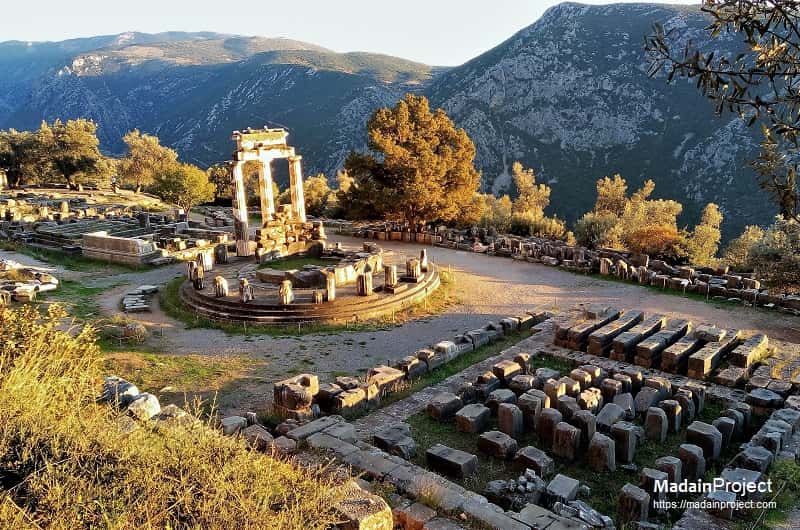
Sanctuary of Athena Pronaia
In the sanctuary of Athena, the goddess was worshipped as the patroness of wisdon, fertility and health. The eastern part of the precinct preserves the foundations of two archaic era / Archaic Greek temples dedicated to the goddess built out of porous stone. Both temples were Doric; the first dates to the mid seventh century BCE and the second to circa 500 BCE. The second temple was peripteral (with surrounding colonnade), with six columns on its narrow sides and twelve on its long sides. Its interior was divided in to two chambers, the pronaos (porch) and the cella, were the cult statue of the goddesss stood. This temple was destroyed by the earthquake of 480 BCE. The third temple of Athena was built in the mid-fourth century BCE. The third temple of Athena was built in the mid fourth century BCE in the western part of the precinct and was made of local grey limestone. Its facade was decorated by six Doric columns, and the opening between the pronaos and cella had two Ionic columns. This temple did not have a surrounding colonnade.
East of the temple, built around 500 BCE may be descerned the meager remains of two buildings attributed to the precinct of the local hero Phylakos (Phylacus). According to Herodotus, in 480 BCE Phylacus and Autonoos, who was also a local hero, routed the Persians by hurling stones from the Phaidriades down on them.
There are two treasuries among the non-religious structures in the precinct of Athena Pronaia. Treasuries were small buildings dedicated by the Greek city-states and their colonies at the sanctuaries. One of these treasuries is Doric and dates to the fifth century BCE. However, it is the second that is noteworthy, the so-called treasury of the Massalians, the Greek colonists of Massalia (modern day Marseilles) who came from Phocaea in Ionia. Masterfully built around 530 BCE in the Ionic order of gleaming Parian marble, it had two columns on its facade with Aeolic order capitals. In front of the two treasuries are preserved the foundations of the stelai on which were recorded confiscations and debts to the sanctuary, as well as the pedestal atop which the Delphic trophy for repulsing the Persians in 480 BCE was mounted.
A series of various sized altars, dating for themost part to the sixth century BCE, is preserved at the eastern edge of the precinct. Their inscriptions inform us about the divinities to whom they were dedicated, including Zeus, Athena Ergane, Athena Zosteria, Eileithyia, and Hygieia.
To the east of the classical period / Classical Greece temple of Athena there rises the sanctuary's most imposing structure, the famous Tholos, a circular building with exterior colonnade partially restored today.
circa 360 BCE

The Tholos
The Tholos of Delphi is a masterpiece of ancient Greek architecture due to its rich sculpted decorated, polychromy and fine craftsmanship. In antiquity the Tholos would stand out among themonuments of the Sanctuary of Athena Pronaia, which was the first sanctuary encountered by pilgrims arriving by land from Attica or Boeotia.
The circular edifice is dated in the early fourth century BCE. Its super-structure is built of marble from Mount Penteli in Attica. The Roman architect Vitruvius mentions in his book De Architecture that the architect of this innovative monument was Theodoros from Phocaea.
The outer colonnade comprised twenty Doric columns, three of which were restored in the 1930s CE. An inner colonnade of ten half-columns of Corinthian style decorated the circular wall inside the cella. The relief metopes of the outer frieze bore scenes of Centauromachy and Amazonomach, now on display in the Archaeological Museum of Delphi. The conical roof was also decorated with sculptures; reminiscent of figures of Nike (Victory) from the Sanctuary of Asclepios in Epidauros. The function of the building is still unknown; it was possibly associated with the cult of Mother Earth, the first divinity worshipped in the sanctuary.
circa 330 BCE

Temple of Apollo
The Temple of Apollo, god of music, harmony and light, occupied the most important and prominent position in the Delphic Sanctuary of Apollo. The edifice with the partially restored colonnade visible today is dated to the fourth century BCE. It is the third temple built at the same place. According to the prevailing theory, the famous oracle operated inside the temple. This location was possibly chosen due to the sacred chasm emitting vapours;these were inhaled by the Pythia, who entered a state of delinium uttering inarticulate cries, which were then turned in to equivocal oracles by the priests.
According to the myth, the foundations of the first temple, dated to the second half of the seventh century BCE, were laid by Apollo himself and its construction was completed by thearchitects Trophonios and Agamedes.
The construction of the second temple was completed in 514-506 BCE with funds by the Athenian family of Alcmaeonids. It was of Doric order with six-columned narrow sides and fifteen-columned long sides. It was made of porous stone, apart from the facade, which was built of marble from the island of Paros. The sculpted decoration of its pediments was the work of the Athenian sculptor Antenor. The remains of the east pediment (inspect) of the temple of the Archaic age / Archaic Greece, which depicted Apollo's arrival at Delphi in triumph on his four-horse chariot, are now preserved in the Delphi Archaeological Museum. The western pediment depicted the battle between gods and giants (gigantomachy). This was destroyed during the strong earthquake of 373 BCE.
The later temple of Apollo, visible today, was inaugurated in 330 BCE; it is attributed to the architect Spintharos from ancient Corinth. It was also of Doric order with a peristyle (surrounding colonnade); it was made of coated porous stone. Its roof and pedimental decorations sculpted by the Athenian artists Praxias and Androsthenes, were made of Parian marble. The east pediment of the fourth century BCE temple was adorned by the figure of Apollo flanked by his mother Leto, his sister Artemis and the Muses. The west pediment depicted the god Dionysus among his female votaries, the Thyiaded. Persian shields taken as booty by the Athenians from the Battle of Marathon in 490 BCE were attached to the temple's metopes along with Gallic shields, spoils of therepulse of Gauls during the 279 BCE invasion.
Inscribed on the walls of the pronaos (the porch before the temple's cella), according to ancient writers, were the renowned maxims of the Seven Sages (know thyself and nothing in excess), as well as the enigmatic Delphic symbol "E".
circa 180 BCE
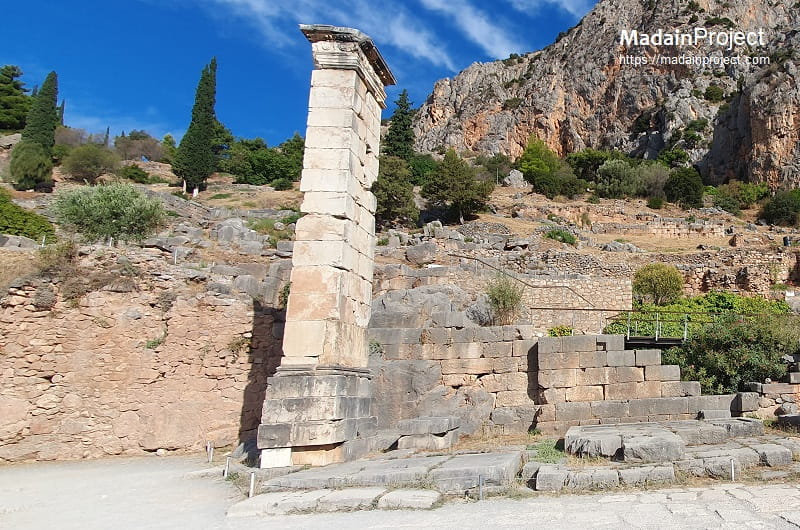
Pillar of Prusias II
The Stele of Prusias constitutes one of the votive offerings (ex votos) within the sanctuary of Apollo at Delphi and was erected in honor of King Prusias II of Bithynia.
Situated to the northeast of the entrance to the Temple of Apollo within the archaeological site of Delphi, the stele has been reconstructed in situ. Its identification is based on an inscribed dedication indicating that it was commissioned by the Aetolian League in recognition of Prusias II, ruler of Bithynia in northwestern Asia Minor. The inscription records that the monument was dedicated in acknowledgment of the king’s virtue and the benefactions he conferred upon the League. This epigraphic evidence also permits a chronological attribution of the monument to a period after 182 BCE, corresponding to Prusias II’s accession to the throne following his father, Prusias I.
Architecturally, the monument comprises a tall base constructed from courses of rectangular stone blocks. The upper section is embellished with relief decoration featuring garlands and bucrania, complemented by a projecting molding supported by geisipodes. The structure attained an overall height of approximately 9.70 meters and originally supported an equestrian statue of King Prusias at its summit. Additionally, the upper portion contains rows of rectangular cuttings, which may have served functional or decorative purposes. These apertures have been interpreted either as fixtures for attaching vegetal ornaments—possibly symbolizing agricultural benefactions attributed to the king—or as sockets for bronze elements intended to deter birds. In its general form and function, the monument bears close resemblance to the pedestal of the Monument of Aemilius Paullus, erected approximately fifteen years later to the south of the Temple of Apollo’s entrance and now housed in the Archaeological Museum of Delphi.
circa 160 BCE

Theatre
The best preserved monument at the archaeological site of Delphi testifies to the intellectual and cultural acme of Apollo's sanctuary. It was constructed at an amphitheatrical location with a magnificient view to the valley of the Pleistos river. The Delphic theatre hosted the musical and dramatic contests of the Pythian Games and other religious festivals.
The original form of the edifice is unknown; most possibly the spectators sat on wooden seats or on the ground. The first stone-built theatre was constructed in the fourth century BCE. In 160/159 BCE it was restored with funds by Eumenes II, the king of Pergamon. Its present form is dated to the early Roman period (circa first century CE). The material used for its construction is local stone from Mount Parnassos.
The deep amphitheatrical cavea (koilon) had a seating capacity of 5,000 people. It was divided in to two sections by a transverse corridor (diazoma), comprising altogether 35 rows of seats. Opposite to the cavea and the orchestra stood the skene (stage) flanked by two wings, the paraskenia. Only the foundations of this skene structure survive today. Its facade (proskenium) was embellished with relief frieze depicting the labours of Herakles, now exhibited in the Delphi Archaeological Museum. The frieze was probably added during the restoration works of 67 CE, at the time of the Roman emperor Nero's visit to Delphi. Inscriptions regarding the emancipation of slaves are embedded in parts of the theatre walls.
During the Delphic Festival in May 1927 CE the theatre hosted a performance of an ancient Greek tragedy; it was the first time in modern Greek history that an ancient theatre was re-used and ancient Greek drama was revived, thanks to the vision of the Greek poet Angelos Sikelianos and his American wife Eva Palmer.
circa 100 CE

Roman Agora
Today, only the northern Ionic stoa is preserved from the Roman-period Agora, the area where meetings and commerce activity took place in late antiquity (circa first-fourth century CE). It was one of the three stoas surrounding the spacious paved rectangular square of the Agora. Five shops opened at the rear of the stoa,where the faithful who were visiting the sanctuary purchased votives and mementos. The marble plaques with crosses on display in the stoa come from a later Christian building in Delphi, built at an unknown location between the fifth and seventh century CE. The Roman Agora was built at the site, which was not only the main entrance to the "Sacred Way", from here the processions for the Pythian Games and other celebrations also passed.
Undated

Crossroad of the Treasuries
Directly adjacent to the Siphnian Treasury is an intersection on the so-called "Sacred Path", which is surrounded by the treasuries of many Greek cities. All of these, including the treasuries of the Boeotians, the Magarians and the Thebans, date to the late sixth and early fifth century BCE.
circa 550 BCE

Gigantomachy Relief of the Siphnian Treasury
The subject matter of the north side of the Siphnian Treasury's frieze is the gigantomachy, the battle of the Olympian gods against the giants, children of Gaia. The myth of the conflict, result of which was a victory for the gods, is a favourite theme in ancient Greek art, symbolizing the triumph of order and civilization over savagery and anarchy. The gods fight hard to subdue the giants, who attack from the right with spears, swords and stones. Some of them are heavily armed with helmets and shields, others with cuirasses and greaves. Starting from the left, Hephaistos (dressed in a short chiton, typical of craftsmen) stands in front of his bellows preparing fire-balls. Nearby are Demeter and Kore, then Dionysus in a panther's skin and Cybele on a chariot drawn by lions. The pair of gods shooting arrows against four giants is identified as Apollo and Artemis. Their opponent is a giant, whose helmet-crest is shaped like kantharos (vase) and he is named after this. The inscription on the shield of the fourth giant refers to the sculptor of the relief but, unfortunately, his name is not preserved. Following would be Zeus on his chariot, then Hera, Athena, Ares armed with helmet and shield, and Hermes wearing the conical pilos, characteristic of Arcadian shepherds. The last figure is fragmentary, probably Poseidon accompanied by his wife, Amphitrite.
circa 550 BCE

The "Judgement of Paris" Relief of the Siphnian Treasury
The few figures preserved from the western facade frieze of the Siphnian Treasury lead to the assumption that here the subject was the judgement of Paris at the beauty contest among Athena, Aphrodite and Hera. He voted for Aphrodite and, in return, earned the most beautiful woman in the world, Helen of Troy, who was the wife of king Menelaos. It was her abduction that triggered the Trojan War. First of the contestants is goddess Athena, who appears as if she is mounting her winged chariot. Hermes frames the scene to the left. Aphrodite isgraciously stepping off her own chariot, touching her necklace with a coquettish gesture. The missing part of the frieze would be feature Hera, ready for departure after her unsuccessful participation. Last would be the judge Paris.
circa 510 BCE

Eastern Pediment of the Archaic Temple of Apollo
Carved out of Parian marble. The centre of the pediment was occupied by Apollo's four-horse chariot framed by kouroi (young men) and korai (young women). In both corners are animal groups depicting a lion mauling a gentle beast. The interpretation of the subject is basedon verses from Aeschylus' Eumenides, in which the Pythia stands before the temple of Apollow and narrates the god's arrival at Delphi from Athens. Apollo is seen off by the Athenians and greeted with great honours by the people of Delphi and their king, Delphos (circa 510-500 BCE.)
And thence he (Apollo) came unto this land of Parnassus
and at his side, with awe revering him,
were the children of Hephaestus, preparing the way
and taming the land that once was wilderness.
And he was received with honouredby all the people and Delphos, their chieftain-king.
-- Aesch. Eumenides 12-16.
circa 460 BCE
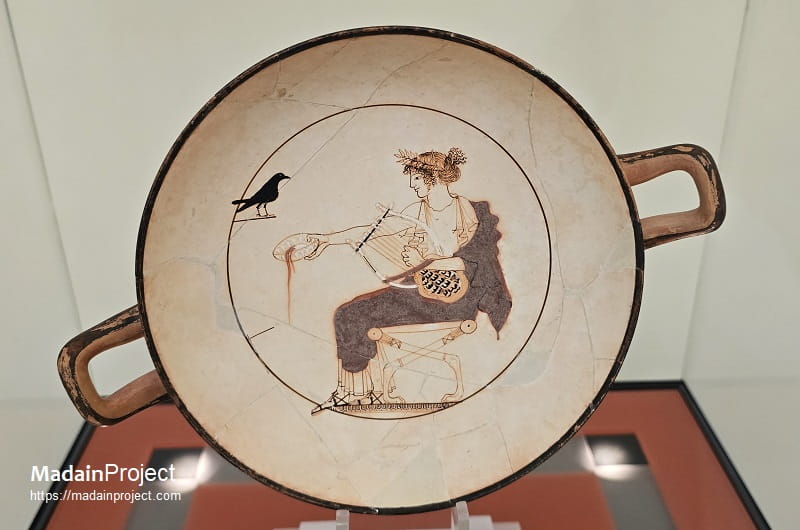
Cylix of Apollo
The Cylix of Apollo is a kylix—a shallow drinking vessel—produced in an Attic workshop circa 460 BCE. It features a distinctive representation of the god Apollo executed in the white-ground red-figure technique. This artifact is among the limited number of ceramic objects exhibited in the Delphi Archaeological Museum and was reportedly discovered in a nearby grave, which is thought to have belonged to a priest.
The interior of the vessel portrays Apollo seated on a chair with legs terminating in lion-paw forms. He is depicted with an elaborate hairstyle and crowned with a laurel wreath. The god is dressed in a white chiton, a red himation, and sandals. In his left hand, secured by a red strap, he holds a seven-stringed lyre, while with his right hand he pours a libation from a shallow patera adorned with relief decoration. Positioned opposite Apollo is a black bird, the interpretation of which remains debated: it has been identified either as an oracular bird or as a crow associated with the myth in which it informs Apollo of the impending marriage of his beloved Koronis, daughter of King Phlegyas.
The attribution of the vessel’s creator remains uncertain. It has been tentatively ascribed either to Euphronios or to an artist within his circle, although some scholars argue that its stylistic features more closely align with the work of the Pistoxenos Painter.
circa 330 BCE

Acanthus Column with Dancers
This was a porous base that supported a column eleven meters tall with acanthus leaves on its body and at its top. Three dancers crowned by a stone omphalos, the symbol of Delphi, are depicted on the column (330 BCE). Today it is in the Museum of Delphi.
circa 197 BCE

The "Melancholy Roman"
Many art historians identify this work as the head of the Roman general and consul Titus Quinctius Flamininus who in 197 BCE, following his victory over Philip V of Macedonia, proclaimed at Corinth the autonomy of the Greek states. At Delphi he was honoured not only as a guarantor of Greek independence from Macedonian rule, but also because he had made valuable offerings to the sanctuary. The aforesaid identification ismainly based on comparisons of the portrait with coins depicting Flamininus, but it has been disputed andother persons and dates have been suggested as well. The bust is now displayed at the Delphi Museum.


Signup for our monthly newsletter / online magazine.
No spam, we promise.

The Madain Project is an online archive of Abrahamic History and Archaeology.
Abrahamic History & Archaeology is the study of history and archaeology with respect to the three Abrahamic Faiths without considering the religious and theological aspects. The goal of Abrahamic History is to understand how and why the religious doctrines and behaviours have evlovled and changed over time. Searching for patterns in the evolution of significant cultural events such as the development of farming, the emergence of cities, or the collapse of major civilizations for clues of why and how these have influenced the three major Abrahamic religions.
Cloud Drive -
About -
Help -
Editorial Policy -
AI Policy -
Privacy Policy -
Contact
Madain Project: Encyclopedia of Abrahamic History & Archaeology.
Copyright MadainProject 2017 - 2026.


