
The Athenian Treasury (Θησαυρός των Αθηναίων) is a votive monument erected by the ancient city-state of ancient Athens between 510 and 480 BCE within the Panhellenic sanctuary of Apollo. In classical archaeology and art history, it is defined as a premium distyle in antis structure built entirely of Parian marble. The building functioned as a civic storehouse for religious dedications and spoils of war, as well as an aggressive piece of political propaganda designed to project Athenian democratic identity, wealth, and military supremacy over Persia to the broader Greek world.
Situated conspicuously along the Sacred Way, the treasury systematically projected the burgeoning ideological framework of the nascent Athenian democracy to the wider Greek world. Its highly structured iconographic program, which juxtaposed the traditional pan-Greek exploits of Herakles with the localized, civic exploits of the Athenian hero Theseus, served to legitimize Athens' geopolitical ascendancy. Furthermore, the building’s external masonry functions as an invaluable epigraphic archive, preserving decades of institutional decrees, citizenship grants, and musical compositions. Consequently, modern scholarship views the Athenian Treasury not merely as a masterwork of classical art history, but as an aggressive statement of civic identity, financial hegemony, and triumphalism in the wake of the Persian Wars.
The Athenian treasury was the first to be built at a Panhellenic sanctuary of Delphi that was dedicated by Athens, however; several other city-states (Siphnos and ) also built treasuries later on.
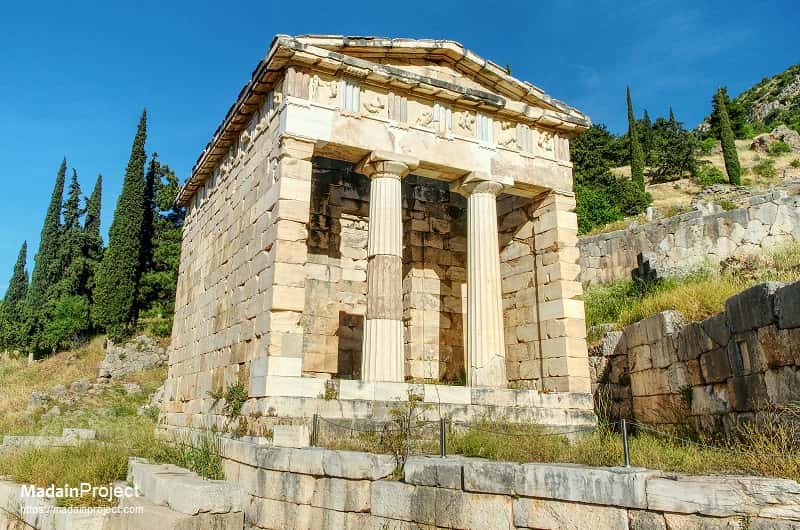
circa 510 BCE
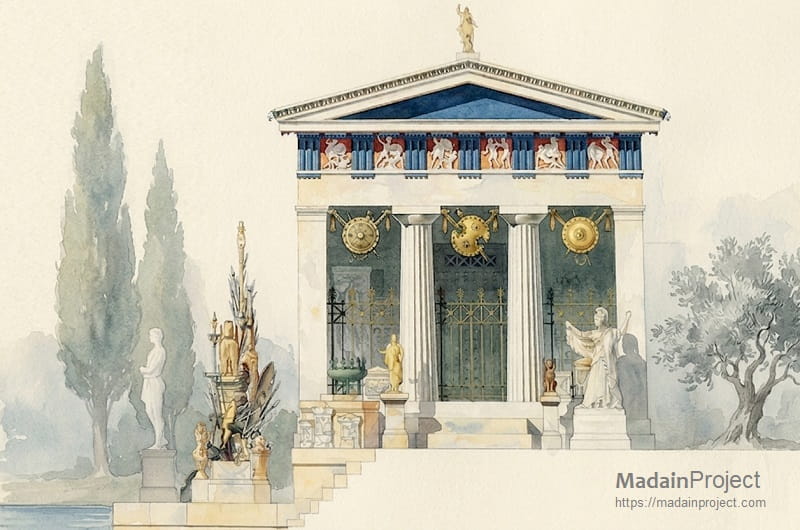
Archaic Period
The origins of the Athenian Treasury is inextricably linked to an intense, unresolved debate within classical archaeology regarding its precise foundation date. One major school of historiographical thought dates the monument to the immediate aftermath of the Kleisthenic reforms around 510–507 BCE. Scholars favoring this late Archaic timeline rely on stylistic analyses of the building’s sculptural reliefs. The metopes exhibit late Archaic stylistic features, notably anatomical stiffness, profile eye renderings, and transitional drapery that align with contemporary late sixth-century Attic red-figure vase painting rather than post-Persian Classical aesthetics. From this perspective, the treasury was commissioned by the nascent Athenian democracy to celebrate the expulsion of the Peisistratid tyranny and to visually assert its newly established civic identity within the Panhellenic sanctuary.
Classical Period
An alternative chronological framework places the structural completion of the treasury firmly in the Early Classical period, specifically post-490 BCE. This timeline aligns with the ancient testimony of Pausanias, who stated that the building was erected using the spoils of the historic victory over the Persians at the Battle of Marathon. Archaeological evidence corroborates this post-Marathon phase via the structural integration of the prominent south-facing triangular platform known colloquially as the Marathon Base. A critical architectural feature reveals that the building's stereobate possesses a projecting ledge that explicitly supports this base, indicating that the treasury and its victory monument were engineered as an integrated architectural unit. Throughout the fifth and fourth centuries BCE, the treasury functioned at peak capacity as a high-security civic safehouse. It protected elite Athenian votive offerings, processional vessels, and captured military panoplies from rival poleis. The building’s external walls also evolved during this period into a dynamic civic billboard. They were progressively incised with state decrees, citizenship grants, and international treaties, transforming the sanctuary into a permanent lithic archive of Athenian statecraft.
Hellenistic and Roman Periods
During the Hellenistic and Roman imperial eras (circa 323 BCE–4th Century CE), the treasury's function shifted from an active symbol of contemporary military dominance to a revered site of cultural memory and epigraphic preservation. In the late second century BCE (circa 128 BCE), the external walls of the treasury were inscribed with the famous Delphic Hymns to Apollo. These two monumental inscriptions represent the largest surviving corpus of ancient Greek notation, explicitly recording vocal and instrumental scores for performances at the Pythian Games. As political autonomy shifted away from individual Greek city-states under Roman hegemony, the treasury was increasingly viewed as a historical monument commemorating a unified Greek identity against foreign invasion. It remained structurally intact and physically protected by the Delphic Amphictyony until the decline of pagan sanctuaries across the Mediterranean. The building was finally decommissioned and abandoned following the anti-pagan edicts of Roman emperor Theodosius I in the late fourth century CE, which forced the systematic closure of the Delphic oracle.
Modern Period
The modern history of the Athenian Treasury began with its systematic excavation by the École Française d'Athènes during the "Grande Fouille" (Great Excavation) of Delphi in 1893 CE. Led by archaeologist Théophile Homolle, excavations uncovered the structure in a state of severe collapse, its marble blocks scattered across the Sacred Way due to successive historic earthquakes. Between 1903 and 1906 CE, the French archaeological team, funded largely by the municipality of Athens, undertook a pioneering anastylosis project. Spearheaded by architect Albert Tournaire, this project reassembled the original Parian marble blocks back onto the stereobate. To ensure long-term structural preservation, the heavily eroded original metopes were excavated and moved to the permanent collection of the Delphi Archaeological Museum, where they reside today. They were replaced on the standing monument by highly accurate plaster casts. Today, the fully reconstructed building serves as the primary typological benchmark for studying ancient thesauroi and early classical Greek architectural development.
circa 510 BCE
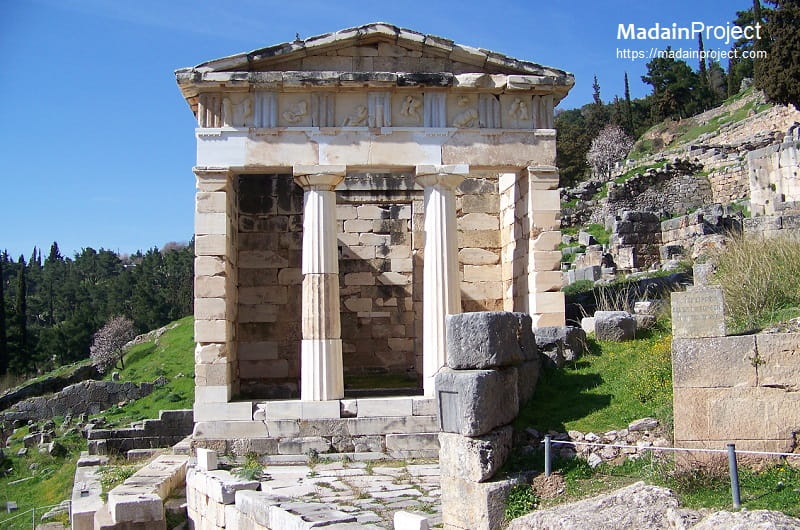
Construction
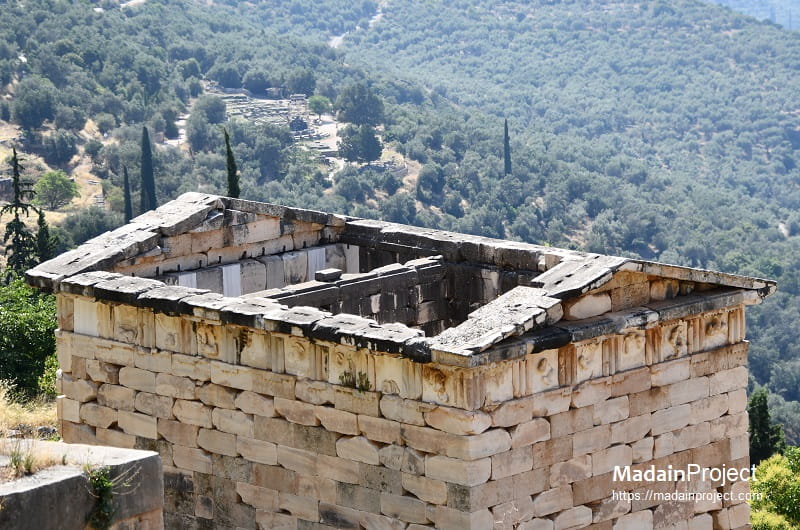
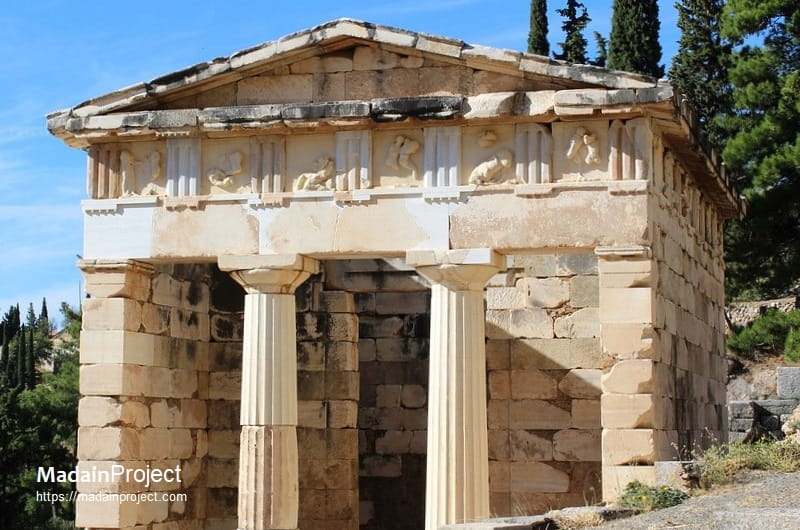
The Athenian Treasury at Delphi is a prototypical manifestation of the late Archaic era and early Classical period Doric order. Constructed exclusively from high-grade Parian marble—with the structural exception of its local limestone foundations—the building is classified as a distyle in antis temple-type structure. It measures 6.57 meters in width by 9.65 meters in length at the level of the stylobate, maintaining an approximate 3:2 spatial proportion. The building rises from a two-stepped platform, or crepidoma, and comprises two primary interior chambers: an eastern anterior porch (pronaos) and a main, un-columned rectangular hall (naos, or cella).
Spatial and structural accessibility was governed strictly by the building's distyle in antis plan on the eastern facade. The entrance to the pronaos is defined by two monolithic, fluted Doric columns positioned symmetrically between the terminating ends of the north and south lateral walls, known as antae. This configuration restricted physical entry into the treasury while offering maximum visual exposure to visitors ascending the Sacred Way. The internal naos was accessed via a single, centrally aligned axial doorway leading from the pronaos. By omitting internal colonnades (astylar layout), the architects maximized the floor area of the cella, optimizing the internal volume required to secure dense, high-value civic property, including precious metals, votive statuary, and military spoils.
Abutting the southern flank of the treasury is an integrated, triangular limestone platform designated in archaeological scholarship as the Marathon Base. This platform is physically keyed into the treasury's stereobate via a projecting stone ledge, confirming that both components were engineered and executed as a singular architectural unit. The superstructure of the treasury adheres to the rigid syntax of the Doric order, featuring column shafts with sharp fluting that terminate in flat, cushion-like echinus capitals without bases. The load-bearing walls are built using regular horizontal courses of isodomic ashlar masonry. These blocks were meticulously joined without mortar, instead relying on internal H-shaped iron clamps cast in lead to provide seismic resilience within the geologically unstable Delphic landscape.
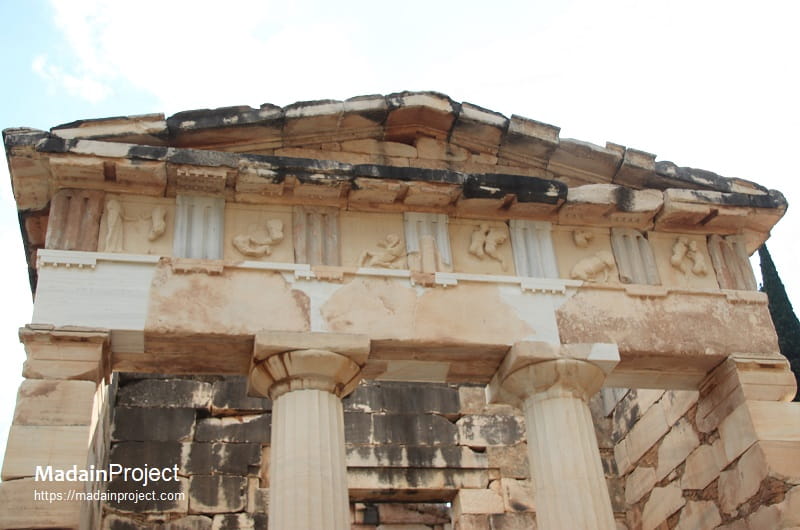
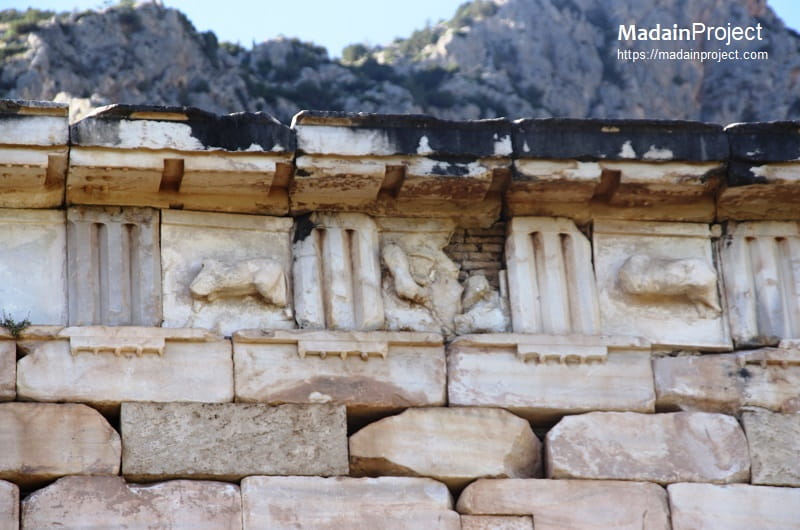
The elevation terminates in a highly regulated entablature consisting of a plain, heavy architrave supporting a continuous frieze of alternating triglyphs and metopes. The architectural frieze features 30 sculpted marble slabs carved in high relief: six metopes span the shorter east and west facades, while nine line the longer north and south facades. These reliefs are divided into parallel iconographic programs, with the south and east metopes depicting the localized exploits of the Athenian democratic hero Theseus, and the north and west metopes illustrating the traditional Panhellenic labors of Herakles. The structure was crowned by a projecting cornice (geison) and a marble gutter system (sima), which framed pediments on the east and west facades that originally housed freestanding, though now highly fragmented, architectural sculptures.
circa 510 BCE
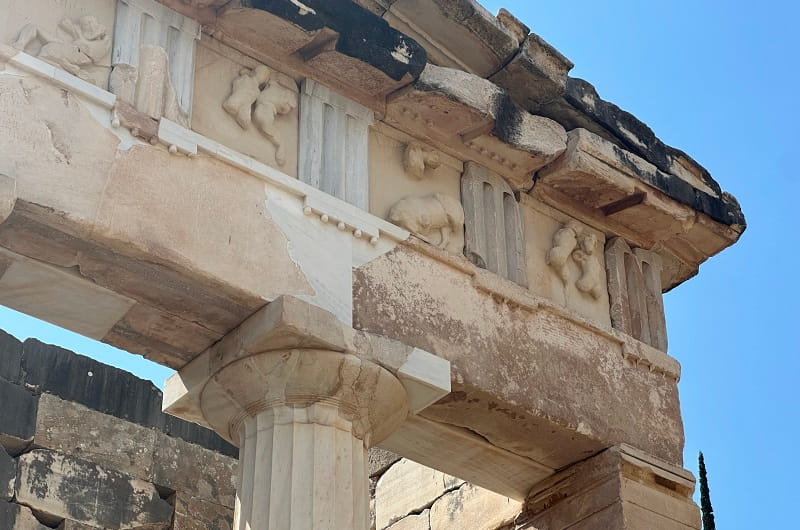
Metopes
The metopes of the Athenian Treasury have been interpreted as alluding to the Greek victory at the Battle of Marathon through the use of mythological imagery. By depicting Theseus, the legendary founder and king of Athens, alongside Herakles, the sculptural program presented Athens as a powerful and preeminent polis within the Greek world. The metopes of the treasury constitute the earliest known surviving large-scale sculptural representation of Theseus. Prior to this monument, representations of Theseus are attested primarily in vase painting, whereas no earlier architectural depictions are known. Although Herakles also features prominently in the metopal decoration, the inclusion of Theseus reflects the increasing importance of the hero within Athenian civic and cultural identity. The juxtaposition of Theseus and Herakles has been interpreted as a symbolic reference to the Battle of Marathon. More broadly, the metopes express Athenian conceptions of collective identity and articulate attitudes toward both external and internal adversaries.
The principal figures represented in the metopes derive from well-established traditions of Athenian mythology. The sculptural program depicts Theseus undertaking a series of heroic exploits. According to mythological tradition, Theseus was the son of Aethra and was associated with both the mortal king Aegeus and the god Poseidon. His labors were performed during his journey to Athens, where he sought to claim his rightful position. Several of these exploits involved the defeat of dangerous opponents encountered along the roads leading to Athens. In the metopes, these deeds function not only as mythological narratives but also as visual expressions of Athenian strength and achievement within the wider Greek world.
At the time of the treasury's construction, Herakles was among the most celebrated heroic figures in Athenian art and literature. By associating Theseus with Herakles, the Athenians elevated their own civic hero through comparison with a figure whose exploits possessed pan-Hellenic significance and divine associations. Each metope depicts a single heroic deed performed by one of the two heroes in pursuit of his respective objective. This visual pairing places Theseus on a level comparable to that of Herakles. Later artistic representations produced after approximately 460 BCE further emphasized this relationship; in some examples, Theseus is shown wielding a club against Periphetes, an iconographic feature that closely recalls Heraklean imagery. The metopes also establish parallels through the motif of the bull: Herakles captured the Cretan Bull as his seventh labor, while Theseus subsequently subdued the same animal and sacrificed it to Apollo and Athena.
The treasury originally contained thirty metopes, each measuring approximately 67 cm in height and between 62 and 64 cm in width. Nine metopes were positioned along each of the longer north and south sides, while six were placed along each of the shorter east and west sides. Together they depicted the labors of Theseus and Herakles and constitute the earliest surviving monumental juxtaposition of the two heroes. Many of the metopes were discovered dispersed throughout the surrounding area, and the original sequence of the sculptural program remains a matter of scholarly debate.
Signup for our monthly newsletter / online magazine.
No spam, we promise.

The Madain Project is an online archive of Abrahamic History and Archaeology.
Abrahamic History & Archaeology is the study of history and archaeology with respect to the three Abrahamic Faiths without considering the religious and theological aspects. The goal of Abrahamic History is to understand how and why the religious doctrines and behaviours have evlovled and changed over time. Searching for patterns in the evolution of significant cultural events such as the development of farming, the emergence of cities, or the collapse of major civilizations for clues of why and how these have influenced the three major Abrahamic religions.
Cloud Drive -
About -
Help -
Editorial Policy -
AI Policy -
Privacy Policy -
Contact
Madain Project: Encyclopedia of Abrahamic History & Archaeology.
Copyright MadainProject 2017 - 2026.


