
Tomb KV8 is a royal sepulcher located in the main wadi of the Valley of the Kings, ancient Thebes (modern Luxor) in Egypt, constructed for Pharaoh Merenptah, who reigned circa 1213–1203 BCE during the Nineteenth Dynasty. It is characterized by its deep axis, descending corridors, and a spacious burial chamber containing a monumental stone sarcophagus. The tomb's architectural plan and decorative program conform to the royal mortuary traditions of the late New Kingdom, featuring inscriptions and religious imagery derived predominantly from funerary texts such as the Book of the Dead and the Book of Gates.
Mereneptah was the 11th son of King Ramses II and Queen Isis-Nofret. He was an old man and he ascended the throne after the long rule of his father. He ruled for only about ten years, but his tomb was completed before his death and only the rearmost chambers beyond the burial chamber were left undecorated and roughly cut. The Tomb of Merneptah is the second largest one in the Valley of the Kings, exceeded only by Tomb KV5.
Merenptah’s tomb became model for royal tombs at the decline of dynasties XIX and XX. The tomb design, although large, is simpler than that of Merenptah’s father and grandfather.
The tomb KV8 is one of many tombs in the Valley of the Kings that has been damaged by flash floods. Most of the tomb has been excavated, but the side chambers off the burial chamber are still full of debris, as are parts of the side chambers. The paint and plaster that survived the floods are in good condition. It was not until 1903 that the rear half of the tomb was excavated; and the Burial Chamber was not excavated until 1987.
The tomb KV8 has suffered extensive damage from repeated flooding, and many of the lower chambers remain filled with debris. The tomb was constructed for Merenptah, whose burial equipment included four nested sarcophagi. The largest of these sarcophagi proved too large to pass through the upper corridors of the tomb.
In order to move the sarcophagus into the burial chamber, ancient workmen removed portions of several architectural elements. The sides of certain gates were cut away, and two pillars were removed from Pillared Chamber F. After the sarcophagus had been brought into the tomb, the damaged gateways were repaired. This repair work involved carving sockets into the walls and installing new sandstone uprights, which were secured in place by pegs fitted into the wall sockets.

circa 1195 BCE

KV8 is large in size, but its design is simpler than the tombs of Merneptah’s grandfather and father. The tomb has a staircase and two descending corridors. Although most paintings decorating the corridors have been damaged by flooding, the ones that were remaining in the reliefs are very beautiful.
circa 1195 BCE

Entryway A
Entryway A measures 3.06 meters in width and 10 meters in length. The original stepped entrance is now covered by a modern stairway that descends to a level landing before Gate B. A short cliff overhang partially shelters the gate.
Two beam holes are located near the gate. A cross beam, slightly longer than the width of the corridor, was inserted into a circular hole on one side and secured into a slot cut into the opposite wall. This arrangement allowed the beam to span the corridor and function as an anchor point for lowering heavy objects into the deeper chambers of the tomb.
Gate B and Corridor B
Gate B was cut back in antiquity, and the sockets for replacement jambs remain visible.
Corridor B has a height of 3.23 meters, a width of 2.64 meters, and a length of 15.66 meters. This corridor originally contained a door. Modern steps now mark both the beginning and end of the sloping passage.
A ceiling recess is located at the front of the corridor, while beam holes appear in opposite walls halfway down the passage. The recess indicates that a door or pair of doors was once fitted at the gate, opening inward into Corridor B and sealing the tomb.
Gate c
The original jambs of Gate C were removed in antiquity. Notches cut into the side walls indicate how replacement jambs were installed.
The replacement jambs were later discovered in Chambers E and F. It is possible that they were removed when the king’s body was taken from the tomb and hidden in a cache.
Corridor C
Corridor C measures 3.15 meters in height, 2.65 meters in width, and 8.03 meters in length.
Trapezoidal recesses located near the tops of both the right (north) and left (south) walls extend nearly halfway down the sloping corridor. The walls and ceiling were originally decorated, although the decoration has suffered considerable damage. In addition, twenty-four instances of graffiti have been recorded within this corridor.
circa 1195 BCE

Gate D and Corridor D
The original jambs of Gate D were cut away in order to permit the passage of the sarcophagi.
Rectangular notches carved into the thicknesses of the gate indicate how replacement jamb blocks were secured. Metal cramps were inserted into slots cut into the bottoms of the notches and the tops of the replacement blocks. Beam holes were also cut just in front of the gate.
Corridor D has a height of 3.49 meters, a width of 2.64 meters, and a length of 9.8 meters. The walls are decorated but have been flood damaged. The ceiling is painted blue with yellow stars to represent the night sky. Along the sides of Corridor D, on the left wall, there is the fourth hour of the Imyduat and on the right, there is the fifth hour.
The walls are decorated, although the decoration has been heavily damaged by flooding. The ceiling is painted blue and decorated with yellow stars, representing the night sky. At the lower end of the corridor there are five pairs of rectangular recesses.
circa 1195 BCE

Gate E and Well Chamber E
The vertical walls of Gate E contain sockets that once held replacement jambs.
Well Chamber E measures 3.74 meters in height, 4.25 meters in width, and 3.58 meters in length. The chamber is roughly square in plan. The floor of the chamber contains a well shaft, whose western wall follows a sloping vein of calcite within the rock. A number of figures are depicted on the upper parts of the well shaft walls. Entering in the chamber, on the the front wall of the chamber, Pharaoh Merneptah stands on the left of the door, Osiris on the right. On the rear wall, Anubis is on the left, the King as Iwnmute on the right. On the left wall, there are finely painted standing figures (inspect) of Imsety, Duamutef, Anubis, Khery-Baqef, Isis, and Neith. On the right, god Hapy is followed by Qebehesnuef, Anubis, Nephthys, and Serqet.
circa 1195 BCE
Gate F and Pillared Chamber F
The outer thicknesses of the original compound jambs of Gate F are now missing. In their place are pairs of recesses with slots in their bases that once held replacement jamb blocks secured by dovetail cramps. Both the replacement blocks and the lintel beam have since disappeared.
Pillared Chamber F measures 3.26 meters in height, 9.42 meters in width, and 8.95 meters in length.
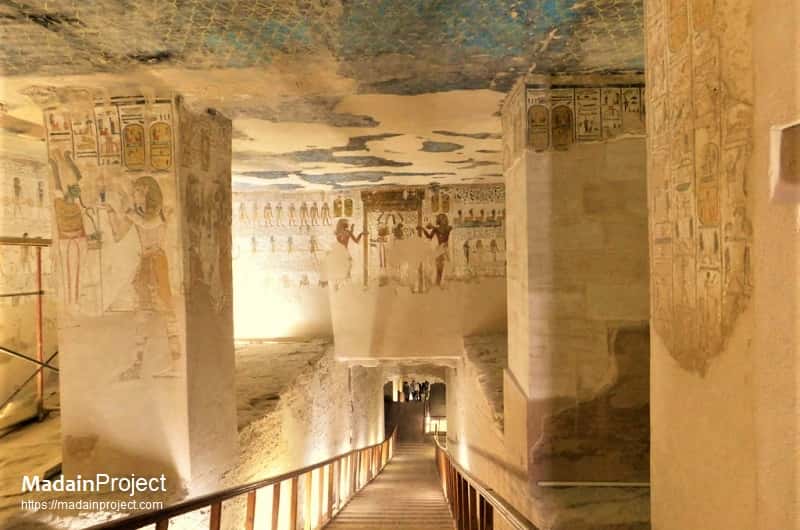
Two pillars flank the central descent, and short flights of steps lead up from either side of the descent to the level floor of this pillared hall. Traces on the ceiling indicate the original presence of another pair of pillars that flanked the descent. The remains of painted plaster on the ceiling still covering the traces of one of these missing pillars indicates that they were removed before the decoration was completed.
Greek and Demotic graffiti are present on the walls. A worker from the craftsmen’s village of Deir el-Medina was accused in antiquity of stealing two pillars from this chamber for use in his own tomb. Like the removed door jambs, these pillars were taken out in order to allow the largest sarcophagus to pass into the tomb, and the worker may have taken advantage of the opportunity to appropriate them. This chamber is decorated with scenes from the ‘Book of Gates’ with a winged Ma’at on the lintel above. On a pillar on the left-hand side the king wears a Nemes headdress and stands before Ptah – and between the figures Greek and Roman graffiti can be seen, left by early visitors to the tomb.
A side-chamber opens to the right of the hall with depictions of the Four Sons of Horus with Isis and Nephthys, and two serpent goddesses on the rear wall.
The fact that the largest sarcophagus was too large to pass through the corridors may have resulted from changes made by Merenptah to the design of the tomb, a practice that was not uncommon in royal tomb construction. Alternatively, the problem may simply have resulted from inefficient planning.
Side Chamber Fa, Gate Fa and Side Chamber Faa
Side Chamber Fa measures 2.79 meters in height, 7.77 meters in width, and 8.42 meters in length.
The axis of this square chamber lies perpendicular to the main axis of the tomb. It is accessed through a gate in the right (north) wall of Pillared Chamber F. Two pillars stand in the center of the chamber, and a gate in the left (west) wall leads to a smaller chamber.
The compound jambs of this undecorated gate remain in place, although the lintel beam has fallen. Two holes above the gate mark the position where the lintel was once situated. A door-bolt hole is present in the left (west) jamb.
A sloping vein of calcite deposits in the rock prevented further cutting of the chamber.
Side Chamber Faa measures 1.14 meters in height, 1.2 meters in width, and 1.06 meters in length.
This small chamber appears to function as a shrine dedicated to Osiris. It may represent either an abandoned beginning of a larger chamber or a purpose-built shrine. The interior surfaces were plastered and decorated with paint.
Gate G and Corridor G
The jambs of Gate G are missing. Notches cut into the thicknesses indicate how they were originally installed. Slots near the top of each side once held a wooden lintel beam. A door or pair of doors once stood at this location. The divided stairs descending from Chamber F terminate within this gate.
Corridor G measures 3.97 meters in height, 2.7 meters in width, and 8.99 meters in length. Much of the original decoration has been lost. However, traces carved through fallen plaster into the underlying rock surface remain visible and indicate the general decorative program that once existed.
Gate H and Chamber H
The jambs of Gate H are missing, although notches cut into the thicknesses reveal how they were originally installed. Slots near the top of the gate once supported a wooden lintel beam.
Chamber H measures 3.12 meters in height, 7.4 meters in width, and 7.37 meters in length. On the right (north) side of this roughly square chamber lies the rectangular lid of the outer sarcophagus of Merenptah. This lid was moved here after the burial assemblage was dismantled and the third sarcophagus was transported to Tanis.
Gate I and Corridor I
A door or pair of doors once stood at Gate I, opening into Corridor I. The sloping floor of Corridor I continues upward through the gate and merges with the floor of Chamber H.
Corridor I measures 3.28 meters in height, 2.71 meters in width, and 9.89 meters in length. The corridor slopes downward toward Gate J and the burial chamber. A ceiling recess occurs at the beginning of the passage, and two narrow vertical recesses appear in each wall at the far end. Only faint traces of inscriptions survive where they were originally carved through plaster into the underlying rock.
circa 1195 BCE

Burial Chamber J
Burial Chamber J measures 6.47 meters in height, 14.87 meters in width, and 13.75 meters in length. The central portion of the chamber contains a sunken floor flanked at the front (east) and rear (west) by rows of four pillars set at a higher level. Six steps descend from the entrance to the central sunken floor, and another flight of steps ascends to the rear upper level. The sunken floor of the central portion of the burial chamber is flanked on the front (east) and rear (west) by a row of four pillars set in the upper level. Six steps lead down from the entrance to a sunken floor in the middle of the chamber and recesses and magical brick niches are spaced along the front and rear walls of the granite sarcophagus lid, surmounted by a mummiform effigy of Merneptah. A continuous bench runs around the chamber, while recesses and magical brick niches are arranged along the front and rear walls. At the center of the chamber, a modern base of limestone blocks supports a second granite sarcophagus lid, which is surmounted by a mummiform effigy of Merenptah.
There are two rows of four pillars each stands before and after the lowered central floor. The front wall of the chamber is decorated with the ninth hour of the Book of the Gates. On the right wall are scenes from the Book of Caverns and more of the Book of the Earth. On the left and rear walls are the twelfth hour of the Book of Gates and excerpts from the Book of the Earth. Only the barest traces remain of the elaborate astronomical vaulted ceiling.
circa 1195 BCE
Side Chambers Ja, Jb, Jc, and Jd
Side Chamber Ja measures 1.95 meters in height, 2.4 meters in width, and 3.14 meters in length. It lies off the southeast corner of the burial chamber and is filled with dirt and stone debris deposited by floods. A recess in the center of the rear (south) wall is visible above the debris. The ceiling is flush with the soffit of the gate.
Side Chamber Jb measures 2 meters in height, 2.26 meters in width, and 3.18 meters in length. It lies off the southwest corner of the burial chamber and is also filled with debris. The ceiling is flush with the soffit of the gate.
Side Chamber Jc measures 2.17 meters in height, 2.63 meters in width, and 3.14 meters in length. It lies to the northwest of the burial chamber and is currently inaccessible due to modern cement blocking the entrance. It has been suggested that materials such as granite fragments from the excavations of Howard Carter may be stored here.
Side Chamber Jd measures 2.1 meters in height, 2.6 meters in width, and 3.15 meters in length. Located to the northeast of the burial chamber, it is also inaccessible and is reported to contain artifacts recovered during Carter’s clearance of the tomb.
Chamber K
Chamber K measures 3.05 meters in height, 4.22 meters in width, and 8 meters in length. This chamber continues along the main axis of the tomb beyond the burial chamber. Traces of painted plaster decoration remain near the ceiling, although insufficient evidence survives to identify the original decorative themes. Two side chambers open near the entrance on either side, while a third chamber opens from the rear (west) wall.
Side Chambers Ka, Kb, and Kc
Side Chamber Ka measures 2.32 meters in height, 5.25 meters in width, and 4.21 meters in length. Its axis lies at a right angle to the main axis of the tomb, and the chamber is currently filled with debris deposited by flooding.
Side Chamber Kb measures 2.34 meters in height, 3.33 meters in width, and 2.23 meters in length. The chamber has roughly carved walls and shows no evidence of decoration.
Side Chamber Kc measures 2.22 meters in height, 5.26 meters in width, and 4.2 meters in length. Like Chamber Ka, it is filled with debris left by flood events.
circa 1195 BCE

At the time of burial the mummy of Merneptah was originally held by a set of four nested sarcophagi. The outer most sarcophagus was so voluminous that parts of the corridor had to have their doorjambs demolished and rebuilt to allow it to be brought in. These jambs were then rebuilt with the help of inscribed sandstone blocks which were then fixed into their place with dovetail cramps. The pillars in Chamber F were removed to allow passage of the sarcophagus, only two were replaced.
circa 1195 BCE

Generally, the decoration of the Tomb of Merneptah is similar to that of the tombs of his father, Rameses II, and his grandfather, Sety I. The workmanship is of a good quality. Though damaged by floods, the paint still shows traces of fine, bright blue-green, yellow, and red pigments.
Originally only the access staircase and two descending corridors were decorated and although the paintings were badly damaged by flooding there are some very beautiful painted reliefs in the first corridor.
In the entrance on the outer lintel (inspect) a sun disc flanked by the goddesses Isis and Nephthys contain a ram-headed god and the Kheper beetle, and on the architrave the god Heh is seen kneeling with Isis and Hathor making ‘nini’.
The first corridor depicts inscribed passages from sacred burial texts, one with an interesting disc similar to that on the lintel, but with the crocodile, serpent and horned creature, enemies of the gods, around it. The walls of these corridors show scenes from the ‘Litany of Re’, the Amduat, the ‘Book of Gates’ and the ‘Book of the Dead’ and the ceilings depict astronomical scenes.


Signup for our monthly newsletter / online magazine.
No spam, we promise.

The Madain Project is an online archive of Abrahamic History and Archaeology.
Abrahamic History & Archaeology is the study of history and archaeology with respect to the three Abrahamic Faiths without considering the religious and theological aspects. The goal of Abrahamic History is to understand how and why the religious doctrines and behaviours have evlovled and changed over time. Searching for patterns in the evolution of significant cultural events such as the development of farming, the emergence of cities, or the collapse of major civilizations for clues of why and how these have influenced the three major Abrahamic religions.
Cloud Drive -
About -
Help -
Editorial Policy -
AI Policy -
Privacy Policy -
Contact
Madain Project: Encyclopedia of Abrahamic History & Archaeology.
Copyright MadainProject 2017 - 2026.


