
Classical Antiquity, distinct from Classical Period, is the period of ancient Mediterranean history centered on the civilizations of Greece and Rome, conventionally dated from the emergence of Archaic Greece in the 8th century BCE to the transformation of the Roman world in the 5th or 6th century CE. It designates not a global comparative stage, but the specific civilizational continuum of the Greco-Roman world.
Classical Antiquity refers to the extended period of Mediterranean history during which the civilizations of ancient Greece and Rome developed their defining political, cultural, and intellectual institutions. The term encompasses roughly the years 800 BCE to 500 CE, spanning the rise of the Greek city-states, the formation and expansion of the Roman Republic, the consolidation of the Roman Empire, and the transitional phase into the early medieval period. It is characterized by the establishment of enduring systems of law, governance, literature, philosophy, art, and architecture, whose influence shaped the subsequent European and Mediterranean world.
Classical Antiquity represents a continuous trajectory of cultural, political, and economic development across the Mediterranean. In its early stages, Greek city-states (poleis) emerged as independent political entities, establishing frameworks of civic governance and cultural identity. Rome later assimilated and adapted these Hellenic traditions while extending political and military control over the Italian peninsula and ultimately the Mediterranean basin. Throughout the period, Mediterranean societies were linked through trade, warfare, colonization, and shared cultural and intellectual currents, producing a rich corpus of written, artistic, and material evidence that defines the classical world.

circa 800 BCE–600 CE

Classical Antiquity is marked by the development of urban political structures, including the polis in Greece and the municipal and provincial systems of Rome. Intellectual achievements include the emergence of philosophy (from pre-Socratic thinkers to Stoic and Epicurean schools), historiography (Herodotus, Thucydides, Livy, Tacitus), and literature in both Greek and Latin traditions. Art and architecture exhibit evolving canons of proportion, symmetry, and ornamentation, exemplified in Greek temples, Roman basilicas, and civic monuments. Military organization, law codes, and administrative bureaucracy demonstrate increasing complexity and centralization, particularly under the Roman Republic and Empire. Religiously, polytheistic systems dominated, while later phases of antiquity witnessed the rise of Christianity, profoundly reshaping cultural and political norms.
circa 800–480 BCE BCE
Archaic Period
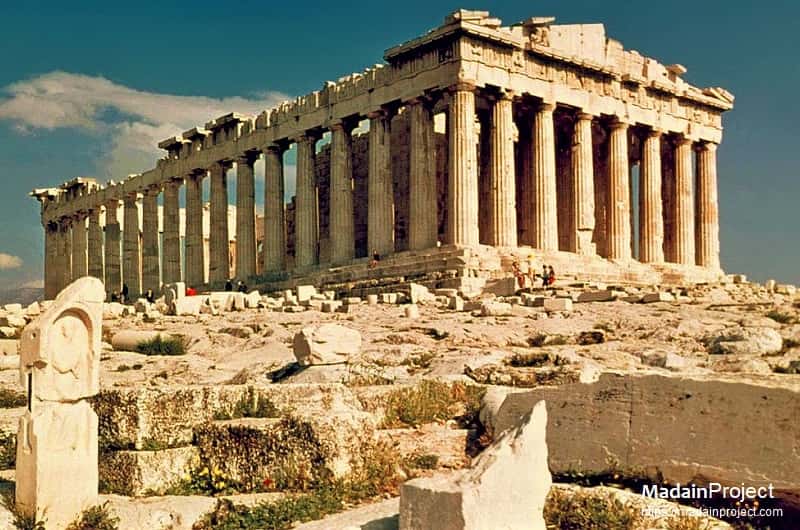
The Archaic period (Archaic Greece: circa 800–480 BCE) marks the consolidation of Greek civilization following the so-called Dark Ages (circa 1100–800 BCE). This era saw the establishment of the polis as the primary political unit, exemplified by cities such as Athens, Sparta, Corinth, and Megara. Greek colonization expanded across the Mediterranean and Black Sea, creating trading networks from southern Italy (Magna Graecia) to the coast of Asia Minor. Politically, early forms of oligarchy and tyranny emerged, and the first codified laws, such as the Draconian and Solonian reforms in Athens, formalized civic governance. Art and architecture underwent significant innovation, including the development of the Doric and Ionic orders in temple construction, the production of black-figure pottery in Corinth and Athens, and the introduction of monumental sculpture such as the kouros and kore statues. Literary culture flourished with the composition of epic and lyric poetry, including works attributed to Homer and Sappho, establishing a cultural framework that persisted into the Classical period of ancient Greece.
circa 480–323 BCE

Classical Period
The Greek Classical period (circa 480–323 BCE) is defined by the political, cultural, and military apex of the Greek city-states, particularly Athens and Sparta. The period begins with the Graeco-Persian Wars, notably the battles of Marathon (490 BCE), Thermopylae, and Salamis (480 BCE), which preserved Greek independence and established Athens as a naval power. Athens experienced the height of democracy under Pericles (circa 495–429 BCE), exemplified by the construction of the Parthenon and the promotion of philosophy, drama, and historiography. Sparta, by contrast, maintained a militarized oligarchic system centered on the agoge. Intellectual achievements include the philosophical contributions of Socrates, Plato, and Aristotle, the historical works of Herodotus and Thucydides, and advancements in drama by Aeschylus, Sophocles, and Euripides. Militarily and politically, the period concludes with the Peloponnesian War (431–404 BCE), the temporary decline of Athens, and the rise of Macedon under Philip II, setting the stage for Alexander the Great’s conquests.
circa 323–31 BCE

Hellenistic Period
The Hellenistic period (323–31 BCE) follows the death of Alexander the Great in 323 BCE and is characterized by the dissemination of Greek culture across the eastern Mediterranean, Egypt, and Asia Minor. Political authority was fragmented among successor kingdoms such as the Ptolemaic dynasty in Egypt, the Seleucid Empire in Syria and Mesopotamia, and the Antigonid dynasty in Macedon. Hellenistic cities, including Alexandria, Pergamon, and Antioch, became centers of administration, trade, and learning. Cultural production merged Greek and local elements, leading to developments in art, science, and philosophy. Notable achievements include the expansion of the Library of Alexandria, advances in mathematics by Euclid and astronomy by Aristarchus, and the emergence of Hellenistic sculpture exemplifying dynamism and realism, such as the Laocoön Group. This period ended with the Roman conquest of the eastern Mediterranean following the defeat of Cleopatra VII and Mark Antony at the Battle of Actium in 31 BCE.
circa 509–27 BCE

Roman Republic Period
The Roman Republic period (509–27 BCE) begins with the overthrow of the Roman monarchy in 509 BCE and is defined by the development of a republican government, including elected magistrates, the Senate, and assemblies representing the patrician and plebeian classes. Expansion across the Italian peninsula occurred through military campaigns, diplomacy, and colonization, culminating in dominance over the western Mediterranean following the Punic Wars (264–146 BCE) against Carthage. Roman law, codified in the Twelve Tables (circa 450 BCE), and the evolution of civic institutions, including roads, aqueducts, and forums, laid the groundwork for later imperial governance. Cultural interaction with Hellenistic territories, particularly after the conquest of Greece (146 BCE), facilitated the adoption of Greek art, philosophy, and literature, which heavily influenced Roman elites.
circa 27 BCE–284 CE

Roman Empire Period
The Roman Empire (27 BCE–284 CE) period begins with the principate of Augustus (27 BCE–14 CE) and extends through the Crisis of the Third Century. Augustus established a centralized administration and a standing army, maintaining the façade of republican institutions while consolidating power. The empire expanded across the Mediterranean and into western Europe, North Africa, and the Near East. Monumental architecture flourished, including the construction of the Colosseum, Pantheon, and aqueduct networks. Roman law and governance, codified in institutions such as the Praetorian Edict and later the Codex Theodosianus, provided a unifying framework. Literature and philosophy, exemplified by Virgil, Horace, Livy, and Seneca, reflected both civic ideology and Hellenistic influence. Economically, the empire relied on an integrated network of roads, ports, and urban centers facilitating trade and taxation.
circa 284–500 CE

Late Antiquity
Late Antiquity (284–500 CE) marks the transition from classical civilizations to the early medieval world. Beginning with the reign of Diocletian (284–305 CE), the Roman Empire underwent administrative and military reforms, including the division into Eastern and Western Empires. Christianity became increasingly central, formalized by the Edict of Milan (313 CE) and consolidated under Theodosius I (379–395 CE) as the official state religion. Urban centers such as Rome, Constantinople, Antioch, and Alexandria remained administrative and cultural hubs, though economic contraction, invasions by Germanic and Hunnic groups, and internal instability weakened imperial control. Classical learning was preserved in monastic and courtly contexts, while architecture evolved to include Christian basilicas and early church complexes, reflecting a transformation of civic and religious life that bridged the classical and medieval periods.
Signup for our monthly newsletter / online magazine.
No spam, we promise.

The Madain Project is an online archive of Abrahamic History and Archaeology.
Abrahamic History & Archaeology is the study of history and archaeology with respect to the three Abrahamic Faiths without considering the religious and theological aspects. The goal of Abrahamic History is to understand how and why the religious doctrines and behaviours have evlovled and changed over time. Searching for patterns in the evolution of significant cultural events such as the development of farming, the emergence of cities, or the collapse of major civilizations for clues of why and how these have influenced the three major Abrahamic religions.
Cloud Drive -
About -
Help -
Editorial Policy -
AI Policy -
Privacy Policy -
Contact
Madain Project: Encyclopedia of Abrahamic History & Archaeology.
Copyright MadainProject 2017 - 2026.


