
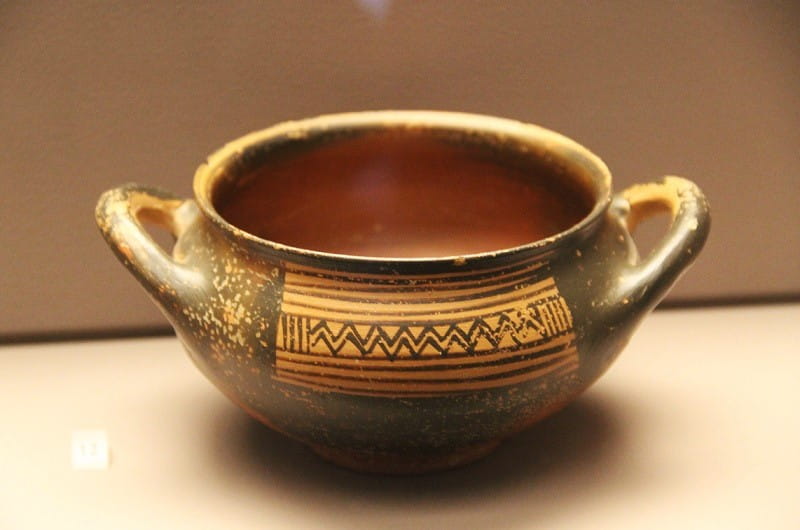
The Geometric Period designates a phase of ancient Greek art and material culture conventionally dated from circa 900 to 700 BCE, following the collapse of the Mycenaean palatial system and the subsequent Protogeometric phase. The term derives from the predominance of rectilinear and curvilinear abstract motifs—meanders, concentric circles, zigzags, lozenges, and cross-hatching—systematically organized across ceramic surfaces. The period is defined primarily through ceramic typology established in Attica by John Coldstream and Vincent Desborough in the twentieth century CE, and it is anchored archaeologically in stratified contexts such as the Kerameikos cemetery at Athens and the cemeteries of Lefkandi on Euboea. The Geometric Period corresponds to a formative era in which the Greek polis began to consolidate, long-distance exchange networks revived, and figural representation re-emerged in stylized form after its near disappearance during the Early Iron Age.
The historical context of the Geometric Period is inseparable from the social reconfiguration that followed the destructions at sites such as Mycenae, Tiryns, and Pylos around 1200 BCE. By the ninth and eighth centuries BCE, regional centers including Athens, Argos, Corinth, and Thebes exhibited demographic recovery and increasing social stratification, visible in the scale and elaboration of funerary monuments. The monumental Dipylon kraters from the Kerameikos cemetery, dated to approximately 760–750 BCE, functioned as grave markers for elite burials and attest to the emergence of aristocratic display. Sanctuaries such as ancient Olympia and ancient Delphi began to accumulate dedications, including bronze tripods and figurines, indicating the institutionalization of Panhellenic cult.
Overseas contacts intensified, particularly with the Levant; Phoenician goods and techniques reached Euboea, as evidenced at Lefkandi’s Toumba cemetery, where the so-called Heroon, dated to circa 950 BCE, contained burials accompanied by Near Eastern imports. The Geometric Period thus coincides with the consolidation of regional identities and the expansion of Mediterranean connectivity.
circa
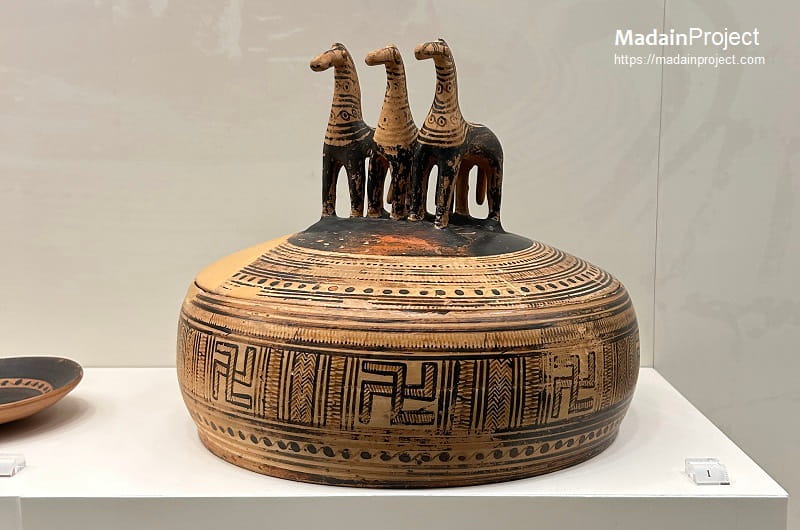
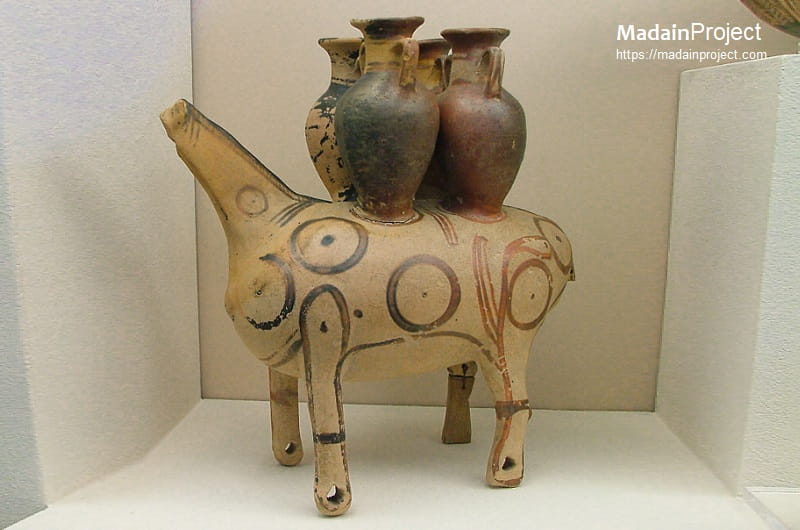
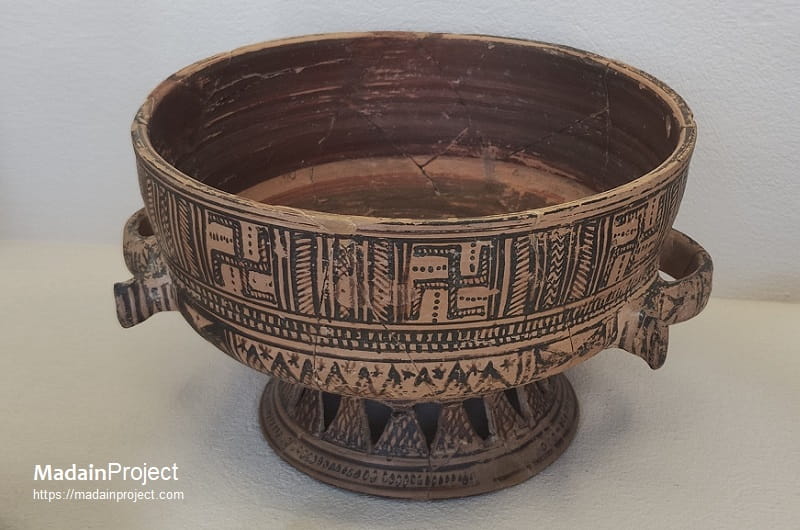
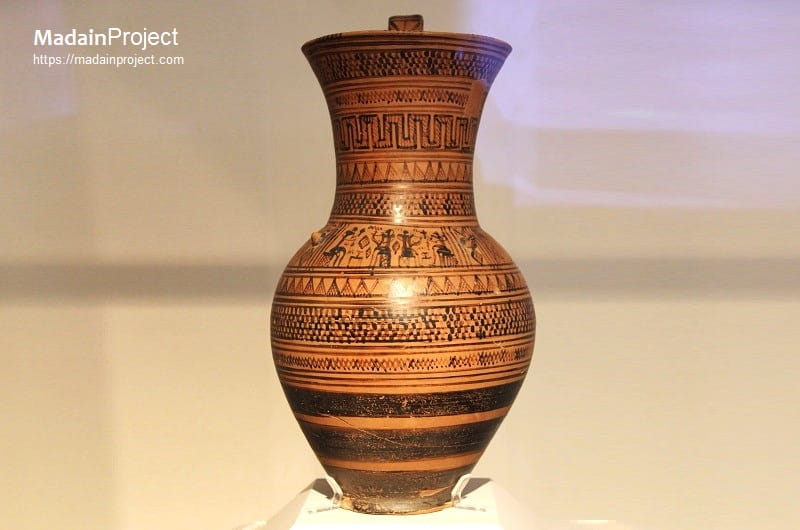
The defining and the core characteristic of the Geometric period was the development and maturity of the Geometric art, with a focus on structural clarity, compositional rigor, and a disciplined ornamental vocabulary. Ceramic vessels are articulated into horizontal registers separated by bands, with decoration concentrated on the shoulder and upper body of kraters and amphorae. The meander motif, constructed from continuous rectilinear turns, becomes emblematic, particularly in Attic workshops. Concentric circles and semicircles, originally executed with a multiple brush compass during the Protogeometric phase, persist but are subordinated to rectilinear schemes. In the later eighth century BCE, figural scenes appear, rendered in silhouette with triangular torsos, cylindrical limbs, and dot-in-circle eyes.
The Dipylon Master, active in ancient Athens around 760–750 BCE, introduced large-scale funerary scenes depicting prothesis and ekphora rituals, with mourners shown in standardized gestures of lamentation. Animal friezes—deer, horses, goats, and occasionally lions—are arranged in repetitive sequences, reflecting both indigenous development and Near Eastern stimulus. In metalwork, small bronze horses from Olympia and the Athenian Acropolis display elongated bodies and schematic forms consistent with ceramic conventions, while fibulae and weapons reveal increasing technical sophistication in iron and bronze.
circa 1050–900 BCE
Protogeometric Period
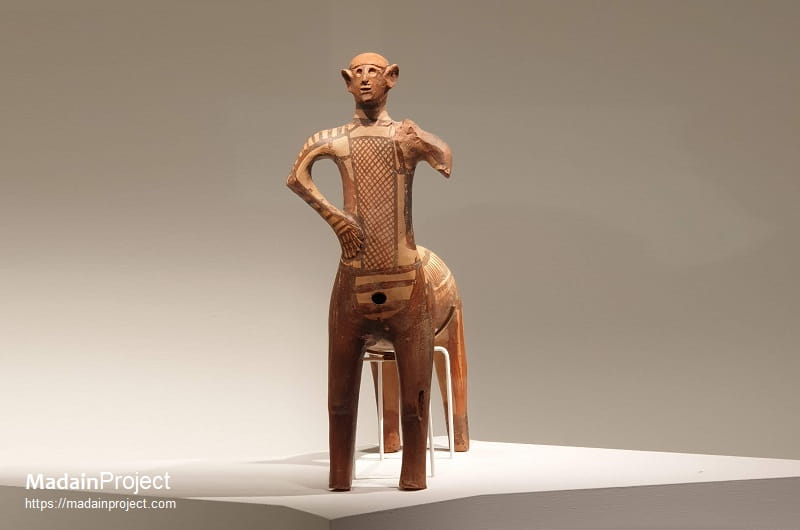
The Protogeometric period, conventionally dated from approximately 1050 to 900 BCE, precedes the fully developed Geometric style but establishes its technical and formal foundations. Protogeometric pottery from the Kerameikos and Lefkandi is characterized by the refined use of the fast wheel and improved firing techniques that produce lustrous black slip. Decoration is restrained, emphasizing broad reserved zones and carefully spaced concentric circles and semicircles applied with a compass. Vessel shapes, including the amphora and skyphos, display balanced proportions and controlled profiles, indicating a departure from the heavier Sub-Mycenaean forms.
circa 900–850 BCE

Early Geometric Period
The Early Geometric period, circa 900 to 850 BCE, marks the expansion of linear ornament across the vessel surface. In Attica, painters begin to employ continuous meanders and hatched triangles, though figural imagery remains absent. Cemeteries in Athens reveal increasing differentiation in grave goods, with cremation becoming dominant for adult males. Regional styles emerge, notably in Argos and Corinth, where local preferences in shape and ornamentation diverge from Attic norms. The decorative system remains predominantly abstract, and the overall visual effect is one of ordered repetition.
circa 850–760 BCE
Middle Geometric Period
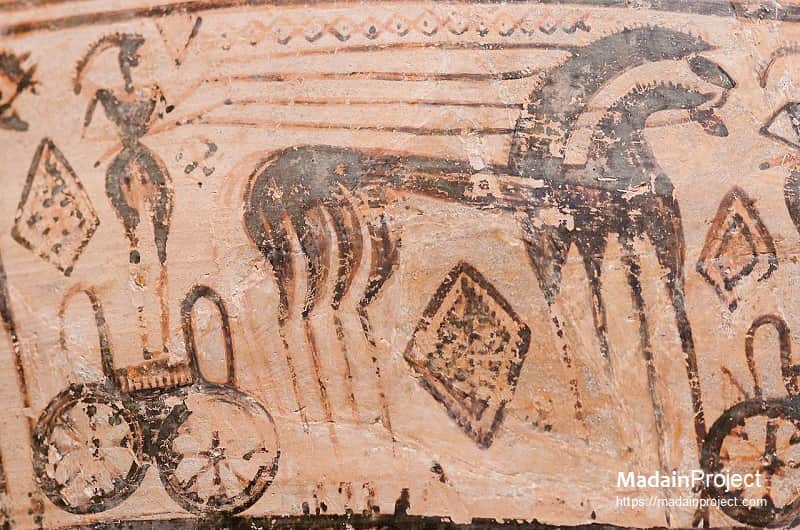
The Middle Geometric period, approximately 850 to 760 BCE, witnesses the introduction of figural motifs within a still predominantly geometric framework. In Athens, workshops associated with the Dipylon cemetery produce large amphorae and kraters that serve as grave markers for women and men respectively. Panels depicting chariots, warriors, and mourning scenes appear in narrow registers, subordinated to the geometric grid. The cemetery at Lefkandi continues to yield rich burials, indicating sustained elite display in Euboea. Trade connections with Cyprus and the Levant intensify, and Near Eastern objects, including bronze bowls and faience beads, circulate in Aegean contexts, contributing to the gradual expansion of iconographic repertories.
circa 760–700/650 BCE
Late Geometric Period
The Late Geometric period, circa 760 to 700/650 BCE, represents the culmination of the style and the threshold of the Orientalizing phase. Monumental funerary vases from the Kerameikos, including the Dipylon Amphora attributed to the Dipylon Master, exemplify the integration of large-scale figural narrative within dense geometric ornament. The human figure becomes more prominent and complex, with overlapping forms and multi-register compositions. Horse imagery proliferates, signaling aristocratic ideology tied to chariot warfare. In the final decades of the eighth century BCE, motifs such as sphinxes and griffins begin to appear, particularly in Corinth, presaging the Orientalizing style of the seventh century BCE. By 700 BCE, the strict geometric order yields to curvilinear forms and exotic imagery, marking the transition to a new artistic and cultural configuration in the Greek world.
Signup for our monthly newsletter / online magazine.
No spam, we promise.

The Madain Project is an online archive of Abrahamic History and Archaeology.
Abrahamic History & Archaeology is the study of history and archaeology with respect to the three Abrahamic Faiths without considering the religious and theological aspects. The goal of Abrahamic History is to understand how and why the religious doctrines and behaviours have evlovled and changed over time. Searching for patterns in the evolution of significant cultural events such as the development of farming, the emergence of cities, or the collapse of major civilizations for clues of why and how these have influenced the three major Abrahamic religions.
Cloud Drive -
About -
Help -
Editorial Policy -
AI Policy -
Privacy Policy -
Contact
Madain Project: Encyclopedia of Abrahamic History & Archaeology.
Copyright MadainProject 2017 - 2026.


