
The Tomb of the Reliefs (Tomba dei Rilievi), is a preeminent funerary monument of late 4th to early 3rd-century BCE Etruscan rock-cut funerary architecture. Situated within the Banditaccia Necropolis, at ancient Caere (present day Cerveteri), it is distinguished from the regional preference for wall paintings, carved reliefs and fine detail of its decorative program.
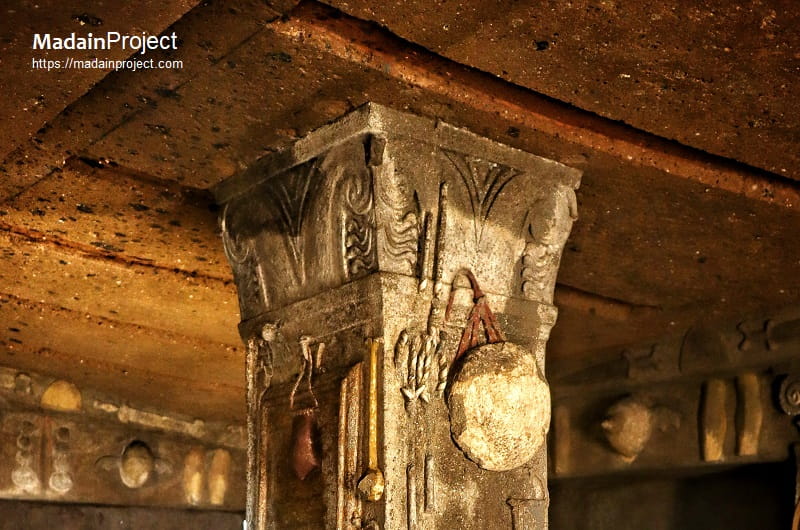
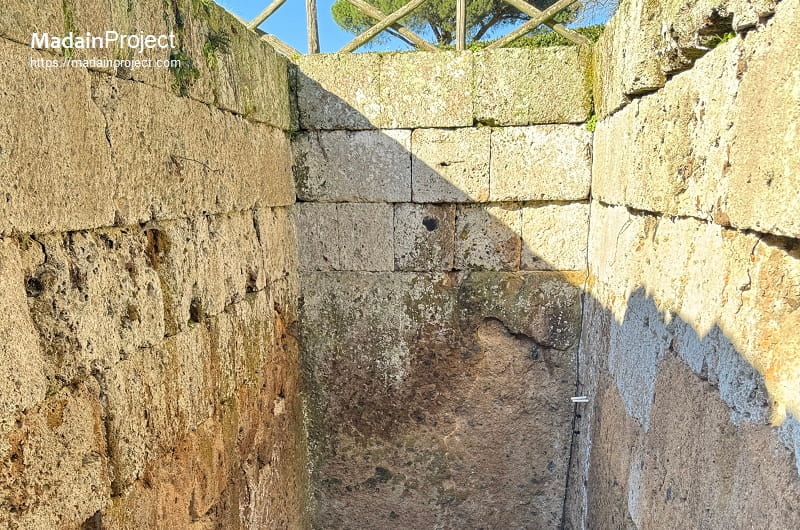
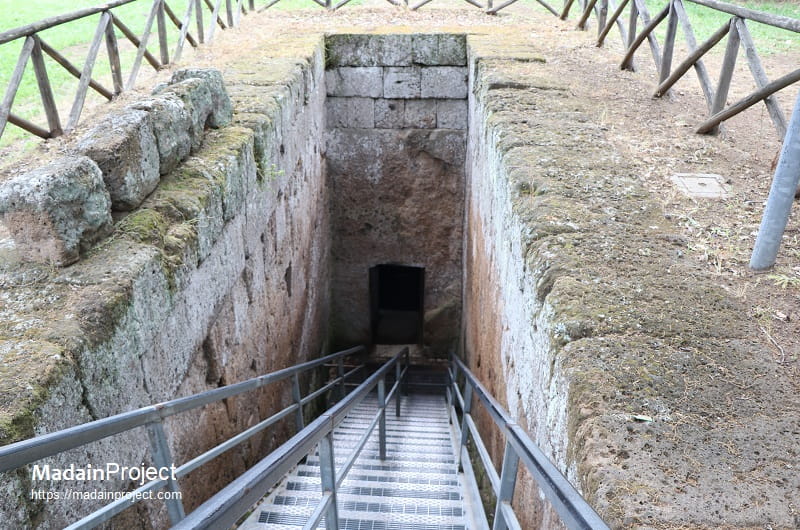
The hypogeum-crypt is unique for its extensive program of polychrome stucco reliefs that simulate the interior of an aristocratic domestic residence. The tomb consists of a singular, quadrangular chamber (approx. 7.7 x 6.5 meters) accessed via a steeply descending dromos. Its gabled ceiling is supported by two square piers featuring Aeolian (or Proto-Ionic) capitals.
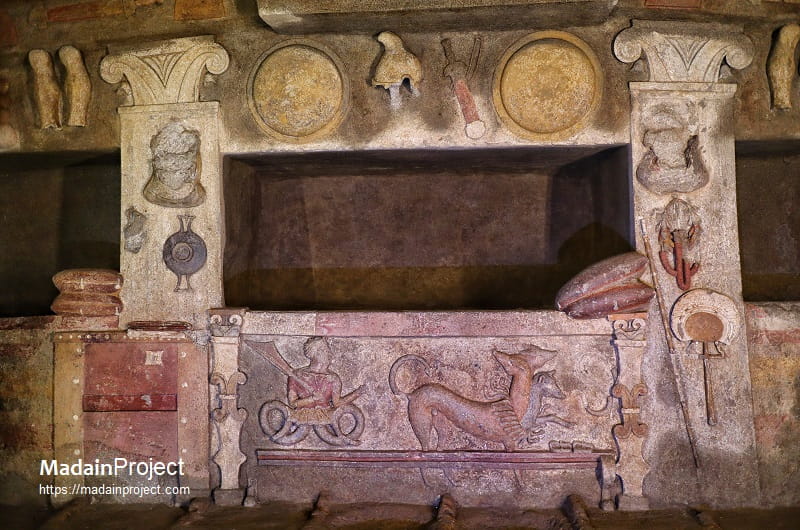
The chamber serves as a collective family mausoleum for the Matuna clan, identified by an inscribed funerary cippus commemorating "Vel Matunas, son of Laris". It incorporates 13 primary burial niches (loculi) modeled after klinai (dining couches) with stucco pillows, as well as a peripheral ledge accommodating over 30 additional interments.
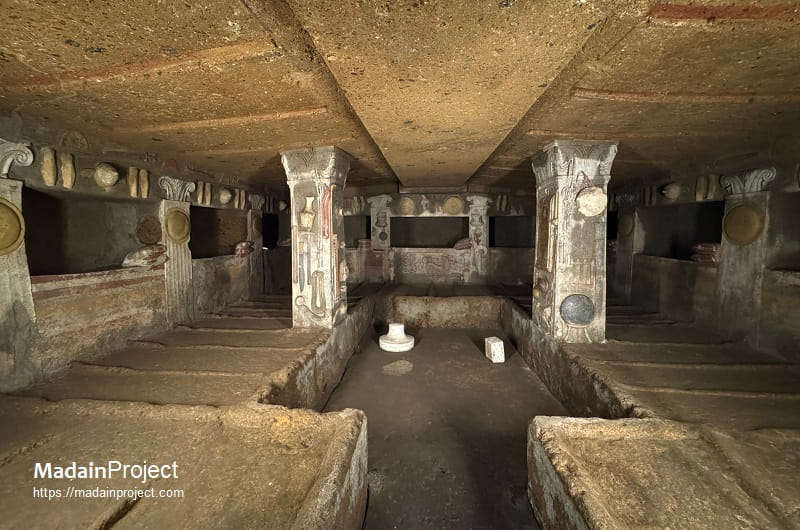
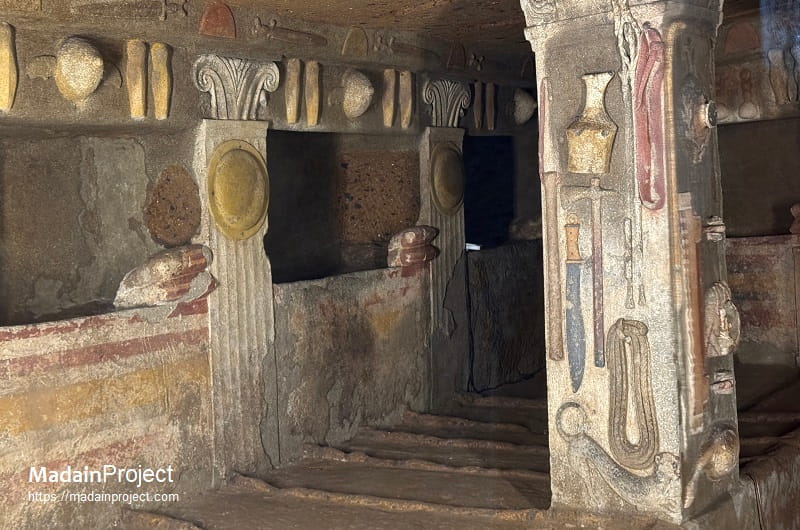
Tomb of the Reliefs (tomba dei rilievi), which belonged to the Matuna family according to the engravings placed on a cippus inside the room, preserves the painted stucco representations of all the furnishings, that is, the objects that accompanied the deceased. The objects are hung on the walls; it is the only Etruscan tomb decorated with stucco reliefs, decidedly unusual compared to the usual frescoes. The tomb is 7.7 metres long, 6.5 metres wide and 2.6 metres high.
The rectangular chamber is very deep and is accessed by a steeply descending stepped entrance, or dromos. It is sculpted like the interior of an Etruscan noble house, with two Aeolic-order capitals, which appear to support a double-pitched roof. The centre of the room is surrounded by a raised platform, which is divided by some low projections into 32 spaces where the deceased of the family would have been laid to rest. Above these are 12 oblong niches carved into the walls, which provided more space to contain more bodies. The large number of burial niches suggests that the tomb was used for a long time, perhaps for more than a century. The lateral niches are modelled as single beds with stucco cushions.
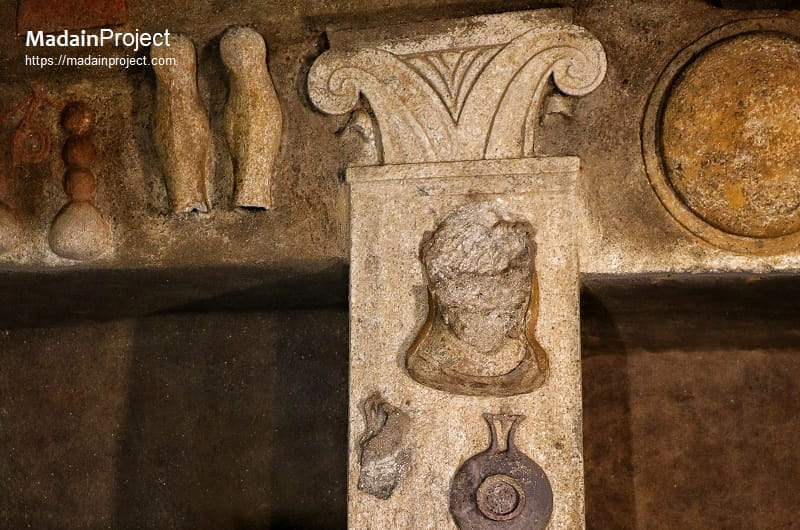
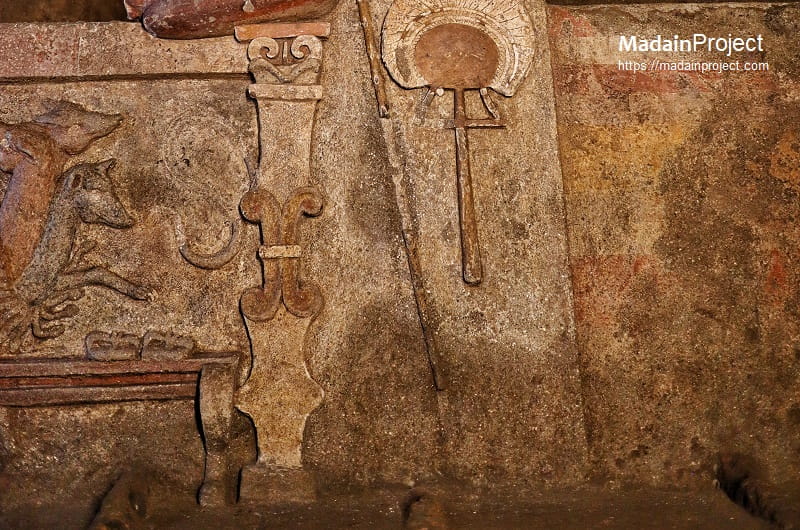
Only the central niche, placed in the wall opposite the entrance, probably intended for the head of the Matuna family and his wife, is deeper than the others, in order to accommodate the progenitor couple side by side. Above the tomb, for the husband hang helmets, shields, greaves and swords, while next to them there is a cup and a chest. On the other side, for the wife hangs an amber necklace, a feather fan and on a bench under the bed, a pair of women's sandals. Below the central niche are reliefs of Cerberus and a demon, perhaps Charon of the underworld. The demon has a tail and a 30 cm long member, holds the helm of the infernal bank and a snake. Two damaged busts on the pilasters flanking the central niche probably depicted the two deceased or the Etruscan deities Aita and Phersipnai.
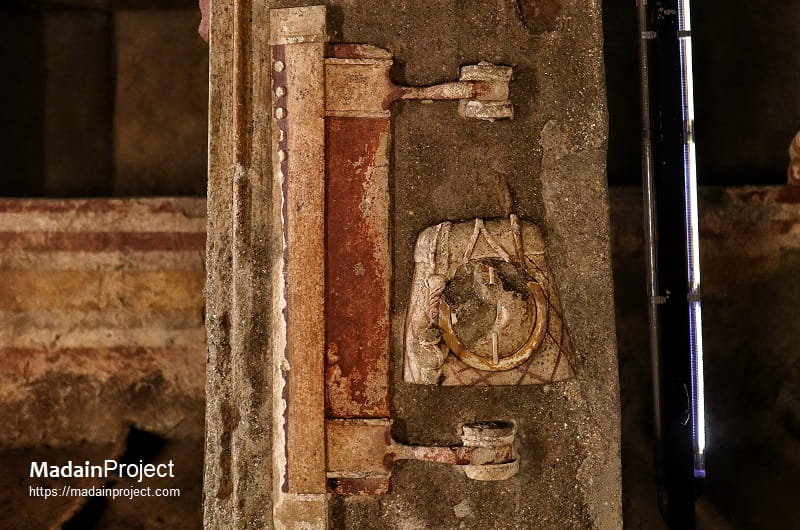
The walls and the two pilasters are decorated with stucco reliefs of everyday objects. The subjects of the reliefs also include household objects, domestic animals and a gaming board or tabula Lusoria. Some objects symbolise the power of the Matuna family as magistrates, such as a folding curule chair, ivory horns and a ritual lituus. Their martial prowess is shown through the various helmets, armour, shields and weapons. The decorations give a realistic impression of the interior of Etruscan houses. In fact, the wardrobe was not yet known, the objects were hung on the walls. One of the few pieces of furniture present in the tomb is the chest/strongbox at the foot of the central niche in the rear wall. It may have been used to store money and valuables. The material (probably linen) folded over this chest were scrolls used for writing, for example religious texts, contracts or family registers.
The decorative schema employs (possibly) "horror vacui", covering surfaces with low-relief depictions of everyday objects—such as kitchen utensils, weapons (shields, helmets, greaves), and hunting equipment—hanging from simulated pegs.
Signup for our monthly newsletter / online magazine.
No spam, we promise.

The Madain Project is an online archive of Abrahamic History and Archaeology.
Abrahamic History & Archaeology is the study of history and archaeology with respect to the three Abrahamic Faiths without considering the religious and theological aspects. The goal of Abrahamic History is to understand how and why the religious doctrines and behaviours have evlovled and changed over time. Searching for patterns in the evolution of significant cultural events such as the development of farming, the emergence of cities, or the collapse of major civilizations for clues of why and how these have influenced the three major Abrahamic religions.
Cloud Drive -
About -
Help -
Editorial Policy -
AI Policy -
Privacy Policy -
Contact
Madain Project: Encyclopedia of Abrahamic History & Archaeology.
Copyright MadainProject 2017 - 2026.


