
The Temple of Maharraqa is an unfinished Greco-Roman period religious structure in Lower Nubia, originally erected at the southern frontier of Roman Egypt and associated with the cults of Isis and Serapis.
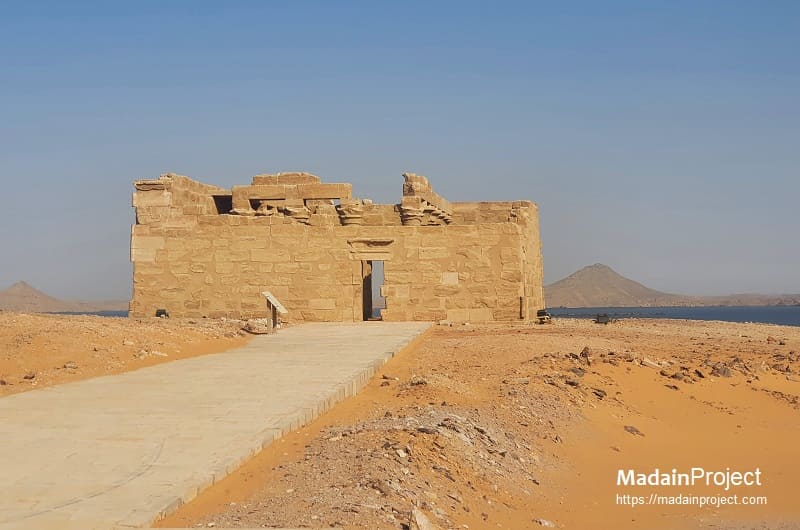
The Temple of Maharraqa occupies a distinctive position within the corpus of Nubian temples constructed under Roman rule in ancient Egypt. Unlike monumental sanctuaries characterized by axial progression and elaborate relief programs, Maharraqa presents a markedly incomplete architectural scheme, consisting primarily of an open courtyard and associated structural elements.
Its significance lies not in decorative richness but in its geographic location at the Roman imperial boundary, its association with frontier administration, and its anomalous architectural features, most notably a spiral staircase ascending to the roof. The temple reflects the adaptive nature of Egyptian religious architecture under Roman authority, particularly in peripheral regions where political, military, and cultural considerations intersected.

circa 50 CE
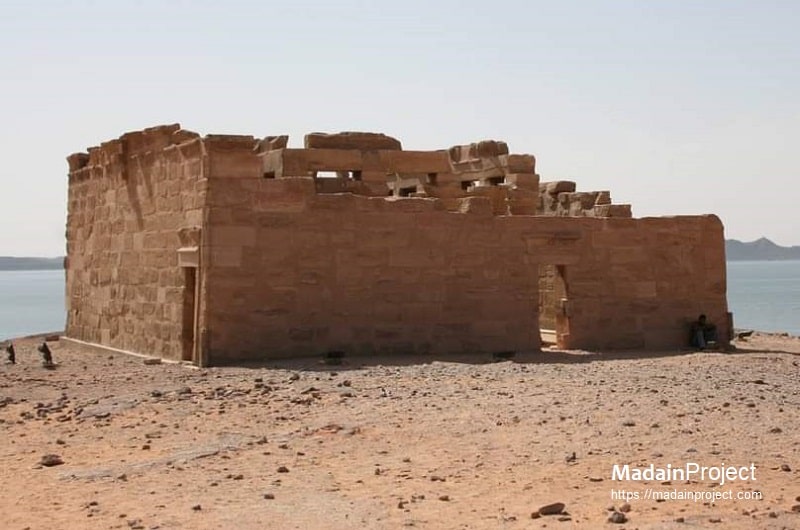
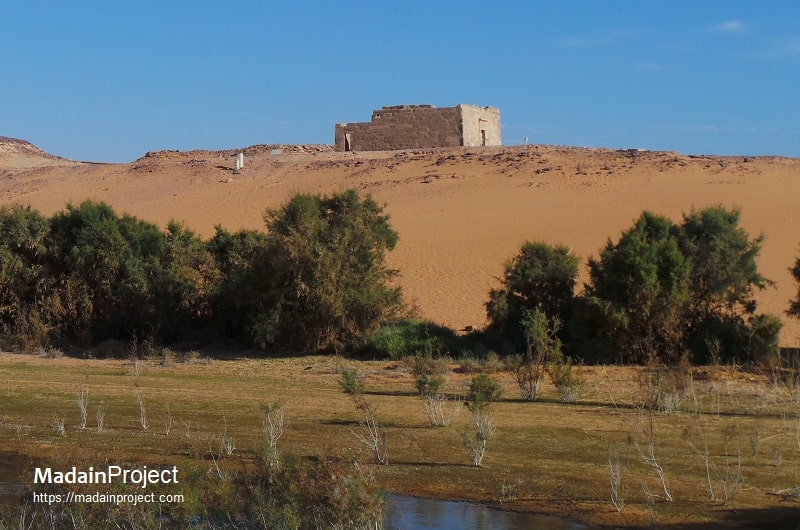
The construction of the Temple of Maharraqa is generally dated to the late first century BCE or early first century CE, following the Roman annexation of Egypt in 30 BCE. Its establishment is closely connected to Roman military activity in Lower Nubia, especially the campaign led by Publius Petronius, prefect of Egypt, against the Kingdom of Kush around 23 BCE. After repelling Kushite incursions north of the First Cataract, Roman forces consolidated their southern frontier in the region of Maharraqa, which subsequently functioned as the effective boundary of Roman Egypt.
Within this frontier context, the temple appears to have been initiated as part of a broader program of religious and administrative stabilization, integrating traditional Egyptian cults with Greco-Roman religious forms. The dedication to Isis aligns with long-standing Nubian devotional practices, while the inclusion of Serapis reflects Roman imperial religious policy and Hellenistic influence. Despite this apparent intent, construction was never completed. The absence of royal cartouches, dedicatory inscriptions, and a finished sanctuary suggests that the project was abandoned at an early stage, possibly due to shifting frontier policies, reduced strategic importance, or financial constraints.
During the early medieval period, following the Christianization of Nubia in the sixth century CE, the temple was repurposed as a Christian church. Historical accounts from later travelers indicate the presence of painted Christian imagery and inscriptions within the structure, attesting to its continued religious use long after the decline of traditional Egyptian cults. In the twentieth century CE, the original site was threatened by flooding caused by the construction of the Aswan High Dam. As part of the international Nubian salvage campaign, the temple was dismantled and reconstructed at New Wadi es-Sebua between 1961 and 1966 CE, ensuring its preservation.
circa 50 CE
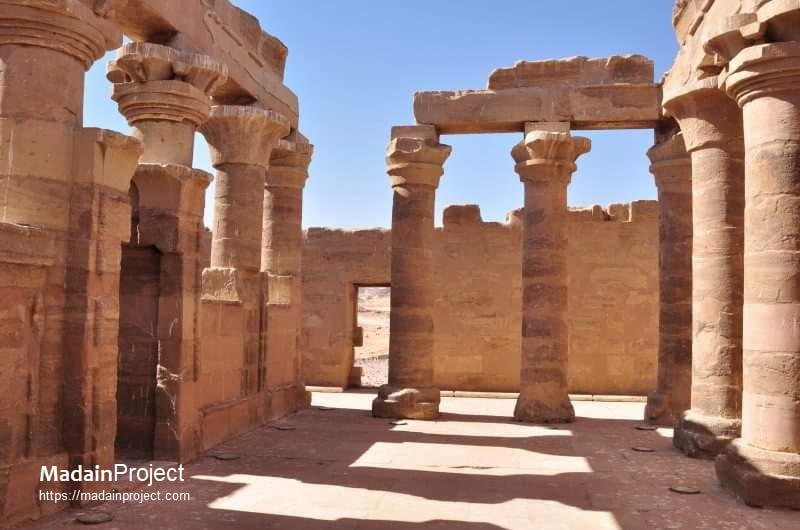
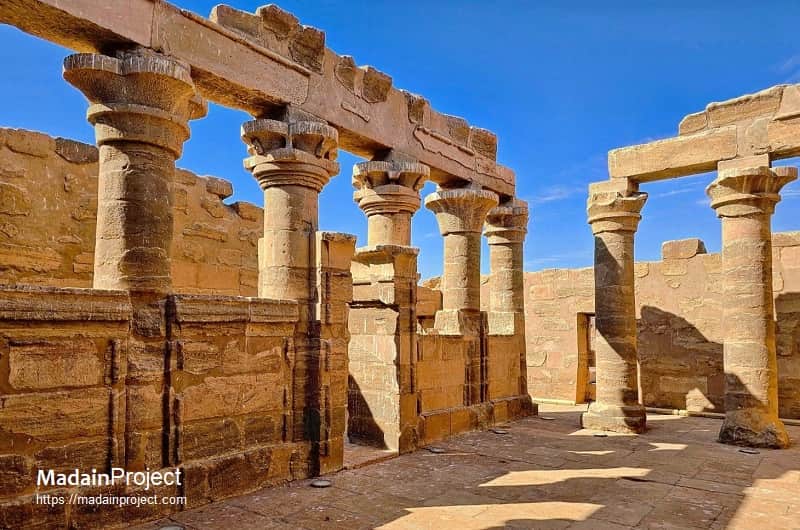
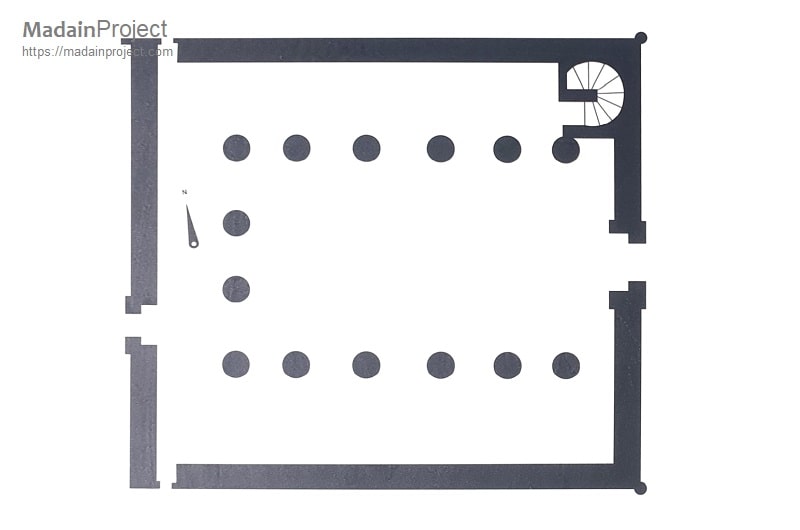
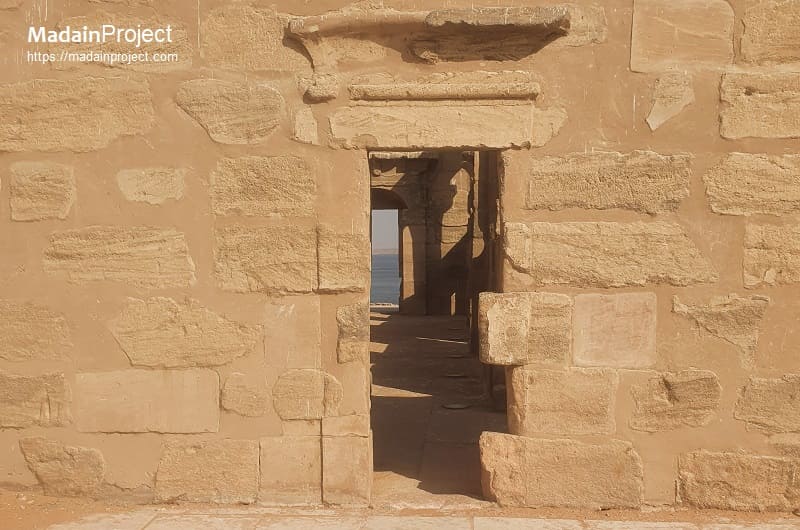
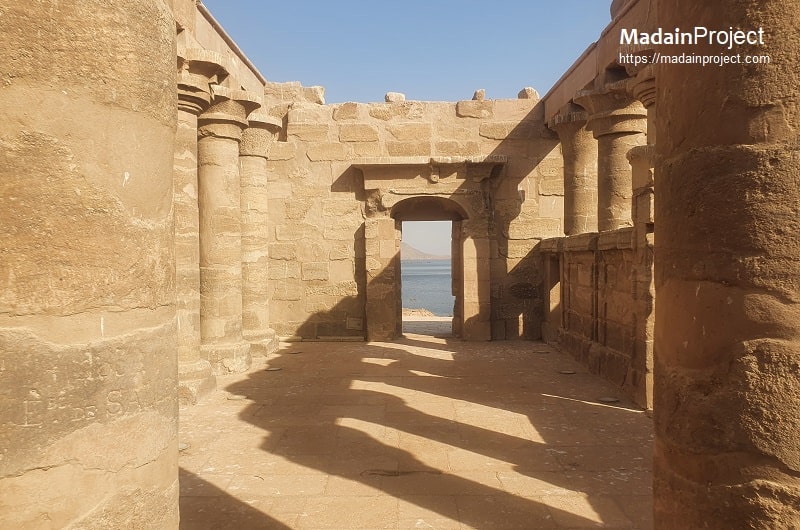
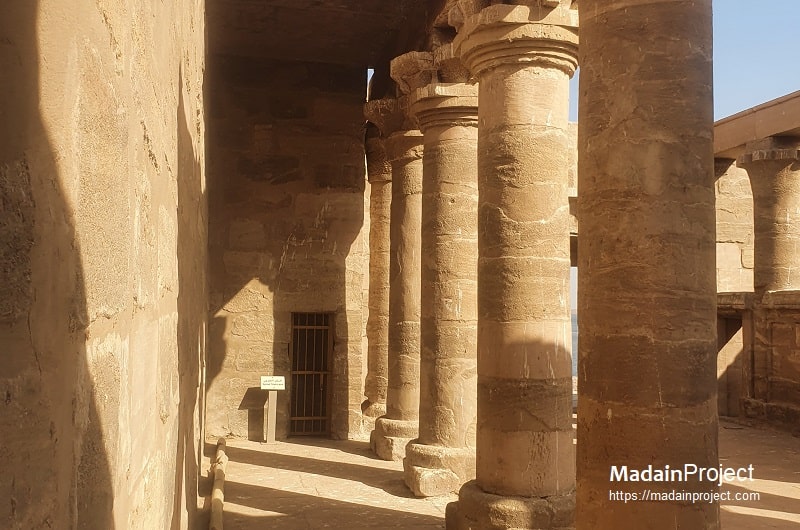
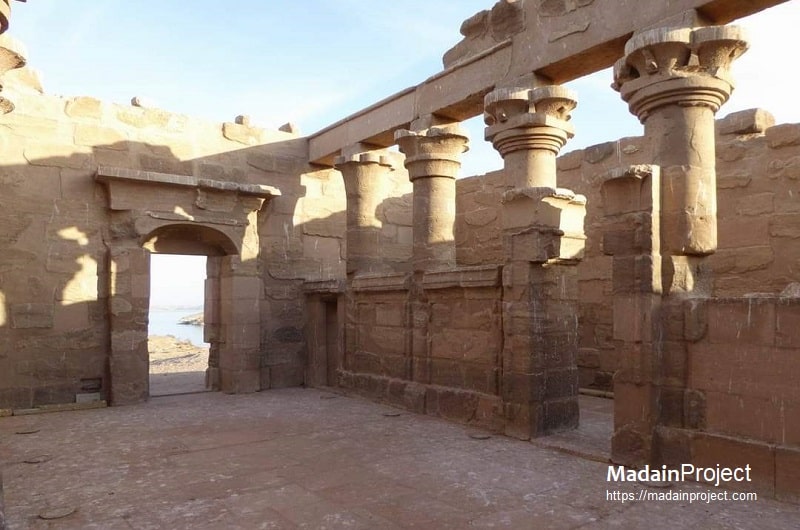
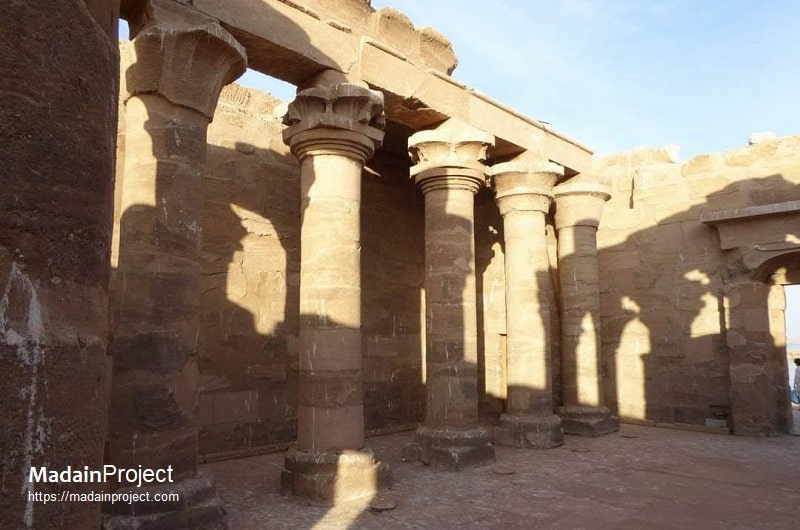
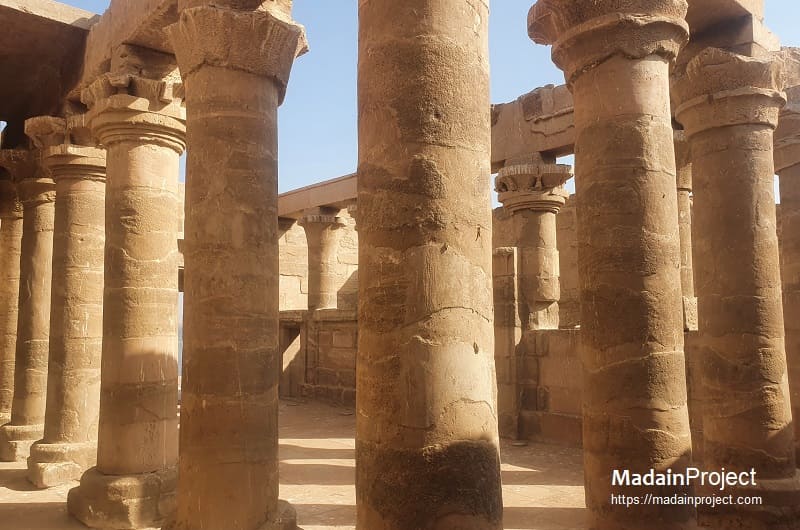
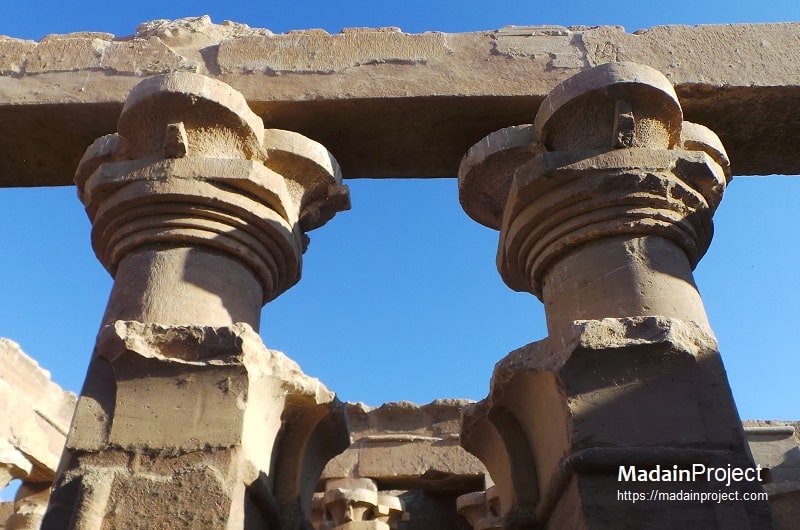
Architecturally, the Temple of Maharraqa diverges from the canonical layout of Egyptian temples. The extant remains consist primarily of an open rectangular court surrounded on three sides by columns, constructed of sandstone. The planned axial progression toward an inner sanctuary and pylon was never realized, leaving the structure without the enclosed sacred core typical of Egyptian religious architecture. Column shafts and architectural elements remain partially finished, reinforcing the impression of an interrupted building process.
The most distinctive architectural feature of the temple is a spiral staircase constructed of stone and integrated into one corner of the courtyard. This staircase ascends to the roof and represents a unique element within Nubian temple architecture, lacking close parallels in earlier Pharaonic or contemporary Roman Egyptian religious buildings. Its function is not definitively known, but it may have served ritual, observational, or ceremonial purposes, possibly connected to solar worship or processional activities.
The simplicity of the remaining architectural fabric, combined with the absence of extensive relief decoration, emphasizes structural form over symbolic ornamentation. At the same time, the coexistence of Egyptian spatial concepts with Greco-Roman religious associations illustrates the syncretic character of temple construction in Roman Nubia. As preserved today, the Temple of Maharraqa provides valuable insight into provincial religious architecture, frontier dynamics, and the limits of imperial architectural ambition in the southernmost reaches of Roman Egypt.
Signup for our monthly newsletter / online magazine.
No spam, we promise.

The Madain Project is an online archive of Abrahamic History and Archaeology.
Abrahamic History & Archaeology is the study of history and archaeology with respect to the three Abrahamic Faiths without considering the religious and theological aspects. The goal of Abrahamic History is to understand how and why the religious doctrines and behaviours have evlovled and changed over time. Searching for patterns in the evolution of significant cultural events such as the development of farming, the emergence of cities, or the collapse of major civilizations for clues of why and how these have influenced the three major Abrahamic religions.
Cloud Drive -
About -
Help -
Editorial Policy -
AI Policy -
Privacy Policy -
Contact
Madain Project: Encyclopedia of Abrahamic History & Archaeology.
Copyright MadainProject 2017 - 2026.


