
The Roman Soldier’s Tomb Complex at Petra is an archaeological designation for a monumental funerary structure carved into the sandstone cliffs of Wadi Farasa in the ancient city of Petra (modern‑day Jordan), notable for its elaborately carved rock‑cut tomb façade featuring three male figures in military garb and its associated courtyard, ancillary buildings, and ritual architecture, reflecting the integration of Nabataean funerary traditions with Greco‑Roman stylistic influences in the first century CE.

circa 100 CE
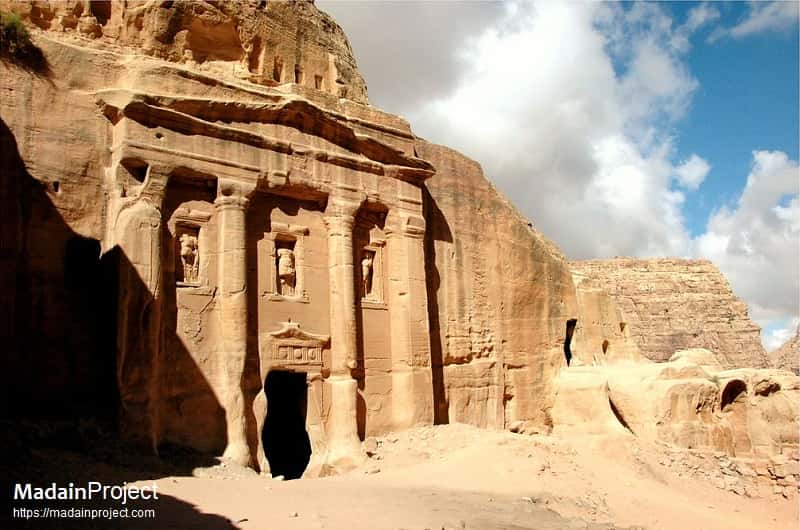
Tomb of the Roman Soldier
The facade of the Roman Soldier Tomb is similar to the so-called Urn Tomb, including the disk decoration on its small frieze. Higher up the facade, three niches are distributed between the four columns on the front of the monument. Each niche contains a male figure, dressed in military style, hence the name. It is one of the best-preserved tombs in the ancient city of Petra.
constitutes one of the most structurally integrated funerary complexes of the Nabataean capital, likely commissioned during the third quarter of the 1st century CE. Despite its traditional moniker—derived from the central facade relief depicting a figure in a Graeco-Roman cuirass—archaeological consensus identifies the site as a Nabatean royal or aristocratic monument rather than a Roman interment. The complex is architecturally unique for its deliberate orchestration of rock-cut and masonry elements, featuring a 14-meter-high facade framed by four engaged columns and three niches containing military-themed statuary carved from limestone blocks. This facade faces a large peristyle courtyard originally enclosed by two-story masonry buildings and a colonnade, which facilitated communal commemorative rituals.
circa 100 CE

Triclinium
The triclinium of the Roman Soldier's Tomb is located directly across the courtyard from the main tomb façade. This space is much more ornately carved than the tomb structure itself. Along the walls of the triclinium there are alternating columns and shallow alcoves, and in the middle of the room there are the remains of a U-shaped triple bench which in Roman society was used for sitting or reclining.
Also called the "Coloured Triclinium", it is a banquet hall renowned for its ornate interior of alternating fluted columns and alcoves, representing a rare instance where the interior decoration surpasses the exterior monumentalism. Sophisticated hydraulic features, including cisterns and drainage channels designed to mitigate flash flood damage, underscore the technical proficiency required to maintain such an extensive desert sanctuary. Remains of opus sectile flooring and polychromatic wall plaster further suggest that the complex originally served as a luxurious, multifunctional site for both the cult of the dead and elite social gatherings.
Signup for our monthly newsletter / online magazine.
No spam, we promise.

The Madain Project is an online archive of Abrahamic History and Archaeology.
Abrahamic History & Archaeology is the study of history and archaeology with respect to the three Abrahamic Faiths without considering the religious and theological aspects. The goal of Abrahamic History is to understand how and why the religious doctrines and behaviours have evlovled and changed over time. Searching for patterns in the evolution of significant cultural events such as the development of farming, the emergence of cities, or the collapse of major civilizations for clues of why and how these have influenced the three major Abrahamic religions.
Cloud Drive -
About -
Help -
Editorial Policy -
AI Policy -
Privacy Policy -
Contact
Madain Project: Encyclopedia of Abrahamic History & Archaeology.
Copyright MadainProject 2017 - 2026.


