
The Tomb of the Roman Soldier (قبر الجندي الروماني), also known as the Tomb of the Soldier, is a rock cut tomb in Wadi Farasa, named after the remains of a Roman styled bust of a military individual. Although predominently of Nabatean style it is (mis)named as Roman because of the stone bust wearing Roman breast armour. The tomb it self forms part of a larger funerary-complex which lies along the road to the High Place, southeastern outskirts of the city center of Petra in the Wadi Farasa.
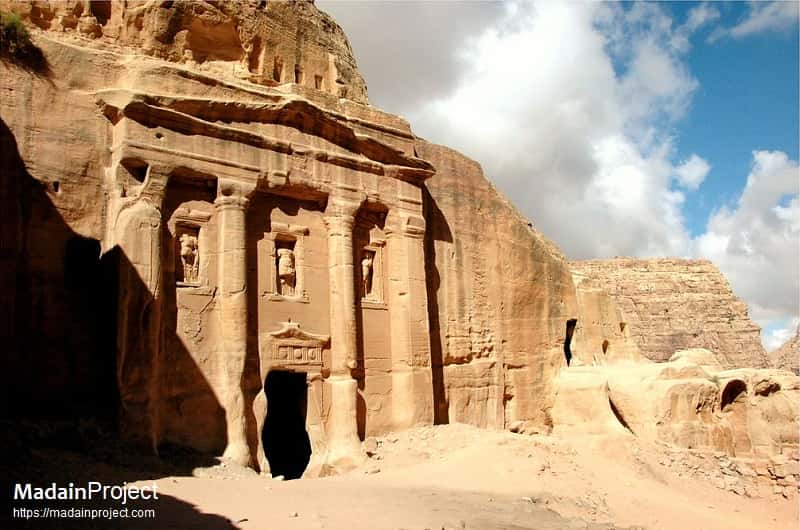
The facade of the Roman Soldier Tomb is similar to the Urn Tomb, including the disk decoration on its small frieze. Higher up the facade, three niches are distributed between the four columns on the front of the monument. Each niche contains a male figure (inspect), dressed in military style, hence the name. The facade of the Roman Tomb is about 14 meters. Above the columns are a frieze and a pediment. Between the four columns there are three niches, each containing an inset male stone figure made out of six limestone blocks.
Because of the grand size of the tomb it is speculated that this tomb would be appropriate for a royal burial, although it is not certain who was interred here.
The architectural juxtaposition of Nabataean and Greco‑Roman architectural elements is characteristic of the cultural syncretism evident in Petra during the late first century CE, a period of vigorous urban development and artistic exchange. Archaeological research indicates that the courtyard and surrounding built structures were initially constructed in the Nabataean period, later undergoing modifications during the early Roman Empire period, which underscores the site’s prolonged functional and symbolic significance.

circa 100 CE

Facade
The facade of the Tomb of the Roman Soldier, located in the Wadi Farasa East at Petra, stands as a primary example of 1st-century CE Nabataean architectural syncretism. Measuring approximately 14 meters in height, the rock-cut facade is defined by its tripartite vertical arrangement, featuring four engaged columns with Nabataean capitals that frame three deeply recessed niches. These niches contain the monument's most distinctive feature: three inset male figures carved from separate limestone blocks, the central of which is clad in a Graeco-Roman cuirass decorated with floral motifs.
Architectural analysis reveals a sophisticated blend of local and Mediterranean traditions. The facade incorporates a Doric entablature with alternating triglyphs and metopes, surmounted by a simple triangular pediment. While the central figure wears Roman-style military armor, recent scholarly observations noted that the figures' long hair—contrary to contemporary Roman grooming standards—strongly suggests a Nabataean identity for the subjects, likely representing a high-ranking family. The central portal is notably narrow (1.6 meters wide) relative to the monumental scale of the facade and is flanked by small carved pillars, one of which has largely eroded. The small frieze above the columns includes disk decorations similar to those found on the Urn Tomb, indicating a stylistic continuity with Petra's Royal Tombs. Originally covered in a light layer of painted stucco, the facade served as the visual anchor of the entire funerary-complex.
Recent archaeological evidence has indicated that this well-proportioned facade was probably part of a complex that was situated in front of the tomb, providing an interesting new insight into nabataean architecture. The tomb was accessible through a large courtyard with porticos and two-story buildings on both sides and a triclinium opposite the entrance. The Tomb of the Soldier is relatively well preserved in comparison with other monumental tombs at Petra.
circa 100 CE

Entrance
The tomb has a single entrance from the north-east, which lies in the center of the façade. The entrance appears to have had two small carved pillars framing its doorway, although the left column has eroded away. Above this entrance is a doric entablature (inspect) with a pattern of alternating triglyphs and metopes. Directly above this is a simple pediment. The dimensions of the door to the Tomb of the Soldier measure only 1.6 meters in width but 3.6 meters in height.
The entrance portal of the Tomb of the Roman Soldier, centrally positioned within the monument’s rock-cut facade, serves as a significant transitional element between the public peristyle courtyard and the subterranean funerary chamber. Measuring approximately 1.6 meters in width and 3.6 meters in height, the aperture is notably narrow in proportion to the 14-meter facade, a design choice common in Nabataean architecture to emphasize the monumentality of the exterior sculptural program. The doorway is framed by a simple yet refined molded architrave and was originally flanked by two small, engaged pilasters, of which the southern example remains partially extant. Above the lintel, a small frieze decorated with circular discs mirrors the motifs found on the Urn Tomb, suggesting a high-status stylistic affiliation with the city's royal necropolis.
The doorway of the Tomb of the Roman Soldier in Petra exhibits specific structural damage primarily attributed to long-term aeolian and fluvial erosion, as well as historical seismic activity. While the tomb is generally considered one of the better-preserved monuments in Petra, the entrance reveals clear signs of degradation. The doorway was originally flanked by two small carved pillars or pilasters. Currently, the left column (from the viewer's perspective) has eroded away for the most part, leaving only a portion of the right pilaster visible.
circa 100 CE

Interior of Main Chamber
Interior of the tomb holds several niches most probably for the burial purposes and since tombs in Petra were family affairs, this tomb may have belonged to a family as well. It is most likely that the three statues in the facade depict a family portrait, with the father in the middle and his sons (or other male relatives) on either side of him. Dating no later than 75 CE, this is the most complete, and one of the richest, funerary complexes in Petra.
The interior of the main chamber of the Tomb of the Roman Soldier in Petra comprises a large, rock-cut space measuring approximately 13 by 15 meters (1.2.5, 1.4.1). In contrast to the elaborate sculptural program of the exterior, the interior is characterized by a functional and relatively austere layout, designed to house multiple interments.
The rear and side walls contain various funerary recesses or niches (inspect). High in the center of the back wall is a deep loculus (shaft tomb), likely reserved for the primary or most esteemed individual. The same wall also features an arcosolium—a vaulted niche with a floor recess—at the bottom right, while the right wall contains three additional arcosolia of varying sizes. Natural light is introduced into the expansive chamber through window openings positioned on both sides of the main facade.
A doorway situated in the left (western) wall leads to an adjoining, nearly square antechamber measuring approximately 9.20 by 8.80 meters.



Signup for our monthly newsletter / online magazine.
No spam, we promise.

The Madain Project is an online archive of Abrahamic History and Archaeology.
Abrahamic History & Archaeology is the study of history and archaeology with respect to the three Abrahamic Faiths without considering the religious and theological aspects. The goal of Abrahamic History is to understand how and why the religious doctrines and behaviours have evlovled and changed over time. Searching for patterns in the evolution of significant cultural events such as the development of farming, the emergence of cities, or the collapse of major civilizations for clues of why and how these have influenced the three major Abrahamic religions.
Cloud Drive -
About -
Help -
Editorial Policy -
AI Policy -
Privacy Policy -
Contact
Madain Project: Encyclopedia of Abrahamic History & Archaeology.
Copyright MadainProject 2017 - 2026.


