
The Mashar al-Haram Mosque (مسجد المشعر الحرام) is a historic and most significant mosque of Mecca in the Hejaz region of western Saudi Arabia. Situated in sacred valley of Muzdalifah, it is one of the most important landmarks of the Hajj pilgrimage. Traditionally it is situated on the site where prophet Muhammad spent the night in Muzdalifah, offered Fajr, and prayed to Allah until daybreak.
Located approximately five kilometres south-east to the Masjid al-Khayf in Mina and seven kilometres north-west to the Nimrah Mosque in Arafat, the contemporary structure is an expansive rectangular complex resulting from a comprehensive reconstruction initiated in 1395 Hijri (1975 CE). This project, executed at an approximate cost of five million Saudi riyals, replaced a historically modest, unroofed square enclosure that had functioned for centuries with only six doors and simple perimeter walls.
Jabal Thawr is situated approx 6.5 kilometers to the west of the Mashar al-Haram masjid.
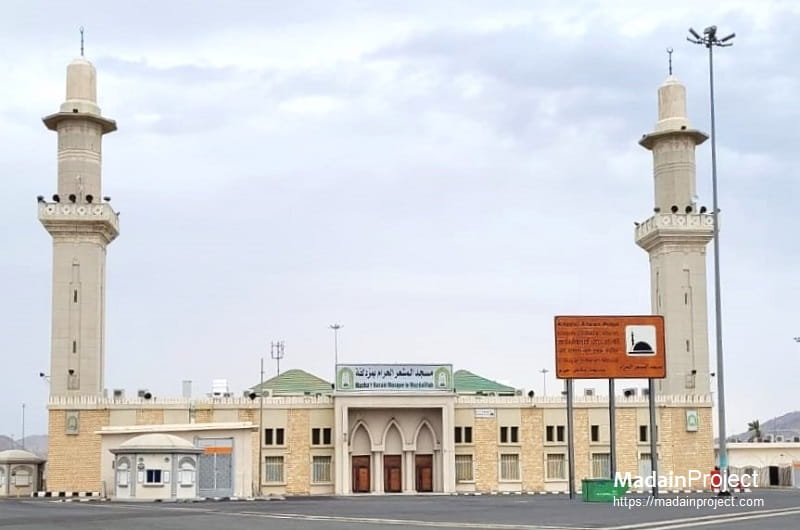
circa 650 CE
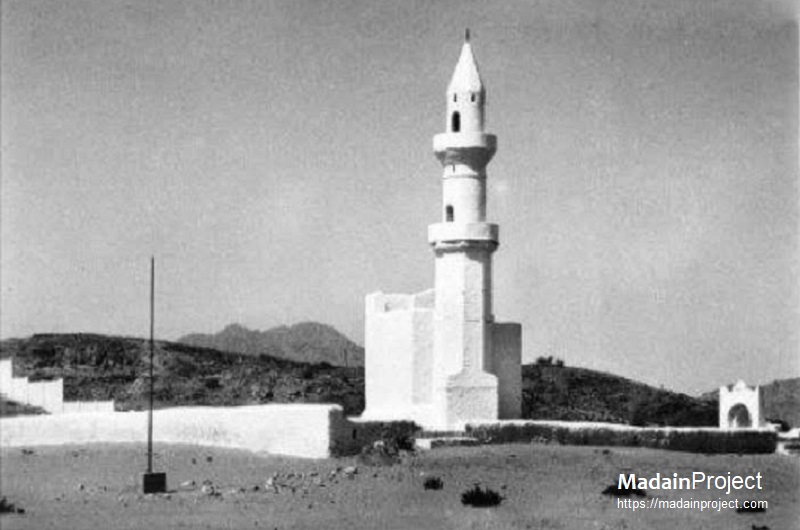
Academic records, most notably the Akhbar Makkah by the 3rd-century Hijri historian al-Azraqi, describe the mosque's earliest known form as a simple, square-shaped wall without an interior canopy, which famously featured fifty-seven balconies (crenellations) along its eastern perimeter. The site underwent sporadic renovations by the Mamluk Sultanate, including efforts by Emir Yalbugha al-Umari in 760 Hijri (1359 CE) and later by Sultan Qaytbay in 874 Hijri (1470 CE). An Ottoman renovation followed in 1072 Hijri (1662 CE) before the 20th-century CE Saudi expansion fundamentally transformed the site into its current modern typology. Contemporary infrastructure also includes auxiliary facilities such as sixty-four restroom units and digital guidance services, reflecting the site's role as a modern logistics hub within the Hajj circuit.
circa 650 CE

The religious significance of the al-Mash'ar al-Haram Mosque is rooted in its designation as the "sacred monument" explicitly mentioned in the Qur’an (Surah al-Baqarah, 2:198), which commands believers to "remember Allah at al-Mash’ar al-Haram" after departing from Arafat.
لَيْسَ عَلَيْكُمْ جُنَاحٌ أَن تَبْتَغُوا۟ فَضْلًۭا مِّن رَّبِّكُمْ ۚ فَإِذَآ أَفَضْتُم مِّنْ عَرَفَـٰتٍۢ فَٱذْكُرُوا۟ ٱللَّهَ عِندَ ٱلْمَشْعَرِ ٱلْحَرَامِ ۖ وَٱذْكُرُوهُ كَمَا هَدَىٰكُمْ وَإِن كُنتُم مِّن قَبْلِهِۦ لَمِنَ ٱلضَّآلِّينَ
There is no blame on you for seeking the bounty of your Lord 'during this journey'. When you return from ’Arafât praise Allah near the sacred place and praise Him for having guided you, for surely before this 'guidance' you were astray. - Translation: Dr. Mustafa Khattab
It serves as a major gathering point for pilgrims after they move from Arafat at the end of the Day of Arafah.
Situated in the valley of Muzdalifah, the site marks the specific location where the Prophet Muhammad performed the Fajr prayer and remained in a state of intense supplication (dua) until shortly before sunrise during his Farewell Pilgrimage. It serves as the primary spiritual focal point for the night of the 9th of Dhu al-Hijjah, where Hajj pilgrims are required to observe the wuquf (standing), combining the Maghrib and Isha prayers in a shortened form (jam’ wa qasr). When staying overnight here, Prophet Muhammad, chose to sleep until shortly before dawn rather than engaging in his usual night worship to prepare for the rites of the 10th. Beyond its role as a site for formal prayer, the mosque and its surrounding precinct represent a transitional stage of spiritual purification, where pilgrims collect pebbles for the Jamarat ritual and reflect on the divine mercy received at Arafat before proceeding to Mina, thus bridging the gap between the Day of Atonement and the acts of sacrifice and stoning.
circa 650 CE
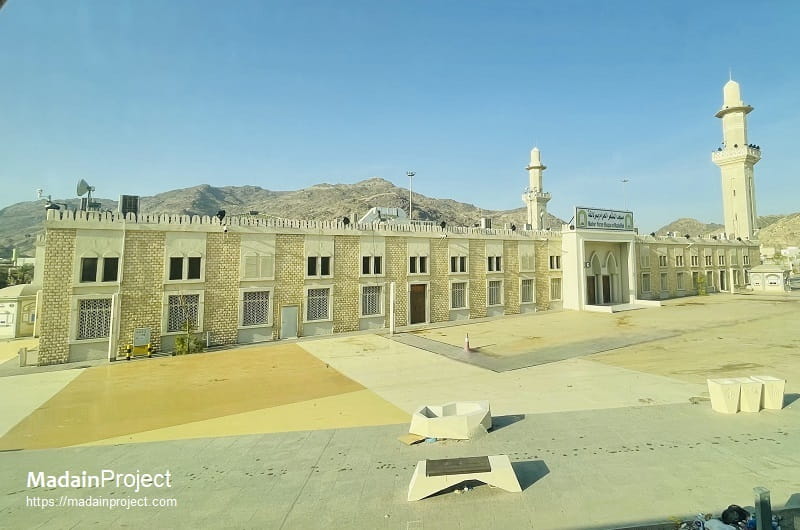
Exterior
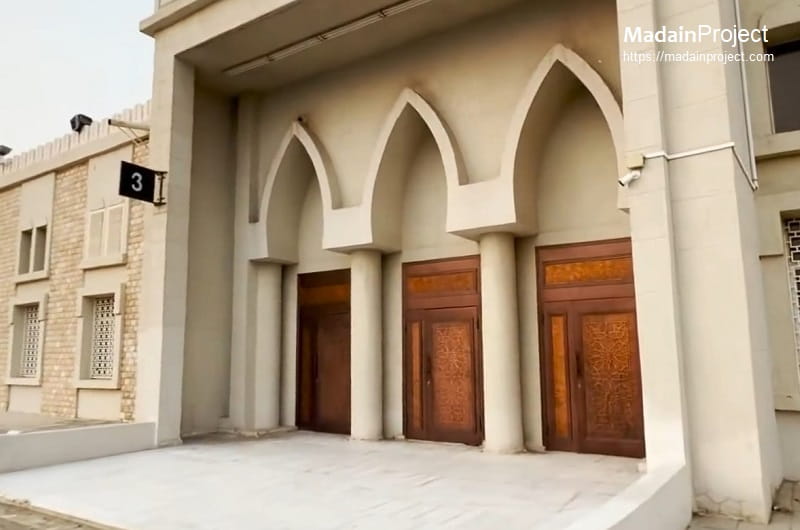
The mosque's plan is strictly defined by its rectangular footprint, extending 90 metres along its longitudinal east-west axis and 56 metres across its transverse north-south axis. This configuration yields a total interior area of 5,040 square metres, engineered to support a static capacity of approximately 12,000 worshippers. The architectural program prioritizes high-volume circulation, essential for the brief but intense occupancy during the Hajj season. To this end, the structure incorporates nine primary entrances; these are distributed symmetrically with three portals each on the eastern, northern, and southern facades. The western wall is intentionally void of ingress, as it functions as the qibla wall oriented toward the Grand Mosque in Makkah.
The mosque's profile is dominated by two symmetrical minarets located at the rear (eastern) section of the building, each reaching a uniform height of 32 metres. Each minaret consists of a cylindrical shaft with limited taper, a single projecting balcony defined by a geometric balustrade, and an upper section terminating in a modest rounded cap with a finial. The minarets are executed in the same material and color palette as the main structure, maintaining visual coherence while providing vertical emphasis within an otherwise horizontally oriented composition. These towers follow modern Arab-Islamic stylistic codes, characterized by slender shafts and functional balconies. The facade is distinguished by an extensive array of windows designed to maximize natural ventilation and daylighting within the prayer hall.
The mosque is strictly rectilinear, low-rise, and horizontally emphasized. The structure has a low parapeted (crenellation-like edging) roofline. The north, east and south façades are composed of light-colored masonry or rendered concrete units arranged in a regular modular pattern. Rectangular windows are uniformly distributed across the elevations, each fitted with metal grilles; their scale and frequency indicate an emphasis on ventilation rather than ornamentation
The only formal interruption in this otherwise uniform façade is the centrally positioned entrance portal, which projects slightly and is articulated by a set of three shallow pointed arches. Above this entrance is a rectangular inscription panel bearing the mosque’s name, framed by minimal molding.
The absence of traditional domical structures distinguishes the mosque from many traditional Islamic precedents and reflects a prioritization of functional efficiency over symbolic form. However, six low triangular "domes" with square base sit atop the rectangular structure.
circa 650 CE
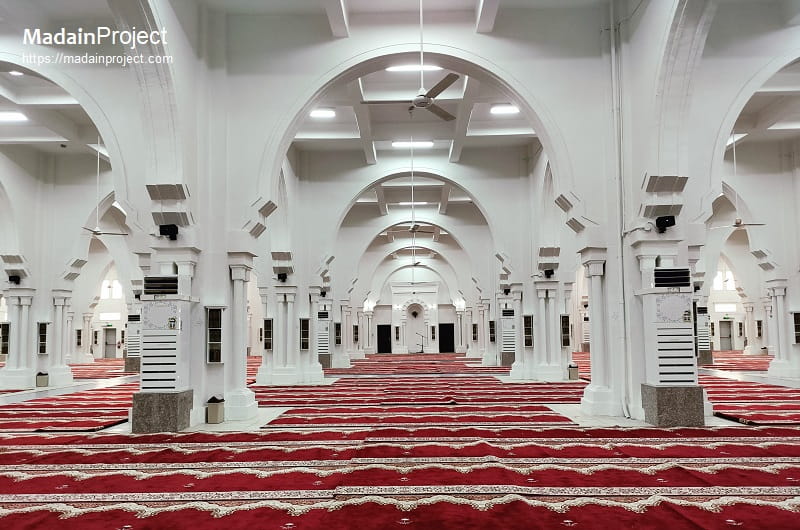
Interior
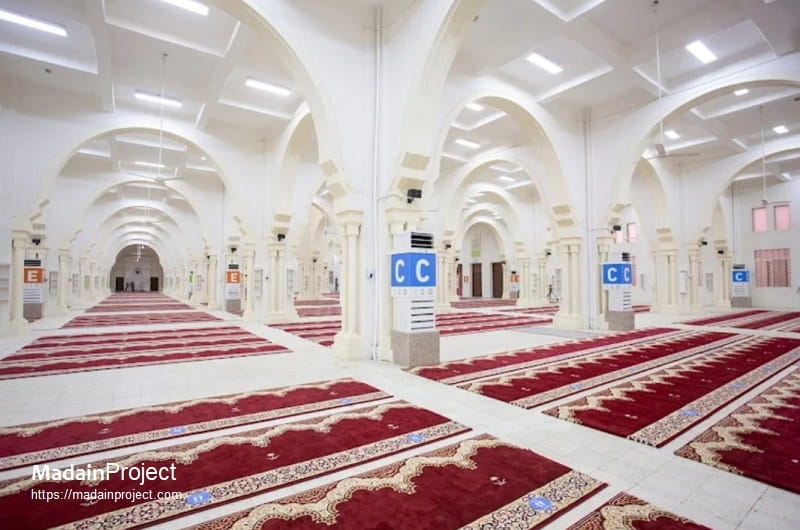
While the interior remains primarily a functional open hall to facilitate mass prayer, the structural system utilizes reinforced concrete and marble cladding—standard materials in the Saudi state’s mid-to-late 20th-century religious architecture. The mosque does not contain a courtyard (ṣaḥn); instead, it functions as a single consolidated prayer hall block.
The interior of Masjid al-Mashʿar al-Ḥarām is organized as a hypostyle hall structured by a dense and regular grid of load-bearing columns that define multiple longitudinal aisles aligned toward the qibla wall. The spatial system is strictly modular, with each bay formed by four columns supporting transverse arches and a flat roof system above. This repetitive structural grid produces a highly legible spatial rhythm, facilitating both orientation and the orderly alignment of congregational salah rows.
The qibla wall is architecturally distinguished but remains consistent with the overall restraint of the interior. It incorporates a centrally positioned miḥrāb niche, expressed as a shallow, arched recess framed by a slightly more articulated molding profile.
Floor treatment consists of a continuous carpet system in a dominant red tone, patterned with repeated miḥrāb-shaped motifs that correspond to individual prayer positions.
Signup for our monthly newsletter / online magazine.
No spam, we promise.

The Madain Project is an online archive of Abrahamic History and Archaeology.
Abrahamic History & Archaeology is the study of history and archaeology with respect to the three Abrahamic Faiths without considering the religious and theological aspects. The goal of Abrahamic History is to understand how and why the religious doctrines and behaviours have evlovled and changed over time. Searching for patterns in the evolution of significant cultural events such as the development of farming, the emergence of cities, or the collapse of major civilizations for clues of why and how these have influenced the three major Abrahamic religions.
Cloud Drive -
About -
Help -
Editorial Policy -
AI Policy -
Privacy Policy -
Contact
Madain Project: Encyclopedia of Abrahamic History & Archaeology.
Copyright MadainProject 2017 - 2026.


