
The Western Wall Heritage Center is a purpose-built institutional complex and visitor-education facility in Jerusalem that serves as the administrative headquarters of the Western Wall Heritage Foundation and as an interpretive and archaeological presentation space focused on the Western Wall (the Kotel) and the subterranean remains immediately adjacent to it. The complex—sited directly across the Western Wall Plaza and constructed above excavated levels—integrates museum-style exhibition, visitor circulation, and access to exposed archaeological strata; functionally it links the surface plaza and prayer areas to stratified remains that span the Mamluk period down through Roman and Second Temple horizons.
Planning for the Heritage Center (Beit Haliba) has been underway for many years, with archaeological excavations under the Western Wall Plaza area (and the adjacent Muslim Quarter) beginning before the structure was built. These digs exposed remains from Roman, Byzantine, Mamluk, and even earlier periods. The project was controversial in some quarters, due to concerns about impact on archaeology.
The site commonly called the Western Wall derives its most visible fabric from Herodian construction campaigns associated with the Temple Mount platform, undertaken under King Herod circa 20 BCE; those retaining walls survived the Roman destruction of the Temple in 70 CE and became a focal point of Jewish devotional attention thereafter.
The modern institutional framework that manages, interprets, and curates the Wall and its associated built and buried fabric is the Western Wall Heritage Foundation, established by the Israeli Ministry of Religious Services in 1988 CE. The Foundation’s remit expanded over time to include management of the Western Wall Plaza, the Western Wall Tunnels, and a set of education and conservation projects intended to present the Wall’s multilayered history to pilgrims, tourists, and scholars. In that trajectory the Heritage Center plays a recent but central role: dedicated in November 2021 CE, the building consolidates offices, exhibition spaces and controlled viewing into a single locus that directly overlies newly exposed archaeological remains.
circa 130 CE
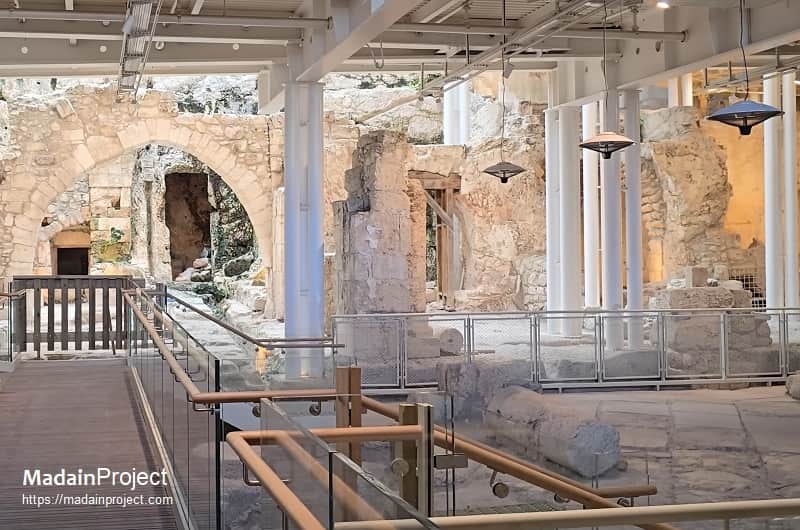
Physically, the Center is constructed over and adjacent to excavated strata, including Roman-period pavement (a Roman road) and layers from later periods; its lowest levels present these ruins in situ rather than burying them, enabling public visibility. It incorporates the “Gateway to Heaven Visitors Center” at the entrance level, and is built to accommodate visitors, scholars, and management functions in one facility.
The Heritage Center comprises several floors: above ground levels for visitor experience and Foundation offices, and subterranean or partially subterranean levels that expose archaeological remains. It is roughly three stories above the ground and around one and a half to two stories below ground level in older plans, though actual layout corresponds to terrain and surrounding structure.
One key component is the Gateway to Heaven Visitors Center, located at the entrance level facing the Western Wall. This is an immersive audio-visual presentation (~8 minutes) designed to introduce visitors to the history of the First and Second Temples, the significance of the Wall, and the emotional/spiritual dimensions of the site. Screens surround the space; there is a central simulation projection; the staging is darkened; available in multiple languages.
Another visitor feature is “A Look into the Past”, a virtual-reality experience, also intended to help visitors visualize the Temple periods and the earlier built fabric. Other interpretative media are used, such as exhibition displays of artifacts, and guided tours (though the tours into tunnels are separate from what the Center itself offers).
From the lower levels of the Center one can see preserved ruins beneath the structure: most notably portions of a Roman-period road uncovered in the course of the excavations prior to construction. These ruins are visible in situ (not reburied) under glass or protected canopy as part of the museum-interpretation design.
circa 2005 CE-
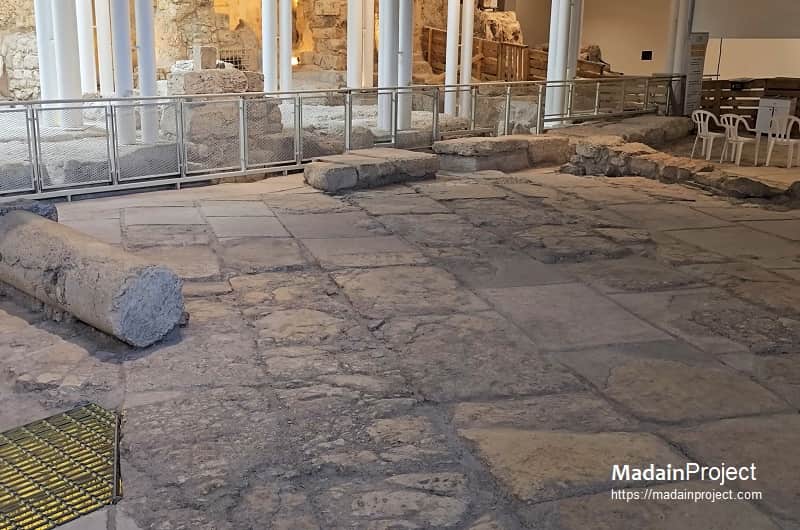
The area under the Heritage Center was the subject of extended archaeological excavation between roughly 2005-2009 (and further work subsequently). Excavators uncovered remains of the Mughrabi Quarter (destroyed in 1967), layers from the Mamluk, Byzantine, Roman periods, and even earlier structures. Among the significant finds was a Roman street (from the 2nd-4th centuries CE), which ran roughly north-south, aligning with what is today al-Wad / Ha-Gai Street from the Wall Plaza toward Damascus Gate. This street forms part of the pavement and roadway system of the Roman colony Aelia Capitolina.
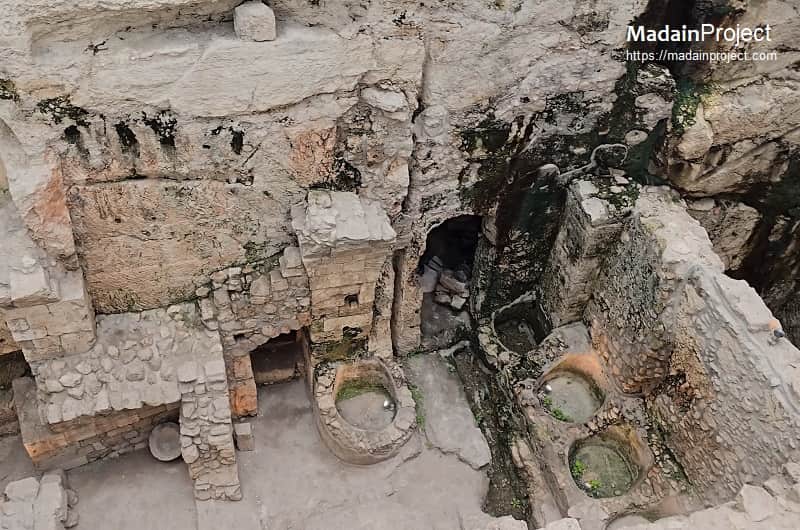
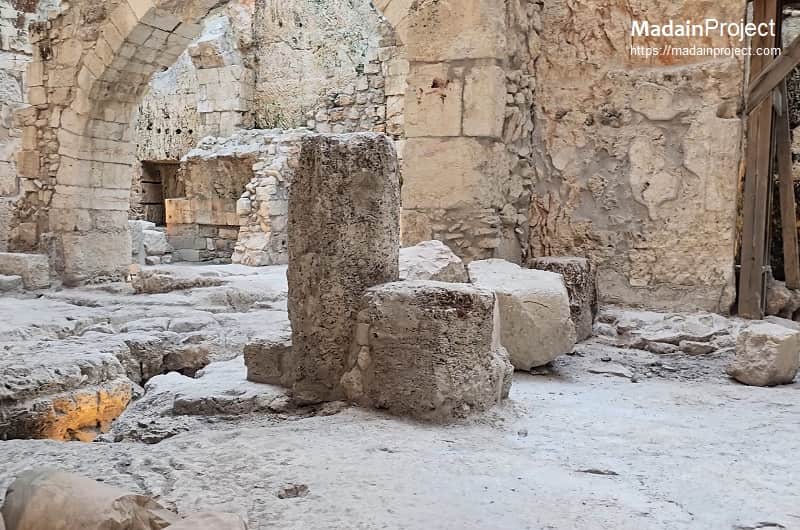
Ground-level excavations also revealed structural remains: building foundations from late Roman / Byzantine times; possibly sections of walls, floors and artifacts (ceramic, ritual baths, etc.) though the record in the sources is more detailed for the tunnel excavations than for the Center’s own site.
These archaeological remains had to be stabilized, conserved, and integrated into the design of the Center rather than destroyed. Conservation required engineering solutions (roofing, protective coverings, visitor paths) to allow public viewing while protecting the material.
Signup for our monthly newsletter / online magazine.
No spam, we promise.

The Madain Project is an online archive of Abrahamic History and Archaeology.
Abrahamic History & Archaeology is the study of history and archaeology with respect to the three Abrahamic Faiths without considering the religious and theological aspects. The goal of Abrahamic History is to understand how and why the religious doctrines and behaviours have evlovled and changed over time. Searching for patterns in the evolution of significant cultural events such as the development of farming, the emergence of cities, or the collapse of major civilizations for clues of why and how these have influenced the three major Abrahamic religions.
Cloud Drive -
About -
Help -
Editorial Policy -
AI Policy -
Privacy Policy -
Contact
Madain Project: Encyclopedia of Abrahamic History & Archaeology.
Copyright MadainProject 2017 - 2026.


