
The Kfar Bar’am Synagogue is the archaeological ruin of an ancient Jewish house of worship located in the Upper Galilee, now preserved within Bar’am National Park in northern Israel/Palestine. It was built circa 220 CE, most probably in honor of Rabbi Shimon bar Yochai.
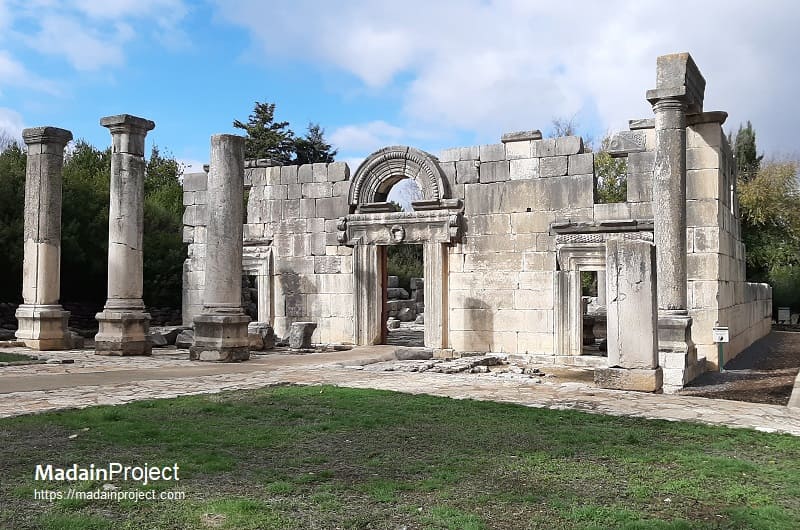
The architecture is similar to that of other synagogues in the Galilee (such as Capernaum Synagogue) built in the Talmudic period. The front entrance of the synagogue has three doorways that face Jerusalem, and had eight columns with Attic bases which supported a porch.
The Kfar Bar’am Synagogue stands among the best-preserved examples of Talmudic-period synagogues in the Galilee. It occupies the site of the former village of Kafr Birʿim, historically known as the Jewish settlement of Kfar Bar’am. Its remains testify to a long-standing Jewish presence in the region during late antiquity. Archaeologists date its original construction to roughly the third century CE, although subsequent modifications and reconstruction occurred in later centuries. Over time, the building fell into ruin; medieval period travelers documented synagogues here, and in the more modern era the site has become part of a national park.
Bar’am itself is today a national park under the Israel Nature and Parks Authority, which maintains the synagogue ruins as a cultural heritage and tourist attraction. The site not only reflects ancient Jewish religious life but also forms part of the layered history of the region, including its later Christian (Maronite) settlement.

Circa 220 CE

Architecturally, the synagogue manifests the so-called “Galilean-type” layout characteristic of many ancient synagogues in the region. Its construction employs finely dressed basalt blocks, giving the building a rugged yet monumental quality. The façade of the synagogue faces south, in the direction of Jerusalem, a ritual orientation common to synagogues of that era.
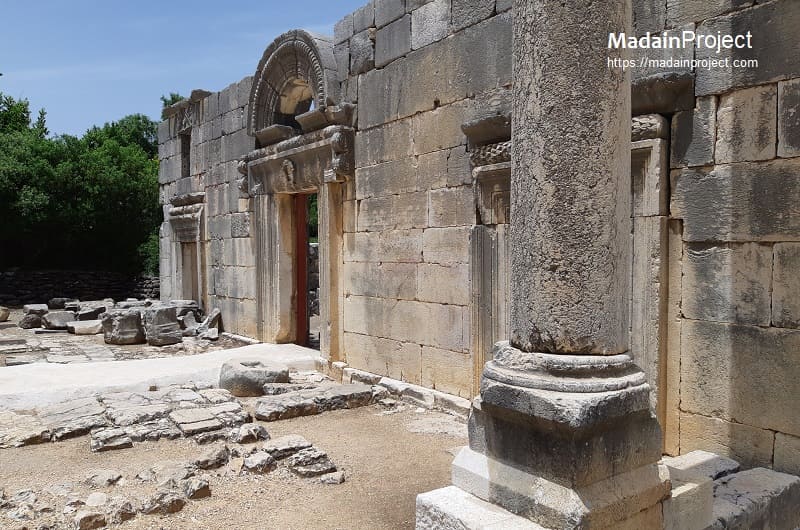
One of its most striking features is the triple-door entrance: three richly carved doorways form the main portal, framed by a covered portico supported by six stone columns. Above the central doorway, a large semicircular window would have admitted light into the interior. Architectural and sculptural decoration is evident: the lintel over the central door once bore a relief of two winged female figures (often identified as Nike, the Greco-Roman figure of Victory) holding a wreath. Later, the winged figures were chipped away, but the wreath remains. Surrounding friezes include grapevine motifs and medallions with putti — motifs reflecting strong Greco-Roman influence.
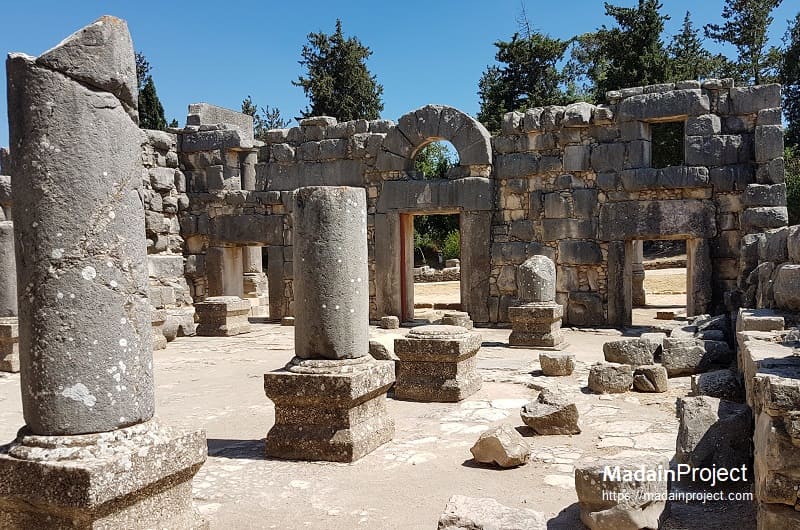
Inside, the prayer hall is divided into three aisles by two rows of columns set on a stylobate; this forms a central nave flanked by side aisles. The interior of the synagogue was divided by rows of columns into three aisles and an ambulatory. The synagogue had a six column portico which is a bit unusual. The Kfar Bar'am synagogue is preserved up to the second story and has been restored. Stone benches line the walls, and in the northwestern corner, archaeologists have identified the remains of a staircase, likely leading to an upper gallery that may have been used for women. Another highly significant internal feature is the so-called “Seat of Moses”: a stone chair, bearing an Aramaic dedicatory inscription, intended for a community elder or teacher.
The synagogue has survived to a remarkable degree, with its southern façade restored to nearly its full two-story height — a rare achievement among ancient synagogues. The reconstruction helps visitors appreciate both the scale and the symmetry of the original design.


Signup for our monthly newsletter / online magazine.
No spam, we promise.

The Madain Project is an online archive of Abrahamic History and Archaeology.
Abrahamic History & Archaeology is the study of history and archaeology with respect to the three Abrahamic Faiths without considering the religious and theological aspects. The goal of Abrahamic History is to understand how and why the religious doctrines and behaviours have evlovled and changed over time. Searching for patterns in the evolution of significant cultural events such as the development of farming, the emergence of cities, or the collapse of major civilizations for clues of why and how these have influenced the three major Abrahamic religions.
Cloud Drive -
About -
Help -
Editorial Policy -
AI Policy -
Privacy Policy -
Contact
Madain Project: Encyclopedia of Abrahamic History & Archaeology.
Copyright MadainProject 2017 - 2026.


