
Ancient Eleutherna was a Cretan polis located on the northwestern slopes of Mount Ida (modern Psiloritis) in central Crete, occupying a strategically defensible ridge that controlled communication routes between the northern coastline and the island’s interior. Established in its historical form during the Early Iron Age, traditionally associated with Dorian settlement in the ninth century BCE, Eleutherna developed into a significant regional center whose political, economic, and religious institutions conformed to the characteristic structures of the Cretan city-state.
One of the most important cities of ancient Crete. According to ancient lexicographers, it was variously named as Satra, Saoros, Aoros and Apollonia. Although familiar to travelers, connoisseurs and archaeologists of past centuries, ancient Eleutherna became known as an exemplary case of Greek systematic excavation, study, conservation, partial restoration, protection.
Continuous excavation by the University of Crete started in 1985 CE and has revealed several thousands square metrs of archaeological deposits in various parts of the site, namely on the hills of ancient Eleutherna (Prines) and the present-day Eleutherna.
Small finds testify to human presence already from the third millennium BCE. The earliest architectural remains date to the Late Bronze Age and have been found on the acropolis of Prines. Continuous occupation of the site is attested from the Early Iron Age through the Geometric, Archaic, Classical, Hellenistic, Roman, Byzantine and partly the Medieval period.
The Early Iron Age (circa 9th to 7th centuries BCE), known mainly through the excavation of the Orthi Petra necropolis, whose finds illustrate vividly the burial customs described by Homer in the Iliad (and also in Odyssey), as for example the cremation of Patroclus. The finds speak of, direct or indirect, contacts with other cretan cities, Attica, the Peloponnese, the Cyclades, the Dodecanese, Asia Minor, Cyprus, the Levant, Egypt and possibly Etruria. Architectural remains include a shrine on the Prines acropolis, a megaron-type building at Katsivelos, a house maybe in Xeniana, more shrines at Nisis and Elleniko, as well as large funerary monuments at the Orthi Petra necopolis.
The Hellenistic period (circa later fourth century to first century BCE), when the city expanded over the hills of Prines and Eleutherna (Nisi). Architectural remains include possible remains of fortifications, walls, a bridge, large retaining-walls, public buildings (shrines etc.) and private dwellings. Finds include works of art, statues and inscriptions (both votive offerings and inter-state treaties).
The Roman period (circa first and second century CE), featuring streets, retaining - walls, luxurious houses, public baths etc. at Katsivelos, the acropolis and Orthi Petra, and the early Christian / Byzantine period (fourth, fifth and sixth centuries CE), featuring basilicas and other public and private buildings (at Katsivelos and the acropolis).
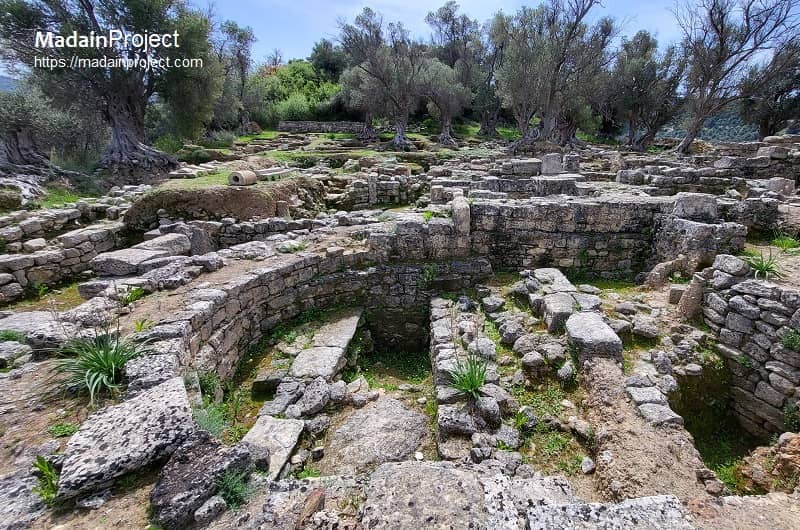
circa 900 BCE- 700/800 CE

Geometric Period
Ancient Eleutherna, situated on the northwestern slopes of Mount Ida in central Crete, emerged as a significant settlement during the Geometric period (circa 900–700 BCE). In the ninth century BCE, in sub-Mycenaean times and within the broader framework of the later Greek Dark Ages, Dorian groups established themselves on a steep, naturally fortified ridge that offered strategic defensive advantages. The site occupied a nodal position in the Cretan landscape: it lay between Kydonia on the northwest coast and Knossos inland, while simultaneously controlling access between the northern shore—through its ports at Stavromenos and Panormos—and the major extra-urban sanctuary at the Idaion Andron near the peak of Ida. This advantageous location made Eleutherna a natural crossroads, facilitating both regional interaction and long-distance exchange.
Archaeological evidence from the necropolis at Orthi Petra indicates a socially stratified community characterized by warrior elites and elaborate funerary practices. Rich cremation burials containing weapons, imported goods, and ornamental objects attest to participation in wider Aegean exchange networks and the consolidation of aristocratic identities. The material culture—particularly pottery styles and burial architecture—demonstrates both continuity with Late Bronze Age traditions and adaptation to emerging Early Iron Age socio-political forms. Eleutherna’s inland yet strategically connected position thus underpinned its development into a regional center during this formative phase of Cretan polis formation.
Archaic Period
During the Archaic period (circa 700–480 BCE), Eleutherna consolidated and institutionalized the foundations laid in the preceding centuries. The Dorian city evolved along lines comparable to other Cretan Dorian poleis such as Lato and Dreros, developing civic and religious structures characteristic of the emergent polis. Epigraphic evidence points to the establishment of formal magistracies and codified legal practices, consistent with broader Cretan constitutional traditions.
The city’s territory appears to have expanded, sustained by the agricultural exploitation of surrounding valleys and the continued control of strategic transit routes linking the coast to the interior and to the Idaean sanctuary. Sanctuaries dedicated to deities such as Apollo, alongside possible local cults, structured a religious landscape that reinforced civic cohesion and collective identity. The presence of imported ceramics and metalwork reflects sustained engagement with eastern Mediterranean trade networks, while architectural remains indicate increasing urban articulation and the material expression of organized civic life.
Classical Period
In the Classical period (circa 480–323 BCE), Eleutherna functioned as an established polis within the competitive and often fragmented political environment of ancient Crete. Literary and epigraphic sources imply intermittent alliances and conflicts with neighboring cities, reflecting the endemic rivalries that characterized Cretan interstate relations. The maintenance of fortified structures underscores the persistent militarization of Cretan society and the strategic importance of defensible urban sites.
Although not among the dominant Cretan powers, Eleutherna retained regional significance, leveraging its strategic position and agricultural base. Civic institutions appear to have matured further, as evidenced by public inscriptions recording decrees and inter-polis agreements. Religious continuity persisted, with sustained cult activity at established sanctuaries, suggesting the resilience of traditional ritual frameworks within an evolving political context.
Hellenistic Period
The Hellenistic period (circa 323–67 BCE) marked both continuity and intensified geopolitical entanglement for Eleutherna. Following the fragmentation of Alexander’s empire, Cretan poleis navigated shifting hegemonies and participated in complex systems of alliance and rivalry. Eleutherna engaged in regional leagues and diplomatic exchanges, as attested by inscriptions documenting treaties and proxeny decrees, while urban development proceeded through infrastructural investments and modifications to public spaces.
A notable episode occurred in 220 BCE, when Eleutherna precipitated the outbreak of the Lyttian War by accusing the Rhodians of assassinating their leader, Timarchus. The Eleuthernans subsequently declared war on Rhodes and became embroiled in the wider Cretan conflict. Initially allied with Knossos and Gortys, they were later compelled by Polyrrhenian pressure to alter their allegiance and join the opposing coalition led by the Macedonian king Philip V. These shifting alliances exemplify the volatility of Hellenistic Cretan politics and the susceptibility of local disputes to broader interstate dynamics. Increasing Roman intervention in the second and first centuries BCE (during the later Roman Republic period) progressively altered the political landscape, foreshadowing the loss of effective autonomy.
Roman Period
Following the Roman conquest of Crete in 68/67 BCE until the 4th century CE, Eleutherna was incorporated into the province of Creta et Cyrenaica. Under Roman administration, the city experienced substantial architectural and urban transformation. The construction of luxurious villas, baths, and other public buildings reflects both the adoption of Roman urban models and the prosperity of the local elite during the Imperial period. Integration into imperial economic systems is further indicated by patterns of imported goods and monetary circulation.
Eleutherna remained a prosperous center until the catastrophic earthquake of 365 CE, which caused widespread destruction across Crete and the eastern Mediterranean. Despite seismic episodes that affected much of the island, occupation persisted into Late Antiquity, accompanied by the gradual Christianization of civic space. The establishment of ecclesiastical structures attests to Eleutherna’s role as an episcopal seat, marking a significant transformation in the city’s institutional and ideological framework.
Early Byzantine Period
In Late Antiquity (4th–7th centuries CE and subsequent period), Eleutherna continued as a Christianized urban center integrated into wider ecclesiastical hierarchies. Bishops are attested at the site, and in the mid-seventh century Bishop Euphratas constructed a large basilica, testifying to organized Christian patronage and sustained urban vitality. Basilicas and associated ecclesiastical architecture structured the transformed sacred topography of the city.
Nevertheless, a combination of destabilizing factors—including earthquakes, economic contraction, and external pressures—contributed to gradual decline. The earthquake of 365 CE had long-term repercussions, and further seismic activity, notably in 796 CE, compounded structural damage. In the later eighth century CE, attacks associated with the campaigns of the caliph Harun al-Rashid, together with the subsequent establishment of Arab rule in Crete, accelerated the abandonment of the site. By this stage, settlement patterns had shifted decisively, and Eleutherna’s prominence waned.
Following the later occupation of the island by the Republic of Venice, a Catholic diocese was established at the site, which survives in titular form within the Roman Catholic ecclesiastical structure. The archaeological remains of Eleutherna thus document a longue durée trajectory extending from the Early Iron Age through Roman prosperity and Christian transformation to eventual medieval abandonment.
circa 1600–1400 BCE
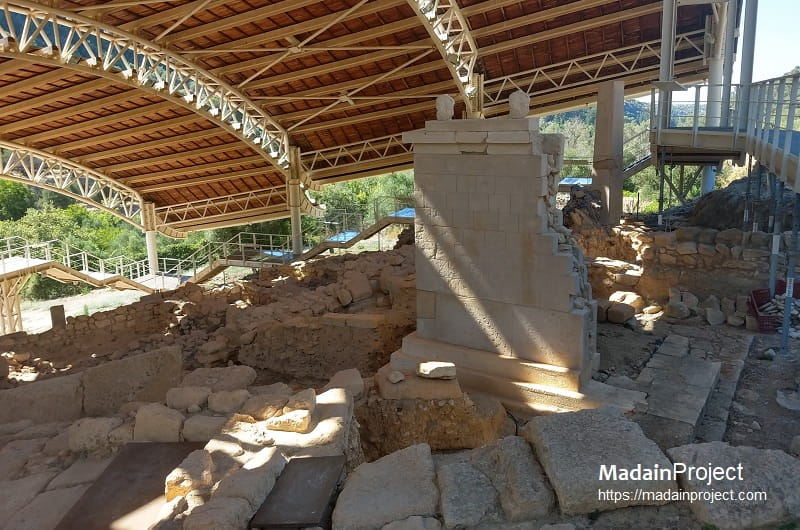
Orthi Petra Necropolis
The Orthi Petra Necropolis, situated on the western slope of the Prines hill within the ancient city of Eleutherna in Crete, represents a critical archaeological palimpsest of funerary practices dating from the Late Protogeometric to the early Archaic periods (circa 870/850–600 BCE). Systematically excavated by Professor Nicholas Stampolidis and the University of Crete over three decades, the site provides unprecedented material evidence that corroborates Homeric descriptions of Iron Age burial rituals, most notably the "Homeric pyres".
The necropolis exhibits a diverse range of burial customs, including simple inhumations, pithos burials, and elaborate cremations; the latter are frequently associated with high-status male "warrior-princes" and are accompanied by rich grave goods such as bronze vessels, gold jewelry, and weapons. Significant discoveries include "Tomb A1K1," containing the remains of over 140 individuals, and "Building M," which housed four related females of high social and priestly standing. These findings, characterized by an abundance of exotic artifacts from the Near East and Egypt, illustrate Eleutherna's role as a wealthy, extroverted society deeply integrated into Mediterranean trade networks during the "Dark Ages" of Greece.
Signup for our monthly newsletter / online magazine.
No spam, we promise.

The Madain Project is an online archive of Abrahamic History and Archaeology.
Abrahamic History & Archaeology is the study of history and archaeology with respect to the three Abrahamic Faiths without considering the religious and theological aspects. The goal of Abrahamic History is to understand how and why the religious doctrines and behaviours have evlovled and changed over time. Searching for patterns in the evolution of significant cultural events such as the development of farming, the emergence of cities, or the collapse of major civilizations for clues of why and how these have influenced the three major Abrahamic religions.
Cloud Drive -
About -
Help -
Editorial Policy -
AI Policy -
Privacy Policy -
Contact
Madain Project: Encyclopedia of Abrahamic History & Archaeology.
Copyright MadainProject 2017 - 2026.


