
The Orthi Petra Necropolis is a significant archaeological burial site located on the western slope of the hill of ancient Eleutherna in central Crete, present day Greece. Dating primarily from the Geometric and Archaic periods (circa 9th–6th centuries BCE), the site serves as a critical record of the social hierarchies, funerary customs, and interregional connections of the Greek Dark Ages. Excavated extensively by Professor Nicholas Stampolidis and the University of Crete, the necropolis is renowned for its diverse burial practices, which include pithos burials, rock-cut tombs, and elaborate pyre cremations.
Notably, the site gained international scholarly attention for its "warrior burials" and the discovery of a cenotaph, which provide physical correlates to the funerary rites described in Homeric epic, such as the Iliadic description of Patroclus’ funeral. The presence of high-status grave goods—ranging from Near Eastern faïence and Phoenician glass to local ceramics—underscores Eleutherna’s role as a pivotal Mediterranean trade hub during the Early Iron Age.
circa 1600–1400 BCE

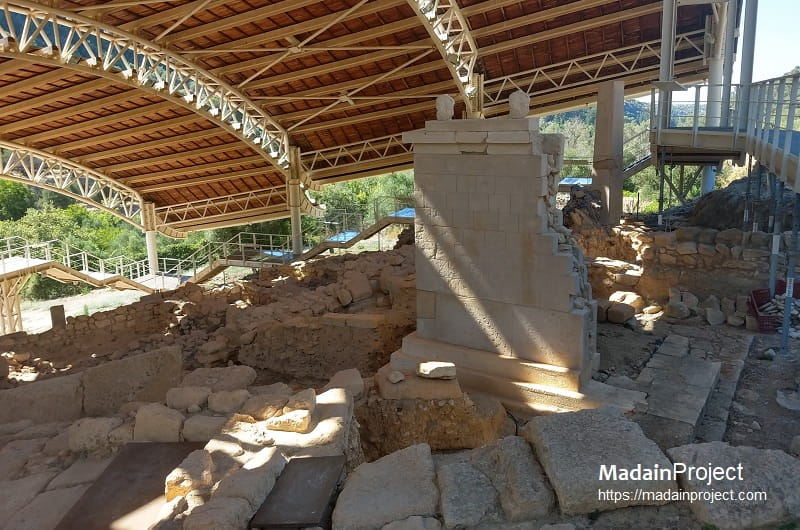
Great Tumulus
A long series of funerary pyres located very close to each other was excavated in the north-east covered part of the cemetery, most of them apparently dating fro the eighth to seventh century BCE. Certainly, these "independent" burial pyres were covered at some point beneath a large elliptical tumulus consisting of small, unworked stones and soil. They lay to the north, west, south, and possibly east of the enormous pedestal of the so-called "Great pillar" (Orthi Petra).
These independent burial pyres were cremations carried out at a specific spot on the ground, not in a pit. Their remains (charred wood and bones, and a variety of grave offerings) stayed in sity, as did the ash urn, which was usually placed at the pyre's edge before a tumulus of earth and rubble concealed everything. They are independent of isolated but not individual, since some were used for more than one body simultaneously.
These funerary pyres, which were ignited directly on the ground with or without the use of mud bricks or unworked stones to facilitate the burning, come very close to the description of burial practices in the verses of Homer, especially in the Iliad; a wooden structure consisting of tree trunks, logs, and dry branches was raised, on which the body (or possibly multiple bodies), in most cases of adults, was placed together with a large number of offerings; large and small vases, both plain and decorated, usually containing offerings of liquid or dry foods (possibly oil, wine, honey, olives, corn, barley, grapes, figs, pomegranates, meat etc.), tools, weapons, jewellery and sometimes animals. It is difficult to say whether the latter were offerings to the deceased of the remains of funeral banquets eaten by those who attended the burial ceremony. The fire usually reached 800-1000 degree C and as Homer tells us, consumed men, animals and objects. After the fire was extinguished, the deceased;s burnt remains were carefully collected, washed, sometimes perfumed, and placed in ash urns, themouths of which were covered with ceramic or bronze vases. These were then sually placed at the edge of the funeral pyre's remnants, after which a tumulus of earth and stone was raised to cover all of the remains. Burnt offerings from memorial services are often found on the tumulus or at its edge, as are pillars or stelae, which served as grave markers.
In the case of Eleutherna's funerary pyres, both the plain and more complex tumulus types have been noted. In the case of the latter the "molten" earth and rubble of the plain tumulus is essentially given a form with bricks around it, like a grave, on top of which small and large rivr pebbles were sometimes placed, either irregularly or arranged more carefully in a variety of shapes. In other cases a built stone structure, a kind of funerary monument, was created around and above the pyre. On the north and west edges of the tumulus, and at certain points above it, jar burials and ordinary internments were placed, partially disturbing its stratigraphy.
circa 650 BCE
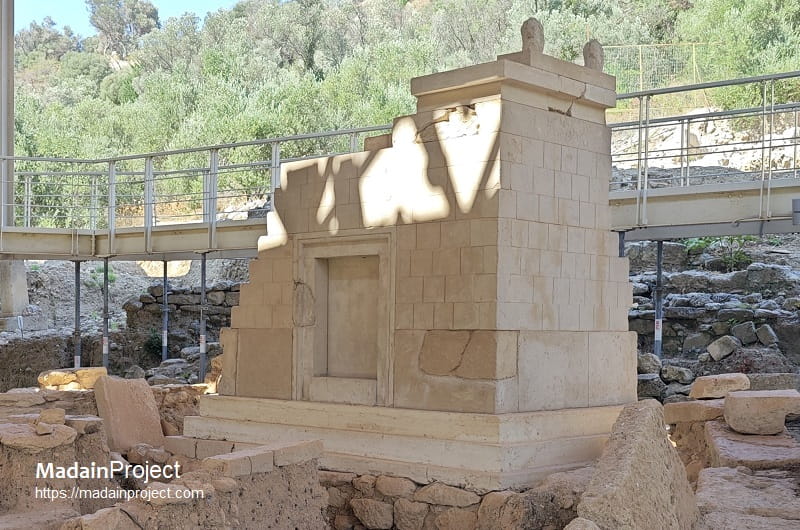
Funerary Monument 4A
Funerary monument 4A, in the middle of the site, is a fairly large masonry structure with a relatively square floor-plan bounded by an enclosure wall on the north, west and south. The lower foundations of the monument, which consist of unworked stones, are fairly strong, and support euthynteria rest at least two limestone orthostates, above which rise stone walls. Based on a series of observations relating to the structure, on fragments of plain and relief architectural elements discovered during excavation, and on stone warriors carrying shields, which were discoveredon its euthynteria and in the surrounding areas, an attemplt was made to reconstruct the western and southern sides using new materials that imitate the ancient finds, in order to give visitors an idea of the overall structure as it may have stood during the antiquity. The west wall of the enclosure of the monument bears traces of funeral pyres on its outer facade, lit on the orthostates of the courtyard of crematorium A, which are dated to about the middle of the seventh century BCE (circa 650 BCE), and this date, therefore, appears to form the terminus ante quem for the monument.
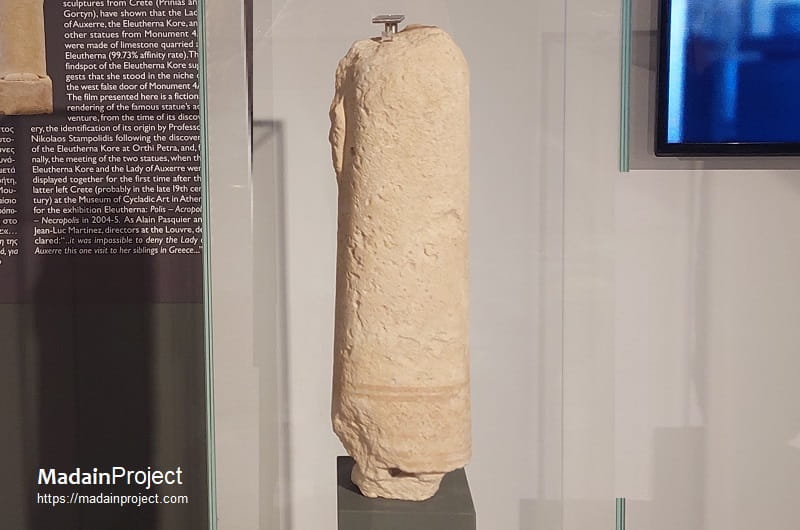
The area to the west of the euthynteria of the monument has yielded the bottom part of a kore (inspect) dating back to proto-archaic/daidalic period, while the legs of an Archaic period kouros were discovered broken and thrown inside the monument, probably when the site was tidied after it had been plundered. The kore, which retains several diagnostic features, calls to mind a masterpiece, the so-called "Lady of Auxerre" a famous statue in Daidalic style now in the Louvre Museum in Paris, which comes from ancient Crete and most probably from Eleutherna itself, as indicated by recent macroscopic, microscopic and petrological analysis as well as stylistic studies. The kore may have been placed in the niche of the west flase door of the monument 4A.
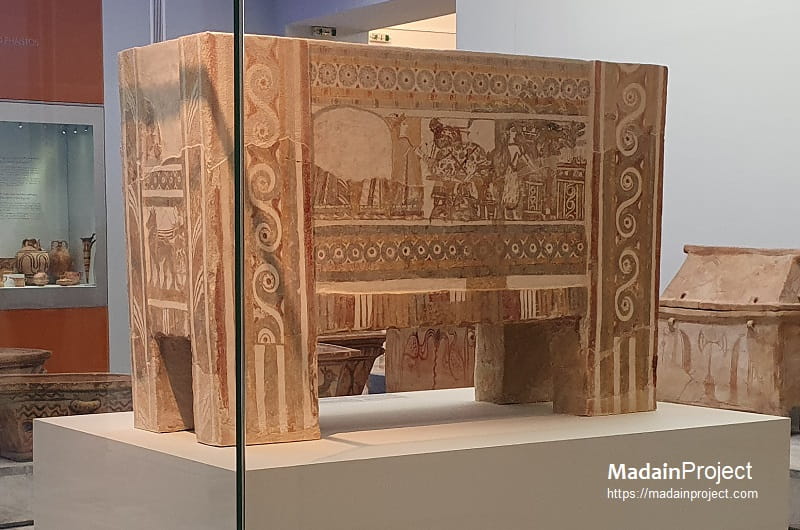
The entire monument reminds of much earlier funerary buildings of the Late Minoan Period, such as the one depicted on the famous AyiaTriada sarcophagus (inspect), now displayed in the Heraklion Museum.
During the excavation no traces of bones were found inside the monument, which points to its probably use as a cenotaph, a sanctuary or a heroon. The warriors carryng shields at the top of the building structure appear to have been its speaking symbols and are probably a reference to the shield bearing Kouretes, who clased their bronze shields together in front of the cave on Mount Ida (Psiloreitis) so that Kronos would not hear the crying of the newly born Zeus and devour him. These warriors will have served as models of military virtue and bravery for the young of the city-state of ancient Eleutherna. according to the ancient authors, indeed it is to one of these, Eleuther, that Eleutherna itself owes its foundation and its name. If this heroon-sanctuary is interpreted as a cenotaph, then, it is one of the earliest monuments to the unknown warrior in world history.
circa 550 BCE
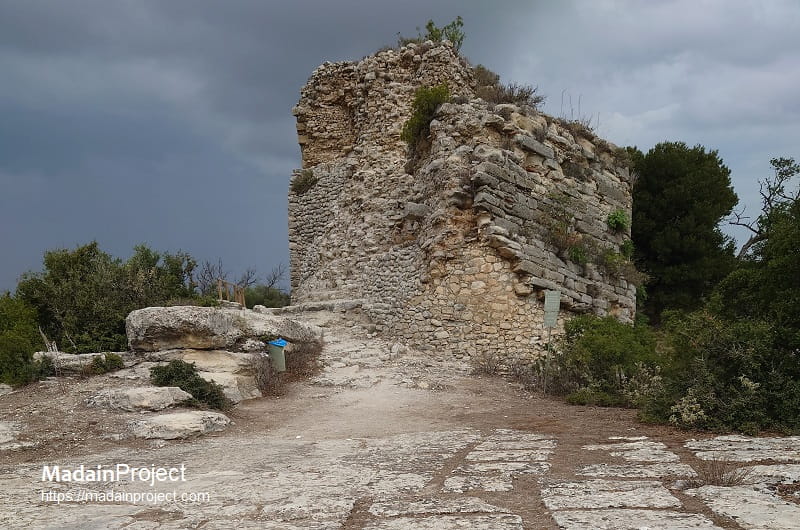
Funerary Monuments K, 3K, 4K and 5K
Funerary enclosures are structures made of rougnly cut or dressed stones that surround an area with one or more burials or cremations. It is often difficult to determine whether the wall was built to enclose a vurial, or cremation, or to define a place for the related burial practice to be carried out.
Building K: North of incinerator A is pi-shaped structure (measuring approx. 2.30 x 4.40 meters), which uses the outer surgace of the incinerator's well built north wall as its south boundary. The structure is built of relatively large unworked stones, Charcoal, pottery, fragments broken clay vases, fragments of bronze enclosures. Certainly, no traces of frequent cremations flames were noted on the outer surface of the incinerator;s north wall, and this may argue for building K being a rubbish pit or ancillary room for the crematorium A.
Structures 3K, 4K and 5K: The structure 3K (west) sits above a series of funeral pyres, while 4K (east) rests on the earthen deposits, sherds and small unworked stones. The foundations of both buildings were built with large and small stones up to a certain height. Above and around the last course of the foundations a two or three stepped stone structure was created, the part that has survived in the middle of the east wall of the structure 4K, consisting of well-dressed stones on which probably orthostates and/or walls rested. The small finds recovered during excavations in the buildings (sculptural gragments such as part of a bird's tail, part of a frieze, wings of daemonic figures, etc) give us an idea of their sculpted decorations. It is difficult to reconstruct them, however, since we do not have enough material and lack the details of their superstructure. It is conceivable that the upper pat of a Daidalic figure, known as the torso of Eleutherma, now on display in the Heraklion Archaeological Museum, was most probably seated on one of them. They were probably either funerary buildings or raised pedestals over funerary pyres for sculptural groups, and appear to have been later in date than both monument 4A (south), and the Orthi Petra (north).
Finally, these appears to be another similar structure, structure 5K, at a higher level than the others, to the east of 4K. This may be the latest in date, circa sixth century BCE.
Signup for our monthly newsletter / online magazine.
No spam, we promise.

The Madain Project is an online archive of Abrahamic History and Archaeology.
Abrahamic History & Archaeology is the study of history and archaeology with respect to the three Abrahamic Faiths without considering the religious and theological aspects. The goal of Abrahamic History is to understand how and why the religious doctrines and behaviours have evlovled and changed over time. Searching for patterns in the evolution of significant cultural events such as the development of farming, the emergence of cities, or the collapse of major civilizations for clues of why and how these have influenced the three major Abrahamic religions.
Cloud Drive -
About -
Help -
Editorial Policy -
AI Policy -
Privacy Policy -
Contact
Madain Project: Encyclopedia of Abrahamic History & Archaeology.
Copyright MadainProject 2017 - 2026.


