
The “Tomb of Joshua” (مقام يوشع بن نون) to a site that is traditionally identified as the burial place of the biblical figure Joshua bin Nun (Hebrew: Yehoshua ben Nun) — the Israelite leader who succeeded Moses and is credited in the Hebrew Bible with incursion into the land of Canaan (see Joshua 24:30) — as well as in various Islamic and local traditions referred to as Yūshaʿ ibn Nūn. These sites are not universally corroborated archaeologically and multiple competing locations exist, each bearing cultural, religious and historical significance.
In the Hebrew Bible, Joshua is depicted as Moses’ successor and the conqueror of ancient Canaan, dying at the age of 110 and buried “in the border of his inheritance in Timnath-serah, in the hill country of Ephraim, north of Mount Gaash”. From this scriptural reference, numerous traditions have developed to locate his tomb. Among Jewish traditions, the site has often been identified with the region of Timnath-serah (or Timnath-heres), though the precise archaeological location remains uncertain. In Islam, Joshua (Yūshaʿ) is also revered as a prophet, and various maqāms (shrines) have been established in his name.
The multiplicity of these tombs reflects both the diffusion of Joshua’s cult and the ambiguity of ancient geographical references. Over time, Jewish, Samaritan, Christian, and Muslim traditions localized Joshua’s memory in places that acquired their own devotional and political significance. Whether or not any site corresponds to the historical figure’s actual burial place, each stands as a record of how different communities have anchored sacred memory within their own topographical and theological frameworks.

Judaic Traditions
In Jewish tradition, Joshua (Yehoshuaʿ ben Nun) is a central biblical figure — the successor of Moses and the leader who brought the Israelites into Canaan. His tomb is mentioned not in the Hebrew Bible itself but in later rabbinic and historical tradition. According to Joshua 24:30 and Judges 2:9, Joshua was buried “in the territory of his inheritance at Timnath-Serah (or Timnath-Heres) in the hill country of Ephraim, north of Mount Gaash.” This site has been identified since antiquity with an area near Kifl Hares, close to Nablus (Shechem) in the West Bank.
Jewish, Samaritan, and later Christian pilgrims during the Byzantine and Crusader periods consistently identified that Kifl Hares location as Joshua’s burial place. Pilgrims’ accounts from the 12th to 19th centuries mention visiting the “Tomb of Joshua” near Nablus, usually accompanied by local Jewish and Muslim caretakers. That tradition remains extant today in Judaism and Samaritanism.
There is no reference in Jewish sources—biblical, rabbinic, or medieval—to a tomb of Joshua in the Transjordan, nor specifically in as-Salt or Balqa. The as-Salt maqām is therefore not a site of Jewish veneration, nor is it connected with the biblical or Talmudic tradition geographically or textually. The Jewish cultic geography of Joshua remains fixed on the western side of the Jordan, in the territory of Ephraim.
However, the idea of Joshua as a prophet and military leader associated with the Jordan Valley and the conquest of Jericho—events that geographically link both banks of the river—created fertile ground for later Islamic localization of his tomb in the east, within the lands of present-day Jordan.
Islamic Traditions
In Islamic tradition, Yushaʿ bin Nun—known in English as Joshua—is recognized as a prophet and the immediate successor to Musa (Moses). Although the Qurʾān does not mention Yushaʿ by name, classical exegetes and hadith scholars identify him with the youthful servant of Moses who accompanies him in the narrative of Surat al-Kahf (18:60–65). This companion, who remains unnamed in the text, was understood by commentators such as al-Tabari, al-Qurtubi, and Ibn Kathir to be Yushaʿ bin Nun, the faithful disciple destined to lead the Israelites into the Holy Land after Moses’s death. In Islamic prophetic historiography, Yushaʿ occupies the transitional position between the Mosaic mission and the establishment of the Israelites in Canaan, and is therefore honored as both a prophet and a righteous commander.
The veneration of Yushaʿ within Islam extends beyond textual exegesis to a complex landscape of devotional sites. Because his prophetic activity is associated with the crossing of the Jordan River and the conquest of Jericho, Muslim tradition localized his memory on both sides of the river. Over centuries, this produced several sites in the Levant that came to be regarded as his resting place. The multiplicity of these shrines reflects the broader pattern of Islamic sacred geography, in which the memory of prophets and saints is embedded within local landscapes through oral tradition and pious visitation.
The site of Maqam Nabi Yushaʿ in as-Salt belongs to this Islamic pattern of localization rather than to any earlier biblical or Jewish precedent. Its emergence as a shrine appears to have taken shape during the late Mamluk or early Ottoman period, when the Balqa region was integrated more firmly into the networks of Islamic settlement and pilgrimage. As-Salt, situated in the highlands east of the Jordan Valley, became a natural center for the commemoration of prophets connected with the Exodus narrative. In the same region, the maqām of Shuʿayb (Jethro) and the maqām of Ayyub (Job) also became well-known pilgrimage sites, indicating the development of a regional devotional topography linking the prophets of the Hebrew and Qurʾānic traditions to the land of Jordan.
The attribution of a tomb of Yushaʿ to as-Salt is best understood as part of this expansion of Islamic sacred geography. The story of Yushaʿ’s leadership after Moses and his conquest of Jericho, situated geographically near the Jordan River, lent symbolic weight to the notion that his burial might lie somewhere in the eastern highlands overlooking the valley. Oral tradition and local piety likely crystallized around a pre-existing grave or small sanctuary, which was gradually reinterpreted as the resting place of the prophet. By the Ottoman era, travelers and local chroniclers referred to a “maqām al-nabī Yushaʿ” known to the inhabitants of Balqa, suggesting that the site’s sanctity was already well established.
Within Islamic devotional life, such maqāmāt serve not only as memorials to prophets but as points of spiritual intercession and reflection. Pilgrims visit the Maqam Nabi Yushaʿ to recite Fātiḥa, seek blessings, and remember the prophetic continuity between Moses and his successor. The shrine’s persistence across centuries illustrates how Islamic tradition extends the prophetic narrative into tangible geography, allowing believers to inhabit the sacred history through place. In modern Jordan, the maqām continues to function within this living tradition, its religious importance sustained by the convergence of popular devotion, state preservation, and the enduring resonance of Yushaʿ bin Nun within the Islamic prophetic lineage.
circa 1200 CE
Grave of Yusha bin Nun (Baghdad)
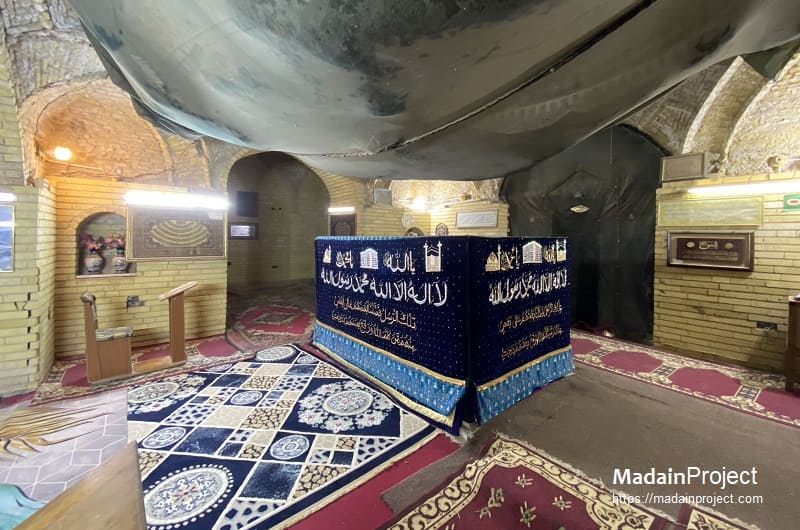
The site, earlist mentioned circa 1200 CE as a Sufi pilgrimage site, in Baghdad attributed to Yūshaʿ ibn Nūn (Joshua bin Nun) is a vaulted brick shrine said by local tradition to contain the prophet’s tomb. According to this tradition, the site features a large rectangular sand-wood coffined burial covered in richly embroidered textiles, and is entered through a low doorway into a domed chamber. The belief in this attribution has no corroborated archaeological foundation and is classified by some scholars as a “secondary” grade shrine within the broader corpus of multiple claimed tomb-sites of Yūshaʿ.
Nonetheless, the Baghdad site has functioned as a locus of devotion for Sunni and Sufi pilgrims for more than twelve centuries, reflecting how prophetic memory was embedded in the urban religious geography of Abbasid Baghdad. An example of this is the citation that a sun-emblem and the name “Joshua bin Nun” were once inscribed on the original walls of the shrine, linking the local narrative to the biblical motif of Joshua commanding the sun to stand still. The site therefore epitomises the complex layering of textual, legendary and devotional elements that characterise the many tomb-traditions associated with Joshua.
circa 1213–1214 CE
Tomb of Joshua (Kifl Haris, Israel/Palestine)
The "Tomb of Joshua" is a deeply significant and historically contested site located in the Palestinian village of Kifl Haris in the northern West Bank, near Nablus. According to biblical tradition, Joshua was buried in Timnath-serah in the hill country of Ephraim (Joshua 24:30), a location that some Jewish and Samaritan traditions identify with modern Kifl Haris. However, archaeological evidence remains inconclusive, and ongoing excavations at the nearby site of Khirbet Tibnah offer an alternative possible location.
The traditional "Tomb of Joshua" in Kifl Haris, a Palestinian village in the West Bank, is primarily associated with the Islamic shrine built by Sultan Saladin in the 13th century CE. Known to Muslims as the Maqam of Yusha' ibn Nun, this structure was built during the Ayyubid period, specifically around 1213–1214 CE. A wall plaque at the site mentions Jawhar bin Abdullah, a servant of the shrine, who made a pilgrimage on behalf of his master, Najm al-Din Ayyub.
The current mausoleum in Kifl Haris is an Islamic shrine, built by Sultan Saladin in the 13th century and known to Muslims as the Maqam of Yusha' ibn Nun (Shrine of Joshua, son of Nun). However, the tradition associating the site with the biblical Joshua dates back much earlier. This shared yet contested claim to the site by both faiths has made it a flashpoint of political and religious tension. After the 1967 Six-Day War, Jewish pilgrimage to the tomb increased, with organized visits taking place under Israeli military escort, particularly on the anniversary of Joshua's death. These visits, and the site's symbolic importance to Jewish heritage, have repeatedly clashed with Palestinian aspirations, leading to incidents of vandalism and violence.
The tomb's complex history thus reflects the broader conflict over religious sites in the West Bank, where spiritual veneration is inextricably linked with national identity and political narratives.
circa 1500 CE
Maqām Nabī Yūshaʿ (As-Salt, Jordan)
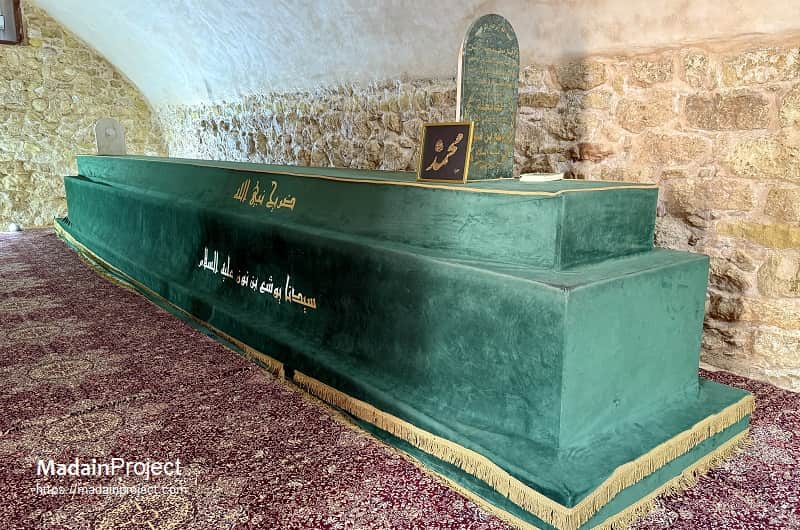
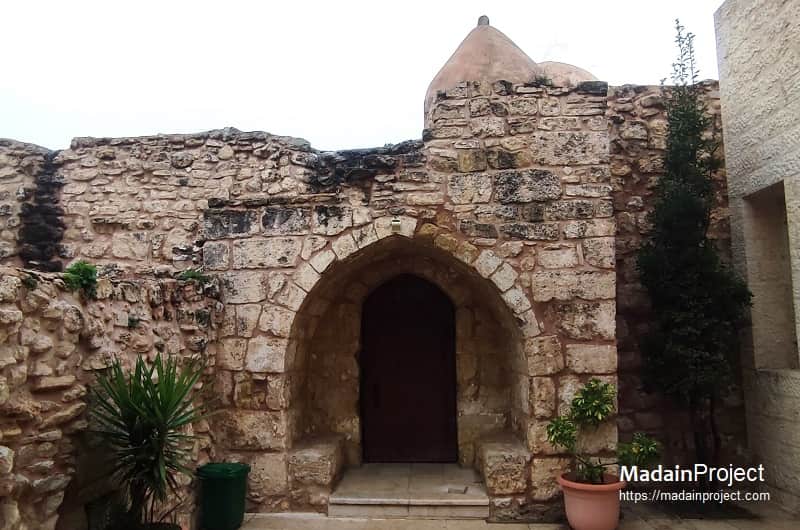
In the Jordanian city of as-Salt lies a shrine known as Maqām an-Nabī Yūshaʿ, believed by local tradition to contain the tomb of Joshua. The complex, originally established during the late Mamluk or early Ottoman period, consists of a rectangular mausoleum with a cenotaph over six metres in length, covered by a green cloth and surrounded by a modern mosque completed in 2004.
The site functions as an active place of worship and local pilgrimage. Though uncorroborated by biblical or archaeological evidence, its veneration as Joshua’s resting place demonstrates the integration of Yūshaʿ within Islamic prophetic lineage, particularly in the Jordan Valley region historically associated with the Israelite entry into the historic region of Canaan. The surrounding cemetery reflects the practice of burial near a prophet’s maqām, underscoring the continuing spiritual authority ascribed to Joshua within Islamic tradition.
The as-Salt site does not derive from any textual Judaic source but from an indigenous Islamic reinterpretation of sacred landscape, where prophets associated with the Exodus narrative are commemorated on both banks of the Jordan. In this sense, the maqām represents an Islamic continuation and re-territorialization of a prophetic figure shared with earlier monotheistic faiths, framed within Jordan’s Islamic historical consciousness.
circa 1750 CE
Al-Nabi Yūshaʿ (Upper Galilee)
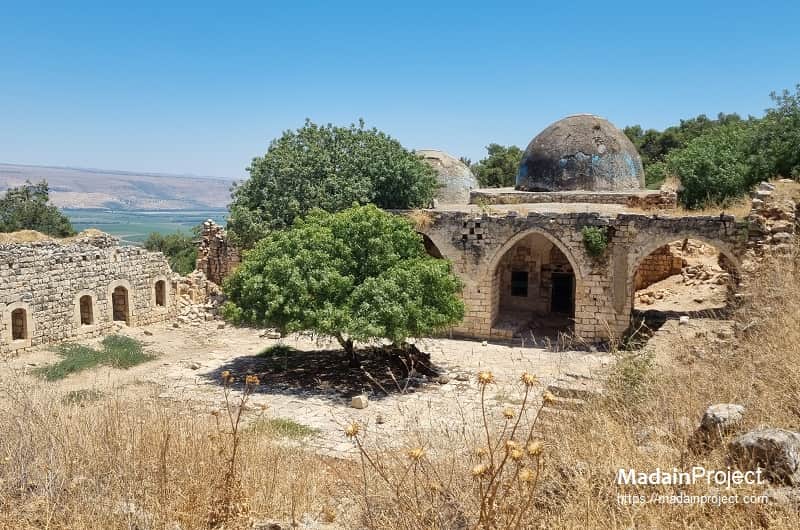
The former Palestinian village of al-Nabi Yūshaʿ, situated in the Upper Galilee, contained a maqam and Shiʿite mosque dedicated to Joshua. The structure, founded in the 18th century CE by a local family, on an earlier undated shrine, included a domed chamber and courtyard typical of rural Galilean maqāms. During the British Mandate, an annual festival was held at the site, attracting Shiʿite pilgrims from southern Lebanon and the surrounding areas. After 1948 CE, the village was depopulated and the inhabitants expelled, and the shrine fell into partial ruin.
Architecturally, it offers evidence of the regional proliferation of prophet-tombs and their role in sustaining communal identity and ritual life among local Muslim populations. In this case, Joshua’s identity merges with the broader veneration of warrior-saints, illustrating the cultural flexibility with which prophetic memory is localized.
circa 1755 CE
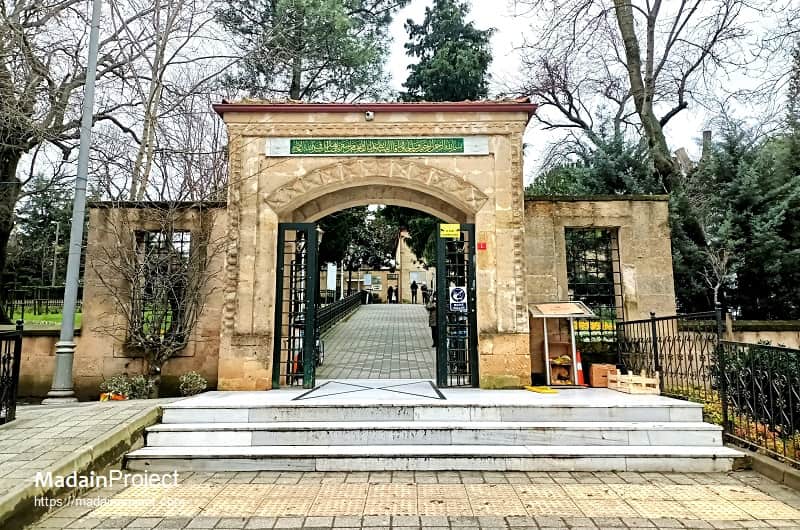
Joshua’s Hill (Yuşa Tepesi, Istanbul, Turkey)
On the Asian side of Istanbul, in the Beykoz district overlooking the Bosphorus, stands Yuşa Tepesi — “Joshua’s Hill”. The site features a mosque and a long earthen grave enclosure measuring approximately 17 metres, venerated as the resting place of the prophet Yūshaʿ. The shrine’s origins trace to Ottoman devotional practices; the first mosque was erected in 1755 by Grand Vizier Mehmed Said Pasha and later rebuilt after a fire in 1863 CE. Local legend attributes the rediscovery of the grave to the 16th-century mystic Yahya Efendi, who, according to tradition, identified it through divine inspiration.
Although geographically far removed from the biblical landscape, the site illustrates how prophetic veneration was assimilated into Ottoman-Turkish religious geography. Scholars generally consider the Istanbul site to represent symbolic rather than historical association, part of a wider pattern in which revered prophets were given multiple memorial loci across the Islamic world.
Signup for our monthly newsletter / online magazine.
No spam, we promise.

The Madain Project is an online archive of Abrahamic History and Archaeology.
Abrahamic History & Archaeology is the study of history and archaeology with respect to the three Abrahamic Faiths without considering the religious and theological aspects. The goal of Abrahamic History is to understand how and why the religious doctrines and behaviours have evlovled and changed over time. Searching for patterns in the evolution of significant cultural events such as the development of farming, the emergence of cities, or the collapse of major civilizations for clues of why and how these have influenced the three major Abrahamic religions.
Cloud Drive -
About -
Help -
Editorial Policy -
AI Policy -
Privacy Policy -
Contact
Madain Project: Encyclopedia of Abrahamic History & Archaeology.
Copyright MadainProject 2017 - 2026.


