
The so-called Sennedjem Collection or the "Sennedjem’s burial goods collection" is a collection of funerary items, preserved and displayed at the National Museum of Egyptian Civilization, among other places. It comprises a remarkably well-preserved set of funerary goods from the tomb TT1 of Sennedjem, a craftsman who served in the village of Deir el-Medina during the reigns of Seti I and Ramesses II in the New Kingdom (19th Dynasty, circa 1295–1186 BCE).
Transferred in 2019 from the Egyptian Museum in Tahrir Square to the National Museum of Egyptian Civilization, the collection features Sennedjem’s painted anthropoid coffin and mummy board adorned with vivid scenes of protective goddesses and passages from the Book of the Dead, alongside canopic boxes, shabti figures inscribed with Chapter 6 of the Book of the Dead, furniture, cosmetic chests, and ostraca, including a fragment of the Story of Sinuhe. The inscriptions name Sennedjem’s relatives—Paramnekhu, Khonsu, Khabekhnet, Iyneferti, and Mose—highlighting the domestic character of the assemblage. Together, these items offer scholars and visitors a direct, material link to New Kingdom funerary beliefs, artisanal skill, and familial piety, making the Sennedjem Collection a vital component of the NMEC’s broader narrative of Egyptian mortuary practice.
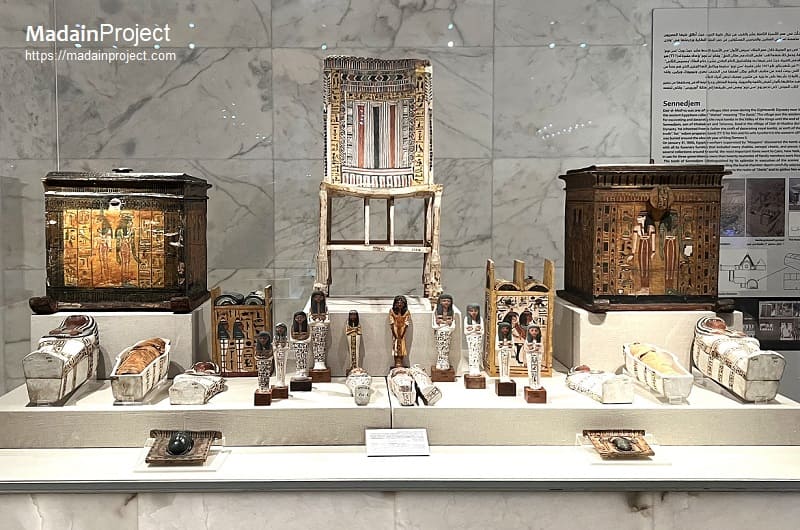
circa 1280 BCE
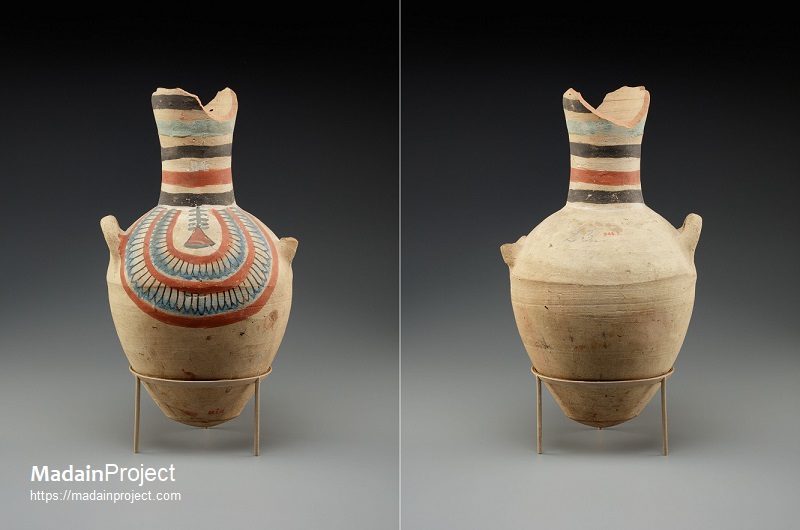
Painted Jar (A)
This painted pottery jar, attributed to the New Kingdom's 19th Dynasty, specifically the Ramesside Period under the reign of Ramesses II, possibly served as a wine vessel and was discovered within the tomb of the artisan Sennedjem (TT 1) at Deir el-Medina, a worker’s village on the west bank of ancient Thebes (modern-day Luxor). The tomb was unearthed during the Egyptian Antiquities Service excavations led by Gaston Maspero in 1885–86 CE.
Crafted from pottery and finished with painted decoration, the jar reflects the utilitarian yet artistically refined ceramic traditions of elite burials during this period. Its physical dimensions—29.3 cm in height, 17 cm in width including the handles, and 15.5 cm in diameter—suggest a moderately sized container, likely intended for funerary provisioning. The presence of wine jars in such contexts was part of the broader ritual practice of supplying the deceased with necessities for the afterlife.
This jar is now housed in The Metropolitan Museum of Art, where it serves as a tangible representation of daily life and funerary customs among the working-class elite of Deir el-Medina, a community known for producing the tombs of Egypt’s New Kingdom pharaohs.
circa 1280 BCE
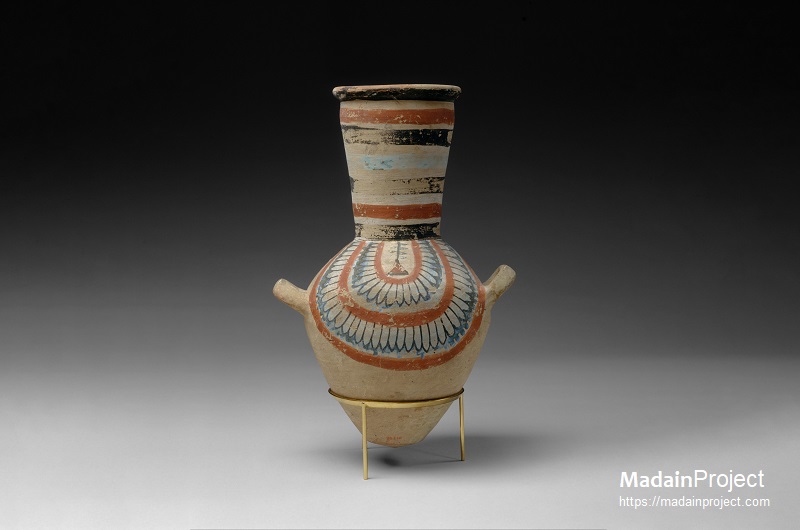
Painted Jar (B)
This wine jar, dating to the 19th Dynasty of ancient Egypt’s New Kingdom, specifically the Ramesside Period under the reign of Ramesses II, was discovered within the tomb of Sennedjem (TT 1) at Deir el-Medina, a necropolis reserved for the royal tomb artisans of Thebes. The jar was excavated by the Egyptian Antiquities Service under Gaston Maspero during the 1885–86 campaign.
Manufactured from painted red pottery, this vessel exhibits the characteristic craftsmanship of utilitarian ceramic wares included among funerary provisions. Its dimensions—30.5 cm in height and 16 cm in width—indicate its capacity to store wine, a commodity frequently associated with sustenance and ritual offerings for the deceased in the afterlife.
The presence of this jar in Sennedjem’s tomb underscores the importance of wine both as a daily luxury and as a symbolic provision within mortuary ideology. Its red-painted surface may reflect stylistic preferences or functional markings, commonly found among votive or domestic ceramics of the period.
Now housed in The Metropolitan Museum of Art, the jar (local identifier 544702) offers insights into the material culture of Deir el-Medina's skilled artisan class, as well as the ritual economy of New Kingdom burial practices.
circa 1280 BCE
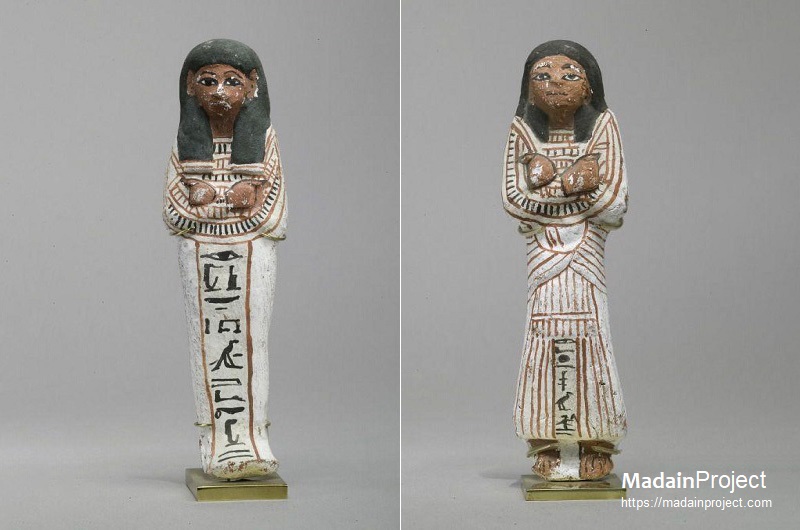
Shabtis of Tamaket and Khonsu
These two painted pottery shabtis, one belonging to Tamaket and the other to Khonsu, were excavated from the tomb of Sennedjem (TT1) at Deir el-Medina, Thebes, during the 1885–86 Egyptian Antiquities Service excavations led by Gaston Maspero. Both date to the 19th Dynasty of the New Kingdom, under the reign of Ramesses II, and are now housed in The Metropolitan Museum of Art.
Shabtis (also spelled ushabtis or shawabtis) were small funerary figurines placed in tombs to perform agricultural or ritual labor on behalf of the deceased in the afterlife, as prescribed in spells from the Book of the Dead. Their inclusion in tombs reflected a broader belief in a productive afterlife and a continued need for service and provision.
The Shabti of Tamaket measures 18.2 cm in height, 5.3 cm in width, and 3.6 cm in depth (7 3/16 × 2 1/16 × 1 7/16 in.). Fashioned from pottery and decorated with paint, this figure likely belonged to a female member of Sennedjem’s family or household, possibly a relative or wife.
The Shabti of Khonsu, slightly smaller at 17.7 cm in height (6 15/16 in.), is similarly constructed from painted pottery. Khonsu is known to have been one of Sennedjem’s sons, and this figurine would have served as his symbolic laborer in the Field of Reeds.
Both figures reflect the standardized style of Ramesside-period shabtis, with arms crossed over the chest and inscriptions (now often faded) designating the name of the owner and sometimes a version of the shabti spell. As artifacts, they offer direct insight into the mortuary customs of Deir el-Medina’s artisan class, a community responsible for crafting the royal tombs in the Valley of the Kings.
Together, these shabtis not only illustrate the spiritual beliefs of ancient Egyptian craftsmen but also embody the personal devotion of a family that prepared carefully for their eternal journey beyond death.
circa 1280 BCE
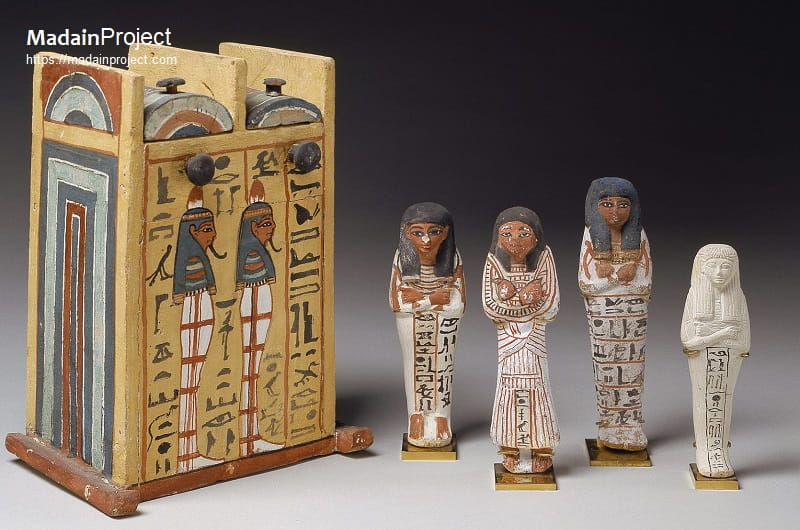
Ushabti
Four ushabtis of Sennedjem and his box; 1279-1213 BCE; painted limestone; ushabti height: 16.7 cm; Metropolitan Art Museum. Ushabtis were placed in tombs among grave goods and were intended to act as servants to the deceased.
One of the figures bears an inscription representing a variant of Spell 6 from the Book of the Dead (also known as the Book of Coming Forth by Day). This text enjoins the shabti to act as a substitute for the deceased when called upon to perform labor in the afterlife, including agricultural tasks such as cultivating fields, irrigating land, and transporting materials. In such instances, the figure is instructed to respond, “Here I am,” thereby assuming responsibility for the required work. The remaining examples are inscribed solely with the names of the individuals to whom they were assigned.
The wooden shabti box is inscribed for Paramnekhu, a servant in the Place of Truth (that is, a royal artisan) and a descendant—either son or grandson—of Sennedjem, within whose tomb (TT 1) the box was discovered. The accompanying shabti figures bear inscriptions naming various members of Sennedjem’s family, including his wife Iineferty, his eldest son Khabekhnet, another son Khonsu, an additional figure naming Khabekhnet alone, and a female relative identified as Mose.
Although Khabekhnet and Khonsu possessed a separate tomb complex (TT 2) situated in proximity to their father’s burial, they are nevertheless represented alongside their siblings in the decorative program of Sennedjem’s burial chamber. Furthermore, objects inscribed with their names—including Khonsu’s coffins and mummy—were interred within the family tomb, indicating the continued significance of familial association in funerary practice.

Signup for our monthly newsletter / online magazine.
No spam, we promise.

The Madain Project is an online archive of Abrahamic History and Archaeology.
Abrahamic History & Archaeology is the study of history and archaeology with respect to the three Abrahamic Faiths without considering the religious and theological aspects. The goal of Abrahamic History is to understand how and why the religious doctrines and behaviours have evlovled and changed over time. Searching for patterns in the evolution of significant cultural events such as the development of farming, the emergence of cities, or the collapse of major civilizations for clues of why and how these have influenced the three major Abrahamic religions.
Cloud Drive -
About -
Help -
Editorial Policy -
AI Policy -
Privacy Policy -
Contact
Madain Project: Encyclopedia of Abrahamic History & Archaeology.
Copyright MadainProject 2017 - 2026.


