
The Sabil Bab al-Silsilah (Arabic: سبيل باب السلسلة) is an Ottoman-era public fountain and water distribution structure located near the Bab al-Silsilah gate of the al-Aqsa Mosque compound (Temple Mount) in the Old City of Jerusalem. Serving both a utilitarian function and symbolic role in the historical fabric of the city, the sabil is an important example of Ottoman architectural and urban planning in Jerusalem during the 16th century.
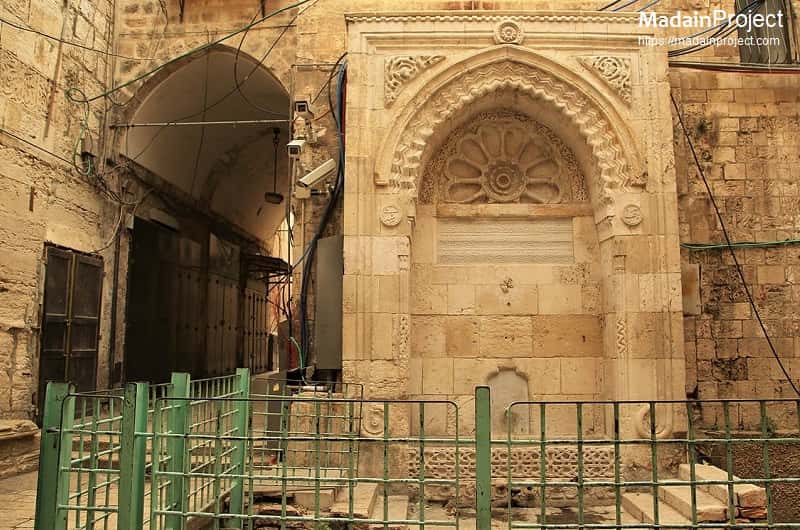
It is one of the sabils (water fountains) built by Sultan Sulayman I in Jerusalem during the 16th century CE. The sabil is of a rectangular shape with a recessed niche framed by a pointed arch. The niche is decorated by a rosette (inspect), taken as a spolia from a crusader rose window. The rosette is cut by the foundation inscription that date the construction to the year of 1537. At the bottom of the niche there is a highly decorated trough (inspect).
It abuts the wall of al-Turba al-Sa'diyya to the west, and faces the square of Bab al-Silsila, standing only 7 meters from the Chain Gate of al-Haram al-Sharif (of the same name). It is considered as one of the most beautiful fountains, because it is decorated with Islamic motifs and high-level architecture. It provided a vital source of drinking water for pilgrims and residents, contributing to the welfare and daily life in the heart of the Old City.
circa

The Sabil Bab al-Silsilah was constructed in 1589 CE during the reign of Sultan Murad III, as part of a larger urban development initiative to improve the infrastructure of Jerusalem under the Ottoman Empire. The city's water systems, including its aqueducts and fountains, were vital to its inhabitants, particularly given the region's arid climate. At the time, the Ottoman authorities were heavily invested in renovating and expanding Jerusalem’s water supply systems to accommodate the growing population and the influx of Muslim, Christian, and Jewish pilgrims.
The sabil was part of a broader program that saw the construction of similar fountains across the city, such as the Sabil Qaitbay near the Jaffa Gate and the Sabil of Sultan Suleiman on the way to the al-Aqsa Mosque. The Ottoman rulers recognized the religious significance of Jerusalem, known to them as al-Quds, and sought to enhance the city’s infrastructure as a reflection of their own power and benevolence, while also providing for the religious needs of its diverse inhabitants. The Sabil Bab al-Silsilah was likely funded by a wealthy patron or as part of a waqf (endowment) designated for public welfare, a common practice in the Islamic world for maintaining religious, educational, and civic facilities.
After the restoration of the monuments in the 19th century CE, the basin was replaced by a royal Ottoman basin, the original moved to the Louvre in Paris in 1866 CE.
circa

Architecturally, Sabil Bab al-Silsilah is a restrained yet refined expression of early Ottoman public fountain design adapted to the dense urban context of the Old City. The plan is essentially rectangular, with a recessed niche framed by a pointed and slightly projecting arch that gives the façade a measured sense of depth and articulation. Within this niche sits a richly decorated trough fed by a tap, originally designed to supply water at an accessible level for passers-by. The niche itself is ornamented with a rosette element that appears to have been reused from an earlier medieval context, possibly a Crusader-period rose window, indicating the practice of spolia in Jerusalem’s built environment.
The stone basin measured approximately 202 cm in length and 25 cm in height; during nineteenth-century restoration the original basin was removed and replaced with an Ottoman royal basin, while the original was transferred to a museum collection in Paris. The dedicatory inscription was originally composed of thirteen lines, though only nine remain legible. Decorative motifs around the niche include classical Ottoman geometric and vegetal patterns, underscored by the sobriety of the sabil’s overall form. This combination of functional clarity and measured ornamentation situates Sabil Bab al-Silsilah within the typological evolution of Ottoman public fountains, where practical utility and aesthetic representation coalesce in a civic monument.


Signup for our monthly newsletter / online magazine.
No spam, we promise.

The Madain Project is an online archive of Abrahamic History and Archaeology.
Abrahamic History & Archaeology is the study of history and archaeology with respect to the three Abrahamic Faiths without considering the religious and theological aspects. The goal of Abrahamic History is to understand how and why the religious doctrines and behaviours have evlovled and changed over time. Searching for patterns in the evolution of significant cultural events such as the development of farming, the emergence of cities, or the collapse of major civilizations for clues of why and how these have influenced the three major Abrahamic religions.
Cloud Drive -
About -
Help -
Editorial Policy -
AI Policy -
Privacy Policy -
Contact
Madain Project: Encyclopedia of Abrahamic History & Archaeology.
Copyright MadainProject 2017 - 2026.


