
The history of Naxos spans over five millennia, encompassing its emergence as a preeminent center of the Cycladic civilization during the Bronze Age and its subsequent role as a powerful maritime state in the Archaic period / Archaic Greece. Strategically located at the heart of the Aegean Sea, the island transitioned from a hub of monumental sculpture and religious influence—exemplified by a sanctuary dedicated to Apollo—to a significant Hellenistic and Roman provincial center.
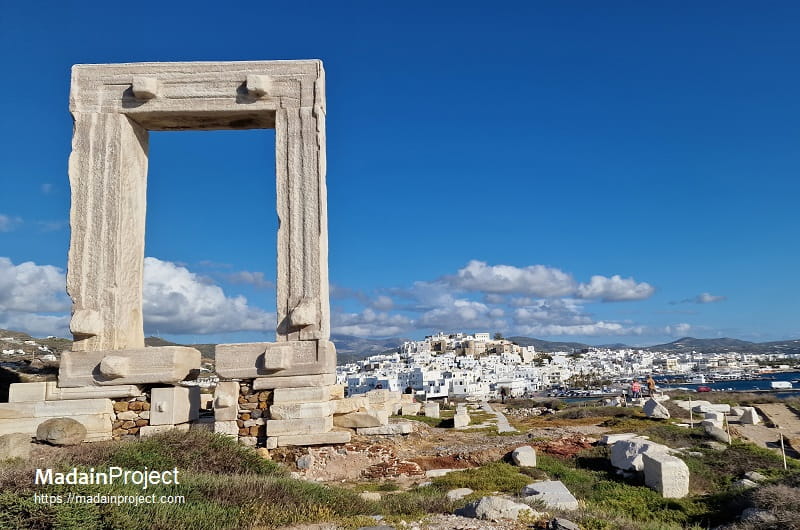
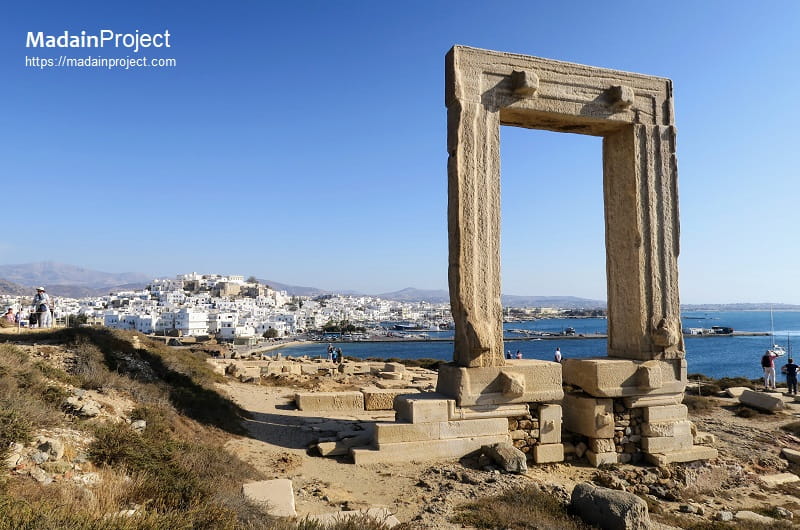
Naxos, the largest and most fertile of the Cyclades, possesses a history where the lines between ancient myth and recorded history are perpetually blurred. Its significance begins in Greek mythology as the childhood home of Zeus and the site where Dionysus rescued the abandoned princess Ariadne, a divine connection that famously blessed the island with its legendary viticulture. This spiritual importance mirrored its early physical power; Naxos was a dominant center of the Cycladic culture (3200–2100 BCE) and later a cultural powerhouse of the Archaic period, leaving behind the iconic Portara.
Following centuries as a defiant Greek city-state and a strategic Byzantine outpost, the island entered a distinct medieval chapter as the seat of the Duchy of the Archipelago under Venetian rule in the 13th century CE. This long tenure as a Latin stronghold, followed by Ottoman influence, transformed Naxos into a unique Mediterranean crossroads where Hellenic roots and Western European feudal history converge.
circa

Prehistoric and Early Cycladic Period
The Stelida quarry, situated just southwest of Chora (modern city of Naxos), has rewritten our understanding of early human history in the Aegean. Excavations there have uncovered Mousterian stone tools—crafted from local chert—that date back roughly 200,000 years. This confirms that Neanderthals (and potentially other early hominids) were active on Naxos during the Middle Paleolithic, likely reaching the area when lower sea levels turned the Cyclades into a contiguous landmass or a series of easily navigable crossings.
Beyond human activity, Naxos once supported a unique prehistoric ecosystem featuring the now-extinct dwarf elephant, Palaeoloxodon lomolinoi. These miniature giants evolved through insular dwarfism, a biological process where large mainland species shrink over generations to adapt to the limited resources of an island environment. These fossils, found in Late Pleistocene deposits, serve as a fascinating reminder of a time when the island’s landscape and inhabitants looked vastly different than they do today.
Archaeological evidence indicates that the island of Naxos was continuously inhabited from the Neolithic period. Zas Cave, one of the several sites inhabited during the Neolithic period on the island, contained objects of stone from Melos and copper objects including a dagger and gold sheet. With more substantial development during the Early Cycladic culture (roughly overlaping with the Early Helladic period of the mainland Greece, circa 3200–2000 BCE). Settlement patterns are attested at sites such as Grotta and Aplomata, where material culture—including marble figurines, obsidian tools, Bronze Age chamber tombs (circa 2800-2300 BCE), sanctuaries and cemeteries etc, and fortified dwellings—reflects integration into wider Aegean exchange networks. Naxos was particularly significant as a source of high-quality marble, which was quarried extensively and exported across the Cyclades. During the Middle and Late Bronze Age (circa 2000–1100 BCE), Naxos fell within the cultural orbit of the Minoan civilization and later the Mycenaean civilization, as evidenced by pottery styles, burial practices, and imported artifacts. The site of Grotta reveals a Mycenaean administrative center, indicating the island’s participation in palatial economic systems. During this period one of the major exports of the island was Emery, used as abrasive material.
Geometric and Archaic Period
Following the collapse of Mycenaean authority, Naxos experienced a period of demographic contraction before re-emerging during the Geometric period (circa 900–700 BCE). By the 8th century BCE, it had become one of the most prosperous islands in the Cyclades. Naxos played a leading role in Greek colonization, notably founding Naxos in Sicily around 734 BCE, traditionally regarded as the earliest Greek colony in the western Mediterranean.
During the Archaic period (Archaic Greece: circa 700–480 BCE), Naxos achieved considerable political and economic prominence. The island’s wealth derived from agriculture, maritime trade, and marble production. This resilient, large-grained crystalline stone—now often called Naxos Crystallina—was a hallmark of ancient Greek craftsmanship. Naxian marble was the material of choice for the earliest marble roof tiles, a technique credited to a Naxian named Byzes. These tiles famously adorned the Athenian Acropolis and the sanctuary at ancient Olympia. Monumental architecture from this period includes the unfinished temple of Temple of Apollo on the islet of Palatia, whose massive marble gateway (the Portara) still stands. Political power was concentrated in aristocratic families, but the island also experienced tyranny under rulers such as Lygdamis in the 6th century BCE, who was supported by Peisistratos. Naxian sculptors were influential in the development of early Greek marble sculpture, producing kouroi that circulated throughout the Aegean. Beyond architecture, it was used to carve some of the world's first monumental kouroi (colossal male statues), such as the unfinished Kouros of Apollonas, which still rests in its original quarry.
Classical Period
During the 8th and 7th centuries BCE, Naxos emerged as a dominant commercial power within the Cycladic region, a position reflected in later accounts by Herodotus, who described the island around 500 BCE as the most prosperous among the Greek islands.
By the late 6th century BCE, Naxos became increasingly entangled in the geopolitical struggles between the Greek city-states and the Achaemenid Empire. In 499 BCE, during the Ionian Revolt, the island was the target of an unsuccessful expedition led by Aristagoras with Persian support. This failed campaign contributed to the broader outbreak of hostilities between the Greek world and Persia. Subsequently, in 490 BCE, Persian forces under Datis and Artaphernes captured and devastated Naxos as part of the campaign preceding the Battle of Marathon.
In the aftermath of the Persian Wars, Naxos became a member of the Delian League under the leadership of Athens. Despite its continued economic significance within Aegean trade networks, the island’s political autonomy was curtailed following its attempt to secede from the League around 469 BCE. This revolt was swiftly suppressed by Athens, marking one of the earliest instances of coercion within the League. As a consequence, Naxos was deprived of its naval forces and required to provide tribute in monetary form rather than military assistance, thereby reinforcing Athenian control while maintaining its role as an economically important center.
Hellenistic Period
Following the death of Alexander III in 323 BCE, Naxos came under the influence of successive Hellenistic kingdoms. Control of the island shifted between the Ptolemaic Kingdom and the Antigonid dynasty, reflecting broader struggles for dominance in the Aegean. During this period, Naxos experienced fluctuating fortunes but remained integrated into regional maritime networks. Fortifications and urban structures from this era indicate continued strategic importance, particularly in relation to naval operations.
Roman and Late Antique Period
After the Roman victory at the Battle of Actium, Naxos was incorporated into the Roman Empire. The island became part of the province of Achaea and later the Diocese of the Islands. Roman administration introduced new economic patterns, including estate-based agriculture and integration into imperial trade systems. Archaeological remains from this period include villas, baths, and road networks.
During Late Antiquity, the spread of Christianity transformed the island’s religious landscape. Ecclesiastical structures were established, and Naxos became a bishopric under the authority of the Byzantine Church. However, from the 6th century CE onward, the island faced increasing threats from piracy and external incursions, contributing to demographic and economic decline.
Byzantine Period
In Late Antiquity, Naxos formed part of the Byzantine provincial administration known as the Province of the Islands. During the 7th century CE, the island gained particular historical prominence when Pope Martin I was detained there for nearly a year following his arrest in Rome by Byzantine authorities, a consequence of his condemnation of Monothelitism. Prior to his transfer to Constantinople for trial, he composed correspondence from the island, including a letter addressed to a certain Theodore residing in the imperial capital.
By the mid-9th century CE, within the administrative framework of the Byzantine Empire, Naxos was incorporated into the Theme of the Aegean Sea as part of the broader theme system. Its strategic maritime position rendered it particularly vulnerable to sustained Arab naval incursions between the 7th and 9th centuries CE, especially during the period of expansion associated with the Emirate of Crete (824–961 CE). In response to these threats, settlement patterns shifted from exposed coastal areas to more defensible inland locations, exemplified by the establishment of fortified centers such as the southern stronghold of Apalyres, which functioned as the island’s capital during this period. The severity of external pressure is further indicated by episodes in which the island was compelled to pay tribute to its attackers.
Despite these challenges, cultural and economic continuities persisted. Artistic evidence, including 10th-century CE frescoes, reveals traces of Islamic influence, reflecting the broader intercultural exchanges of the eastern Mediterranean. By the 10th and 11th centuries CE, a degree of stability had been restored, facilitating modest economic recovery. As in earlier periods, Naxos remained noted for its agricultural productivity and animal husbandry, with particular emphasis on cattle raising, as recorded by the 12th-century CE geographer al-Idrisi. The cultivation of wine and olive oil continued to underpin the local economy, while monastic institutions assumed an important role in landholding and cultural life, in accordance with wider Byzantine socio-economic patterns.
In the later 12th century CE, Naxos may also have served, albeit briefly, as the administrative center of a short-lived theme referred to as the Dodekanesos theme, underscoring its continued regional significance within the Aegean world.
Venetian Rule
In the aftermath of the Fourth Crusade, which resulted in the fragmentation of Byzantine authority and the establishment of the Latin Empire under strong Venetian influence, the Cycladic island of Naxos was conquered between 1205 and 1207 CE by the Venetian noble Marco Sanudo. Unlike many neighboring islands, Naxos offered resistance: a group of Genoese pirates had occupied its principal fortress during the transitional period following the end of Byzantine rule. According to tradition, Sanudo, in order to compel his followers to commit fully to the campaign, burned his own ships and forced a decisive confrontation; after a siege lasting approximately five weeks, the defenders capitulated.
Venetian domination introduced profound institutional transformations. Feudal structures based on the Assizes of Romania were imposed, alongside the establishment of Latin ecclesiastical institutions. Nevertheless, the indigenous Greek population retained the use of Byzantine law in civil affairs at least until the late 16th century CE, illustrating the coexistence of parallel legal and cultural systems. Fortifications, most notably the Kastro in the principal town, were constructed or expanded during this period, reflecting both defensive needs and the consolidation of Latin authority. The island, known under Venetian rule by its Italian name “Nasso”, functioned within a socio-economic framework characterized by agriculture, regional trade, and, at times, piracy, while maintaining a degree of autonomy under broader Venetian hegemony.
Duchy of the Archipelago
Following his conquest, Marco Sanudo established a new political entity, the Duchy of the Archipelago (also known as the Duchy of Naxos), with Naxos as its capital and administrative center. This polity endured under two ruling dynasties for a total of twenty-one dukes until 1566 CE, while residual Venetian control over various Aegean islands persisted until 1714 CE. Although the duchy acknowledged varying degrees of overlordship—initially from Venice and subsequently from other dominant powers—it retained a notable level of internal autonomy.
During the 13th century CE, broader geopolitical developments in the eastern Mediterranean influenced the island’s demographic composition. Following the Seljuk Turkish capture of Antalya and Alanya, refugees from these regions sought settlement on Naxos. In the 14th century CE, however, the island again faced external pressures, particularly from Anatolian Turkish maritime principalities such as the Aydınids. In response, the Sanudi rulers engaged in broader regional conflicts, cooperating with other Latin powers: they assisted the Genoese in the capture of Chios in 1304 CE and supported the Knights Hospitaller in their conquest of Rhodes in 1309 CE, aiming to curtail the use of these islands as bases for Turkish piracy.
Despite such efforts, raids against Naxos continued, with recorded attacks in 1324 and 1326 CE. A particularly devastating incursion occurred in 1341 CE, when Umur of Aydın reportedly deported approximately 6,000 inhabitants and imposed tribute on the island. Although the subsequent Smyrniote Crusade succeeded in capturing Smyrna, thereby temporarily weakening Turkish naval power, renewed raids later in the century contributed to severe depopulation. By circa 1420 CE, the traveler Cristoforo Buondelmonti observed that the demographic decline was so pronounced that there were insufficient men to marry local women.
The rise of the Ottoman Empire introduced a new phase of external dominance. The Ottomans first attacked Naxos in 1416 CE; however, rather than immediate annexation, they recognized Venetian overlordship over the duchy through successive treaties, in exchange for the payment of annual tribute. This arrangement underscored the duchy’s intermediate status, situated between declining Latin authority and expanding Ottoman power, while Naxos itself remained a key administrative, economic, and strategic center within the Aegean world.
Ottoman Period
In 1537 CE, the Ottoman admiral Hayreddin Barbarossa conquered Naxos, thereby incorporating the island into the Ottoman Empire. Although Ottoman sovereignty was thus firmly established, local governance frequently remained in the hands of former Venetian elites under tributary arrangements. This administrative continuity preserved existing patterns of landholding and social organization. During this period, the island’s economy remained predominantly agrarian, accompanied by limited urban development. Naxos’ relative isolation and peripheral status within the empire contributed to comparatively modest economic activity, especially when measured against earlier phases of prosperity. Nevertheless, local communities retained their cultural and religious traditions, most notably through the institutions of the Orthodox Church.
In 1566 CE, the last Latin Christian duke, Giacomo IV Crispo, was deposed by the Ottoman Sultan Selim II, the son of Suleiman the Magnificent. Subsequently, the Sultan appointed the Portuguese Sephardi diplomat and administrator Joseph Nasi as Duke of Naxos. Nasi, who governed principally from his palace of Belvedere near Constantinople, exercised authority over the duchy through his local representative, Francesco Coronello. His rule represents the penultimate phase of ducal governance under Ottoman suzerainty. Upon his death in 1579 CE, the Ottomans formally annexed the territory, thereby terminating the semi-autonomous ducal system.
The title was later revived in 1616 CE when the Dalmatian nobleman Gaspar Graziani was awarded the duchy by the Ottoman Sultan Ahmed I. However, Graziani’s political ambitions soon extended beyond Naxos, as he sought to secure the Moldavian throne through an alliance with Sigismund III Vasa. This initiative provoked Ottoman opposition, leading the Sultan to order his removal in 1617 CE. Although Graziani initially evaded capture, he was ultimately killed in 1620 CE by his own supporters, who feared reprisals from the Ottoman authorities.
Throughout the period of Ottoman rule, which endured until 1821 CE, very few Turks settled on Naxos, and consequently Turkish cultural and social influence on the island remained limited. In Ottoman administrative terminology, the island was referred to as Nakşa. Despite imperial control, the continuity of local traditions and the absence of significant demographic transformation contributed to the preservation of the island’s distinctive character.
In 1821 CE, Naxos participated in the Greek War of Independence, contributing its fleet to the broader insurrection against Ottoman authority. Subsequently, the island became part of the autonomous Greek state in 1827 CE and was fully integrated into the independent Greece by 1830 CE.
Modern Greek Period
Naxos participated in the Greek War of Independence, aligning with insurgent forces against Ottoman rule. Following the establishment of the modern Greek state, the island was incorporated into the Kingdom of Greece. Throughout the 19th and early 20th centuries CE, Naxos remained largely rural, with agriculture and emigration shaping its demographic patterns.
In the post–World War II period, Naxos experienced gradual economic transformation, particularly with the growth of tourism from the late 20th century CE onward. Infrastructure development, including ports and roads, facilitated increased connectivity with mainland Greece and other Cycladic islands. Today, Naxos is part of the administrative region of South Aegean, combining agricultural production with a significant tourism sector, while preserving extensive archaeological and historical heritage.
Signup for our monthly newsletter / online magazine.
No spam, we promise.

The Madain Project is an online archive of Abrahamic History and Archaeology.
Abrahamic History & Archaeology is the study of history and archaeology with respect to the three Abrahamic Faiths without considering the religious and theological aspects. The goal of Abrahamic History is to understand how and why the religious doctrines and behaviours have evlovled and changed over time. Searching for patterns in the evolution of significant cultural events such as the development of farming, the emergence of cities, or the collapse of major civilizations for clues of why and how these have influenced the three major Abrahamic religions.
Cloud Drive -
About -
Help -
Editorial Policy -
AI Policy -
Privacy Policy -
Contact
Madain Project: Encyclopedia of Abrahamic History & Archaeology.
Copyright MadainProject 2017 - 2026.


