
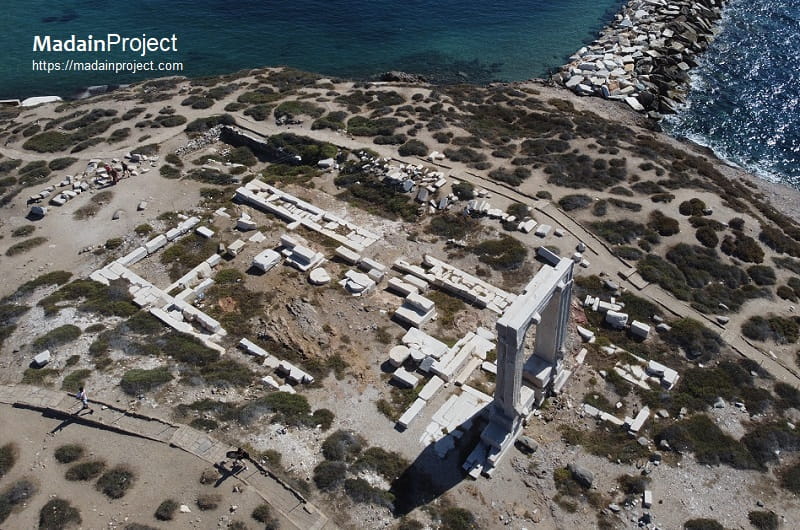
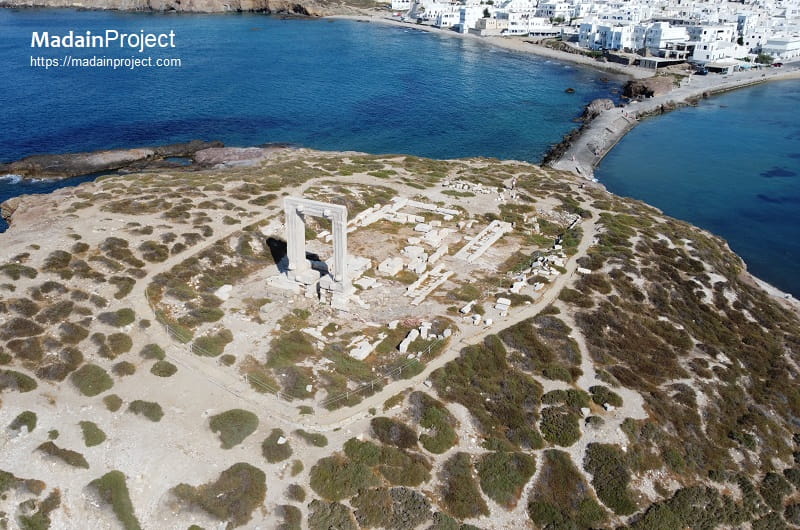
The Temple of Apollo at Naxos, primarily known for its surviving monumental gateway, the Portara, is an unfinished Archaic Greek temple dating to the mid-6th century BCE. Located on the islet of Palatia, which was once connected to the main port of Naxos by a narrow causeway, the structure was designed in the Ionic order as a dipteral temple—a massive building surrounded by a double colonnade.
Academically, it represents the architectural ambition of the Naxian tyranny and serves as a critical example of monumental marble construction in the Cycladic islands, specifically intended to rival the great Samian and Ephesian sanctuaries of the same era. The temple’s construction was commissioned by the tyrant Lygdamis, who sought to demonstrate Naxian supremacy through grand public works.
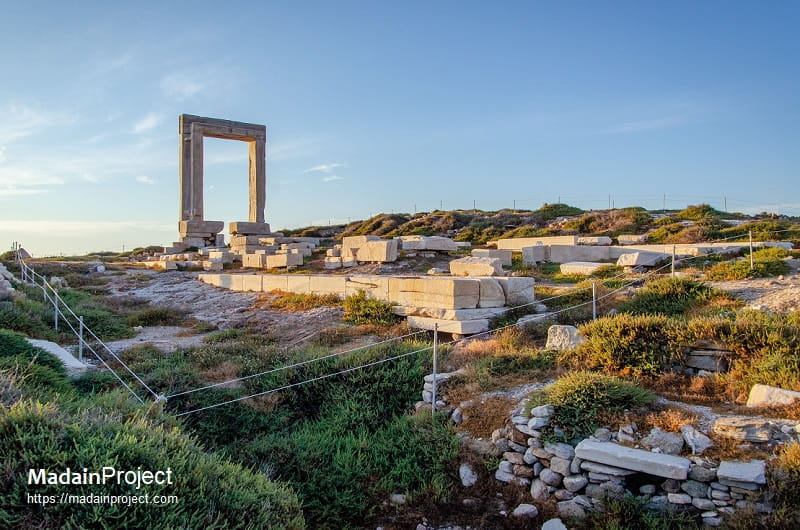
circa 530 BCE

The Temple of Apollo on the islet of Palatia was initiated around 530 BCE during the rule of the tyrant Lygdamis, as part of a wider program of monumental construction aimed at reinforcing his political power and religious prestige. Archaeological evidence indicates that the temple’s construction occurred in two phases: initial work likely began in the 540s BCE, but around 530 BCE the plan was revised and the orientation of the structure rotated 180 degrees, possibly to better align it with the sacred island of Delos, the principal cult center of Apollo in the Cyclades.
Construction came to an abrupt halt by 524 BCE, when Lygdamis was deposed by the Peloponnesian League, led by ancient Sparta. The temple remained unfinished, leaving the massive Portara doorway in situ with its lifting bosses still visible—a clear indication that the final assembly and finishing touches were never completed. The marble for the doorway was quarried at Flerio, approximately 10 kilometer from the site, highlighting both the scale of the project and the advanced craftsmanship of Naxos’ marble workers.
In later centuries, the temple was repurposed for Christian worship. In the 5th century CE, a church dedicated to Panagia Palatiani was built atop the ruins, followed by a 9th-century church honoring Saints Nicholas and Constantine. During the Venetian period, much of the temple’s material was reused for the construction of the Kastro of Naxos, though the enormous marble doorway remained due to its immovable size. Today, the Portara stands as a monument to the island’s Archaic period heritage and continues to symbolize Naxos’ historical and cultural identity.
circa 530 BCE
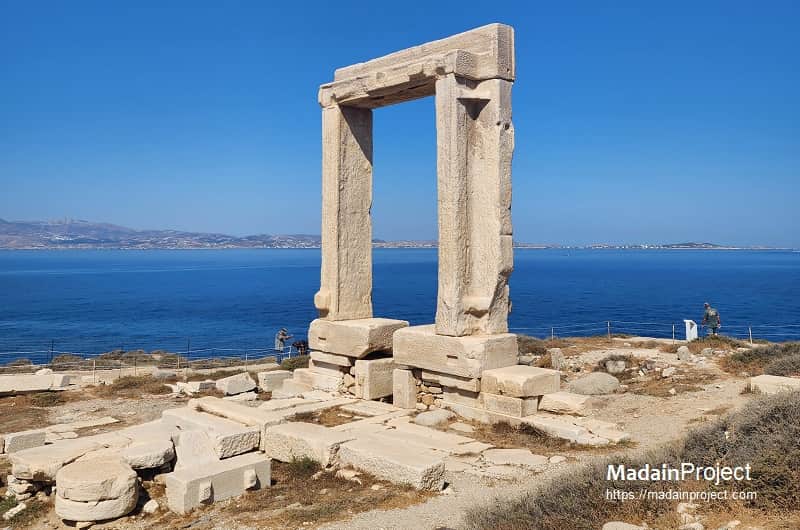
The temple of Apollo on Palatia was designed in the Ionic order and measured approximately 38 meters in length and 16 meters in width, with its entrance oriented toward the sacred island of Delos, the traditional cult center of Apollo. Archaeological evidence suggests that construction occurred in two phases: initial work likely began in the 540s BCE, but around 530 BCE, the plan was revised and rotated by 180 degrees, reflecting changes in design or symbolic orientation.
The most prominent surviving element of the temple is the marble doorway, or Portara, originally composed of four to five massive marble blocks, each weighing up to 20 tons. The marble was quarried at Flerio, approximately 10 km from the site, and transported to the islet. Carved bosses on the blocks—protrusions used to attach ropes for lifting—remain visible, providing direct evidence that the temple was never completed, as these would normally have been removed after construction. The scale of the doorway highlights both the technical ambition of Archaic Naxian architecture and the island’s mastery of marble working, which was a hallmark of Naxos from the Early Cycladic period onward.
In later centuries, modifications were made for Christian worship, including a cut in the Portara threshold to accommodate the entrance of Panagia Palatiani. Despite these adaptations, the temple’s monumental entrance remains largely intact, offering a striking example of ancient Greek temple design and serving as a lasting testament to the island’s artistic and religious heritage.
Signup for our monthly newsletter / online magazine.
No spam, we promise.

The Madain Project is an online archive of Abrahamic History and Archaeology.
Abrahamic History & Archaeology is the study of history and archaeology with respect to the three Abrahamic Faiths without considering the religious and theological aspects. The goal of Abrahamic History is to understand how and why the religious doctrines and behaviours have evlovled and changed over time. Searching for patterns in the evolution of significant cultural events such as the development of farming, the emergence of cities, or the collapse of major civilizations for clues of why and how these have influenced the three major Abrahamic religions.
Cloud Drive -
About -
Help -
Editorial Policy -
AI Policy -
Privacy Policy -
Contact
Madain Project: Encyclopedia of Abrahamic History & Archaeology.
Copyright MadainProject 2017 - 2026.


