
The history of Jerash, known in antiquity as Gerasa, spans millennia and reflects the city's transformation from a modest settlement to a thriving urban center in the ancient world. Located in northern Jordan, Jerash's significance as both a city and an archaeological site has made it a key subject of historical and archaeological study. From its early Neolithic roots to its golden age under Roman Empire, and through to its later periods of decline and rediscovery, the history of Jerash offers a unique lens through which to examine the cultural, political, and architectural evolution of the broader Mediterranean and Near Eastern regions.
The history of Jerash spans several key phases, from its earliest settlement in the Neolithic period (circa 6500 BCE) to its flourishing under Roman rule. The city began to take shape during the Hellenistic period (around 333 BCE), but its most significant growth occurred under the Romans, when it became part of the Decapolis, a group of ten cities aligned with the Roman Empire. During this time, Jerash saw extensive urban development, including the construction of monumental public buildings, theaters, and colonnaded streets, much of which still stands today. The city also prospered under Byzantine rule, although it began to decline in the 7th century CE due to natural disasters, shifting trade routes, and the rise of Islam.
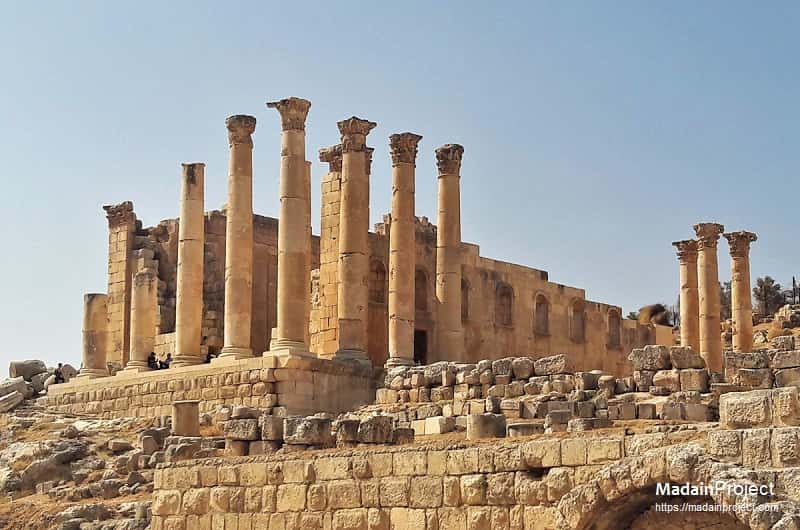
While Jerash’s importance diminished after the advent of Islam, it remained inhabited in the early Islamic period before fading into obscurity. The city was largely forgotten until European explorers and archaeologists rediscovered it in the late 19th and early 20th centuries. Today, Jerash is one of the best-preserved Roman provincial cities, offering a rich archaeological record of ancient life, culture, and architecture. Its remains, including the Oval Plaza and the Temple of Artemis, serve as enduring symbols of its historical significance as a crossroads of Greek, Roman, Byzantine, and Islamic influences.

circa 7500 BCE– modern period

Neolithic and Chalcolithic Presence
Archaeological evidence from the Jerash region suggests human presence as early as the Neolithic period, though findings are scattered and largely associated with seasonal habitation rather than permanent settlement. Flint tools, simple ceramics, and traces of early agricultural activity point to small groups exploiting the fertile valley lands and abundant water resources. By the Chalcolithic and Early Bronze Age, the area fell within broader networks of Levantine cultures, with pottery fragments and burial remains suggesting intermittent occupation. However, no continuous urban development can be securely traced to this stage, and Jerash’s later prominence should be understood as a classical-era foundation over earlier but discontinuous occupation layers.
Iron Age and Early Levantine Context
During the Iron Age, the region formed part of the contested borderlands between the Ammonites, Moabites, and other Transjordanian polities. Evidence remains sparse, consisting primarily of small-scale ceramics and structural remnants on the city’s periphery, but it is likely that Jerash lay within the cultural orbit of Ammon, whose capital at Rabbath-Ammon (modern Amman) lay only some 50 kilometers to the southwest. The area’s fertile plains and its location near trade routes leading north toward Damascus. and south toward ancient Petra would have made it strategically valuable, though there is no indication of Jerash as a fully urbanized center in this period.
Hellenistic Period
Jerash emerges more clearly in the Hellenistic period, following the conquests of Alexander the Great in the late 4th century BCE and the subsequent Seleucid and Ptolemaic rivalries in the Levant. The settlement that developed here was likely influenced by the Greek urban model, although little material evidence survives to demonstrate a fully planned polis at this stage. By the 2nd century BCE, Gerasa had begun to take on the character of a Hellenistic foundation, with urban structures, sanctuaries, and a civic identity reflecting the influence of the Seleucid state. Its incorporation into the Hellenistic cultural sphere set the stage for its later expansion under Roman rule.
Roman Period
The Roman period marks the height of Gerasa’s prominence. Following Pompey’s eastern campaigns in 63 BCE (in the later period of Roman Republic), Gerasa came under Roman influence and was formally incorporated into the province of Syria (modern Syria). By the 1st century CE, Gerasa was flourishing as a member of the Decapolis, a league of ten Greco-Roman cities in the Near East. The Pax Romana and integration into imperial trade networks fueled rapid urban development, transforming Gerasa into one of the most impressive provincial cities in the eastern Mediterranean.
Under emperor Trajan (98–117 CE), Gerasa prospered further, benefitting from his annexation of Arabia Petraea in 106 CE, which reoriented trade routes through the region. Monumental architecture, including the Oval Plaza, colonnaded streets, temples to Zeus and Artemis, theaters, baths, and a complex water system, reflect the city’s wealth and status. Hadrian’s visit in 129–130 CE left an enduring mark, commemorated by the triumphal arch at the city’s entrance. The 2nd century represents the zenith of Gerasa’s classical splendor, during which its population may have reached 20,000 to 25,000 inhabitants.
Byzantine Period
With the Christianization of the Roman Empire, Gerasa underwent significant transformation. Beginning in the 4th century CE, pagan temples were repurposed or replaced by churches, and the city became an important ecclesiastical center. Excavations have revealed at least fifteen churches built between the 4th and 7th centuries, many adorned with elaborate mosaic pavements. The city walls were expanded and reinforced, reflecting both civic pride and the need for defense during a period of regional instability.
Despite these changes, Gerasa maintained continuity with its classical past, with the urban layout, colonnades, and civic structures still actively used. The Byzantine period, however, was also marked by economic challenges, as shifting trade routes and the decline of Roman authority reduced the prosperity that had characterized earlier centuries.
Early Islamic Period
In 636 CE, following the Battle of Yarmouk, Gerasa came under the control of the Rashidun Caliphate. The city continued to be inhabited under Umayyad rule, and evidence suggests the adaptation of some classical buildings for Islamic purposes. The presence of a congregational mosque constructed near the former forum demonstrates the continuity of urban life, though on a reduced scale compared to the Roman and Byzantine zenith.
The catastrophic earthquake of 749 CE devastated much of northern Jordan, including Gerasa. Large sections of the colonnaded streets, monumental arches, and churches collapsed. While there is evidence of continued occupation into the Abbasid period, the city never fully recovered its former significance. Rural settlement patterns shifted, and Gerasa diminished to a small town surrounded by villages.
Medieval and Ottoman Periods
During the Crusader and Ayyubid periods, Gerasa lay largely in ruins, though some reoccupation occurred in the surrounding valley. By the Mamluk and Ottoman periods, the ancient city was a source of building stone for nearby villages, and agricultural terraces were established among the ruins. Western travelers of the 19th century rediscovered Jerash as an archaeological site, noting its remarkably preserved colonnaded streets, temples, and theaters, which remained visible despite centuries of decline.
Modern Period
Excavations and restorations beginning in the early 20th century under British and later Jordanian authorities transformed Jerash into one of the most extensively studied Roman provincial cities in the Near East. The site today represents a major cultural and tourist landmark in Jordan, offering unparalleled insight into Greco-Roman urbanism, Byzantine religious architecture, and the long continuity of Levantine settlement.
Signup for our monthly newsletter / online magazine.
No spam, we promise.

The Madain Project is an online archive of Abrahamic History and Archaeology.
Abrahamic History & Archaeology is the study of history and archaeology with respect to the three Abrahamic Faiths without considering the religious and theological aspects. The goal of Abrahamic History is to understand how and why the religious doctrines and behaviours have evlovled and changed over time. Searching for patterns in the evolution of significant cultural events such as the development of farming, the emergence of cities, or the collapse of major civilizations for clues of why and how these have influenced the three major Abrahamic religions.
Cloud Drive -
About -
Help -
Editorial Policy -
AI Policy -
Privacy Policy -
Contact
Madain Project: Encyclopedia of Abrahamic History & Archaeology.
Copyright MadainProject 2017 - 2026.


